AP EAPCET (Engineering) · Chemistry (JEE & NEET)
Organic Compounds Containing Oxygen, Nitrogen and Halogens
Chemistry of haloalkanes, alcohols, phenols, ethers, aldehydes, ketones, carboxylic acids and amines with reactions and mechanisms.
Fifteen concepts spanning NCERT Class 12 Units 6–9: haloalkane substitution and elimination (including Finkelstein/Swarts and Saytzeff), phenol acidity and Kolbe/Reimer–Tiemann, alcohols and Williamson ethers, carbonyl addition, aldol/Cannizzaro, Tollens/Fehling, carboxylic acidity, amine basicity and Gabriel/Hoffmann preparations, diazonium/Sandmeyer, and the Hinsberg/iodoform lab tests.
- AP EAPCET (Engineering)
- Hard level
- 15 concepts
- 5 practice questions
1SN1 versus SN2 at the carbon–halogen bond
Nucleophilic substitution at a saturated carbon splits into two mechanisms that exam stems treat as alternatives. S_N1 is unimolecular: the C–X bond breaks first, a carbocation forms, and the nucleophile attacks afterward — rate = k[\text{substrate}], favoured at 3° carbons, and a chiral centre racemises because the flat carbocation can be attacked from either face. S_N2 is concerted: the nucleophile attacks the backside while the leaving group departs — rate = k[\text{substrate}][Nu], favoured at 1° carbons, and a chiral centre inverts.
Leaving-group ability tracks C–X bond weakness: C–I > C–Br > C–Cl. Secondary substrates sit between the extremes and tip toward S_N1 in polar protic solvent with a weak nucleophile, or toward S_N2 with a strong nucleophile in polar aprotic solvent. A tertiary carbon is too hindered for backside attack, so S_N2 is blocked even when the nucleophile is excellent.
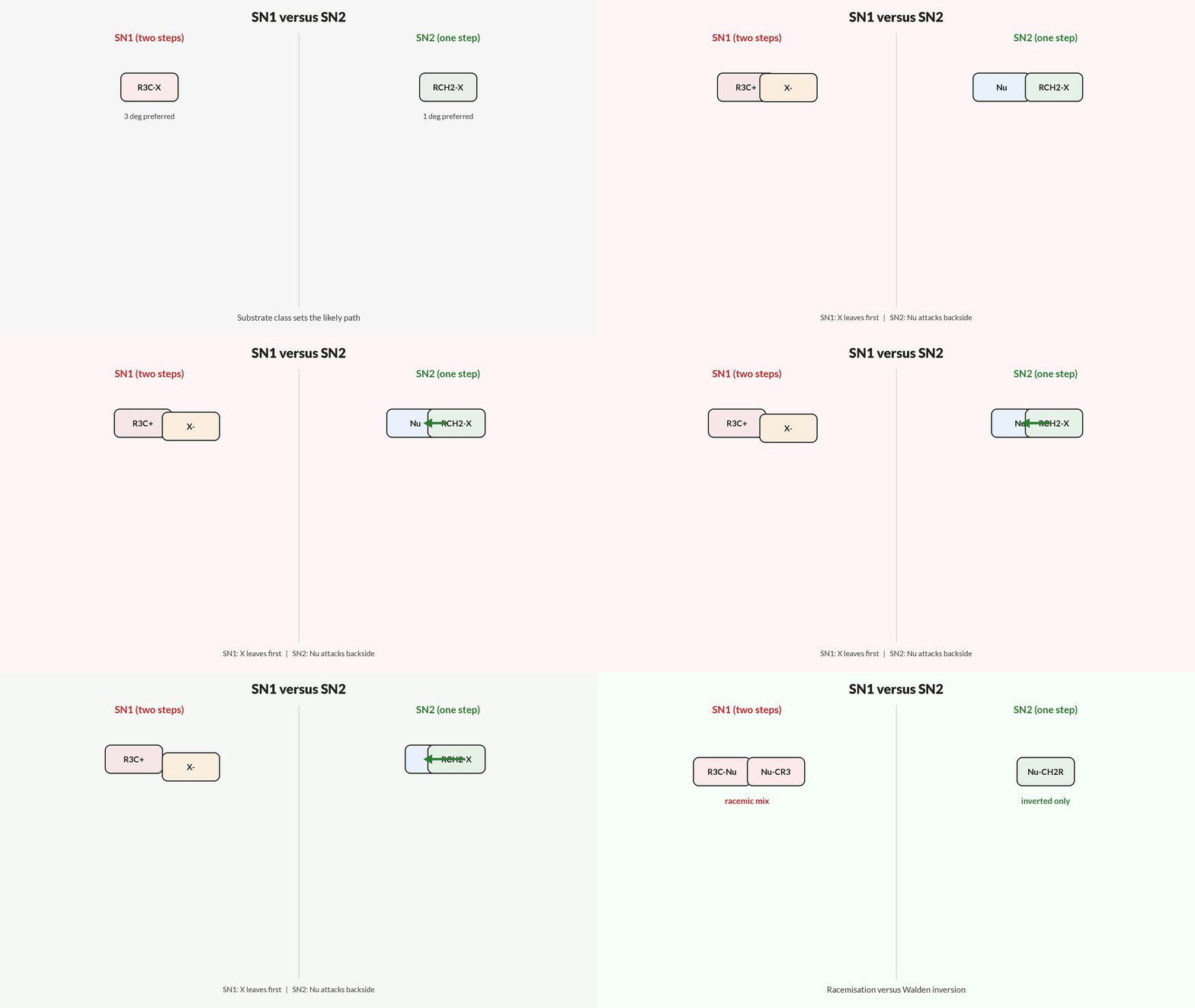
Pick the mechanism
- Read the carbon3° → S_N1 (stable carbocation, hindered backside). 1° → S_N2 (no stable carbocation, open backside). 2° → check solvent and nucleophile.
- Read the rate lawS_N1 depends only on substrate; doubling [Nu] does nothing. S_N2 is second-order — both concentrations appear in the rate.
- Read the stereochemistryS_N1 on a chiral carbon gives racemisation; S_N2 gives inversion. Leaving-group order is C–I > C–Br > C–Cl for both.
| Feature | SN1 | SN2 |
|---|---|---|
| Rate law | k[\text{substrate}] | k[\text{substrate}][Nu] |
| Preferred substrate | 3° > 2° ≫ 1° | 1° > 2° ≫ 3° |
| Stereochemistry | Racemisation | Inversion |
| Leaving group | C–I > C–Br > C–Cl | C–I > C–Br > C–Cl |
tert-Butyl bromide with aqueous OH⁻
Predict whether tert-butyl bromide reacts with aqueous OH⁻ by S_N1 or S_N2, and state the kinetic order and stereochemical outcome at a chiral analogue.
- Carbon class of (CH₃)₃C–Br3° halide
- 3° carbocation stability vs backside accesscarbocation favoured; SN2 blocked
- Mechanism and rate lawSN1; rate = k[RBr]
- Stereochemistry at a chiral 3° analogueracemisation (planar R⁺)
Pro tip. Primary halide → SN2; tertiary → SN1. Secondary depends on solvent and nucleophile — do not memorise a blanket rule for 2°.
Doubling [OH⁻] doubles the rate of substitution of a certain alkyl bromide. The mechanism is
- SN1, because the rate always depends on the nucleophile
- SN2, because the nucleophile appears in the rate law
- Either SN1 or SN2 — concentration cannot distinguish them
SN2 rate = k[substrate][Nu], so doubling [OH⁻] doubles the rate. SN1 rate is independent of [Nu].
2Finkelstein and Swarts halogen exchange
Alkyl iodides are often made not by direct iodination but by exchanging halogen: an alkyl chloride or bromide treated with NaI in dry acetone gives the iodide. That is the Finkelstein reaction. NaCl or NaBr precipitates in dry acetone, so Le Chatelier pulls the equilibrium toward RI.
Alkyl fluorides are prepared by heating an alkyl chloride or bromide with a metallic fluoride such as AgF, Hg₂F₂, CoF₂ or SbF₃ — the Swarts reaction. Freon 12 (CCl₂F₂) is manufactured from CCl₄ by Swarts chemistry. Both exchanges are S_N2-class substitutions on the carbon–halogen bond; the exam question is usually which reagent pair names which reaction.
Figure. Finkelstein: NaI in dry acetone drives R–Cl/Br to R–I as NaX precipitates. Swarts: AgF (or SbF₃) exchanges to the fluoride. Same substrate class, different reagent and product halogen.
Name the exchange
- Want RIRCl or RBr + NaI in dry acetone → RI. Precipitated NaCl/NaBr drives Finkelstein forward.
- Want RFRCl or RBr + AgF / Hg₂F₂ / SbF₃ (heat) → RF. That is Swarts, not Finkelstein.
- Do not swap namesIodide + dry acetone = Finkelstein. Metal fluoride = Swarts. Both are halogen exchange; the nucleophile names the reaction.
| Reaction | Reagents | Product |
|---|---|---|
| Finkelstein | RCl/RBr + NaI, dry acetone | RI |
| Swarts | RCl/RBr + AgF (or Hg₂F₂, SbF₃) | RF |
CH₃CH₂Br is converted to CH₃CH₂I by NaI in dry acetone. The reaction is
- Swarts reaction, because bromide is replaced by a halogen
- Finkelstein reaction; precipitated NaBr drives the exchange
- Sandmeyer reaction, because a halide is introduced on carbon
NaI in dry acetone on an alkyl bromide is Finkelstein. Swarts uses a metal fluoride for RF; Sandmeyer replaces a diazonium group on an arene.
3β-Elimination and Saytzeff’s rule
A haloalkane with a β-hydrogen, heated with alcoholic KOH, loses HX: hydrogen from the β-carbon and halogen from the α-carbon, giving an alkene. That β-elimination competes with nucleophilic substitution. Bulky bases and heat favour elimination; strong nucleophiles that can approach carbon favour substitution. Primary substrates lean S_N2; tertiary lean S_N1 or elimination depending on whether the carbocation or the more substituted alkene is the easier path.
When more than one alkene can form, Saytzeff’s (Zaitsev’s) rule picks the major product: the alkene with more alkyl groups on the doubly bonded carbons. So 2-bromopentane gives pent-2-ene as the major dehydrohalogenation product, not pent-1-ene.
Figure. β-Elimination with alcoholic KOH prefers the more substituted alkene (Saytzeff). From 2-bromopentane, pent-2-ene outruns pent-1-ene because two alkyls stabilise the C=C better than one.
Pick elimination’s product
- Need a β-HNo β-hydrogen → no β-elimination. Alcoholic KOH + heat on a substrate with β-H → alkene.
- Saytzeff majorIf two alkenes are possible, count alkyl groups on the C=C carbons; the more substituted alkene dominates.
- Vs substitutionSame substrate can S_N or eliminate. Bulkier base / higher temperature tips toward elimination; open 1° carbon + good nucleophile tips toward S_N2.
| Condition | Favours | Why |
|---|---|---|
| 1° halide, strong Nu | S_N2 | Backside open; Nu attacks carbon |
| Bulky base, heat, β-H | Elimination | Base abstracts β-H rather than attacking C |
| Two possible alkenes | Saytzeff major | More substituted C=C is preferred |
2-Bromopentane with alcoholic KOH
2-Bromopentane is heated with alcoholic KOH. Name the major alkene and state the rule that selects it.
- β-Carbons availableC1 and C3 (relative to C2–Br)
- Alkene from loss toward C1pent-1-ene (less substituted)
- Alkene from loss toward C3pent-2-ene (more substituted)
- Saytzeff major productpent-2-ene
Pro tip. Saytzeff counts alkyl groups on the doubly bonded carbons — not which carbon lost the halogen.
Major product of dehydrohalogenation of 2-bromobutane with alcoholic KOH is
- But-1-ene, because the terminal alkene always forms first
- But-2-ene, the more substituted Saytzeff alkene
- Butane, because KOH reduces the halide
β-Elimination can give but-1-ene or but-2-ene; Saytzeff selects the more substituted alkene, but-2-ene.
4Phenol is more acidic than an alcohol
Phenol (\mathrm{p}K_a \approx 10) is many orders of magnitude more acidic than a typical aliphatic alcohol (\mathrm{p}K_a \approx 15–18). The difference is not the O–H bond in the acid; it is the conjugate base. Phenoxide spreads the negative charge into the aromatic ring by resonance — ortho and para carbons carry partial negative charge in the contributing structures — so \mathrm{PhO}^- is far more stable than \mathrm{RO}^-, which has nowhere to put the charge except on oxygen.
Electron-withdrawing substituents on the ring (–NO₂, –CN, –X) pull charge further and raise acidity; electron-donating groups (–CH₃, –OCH₃) do the opposite. That substituent logic is the same one carboxylic acids use, applied here to the phenoxide resonance hybrid.
Figure. Phenol (pKa ≈ 10) is vastly more acidic than a typical alcohol (pKa ≈ 16) because the phenoxide charge delocalises into the ring. The Ka gap is orders of magnitude — that is the conjugate-base story in one chart.
Why phenol wins
- Write both acidsCompare PhOH with ROH. Both lose H⁺ to give an oxyanion; the question is which anion is lower in energy.
- Stabilise the anionPhO⁻ delocalises the charge onto ortho/para ring carbons by resonance. RO⁻ cannot — the alkyl chain offers only a weak +I push, which makes the anion worse, not better.
- Read the pKaStabilised conjugate base → stronger acid. Phenol sits near pKa 10; ethanol near 16. Substituents that further stabilise PhO⁻ move pKa down.
Phenol is more acidic than ethanol primarily because
- The O–H bond in phenol is longer, so H⁺ leaves more easily
- Phenoxide is resonance-stabilised into the aromatic ring; ethoxide is not
- Phenol has a larger molecular mass, so it dissociates more in water
Acidity tracks conjugate-base stability. PhO⁻ delocalises charge into the ring; EtO⁻ cannot. Bond length and molar mass are red herrings.
5Kolbe and Reimer–Tiemann on phenol
Phenoxide is more reactive toward electrophilic aromatic substitution than phenol itself. In Kolbe’s reaction, phenoxide is treated with CO₂ (a weak electrophile) under pressure; after acidification the main product is 2-hydroxybenzoic acid (salicylic acid) — ortho carboxylation.
In the Reimer–Tiemann reaction, phenol with chloroform and sodium hydroxide introduces a –CHO group at the ortho position; the intermediate dichloromethyl species hydrolyses in alkali to salicylaldehyde. Both reactions are ortho-directing stories about an activated phenoxide ring, not about the O–H acidity concept alone.
Figure. Phenoxide is the activated ring: Kolbe carboxylates ortho with CO₂ under pressure to salicylic acid; Reimer–Tiemann formylates ortho with dichlorocarbene from CHCl₃/base to salicylaldehyde.
Name the phenol reaction
- CO₂ on phenoxideKolbe → salicylic acid (o-HO–C₆H₄–COOH) after acid work-up.
- CHCl₃ / NaOH on phenolReimer–Tiemann → salicylaldehyde (o-HO–C₆H₄–CHO) after hydrolysis.
- Do not confuse reagentsCO₂ = carboxyl at ortho. CHCl₃ + base = formyl at ortho. Both need the activated ring.
| Reaction | Reagents | Ortho product |
|---|---|---|
| Kolbe | PhO⁻ + CO₂, then H⁺ | Salicylic acid |
| Reimer–Tiemann | PhOH + CHCl₃ / NaOH | Salicylaldehyde |
Phenol is heated with chloroform and NaOH. The ortho product after work-up is
- Salicylic acid from Kolbe carboxylation
- Salicylaldehyde from Reimer–Tiemann formylation
- Benzene from zinc-dust reduction
CHCl₃ / NaOH is Reimer–Tiemann and installs –CHO ortho to OH. Kolbe uses CO₂ for –COOH; Zn dust reduces phenol to benzene.
6Alcohol dehydration and esterification
Two alcohol reactions dominate the functional-group chapter. Acid-catalysed dehydration is an elimination: heating with conc. H₂SO₄ or H₃PO₄ removes water to give an alkene, with ease 3° > 2° > 1° because the path goes through a carbocation (E1) for 2°/3° alcohols. Saytzeff's rule picks the more substituted alkene when more than one is possible.
Esterification (Fischer) is the equilibrium \mathrm{RCOOH} + \mathrm{R'OH} \rightleftharpoons \mathrm{RCOOR'} + \mathrm{H_2O}, acid-catalysed. Excess alcohol or removal of water drives it forward; excess water drives hydrolysis back. Both reactions are asked as mechanism-class questions more often than as arithmetic.
Figure. E1 dehydration of a 2°/3° alcohol: two transition states with a carbocation intermediate between them. The first hump is loss of water; the second is loss of H⁺ to form the alkene. 3° alcohols sit lower at the R⁺ well than 1° alcohols would.
Two alcohol paths
- DehydrationProtonate –OH → leave as H₂O → carbocation → lose H⁺ from an adjacent carbon → alkene. 3° alcohols dehydrate under the mildest conditions.
- Saytzeff choiceWhen two alkenes can form, the more substituted (Saytzeff) product dominates under ordinary acid catalysis.
- Fischer esterificationAcid catalyst, heat, and Le Chatelier: remove water or use excess alcohol to push toward the ester; add water to hydrolyse it back.
| Reaction | Typical conditions | Product class |
|---|---|---|
| Dehydration | Conc. H₂SO₄ / H₃PO₄, heat | Alkene (Saytzeff) |
| Fischer esterification | RCOOH + R'OH, H⁺ catalyst | Ester + H₂O (equilibrium) |
tert-Butyl alcohol is heated with concentrated H₂SO₄. The major organic product is
- An ester, because alcohols always esterify in acid
- 2-Methylpropene, from E1 dehydration of the 3° alcohol
- A 1° alkyl hydrogen sulfate that cannot eliminate
3° alcohols dehydrate readily by E1 under hot conc. acid to the Saytzeff alkene 2-methylpropene. Esterification needs a carboxylic acid partner, which is not present.
7Williamson ether synthesis
Williamson synthesis prepares symmetrical and unsymmetrical ethers: an alkyl halide reacts with a sodium alkoxide, \mathrm{R–X + R'O^-Na^+ \rightarrow R–O–R' + NaX}. The mechanism is S_N2 attack of alkoxide on the alkyl halide.
Because the path is S_N2, the alkyl halide should be primary. Secondary or tertiary alkyl halides compete with elimination (alkoxide is a strong base), so for an unsymmetrical ether the usual design is: put the more hindered alkyl group in the alkoxide and the primary alkyl group in the halide.
Figure. Williamson is SN2 of alkoxide on a primary alkyl halide. A tertiary halide elimination-competes to an alkene — design the synthesis so the halide is the less hindered partner.
Design the ether
- Write RO⁻ + R'XAlkoxide carbon is already bound to O; the new C–O bond forms to the carbon of the alkyl halide.
- Keep R'X primaryS_N2 needs an open carbon. 3° (and often 2°) R'X give alkenes with RO⁻ instead of ethers.
- Unsymmetrical choiceFor tert-butyl methyl ether, use (CH₃)₃CO⁻ + CH₃X, not CH₃O⁻ + (CH₃)₃CX.
Ethyl methyl ether
Give one Williamson route to CH₃OCH₂CH₃ that avoids elimination, naming both partners.
- Ether connectivityCH₃–O–CH₂CH₃
- Primary halide option ACH₃O⁻ + CH₃CH₂Br
- Primary halide option BCH₃CH₂O⁻ + CH₃Br
- Either works?yes — both halides are 1°
Pro tip. When one partner would have to be a 3° halide, flip the design so the 3° group is the alkoxide.
Best Williamson pair for tert-butyl methyl ether is
- CH₃ONa + (CH₃)₃CBr
- (CH₃)₃CONa + CH₃Br
- (CH₃)₃CONa + (CH₃)₃CBr
CH₃Br is primary and undergoes S_N2 with tert-butoxide. (CH₃)₃CBr with methoxide eliminates to isobutene; two tertiary partners cannot give a clean S_N2 ether.
8Nucleophilic addition at the carbonyl
Aldehydes and ketones react by nucleophilic addition at the carbonyl carbon. The C=O is polarised — carbon δ⁺, oxygen δ⁻ — so a nucleophile bonds to carbon and a negative charge appears on oxygen, which is then protonated. Aldehydes are more reactive than ketones: a hydrogen on the carbonyl carbon is smaller and less electron-releasing than an alkyl group, so the aldehyde carbon is both more open and more electrophilic.
The reactivity order that exam options quote is \mathrm{HCHO} > \mathrm{CH_3CHO} > \text{ketones}. Formaldehyde has no alkyl group at all; each added alkyl group raises the barrier by steric hindrance and by +I electron density at carbon.
Figure. Relative ease of nucleophilic addition (ordinal ranks, not absolute rate constants). Each alkyl group on the carbonyl carbon slows attack by steric bulk and +I push. Bar length is the rank, not a measured k.
How addition runs
- PolariseC=O has C δ⁺ and O δ⁻. Nucleophiles (CN⁻, HSO₃⁻, RMgX, H⁻ from LiAlH₄/NaBH₄) attack carbon.
- Add, then protonateThe tetrahedral intermediate carries O⁻; acid work-up (or the medium) delivers H⁺ to give the addition product.
- Rank reactivityHCHO > RCHO > R₂C=O. Alkyl groups hinder approach and feed electron density onto carbon, both slowing attack.
Which compound undergoes nucleophilic addition most readily?
- Acetone
- Acetaldehyde
- Formaldehyde
HCHO has no alkyl group on the carbonyl carbon, so it is the least hindered and most electrophilic. Acetaldehyde is next; acetone is slowest of the three.
9Aldol versus Cannizzaro: the α-hydrogen fork
Two carbonyl self-reactions under base are sorted by one structural fact: does the aldehyde or ketone have at least one α-hydrogen? If yes, dilute base abstracts that α-H, the enolate adds to a second carbonyl, and you get a β-hydroxy carbonyl — the aldol addition (which can dehydrate to an α,β-unsaturated carbonyl on heating).
If there is no α-hydrogen — formaldehyde, benzaldehyde, trimethylacetaldehyde — concentrated NaOH forces disproportionation instead: one molecule is reduced to the alcohol and another is oxidised to the carboxylate. That is the Cannizzaro reaction. Crossed versions exist, but the exam's first filter is always α-H present or absent.
Figure. One structural fact forks the self-reaction: an α-hydrogen opens aldol under dilute base; no α-hydrogen opens Cannizzaro under concentrated NaOH (disproportionation to alcohol + carboxylate).
Apply the fork
- Find α-HLook at carbons attached to the C=O. If any bears H, aldol is available under dilute base.
- Aldol pathEnolate + carbonyl → β-hydroxy carbonyl; heat → conjugated enone by dehydration.
- Cannizzaro pathNo α-H + conc. NaOH → one alcohol + one carboxylate (disproportionation). Formaldehyde and benzaldehyde are the classic pair of examples.
| Carbonyl | α-H? | Base conditions | Reaction |
|---|---|---|---|
| CH₃CHO | Yes | Dilute NaOH | Aldol |
| CH₃COCH₃ | Yes | Dilute NaOH | Aldol |
| HCHO | No | Conc. NaOH | Cannizzaro |
| PhCHO | No | Conc. NaOH | Cannizzaro |
Benzaldehyde is warmed with concentrated NaOH. The products are
- An aldol, because aromatic aldehydes always enolise
- Benzyl alcohol and sodium benzoate (Cannizzaro)
- Only benzene, by decarbonylation
PhCHO has no α-hydrogen, so it cannot form an enolate. Conc. NaOH triggers Cannizzaro disproportionation to PhCH₂OH and PhCOO⁻.
10Tollens’ and Fehling’s tests
Aldehydes are oxidised even by mild reagents that leave ordinary ketones untouched. Tollens’ reagent is freshly prepared ammoniacal silver nitrate: on warming, an aldehyde reduces Ag⁺ to a bright silver mirror and is itself oxidised to the carboxylate in alkaline medium.
Fehling’s reagent is an equal mix of aqueous CuSO₄ (solution A) and alkaline sodium potassium tartrate (solution B). An aliphatic aldehyde gives a reddish-brown Cu₂O precipitate on heating. NCERT states that aromatic aldehydes do not respond to Fehling’s test — so benzaldehyde is Tollens-positive and Fehling-negative, while a ketone is negative to both mild tests.
Figure. Decision sketch only — not molecular geometry. Aliphatic RCHO feeds both mild oxidants; aromatic aldehydes take the Tollens’ branch and skip Fehling’s (see table).
Read the test pair
- Tollens’Ammoniacal AgNO₃, warm → silver mirror means an oxidisable aldehyde (including many aromatics).
- Fehling’sCu²⁺ / tartrate, alkaline, heat → red-brown Cu₂O means an aliphatic aldehyde. Aromatic aldehydes fail this test.
- KetonesOrdinary ketones do not reduce Tollens’ or Fehling’s under these mild conditions — use that to separate them from aldehydes.
| Compound class | Tollens’ | Fehling’s |
|---|---|---|
| Aliphatic aldehyde | Silver mirror | Red-brown ppt |
| Aromatic aldehyde | Silver mirror | No response |
| Ketone (typical) | No response | No response |
A compound gives a silver mirror with Tollens’ reagent but no red precipitate with Fehling’s reagent. It is most likely
- Acetone
- Benzaldehyde
- Ethanal
Tollens’-positive rules out a typical ketone. Fehling’-negative with Tollens’-positive matches an aromatic aldehyde (benzaldehyde). Ethanal would give both tests.
11Carboxylic acidity and the −I effect
Carboxylic acids are acidic because the carboxylate anion is resonance-stabilised: the negative charge is shared equally by the two oxygen atoms. Electron-withdrawing groups near –COOH (–NO₂, –Cl, –F, –CF₃) pull electron density from the anion and raise acidity; electron-donating groups (–CH₃, –OCH₃) push density onto the anion and lower it. The effect falls off with distance from the carboxyl carbon.
The chloroacetic series is the clean examination of −I: each added chlorine on the α-carbon multiplies Ka. Acidity rises \mathrm{CH_3COOH} < \mathrm{ClCH_2COOH} < \mathrm{Cl_2CHCOOH} < \mathrm{Cl_3CCOOH}.
Figure. Aqueous Ka at ~25 °C on a log scale (four decades). Each α-chlorine multiplies Ka; trichloroacetic acid is ~10⁴ times stronger than acetic acid. Bar length follows Ka, not pKa.
Order an acid series
- Identify the conjugate baseWrite RCOO⁻. Resonance already stabilises every carboxylate; substituents decide the fine ranking.
- Count −I groupsMore / closer EWGs → more stable anion → larger Ka (smaller pKa). EDGs reverse the arrow.
- Check distanceCl on the α-carbon beats Cl on the β-carbon. Ortho-nitro on benzoic acid beats para for the same reason of proximity.
Ordering the chloroacetic acids
Arrange \mathrm{CH_3COOH}, \mathrm{ClCH_2COOH}, \mathrm{Cl_2CHCOOH}, \mathrm{Cl_3CCOOH} in increasing acidity, and estimate how K_a changes from acetic acid (\mathrm{p}K_a = 4.76) to chloroacetic acid (\mathrm{p}K_a = 2.86).
- Ka(CH₃COOH) = 10⁻⁴·⁷⁶1.74 × 10⁻⁵
- Ka(ClCH₂COOH) = 10⁻²·⁸⁶1.38 × 10⁻³
- Ka ratio (mono-Cl / acetic)1.38×10⁻³ / 1.74×10⁻⁵ ≈ 79
- Increasing acidity orderCH₃COOH < ClCH₂COOH < Cl₂CHCOOH < Cl₃CCOOH
Pro tip. Each α-chlorine is worth roughly an order of magnitude in Ka. Electron-withdrawing groups near –COOH raise acidity; their effect weakens with distance from the carboxyl.
The strongest acid among the following is
- CH₃COOH
- ClCH₂COOH
- Cl₃CCOOH
Three α-chlorines give the strongest −I stabilisation of the carboxylate, so Cl₃CCOOH has the largest Ka.
12Amine basicity in water and in the gas phase
Aliphatic amines are stronger bases than ammonia because alkyl groups donate electron density (+I) onto nitrogen. In the gas phase that is the whole story, so basicity runs 3^\circ > 2^\circ > 1^\circ > \mathrm{NH_3}. In aqueous solution solvation of the ammonium ion matters too: a 3° ammonium ion is crowded and poorly hydrated, so the aqueous order for methyl amines becomes 2^\circ > 1^\circ > 3^\circ > \mathrm{NH_3} — inductive push still helps, but solvation penalises the tertiary ion.
Aromatic amines are much weaker. Aniline's lone pair conjugates into the ring, so it is less available for protonation; \mathrm{p}K_b of aniline is about 9.4 against about 3.3 for methylamine. Electron-withdrawing ring substituents weaken the base further; electron-donating ones strengthen it.
Figure. Alkyl +I raises amine basicity in the gas phase (3° > 2° > 1°). Water reorders to 2° > 1° > 3° by solvation of the cation. Aniline is far weaker because the lone pair conjugates into the ring.
Read the medium
- Gas phaseOnly +I counts: 3° > 2° > 1° > NH₃.
- Aqueous aliphatic+I versus hydration of R₃NH⁺. For methyl amines the compromise is 2° > 1° > 3° > NH₃.
- AromaticLone-pair delocalisation into the ring makes ArNH₂ far weaker than RNH₂. Do not put aniline on the aliphatic ladder.
Aqueous Kb of the methyl amines
Given approximate aqueous \mathrm{p}K_b values \mathrm{Me_2NH}\,3.27, \mathrm{MeNH_2}\,3.36, \mathrm{Me_3N}\,4.22, \mathrm{NH_3}\,4.75, rank the bases and compute K_b for dimethylamine and trimethylamine.
- Kb = 10⁻pKb(Me₂NH) = 10⁻³·²⁷5.37 × 10⁻⁴
- Kb(Me₃N) = 10⁻⁴·²²6.03 × 10⁻⁵
- Kb(Me₂NH) / Kb(Me₃N)5.37×10⁻⁴ / 6.03×10⁻⁵ ≈ 8.9
- Aqueous basicity orderMe₂NH > MeNH₂ > Me₃N > NH₃
Pro tip. Gas-phase order is 3° > 2° > 1°. Water rearranges the top of the ladder because the tertiary ammonium ion is poorly solvated — quote the medium before you quote the order.
In aqueous solution the strongest base among the following is
- Ammonia
- Trimethylamine
- Dimethylamine
Aqueous aliphatic order is 2° > 1° > 3° > NH₃ for the methyl series. Dimethylamine sits at the top; trimethylamine is weakened by poor solvation of Me₃NH⁺.
13Gabriel and Hoffmann amine preparations
Gabriel phthalimide synthesis makes primary amines: phthalimide → potassium phthalimide (ethanolic KOH) → N-alkyl phthalimide (heat with alkyl halide) → alkaline hydrolysis to RNH₂. Aromatic primary amines cannot be made this way — aryl halides do not undergo the needed nucleophilic substitution on the phthalimide anion’s alkylation step.
Hoffmann bromamide degradation treats an amide with Br₂ in aqueous or ethanolic NaOH. An alkyl or aryl group migrates from the carbonyl carbon to nitrogen, and the amine produced has one carbon fewer than the amide. Both routes are asked as “which method gives a 1° amine with one carbon less?” versus “which fails for aniline?”.
Figure. Gabriel keeps every carbon of R on the amine after phthalimide alkylation and hydrolysis. Hoffmann shortens by one carbon: the amide carbon is lost as CO₂/carbonate and R migrates onto nitrogen.
Choose the 1° amine route
- GabrielPhthalimide + KOH → alkyl halide → hydrolyse → RNH₂. Needs an alkyl (not aryl) halide.
- HoffmannRCONH₂ + Br₂ / NaOH → RNH₂ with one fewer carbon. Works for alkyl and aryl migration from the amide.
- Exam forkNeed ArNH₂ from ArCONH₂ → Hoffmann. Need RNH₂ from RX without losing a carbon → Gabriel.
| Method | Starts from | Carbon count | Aromatic 1° amine? |
|---|---|---|---|
| Gabriel | RX + phthalimide | Same as R in RX | No |
| Hoffmann bromamide | RCONH₂ + Br₂/NaOH | One less than amide | Yes (from ArCONH₂) |
Hoffmann carbon count
CH₃CH₂CONH₂ is treated with Br₂ / NaOH. Identify the amine and relate its carbon count to the amide.
- Amide carbons3 (propanamide)
- Migrating groupCH₃CH₂–
- Amine formedCH₃CH₂NH₂
- Carbon change3 → 2 (one fewer)
Pro tip. Hoffmann always drops the carbonyl carbon; Gabriel keeps every carbon of the alkyl halide.
Aniline cannot be prepared by Gabriel synthesis because
- Phthalimide does not form a potassium salt
- Aryl halides do not undergo nucleophilic substitution with the phthalimide anion
- Aniline is secondary, and Gabriel only makes tertiary amines
Gabriel needs RX to alkylate phthalimide anion by nucleophilic substitution. Aryl–X bonds do not do that substitution under these conditions, so ArNH₂ is out of reach.
14Diazonium salts and Sandmeyer reaction
A primary aromatic amine in cold aqueous mineral acid with NaNO₂ forms an arenediazonium salt. That diazonium group is an excellent leaving group: mixing the fresh salt with CuCl or CuBr replaces –N₂⁺ by –Cl or –Br — Sandmeyer’s reaction. Copper powder with HCl or HBr gives the same halogen replacement (Gattermann). Iodide and cyanide have their own diazonium displacements; the synthetic point is that many substituents enter the ring via aniline → diazonium → product.
Aliphatic primary amines also meet HNO₂, but their diazonium salts are unstable and lose N₂ to give alcohols (and nitrogen gas quantitatively). The stable, synthetically useful salts in NCERT’s amine chapter are the aromatic ones kept cold.
Figure. Cold aromatic primary amines form stable arenediazonium salts; CuCl/CuBr effects Sandmeyer substitution with N₂ loss. Aliphatic diazonium ions do not last — nitrogen leaves and an alcohol remains.
Use the diazonium gate
- Make ArN₂⁺ArNH₂ + NaNO₂ / mineral acid, 0–5 °C → arenediazonium salt.
- SandmeyerArN₂⁺ + CuCl / CuBr → ArCl / ArBr + N₂. Gattermann uses Cu powder + HX.
- Aliphatic contrastRNH₂ + HNO₂ → unstable RN₂⁺ → N₂↑ + alcohol; not a Sandmeyer halide route.
| Starting amine | With HNO₂ | Useful next step |
|---|---|---|
| ArNH₂ (cold) | Stable ArN₂⁺ | Sandmeyer / Gattermann / other replacements |
| RNH₂ (aliphatic) | Unstable RN₂⁺ | N₂ evolution; alcohol forms |
Sandmeyer reaction converts a freshly prepared arenediazonium salt into chlorobenzene using
- NaCl in dry acetone (Finkelstein conditions)
- CuCl (or CuBr for bromobenzene)
- Alcoholic KOH to eliminate nitrogen as ammonia
Sandmeyer replaces –N₂⁺ by Cl or Br with CuCl or CuBr. Finkelstein is alkyl halogen exchange; alcoholic KOH is not the Sandmeyer reagent.
15Hinsberg and iodoform identification tests
Two wet-lab tests sort functional groups the exam still asks by name. The Hinsberg test treats an amine with benzenesulfonyl chloride in aqueous base. A 1° amine gives a sulfonamide that is soluble in base (the N–H is acidic); a 2° amine gives a sulfonamide that is insoluble in base (no acidic N–H); a 3° amine does not form a sulfonamide and remains insoluble, but dissolves when acid is added because it can still form an ammonium salt.
The iodoform test is positive for the methyl-carbonyl group CH₃CO– and for alcohols that oxidise to it (CH₃CH(OH)–): yellow crystalline CHI₃ precipitates with I₂/NaOH. Ethanol, acetaldehyde, acetone and butan-2-ol give iodoform; methanol, benzaldehyde and pentan-3-one do not.
Figure. Hinsberg sorts amines by sulfonamide solubility in base. Iodoform's yellow crystals flag a methyl ketone or a methyl carbinol that oxidises to one. Both are observation→structure maps.
Read the observation
- Hinsberg 1°Sulfonamide forms and dissolves in base → primary amine.
- Hinsberg 2° / 3°Insoluble sulfonamide → secondary. No sulfonamide, but soluble in acid → tertiary.
- IodoformYellow CHI₃ with I₂/NaOH → molecule has CH₃CO– or CH₃CH(OH)–. No precipitate → it does not.
| Test | Positive structural cue | Observation |
|---|---|---|
| Hinsberg (1°) | RNH₂ | Sulfonamide soluble in base |
| Hinsberg (2°) | R₂NH | Sulfonamide insoluble in base |
| Hinsberg (3°) | R₃N | No sulfonamide; dissolves in acid |
| Iodoform | CH₃CO– or CH₃CH(OH)– | Yellow CHI₃ precipitate |
Which compound gives a yellow precipitate with I₂/NaOH?
- Benzaldehyde
- Pentan-3-one
- Butan-2-ol
Butan-2-ol has the CH₃CH(OH)– fragment and oxidises under the reagent to a methyl ketone that then gives iodoform. Benzaldehyde and pentan-3-one lack CH₃CO– / CH₃CH(OH)–.
Notes
- Haloalkanes: S_N1 proceeds via a carbocation with racemisation (favoured for 3°), while S_N2 is concerted with inversion (favoured for 1°); reactivity is C-I > C-Br > C-Cl.
- Alcohols and phenols: phenol is more acidic than an alcohol because the phenoxide ion is resonance-stabilised; alcohols undergo dehydration and esterification.
- Aldehydes and ketones: undergo nucleophilic addition at the carbonyl; aldehydes are more reactive than ketones and give aldol (with alpha-H) and Cannizzaro (no alpha-H) reactions.
- Carboxylic acids: are acidic because the carboxylate is resonance-stabilised; electron-withdrawing groups increase acidity (Cl_3CCOOH>CH_3COOH).
- Amines: aqueous basicity is 2^\circ>1^\circ>3^\circ for aliphatic amines (balance of +I and solvation), and aromatic amines are weaker because the lone pair delocalises into the ring.
Formulas
- S_N1 rate =k[\text{substrate}]; S_N2 rate =k[\text{substrate}][Nu]
- Acidity: EWG (–NO₂, –Cl) raise, EDG (–CH₃, –OCH₃) lower carboxylic-acid strength
- Aldol: two carbonyls with alpha-H under base give a β-hydroxy carbonyl
- Cannizzaro: an aldehyde with no alpha-H + conc. NaOH disproportionates to an alcohol + carboxylate
- Iodoform test: positive for CH_3CO- or CH_3CH(OH)- groups (yellow precipitate)
Exam traps & shortcuts
- Reactivity toward nucleophilic addition: HCHO > CH₃CHO > ketones, because alkyl groups add steric hindrance and +I electron density.
- In the gas phase, amine basicity is 3^\circ>2^\circ>1^\circ>NH_3 (only inductive, no solvation effect).
- The Hinsberg test (benzenesulphonyl chloride) distinguishes 1°, 2° and 3° amines.
Reference tables
The reactions and tests this topic asks by name. Mechanism class and structural cue matter more than reagents memorised in isolation.
| Topic cue | Governing fact | Exam use |
|---|---|---|
| SN1 vs SN2 | 3° → SN1 (racemise); 1° → SN2 (invert); C–I > C–Br > C–Cl | Pick mechanism / stereochemistry |
| Phenol vs ROH | PhO⁻ resonance-stabilised | Acidity order / substituent effect |
| Aldol vs Cannizzaro | α-H present → aldol; absent + conc. NaOH → Cannizzaro | Predict products under base |
| RCOOH acidity | EWG raise Ka; Cl₃CCOOH ≫ CH₃COOH | Order acids |
| Amine basicity | Aq: 2° > 1° > 3°; gas: 3° > 2° > 1°; ArNH₂ weak | Order bases / name the medium |
| Iodoform | CH₃CO– or CH₃CH(OH)– → yellow CHI₃ | Identify methyl carbonyl / alcohol |
Four Class 12 units share this topic — use this map when a stem only names the reaction.
| Reaction | Chapter cue | Concept |
|---|---|---|
| Finkelstein / Swarts | Halogen exchange | haloalkane_halogen_exchange |
| Saytzeff elimination | Alcoholic KOH, β-H | elimination_saytzeff |
| Williamson | RONa + R'X | williamson_ether_synthesis |
| Kolbe / Reimer–Tiemann | Phenol ring | phenol_kolbe_reimer |
| Tollens’ / Fehling’s | Aldehyde vs ketone | carbonyl_oxidation_tests |
| Gabriel / Hoffmann | 1° amine prep | amine_gabriel_hoffmann |
| Sandmeyer | ArN₂⁺ + CuX | diazonium_sandmeyer |
| Hinsberg / iodoform | Lab identification | hinsberg_and_iodoform |
Recap
Read only this the night before.
- SN1 / SN2
- 3° racemises (SN1); 1° inverts (SN2). Rate laws expose the nucleophile only in SN2. Leaving group C–I > C–Br > C–Cl.
- Phenol
- More acidic than ROH because PhO⁻ is resonance-stabilised into the ring — conjugate-base stability, not a special O–H bond.
- Carbonyl fork
- Nu addition: HCHO > RCHO > ketones. α-H → aldol (dilute base); no α-H → Cannizzaro (conc. NaOH).
- Acidity / basicity
- Cl₃CCOOH ≫ CH₃COOH (−I). Aqueous amines 2° > 1° > 3°; gas-phase 3° > 2° > 1°; aniline is weak by conjugation.
- Tests
- Hinsberg sorts 1°/2°/3° amines by sulfonamide solubility. Iodoform yellow ppt means CH₃CO– or CH₃CH(OH)–.
- Halogen exchange
- NaI / dry acetone → Finkelstein (RI). Metal fluoride → Swarts (RF).
- Saytzeff
- β-Elimination with alcoholic KOH; major alkene is the more substituted one. Competes with SN.
- Williamson
- RO⁻ + primary R'X → ether by SN2. Keep the halide primary or elimination wins.
- Phenol ring
- Kolbe (CO₂) → salicylic acid; Reimer–Tiemann (CHCl₃/NaOH) → salicylaldehyde.
- Tollens / Fehling
- Aldehydes: Ag mirror (Tollens’). Aliphatic aldehydes: Cu₂O (Fehling’). Aromatic aldehydes skip Fehling’. Ketones skip both.
- 1° amine prep
- Gabriel from RX (not ArX). Hoffmann from amide loses one carbon; can give ArNH₂ from ArCONH₂.
- Diazonium
- Cold ArN₂⁺ + CuCl/CuBr → Sandmeyer. Aliphatic RN₂⁺ dies to alcohol + N₂.
Practise Organic Compounds Containing Oxygen, Nitrogen and Halogens
Reading is free and needs no account. Practice, mocks and progress live in the app.
- 5 exam-style questions on this topic, with explanations
- A 9-question practice set that ends the chapter
- Timed mocks scored with the real marking scheme
- Readiness tracked per topic, kept on your device