CLAT (Common Law Admission Test) · General Intelligence & Reasoning
Coding-Decoding
Encoding and decoding of words and numbers using letter shifts, patterns and symbolic operations.
Five concepts. Coding-decoding is letter arithmetic and set intersection dressed as a cipher — find the rule on every letter (or every shared word), then apply it. The marks sit in refusing the first-letter guess.
- CLAT (Common Law Admission Test)
- Medium level
- 5 concepts
- 615 practice questions
1Fixed letter shift
Start with what a code language actually is. Someone takes an ordinary English word, replaces every letter with a different letter by a secret rule, and shows you one solved pair — say, CAT written as FDW. Your whole job is to work out the rule from that solved pair and then apply the same rule to a new word. To do that you need one convention before anything else: number the alphabet like a ruler, A=1, B=2, C=3, all the way to Z=26. Every coding rule in this topic is arithmetic on those position numbers.
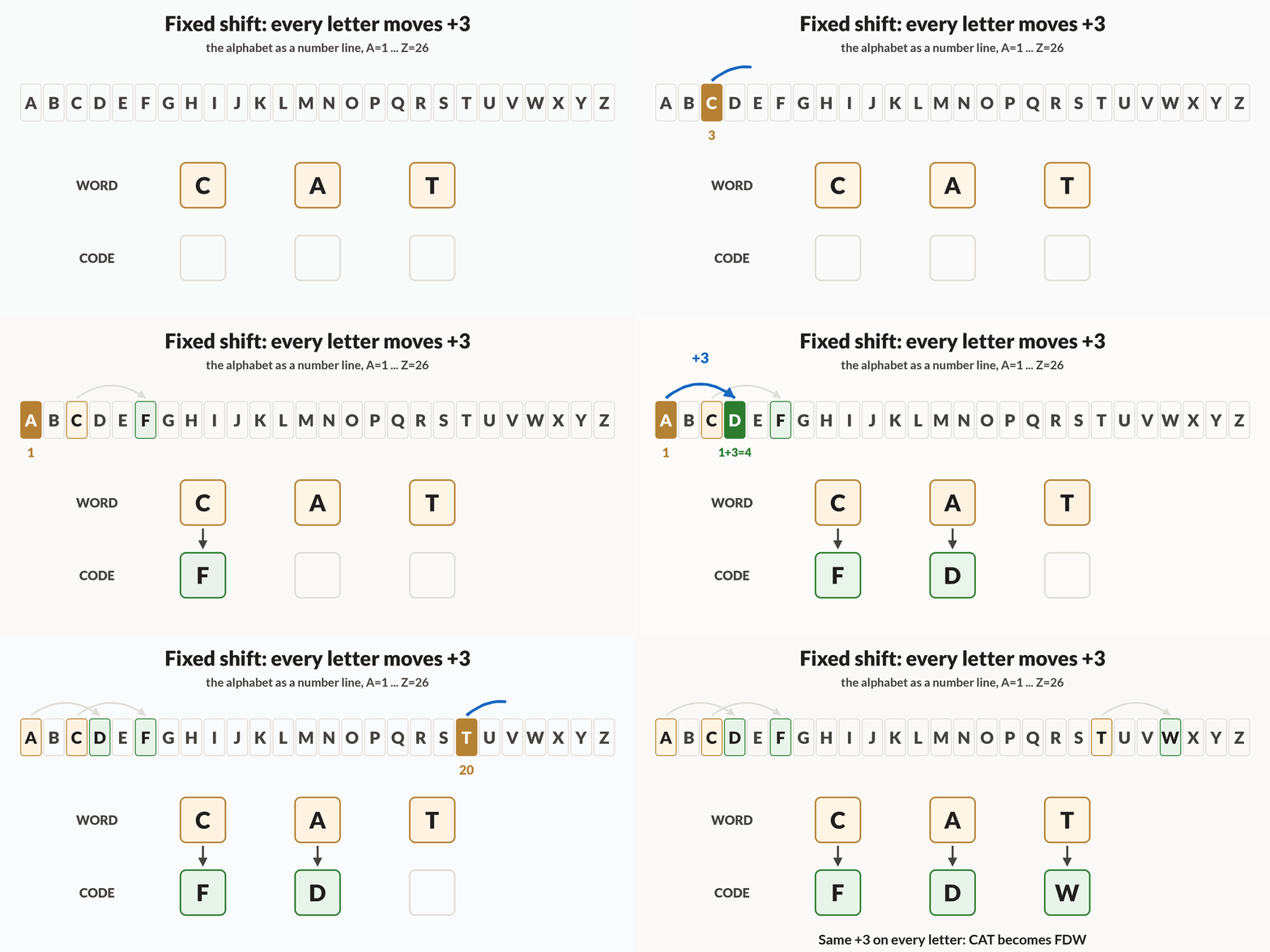
The simplest rule is the fixed shift: every letter slides the same number of places along that ruler. Watch CAT become FDW. C sits at position 3, A at 1, T at 20. The code letters F, D, W sit at 6, 4, 23. Subtract in each column: 6 − 3 = 3, 4 − 1 = 3, 23 − 20 = 3. The gap is +3 in every column — that constant gap is the shift, and it is the entire rule. To code any new word under this language, you move each of its letters exactly 3 places forward.
Finding positions by counting from A every time is slow, so exam solvers carry five landmarks: E=5, J=10, O=15, T=20, Y=25 — remembered as the word EJOTY. Any letter is at most two steps from a landmark: S is one before T, so S=19; W is two before Y, so W=23. Write the given word, its code beneath it, positions under both, and read the gaps column by column. If the gap is the same in every column, you have a fixed shift.
One mechanical detail: the alphabet wraps around. Shifting Y forward by 3 runs past Z, and the count circles back to the start: Y is 25, 25 + 3 = 28, and position 28 means 28 − 26 = 2, which is B. So Y + 3 = B, and Z + 1 = A. Whenever a shifted position leaves the 1 to 26 range, subtract 26 (or add 26 when a backward shift drops below 1) and read the letter sitting there.
Now the trap this concept exists to kill. Checking one column and declaring a rule is exactly what the examiner is betting on: a code whose gaps run +2, +3, +4 also shows +2 on its first letter, and a solver who stops there codes the whole answer wrongly. Confirm the same gap on every letter before you trust it. If even one column disagrees, you are not looking at a fixed shift — you are looking at the positional patterns of the next concept.
Order of attack
- Number both wordsWrite the given word with its code directly beneath it, and put A=1 … Z=26 position numbers under every letter of both. The EJOTY landmarks (E=5, J=10, O=15, T=20, Y=25) locate any position within two steps, so no count ever starts from A.
- Read the gapsSubtract in every column: code position minus original position, adjusting by 26 when the count wraps past Z or before A. A constant difference in every column is a fixed shift; a changing difference means a positional map — a different concept, not a sloppier shift.
- Apply to the targetOnly after the gap has matched on every letter, move each letter of the asked word by that same shift, wrapping past Z back to A when the sum leaves 1 to 26. TEACHER → VGCEJGT is +2 on all seven letters, so STUDENT codes as UVWFGPV.
| Letter | Position | Letter | Position |
|---|---|---|---|
| E | 5 | T | 20 |
| J | 10 | Y | 25 |
| O | 15 | Z | 26 |
Fixed Letter Shift
If in a code language TEACHER is written as VGCEJGT, how is STUDENT written in that code?
- T→V, E→G, A→C (positions)each gap = +2
- C→E, H→J, E→G, R→T+2 on every letter
- Ruleshift each letter forward by 2
- S→U, T→V, U→W, D→F, E→G, N→P, T→VUVWFGPV
Pro tip. Confirm the shift on at least three letters before applying it to the target word to avoid positional-shift traps.
A code maps P→R and A→C on the first two letters of a word. Before coding the rest of the word you should
- Assume a uniform +2 and finish the word
- Check the remaining letters for the same +2 gap
- Switch to opposite-letter coding
Two matching gaps are not yet a rule. A positional shift can open +2, +3, +4…; only a constant gap on every letter licenses a fixed shift.
2Positional and alternating letter maps
Sometimes you number both words, subtract column by column — and the gaps refuse to settle on one number. Take CAT again and suppose the code this time is DCW. Positions: C=3, A=1, T=20; code letters D=4, C=3, W=23. The gaps read 4 − 3 = +1, 3 − 1 = +2, 23 − 20 = +3. No single shift fits, yet the question is not broken: each letter still moves by a definite amount, but the rule depends on position. The first letter moves 1 place, the second 2, the third 3.
The gap list itself is the rule. Written under CAT → DCW it reads +1, +2, +3 — an increasing sequence, so a fourth letter would move +4 and a fifth +5. Other stems alternate instead: +2, −2, +2, −2 swings odd-position letters forward and even-position letters back. A third family runs two separate fixed shifts, one on the odd seats and one on the even seats. In every case it is the sequence of gaps, not any single gap, that you extend onto the target word.
The working method starts with the same first move as the fixed shift — number both words and subtract in every column — but the reading changes. Do not average the gaps, and do not force the first gap onto the whole word: a +1, +2, +3 code answered with a uniform +1 is precisely the wrong answer the options are built to offer. Name the sequence in words first ("gaps climb by one", "gaps alternate in sign"), predict what the next gap must be, and only then shift the target word letter by letter, giving its nth letter the nth gap.
This concept and the fixed shift are told apart by one glance at the gap list. All gaps equal: fixed shift. Gaps climbing or alternating: positional map. That is why the every-letter check from the previous concept is not pedantry — it is the classifier that tells you which of the two concepts the question belongs to.
Figure. Number both words, then write each gap under its column. CAT to DCW is +1, +2, +3 — the sequence is the rule, so a fourth letter would move +4.
Order of attack
- List the gapsUnder each column write code position minus original position, using A=1 … Z=26 and adjusting by 26 where the alphabet wraps. For CAT → DCW that list is +1, +2, +3. The list is the evidence; never work from its first entry alone.
- Name the sequenceSay what the list is doing: climbing by one (+1, +2, +3, …), alternating in sign (+k, −k, +k, …), or running two fixed shifts on odd and even seats. Predict the next term, and check the prediction against any letters of the given pair you have not yet used.
- Apply position-wiseShift the nth letter of the target word by the nth term of the sequence — the fourth letter of a +1, +2, +3 code moves +4, never +1. Collapsing the sequence to a single k is the trap answer, not a shortcut.
| Pattern | What the gaps look like | How to apply |
|---|---|---|
| Increasing shift | +1, +2, +3, … | nth letter moves n places |
| Alternating shift | +k, −k, +k, −k, … | odd and even positions use opposite signs |
| Split by position | two fixed ks on odd/even seats | decode the two sub-chains separately |
Original gaps to a code read +1, +2, +3 on the first three letters. The fourth letter should be shifted by
- +1 (reuse the first gap)
- +2 (the average)
- +4 (continue the increasing sequence)
An increasing positional map is one sequence, not a single k. After +1,+2,+3 the next term is +4.
3Opposite letters (sum to 27)
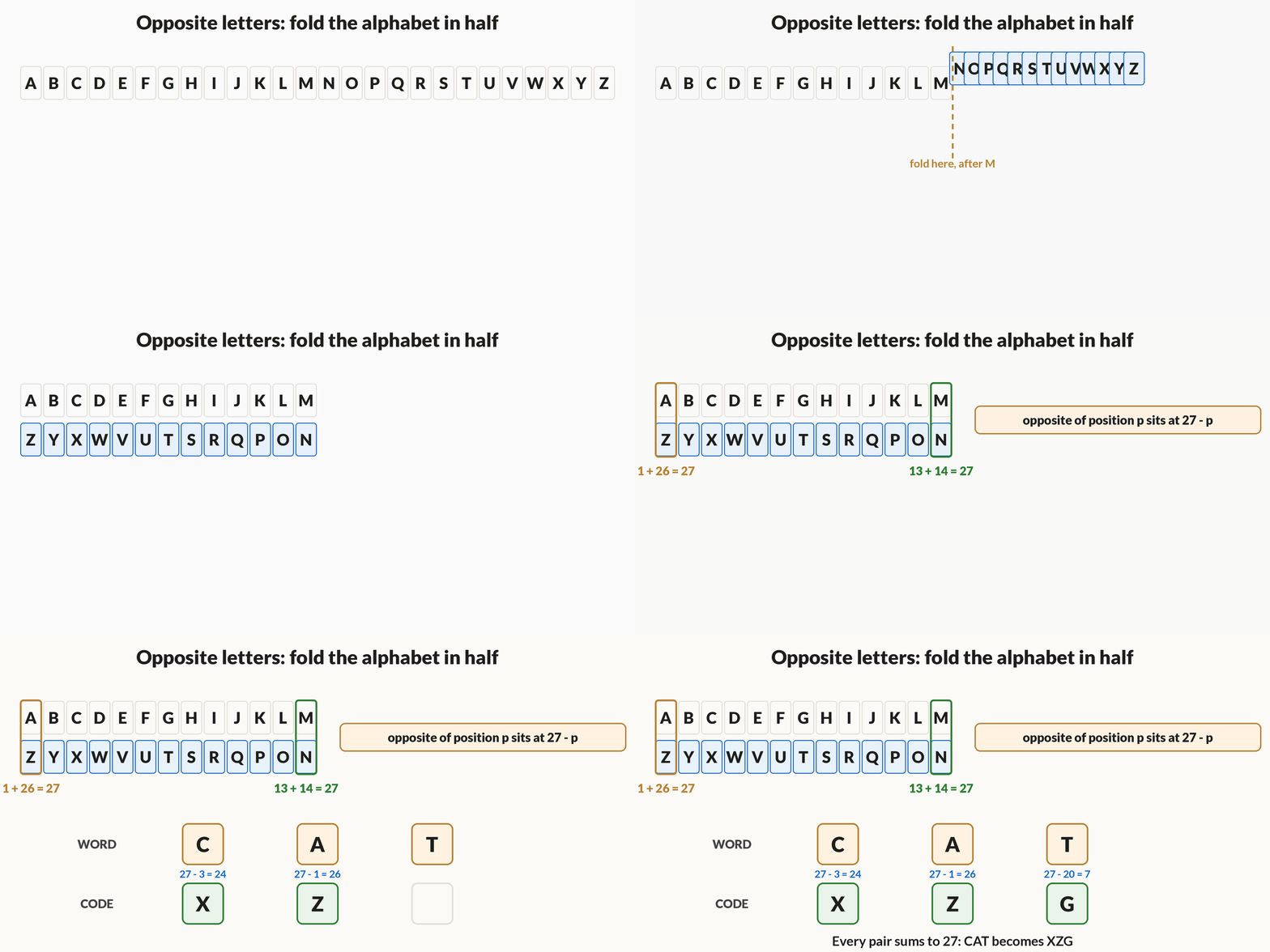
Picture the alphabet strip A to Z and fold it in half between M and N. A lands exactly on Z, B on Y, C on X, and so on until M meets N at the crease. Each letter is now stacked on its opposite — the letter that sits the same distance from the far end of the alphabet as it does from the near end. Opposite-letter codes replace every letter with the one it touches in that fold: nothing slides, nothing rearranges; each letter simply swaps with its mirror partner.
The fold has one arithmetic signature. A is position 1 and Z is 26: 1 + 26 = 27. B and Y: 2 + 25 = 27. M and N at the crease: 13 + 14 = 27. Every folded pair sums to 27, because the pth letter from the front lines up with the pth letter from the back, and the pth letter from the back sits at position 26 − p + 1 = 27 − p. So the opposite of a letter at position p is the letter at 27 − p — one subtraction converts any letter without picturing the strip at all.
Run the running word through it. C is position 3, so its opposite sits at 27 − 3 = 24, which is X. A is 1, and 27 − 1 = 26 is Z. T is 20, and 27 − 20 = 7 is G. CAT codes as XZG. Check each conversion the fast way: original position plus code position should total 27, and 3 + 24, 1 + 26, 20 + 7 all do. That sum-check catches slips instantly, because any wrong opposite breaks the 27 total.
Do not confuse this with a shift. A shift moves every letter the same distance in the same direction; the fold moves letters different distances — A jumps 25 places to reach Z while M barely steps to N. If your gap list from the previous concepts looks chaotic but original and code always sum to 27, you are in this concept. Keep the anchor pairs A–Z, B–Y, C–X in memory for instant starts, and let 27 − p (with EJOTY finding p) handle every other letter.
How it works
- Read the positionConvert the letter to its number with A=1 … Z=26, using the EJOTY landmarks (E=5, J=10, O=15, T=20, Y=25) so no count starts from A. T is a landmark itself: position 20.
- Subtract from 27The opposite sits at 27 − p: C is 3, so 27 − 3 = 24, which is X. Verify by adding original and answer — every true opposite pair totals exactly 27, so a sum that is not 27 is a slip caught on the spot.
- Repeat per letterFlip each letter of the word on its own; opposite coding never mixes columns and never reorders the word. CAT flips letter by letter to XZG.
| Letter | Opposite | Letter | Opposite |
|---|---|---|---|
| A | Z | G | T |
| B | Y | H | S |
| C | X | I | R |
| D | W | J | Q |
| E | V | K | P |
| F | U | L | O |
| M | N | N | M |
Under opposite-letter coding, M maps to
- L
- N
- Z
M is position 13; 27 − 13 = 14, which is N. L is 12 (one step the wrong way); Z is the opposite of A, not of M.
4Number coding from letter positions
Here the code is not another word — it is a number, and the number is built out of the letters' positions. The same A=1 … Z=26 ruler does all the work: replace each letter with its position, then apply some small piece of arithmetic to those numbers. With CAT the positions are 3, 1, 20, and the common recipes give: sum 3 + 1 + 20 = 24, product 3 × 1 × 20 = 60, the sum's digits reversed 24 → 42, or the sum's digit-sum 2 + 4 = 6. One word, four different possible codes — the question is which recipe the examiner used.
You find out by testing recipes in order of how often exams use them. The first test is almost always the sum: it is the most common rule by far, and it costs one line. If the given code matches the sum, stop. If not, escalate deliberately — reverse the sum's digits, then try the product — before reaching for anything exotic. BAD is 2 + 1 + 4 = 7; if the stem says BAD codes as 7, the sum already fits, and a second given word like CAT should then confirm with 24.
The code's size is itself a clue. A code in the same range as the positions' total is probably a sum. A code far bigger than any sum could be points at the product — DOG coded as 420 cannot be a sum, because its positions 4, 15, 7 only add to 26, but they multiply to exactly 420. A two-digit code that looks like a plausible sum written backwards, 42 where the sum is 24, points at digit reversal. Reading sizes this way kills half the recipes before you compute anything.
Whatever recipe fits the first solved word, confirm it on a second solved word before applying it to the target — the same discipline as the every-letter check for shifts. One word agreeing can be a coincidence: BAD gives 7 under both the sum and the reversed-sum recipe, since 7 reversed is still 7, and only another word separates the two. Two solved words agreeing on one recipe is a rule.
Figure. Replace CAT with 3, 1, 20. The sum is 24 — try that first. Digit-reverse of 24 is 42 and the product is 60; those are later tests, not the opening move.
Order of attack
- Write positionsReplace every letter with its A=1 … Z=26 number — CAT becomes 3, 1, 20. Every candidate recipe operates on this one list, so write it once and keep it in view.
- Try the sumAdd the positions and compare with the given code: 3 + 1 + 20 = 24. The sum is the most common recipe, so a match here usually ends the question on the spot.
- Escalate onceIf the sum misses, test the sum's digits reversed (24 → 42), then the product (3 × 1 × 20 = 60), then a digit-sum (2 + 4 = 6). Confirm whichever recipe fits on a second solved word before coding the target — one agreeing word can still be a coincidence.
| Try | On CAT (3,1,20) | Result |
|---|---|---|
| Sum | 3+1+20 | 24 |
| Digit reverse of sum | 24 → | 42 |
| Product | 3×1×20 | 60 |
Sum of letter positions
A word is coded as the sum of its letter positions (A=1 … Z=26). What is the code for BAD?
- B, A, D positions2, 1, 4
- 2 + 1 + 47
Pro tip. If a word maps to a number, first test the sum of letter positions, then the reverse or product before assuming anything exotic.
Under sum-of-positions coding, CAT codes as
- 24
- 6
- 60
3+1+20 = 24. 6 is a digit-sum of 24 (a later test, not the sum itself); 60 is the product 3×1×20.
5Sentence word-substitution coding
This family swaps whole words, not letters. You are shown two or three sentences in an invented language — 'pit dar na' means 'you are good', 'dar tok fa' means 'good and bad' — and each English word corresponds to exactly one code token. The catch, stated plainly because everything depends on it: the tokens are not in the same order as the English words. 'pit' is not necessarily 'you'; a token's position inside its sentence tells you nothing. All you know is that the three tokens of a coded sentence are the codes of its three English words, shuffled.
With order useless, the tool is overlap. The word 'good' appears in both English sentences; the token 'dar' appears in both code strings; and each sentence's tokens code exactly its own words. So whatever token codes 'good' must appear in both code strings — and 'dar' is the only token that does. That forces dar = good. This is the whole method, and it is worth saying as a rule: the code common to two sentences corresponds to the word common to those two sentences.
Notice what the lock did not tell you. After dar = good, the first sentence still has 'pit' and 'na' left for 'you' and 'are' — and nothing decides which is which. Both assignments are consistent, so a question asking for the code of 'you' from these two sentences alone would be unanswerable. That is why you never start from a word that appears once: unique words stay ambiguous until every shared word around them has been locked first.
So the working order is mechanical. Write each English sentence directly above its code string. Circle every English word that repeats across sentences, and circle every token that repeats across the code strings — repeats pair with repeats, and each such pairing is certain. Then subtract: remove locked words and their tokens from each sentence, and look for new repeats among what remains. Stop the moment the asked word is locked; most exam stems, like this one, need only the first lock.
Figure. The only English word in both sentences is good; the only token in both code strings is dar. Order inside a sentence does not matter — the shared pair locks.
Order of attack
- Align the sentencesWrite each English sentence with its code string directly beneath it, and treat each sentence as a set of words over a set of tokens — order inside a sentence carries no information, so nothing is gained by matching first word to first token.
- Find the shared wordCircle the English word that appears in more than one sentence — here 'good', the only word in both 'you are good' and 'good and bad'. Shared words are the only certain starting points; a word that appears once cannot be pinned yet.
- Find the shared codeCircle the token common to those same code strings — 'dar' is the only one — and lock the pair: dar = good. Subtract the locked pair from both sentences and repeat on what remains, or stop if the question asked only for the shared word's code.
Sentence Word-Substitution Coding
If 'pit dar na' means 'you are good', 'dar tok fa' means 'good and bad', what is the code for 'good'?
- 'you are good' ↔ pit dar nacodes: pit, dar, na
- 'good and bad' ↔ dar tok facodes: dar, tok, fa
- word common to both sentencesgood
- code common to both code-setsdar
Pro tip. Always start from the word (and code) that appears in more than one sentence; it fixes one mapping with certainty.
Two coded sentences share exactly one English word and exactly one code token. That token
- May belong to either shared or unshared words
- Must be the code for the shared word
- Is always the middle token
Intersection of the word-sets and intersection of the code-sets are forced to match. Position inside the string is irrelevant.
Notes
- Letter-Shift Coding: A word is coded by shifting each letter forward/backward by a fixed number of positions in the alphabet; e.g. CAT -> DBU is a +1 shift. Always write the A=1..Z=26 (and reverse Z=1..A=26 as EJOTY landmarks) to find the constant gap quickly.
- Letter-to-Letter (Substitution) Coding: Each letter maps to another by a rule that may differ per position (e.g. +1, +2, +3...). Compare the code letter-by-letter against the original to detect an increasing/alternating pattern rather than a single fixed shift.
- Number/Symbol Coding: Words are coded as numbers using position values, their sum, product, or reversal; e.g. sum of letter positions of CAT = 3+1+20 = 24. Check divisibility or digit-sum clues to spot the operation.
- Coding by Analogy / Conditional Coding: You are given several coded sentences and must map words to codes by comparing sentences that share a common word. The common word narrows down which code corresponds to it.
- Common trap: Do not assume a uniform shift after checking only the first letter; verify the rule on every letter, because SSC frequently uses positional (increasing) shifts to fool candidates.
Formulas
- Forward shift: coded position = (\text{original position} + k - 1)\bmod 26 + 1, where k is the shift.
- Reverse (opposite) letter: opposite of position p is 27 - p (A<->Z, B<->Y, M<->N).
- Sum-coding: word value = \sum(\text{position of each letter}); e.g. BAD = 2+1+4 = 7.
- EJOTY memory rule: E=5, J=10, O=15, T=20, Y=25 to locate any letter's position fast.
- For sentence (word-substitution) coding: the code common to two sentences corresponds to the word common to those two sentences.
Exam traps & shortcuts
- Write letters with their positions above them before decoding; the constant gap between original and code is the shift.
- For opposite-letter codes, use the pairs A-Z, B-Y, C-X (sum of positions = 27) to convert instantly.
- When comparing coded sentences, circle repeated words and their repeated codes to lock mappings before guessing the rest.
- If a word maps to a number, first test the sum of letter positions, then the reverse or product before assuming anything exotic.
Reference tables
Pick the tool from the stem shape before computing.
| Stem shape | Tool | First check |
|---|---|---|
| Word → word, same length | Letter shift or opposite | Constant gap? Else 27 − p |
| Gaps climb or alternate | Positional map | List every gap |
| Word → number | Position arithmetic | Sum, then reverse/product |
| Several short sentences | Word–code intersection | Shared word ↔ shared code |
Recap
Read only this the night before.
- Verify every letter
- A fixed shift is a constant gap on the whole word. First-letter agreement is not a rule.
- Positional gaps
- If the gaps are +1,+2,+3… apply the sequence position-wise — do not collapse it to one k.
- Opposite = 27 − p
- A↔Z, B↔Y, …, M↔N. Sum of positions in a reverse pair is always 27.
- Number codes
- Sum of positions first (CAT = 24, BAD = 7); only then reverse digits or product.
- Sentence codes
- Shared word ↔ shared code. Lock repeats before touching unique tokens.
Practise Coding-Decoding
Reading is free and needs no account. Practice, mocks and progress live in the app.
- 615 exam-style questions on this topic, with explanations
- A 3-question practice set that ends the chapter
- Timed mocks scored with the real marking scheme
- Readiness tracked per topic, kept on your device