JEE Main (Engineering) · Chemistry (JEE & NEET)
Chemical Kinetics
Rate of reaction, order and molecularity, integrated rate laws, half life, activation energy and the Arrhenius equation.
Eight concepts on how fast, not how far. Thermodynamics decides whether a reaction can go; kinetics decides whether you will live to see it — and every question in this chapter is a rate law, an integrated rate law, or an exponential in disguise.
- JEE Main (Engineering)
- Medium level
- 8 concepts
- 5 practice questions
1Rate and the rate law
The rate of a reaction is a single number, not one number per species. Divide each measured slope by that species' stoichiometric coefficient and they all agree: for aA → pP, rate = −(1/a)d[A]/dt = (1/p)d[P]/dt. Skip the division and you report a number that is two or four times too big, depending on which species you happened to watch.
The rate law then says what that rate depends on: rate = k[A]ˣ[B]ʸ. The concentrations change as the reaction runs; k does not. Everything temperature does to a reaction, it does through k.
Figure. The NO₂ curve climbs exactly twice as fast as the N₂O₅ curve falls, at every instant — checked segment by segment, the ratio is 2.000. That factor of two is the stoichiometry, and it is the whole reason the rate has to be defined per coefficient.
How it works
- Follow one speciesMeasure how fast one concentration changes — whichever is easiest to detect.
- Divide by its coefficientThat converts a species' slope into the reaction's rate, which every species now agrees on.
- Fix kWith the exponents known from experiment, one rate-and-concentration pair fixes k and its units.
One reaction, three different slopes
In 2N₂O₅ → 4NO₂ + O₂, oxygen appears at 2.5 × 10⁻⁴ mol L⁻¹ s⁻¹. Find the rate of the reaction and the rates of change of N₂O₅ and NO₂.
- O₂ has coefficient 1, so rate = d[O₂]/dt2.5 × 10⁻⁴ mol L⁻¹ s⁻¹
- −d[N₂O₅]/dt = 2 × rate5.0 × 10⁻⁴ mol L⁻¹ s⁻¹
- d[NO₂]/dt = 4 × rate1.0 × 10⁻³ mol L⁻¹ s⁻¹
- Check: (1/4)(1.0 × 10⁻³) and (1/2)(5.0 × 10⁻⁴)both 2.5 × 10⁻⁴ ✓
Pro tip. The three slopes differ by a factor of four, and only one of them is 'the rate'. Whenever a question gives you one species and asks for another, go through the reaction rate rather than scaling directly — it is the same two steps and it never picks up the reciprocal.
For 2N₂O₅ → 4NO₂ + O₂, N₂O₅ disappears at 8.0 × 10⁻⁴ mol L⁻¹ s⁻¹. The rate of the reaction is
- 8.0 × 10⁻⁴ mol L⁻¹ s⁻¹
- 4.0 × 10⁻⁴ mol L⁻¹ s⁻¹
- 1.6 × 10⁻³ mol L⁻¹ s⁻¹
N₂O₅ has coefficient 2, so rate = (1/2)(8.0 × 10⁻⁴) = 4.0 × 10⁻⁴ mol L⁻¹ s⁻¹. Option 1 forgets the coefficient; option 3 multiplies by it instead of dividing.
2Order versus molecularity
Order is measured; molecularity is counted. The exponents x and y in rate = k[A]ˣ[B]ʸ come out of experiment and may be zero, fractional or negative — they describe an observed rate law and nothing else. Molecularity is the number of species that collide in one elementary step, so it is 1, 2 or 3, never a fraction, and it belongs to a step rather than to a balanced equation.
For an elementary step the two coincide, and only then may you read the rate law off the equation. Otherwise the rate law belongs to the slowest step, which is why a species can sit in the balanced equation and be completely absent from the rate law.
Figure. Vary one concentration at a time and the exponent is the shape of the curve you get. Quadrupling the rate when [NO₂] doubles is order 2; a flat line when [CO] doubles is order 0. Both runs pass through the same reference point, so the two curves are directly comparable.
| Order | Molecularity | |
|---|---|---|
| Where it comes from | Experiment | A proposed elementary step |
| Values it can take | 0, fractions, negatives | 1, 2 or 3 only |
| What it describes | The overall reaction | One step, never the overall equation |
| Readable off the equation? | Only if the step is elementary | Yes, by counting the species that collide |
A reactant that does not appear in the rate law
For NO₂ + CO → NO + CO₂, doubling [CO] at fixed [NO₂] leaves the initial rate unchanged, while doubling [NO₂] at fixed [CO] multiplies it by four. Find the rate law, the overall order and the units of k.
- [CO] doubled, rate ratio 1 = 2ʸy = 0
- [NO₂] doubled, rate ratio 4 = 2ˣx = 2
- rate = k[NO₂]²[CO]⁰, n = x + ysecond order
- Units of k = (mol L⁻¹)¹⁻ⁿ s⁻¹ with n = 2L mol⁻¹ s⁻¹
Pro tip. The accepted mechanism is 2NO₂ → NO₃ + NO (slow) then NO₃ + CO → NO₂ + CO₂ (fast). The slow step is bimolecular in NO₂ and contains no CO at all, which is exactly what the rate law says. Note the sum of the coefficients in NO₂ + CO is also 2 — so the overall order happens to come out right by accident. The individual orders, 2 and 0 rather than 1 and 1, are what stoichiometry gets wrong.
A reaction is found by experiment to be of order 1.5. Its molecularity is
- 1.5, because order and molecularity are the same quantity
- 2, since molecularity must be a whole number
- Undefined — the reaction cannot be a single elementary step
Molecularity counts colliding species in one elementary step, so it is a whole number and only a step has one. A fractional order is proof the reaction runs through several steps; the overall reaction simply has no molecularity to quote.
3Zero order
A zero-order reaction consumes reactant at a fixed rate: rate = k no matter what [A] is. Integrating gives [A] = [A]₀ − kt — a straight line, not a curve — so k carries the units of a rate, mol L⁻¹ s⁻¹, and the reactant is genuinely exhausted at t = [A]₀/k instead of approaching zero forever.
This happens when something other than the reactant is the bottleneck: a catalyst surface already saturated, or a photochemical step limited by the light supplied. The half-life t₁/₂ = [A]₀/2k then depends on where you start, and shrinks as the reaction runs.
Figure. Both curves are drawn as fractions of their initial value, so they share an axis. Rate is the slope of the concentration line, and a straight line has a constant slope — hence the flat dashed line, which drops to zero only when the reactant does, at 50 s. Sketching the rate as a decaying curve is the commonest error in this topic.
Reading the two graphs
- The line[A] against t is straight, with slope −k, for the whole of the reaction.
- Its slope is the rateA straight line has one slope, so the rate–t graph is flat at k — not a decaying curve.
- The cliffWhen [A] reaches zero the rate collapses to zero at once. That corner is what makes zero order recognisable.
Half-lives that keep shrinking
A zero-order decomposition starts at [A]₀ = 0.10 mol L⁻¹ with k = 2.0 × 10⁻³ mol L⁻¹ s⁻¹. Find the first half-life, the second, and when the reactant runs out.
- t₁/₂ = [A]₀/2k = 0.10/(2 × 2.0 × 10⁻³)25 s
- [A] then = 0.10 − 2.0 × 10⁻³ × 250.050 mol L⁻¹
- Second half-life = 0.050/(2 × 2.0 × 10⁻³)12.5 s
- Reactant gone at t = [A]₀/k50 s, exactly 2 t₁/₂
Pro tip. Each half-life is half the one before, so they sum to a finite time: 25 + 12.5 + 6.25 + … = 50 s, which is exactly the [A]₀/k the straight line predicts. A first-order reaction, whose half-lives never shrink, never finishes.
The initial concentration of a zero-order reaction is doubled. Its half-life
- Is unchanged, as for first order
- Doubles
- Halves
t₁/₂ = [A]₀/2k is directly proportional to [A]₀: 0.10 M gives 25 s, 0.20 M gives 50 s. Only first order has a half-life free of [A]₀, and carrying that fact across orders is the standard slip.
4First order
First order means the rate is proportional to what is left: −d[A]/dt = k[A]. Integrating gives ln[A] = ln[A]₀ − kt, or in the form the exam expects, k = (2.303/t) log([A]₀/[A]). Only the ratio [A]₀/[A] appears, so you never need an absolute concentration — percentages, partial pressures and titre readings all go in directly, and k comes out in reciprocal time whose unit is set by the t you substituted, never by how the concentrations were measured.
Plot ln[A] against t and a first-order reaction gives a straight line of slope −k. That is both the standard test and the standard trap: the slope is negative while k is positive.
Figure. Both lines fall to the right, because ln[A] decreases as the reactant is used up and the slope is −k. The intercept is ln[A]₀ and halving k halves the steepness without moving the intercept. If your ln[A] line rises, you have plotted ln([A]₀/[A]) instead — a different graph, with slope +k.
Percentages, no concentrations needed
A first-order reaction is 20% complete in 10 minutes. How long until it is 60% complete?
- 20% done leaves 80%: k = (2.303/10) log(100/80)0.0223 min⁻¹
- 60% done leaves 40%: t = (2.303/0.0223) log(100/40)41.1 min
- Check without k: t₆₀/t₂₀ = log 2.5 / log 1.254.11, so 41.1 min
Pro tip. The second route never computes k at all: for first order, every time is proportional to log([A]₀/[A]), so a ratio of times is a ratio of logs. Use it whenever the question gives one completion time and asks for another — it removes the step where the rounding of k usually goes wrong.
The initial concentration of a first-order reaction is doubled. The initial rate and the half-life respectively
- Double; stay the same
- Double; double
- Stay the same; double
rate = k[A], so the initial rate doubles. t₁/₂ = 0.693/k contains no concentration at all, so it does not move. The two behave differently, and a question that changes [A]₀ is usually testing exactly that.
5Half-life as a fingerprint
For first order, t₁/₂ = 0.693/k contains no [A]₀ at all: however much you start with, half of it goes in the same time. That single fact turns most first-order questions into counting. 75% consumed leaves a quarter, which is two half-lives; 87.5% is three; ten half-lives leave 1/2¹⁰ = 1/1024, or 0.098%, which is where the '99.9% in ten half-lives' shortcut comes from.
Across orders the half-life is a fingerprint: t₁/₂ ∝ [A]₀^(1−n). It rises with [A]₀ for zero order, is flat for first, and falls for second. Because each successive half-life starts from half the previous concentration, one run gives you the whole sequence — and the sequence names the order without any graph at all.
Figure. The two reactions are tuned to share a first half-life, so everything after it is the fingerprint. The first-order marks at 50% and 25% are equally spaced along t and always will be; the zero-order line, having spent its first half-life reaching 0.5, needs exactly as long again to finish entirely — 2 t₁/₂ in all, even though its second half-life is only half as long as its first.
Counting half-lives instead of taking logs
A first-order reaction has k = 2.0 × 10⁻³ s⁻¹. How long until 75% of the reactant is consumed?
- t₁/₂ = 0.693/k = 0.693/(2.0 × 10⁻³)346.5 s
- 75% gone leaves 25%, so [A]₀/[A] = 4 = 2²2 half-lives
- t = 2 × 346.5693 s
- Check the long way: (2.303/k) log 4 = 1151.5 × 0.602693 s ✓
Pro tip. Ten half-lives here is 3465 s, and it leaves 1/1024 rather than exactly 1/1000 — so '99.9%' is really 99.90%, and the shortcut is good to a third of a percent. Whenever the fraction left is a power of two, count half-lives; reach for the log form only when it is not.
Successive half-lives of a reaction, measured in one run, come out as 40, 20 and 10 minutes. The order is
- Zero
- First
- Second
Each half-life starts at half the previous concentration, and t₁/₂ ∝ [A]₀^(1−n), so the ratio of successive half-lives is 0.5^(1−n): 0.5 for n = 0, 1 for n = 1, 2 for n = 2. Half-lives that halve are zero order; half-lives that double are second.
6Arrhenius and activation energy
Only collisions carrying at least Ea can get over the barrier, and the Boltzmann factor e^(−Ea/RT) is the fraction that do. Hence k = Ae^(−Ea/RT), with A the frequency factor. Take logarithms: ln k = ln A − Ea/RT, so a plot of ln k against 1/T is a straight line whose slope is −Ea/R and whose intercept is ln A.
The slope is negative and Ea is positive; the minus sign lives in the slope, never in Ea. For two temperatures the same equation becomes log(k₂/k₁) = (Ea/2.303R)(1/T₁ − 1/T₂), written with T₁ first inside the bracket so that warming the reaction gives a positive answer.
Figure. 1/T grows to the right, so temperature falls to the right and ln k falls with it — the line runs downwards, slope −Ea/R. The two marked points are the worked example: at Ea = 53.6 kJ mol⁻¹ they sit exactly ln 2 apart, which is the rate constant doubling. The half-Ea line is drawn through the same point so that only the slopes differ.
Activation energy from two temperatures
The rate constant doubles when the temperature rises from 300 K to 310 K. Find Ea, taking R = 8.314 J mol⁻¹ K⁻¹.
- log(k₂/k₁) = log 20.301
- 1/300 − 1/310 = 10/930001.075 × 10⁻⁴ K⁻¹
- Ea = 0.301 × (2.303 × 8.314)/(1.075 × 10⁻⁴)5.36 × 10⁴ J mol⁻¹
- Slope of ln k against 1/T = −Ea/R−6446 K
Pro tip. The famous 'rate doubles for every 10 °C' is an accident of room temperature, not a law. The same doubling between 500 and 510 K needs Ea = 147 kJ mol⁻¹, and between 800 and 810 K it needs 373 kJ mol⁻¹, because 1/T₁ − 1/T₂ collapses as T rises. Quote the rule only near 300 K — and note the data here carries two significant figures, so 54 kJ mol⁻¹ is as much as it really justifies.
Two reactions are plotted as ln k against 1/T on the same axes. The one with the larger Ea gives
- The line that falls more steeply to the right
- The line that is flatter
- A curve rather than a line
The slope is −Ea/R, so doubling Ea doubles the steepness of a line that already runs downwards. A large Ea means a reaction whose rate is very sensitive to temperature — which is the same statement as a steep Arrhenius line.
7Collision theory
A reaction needs three things, and collision theory keeps them apart: a collision at all, enough energy, and the right orientation. Writing k = P·Z·e^(−Ea/RT) puts each in its own factor — Z is the collision frequency, the exponential is the energy requirement, and the steric factor P is the fraction of energetic collisions that are also correctly aligned.
The exponential is brutal. At 300 K with Ea = 53.6 kJ mol⁻¹, fewer than five collisions in every 10¹⁰ carry enough energy, and the reaction still runs at a measurable rate only because Z is astronomically large. It is also why a 10 K rise matters so much: it barely changes how fast the molecules move, but it doubles how many of them can clear the barrier.
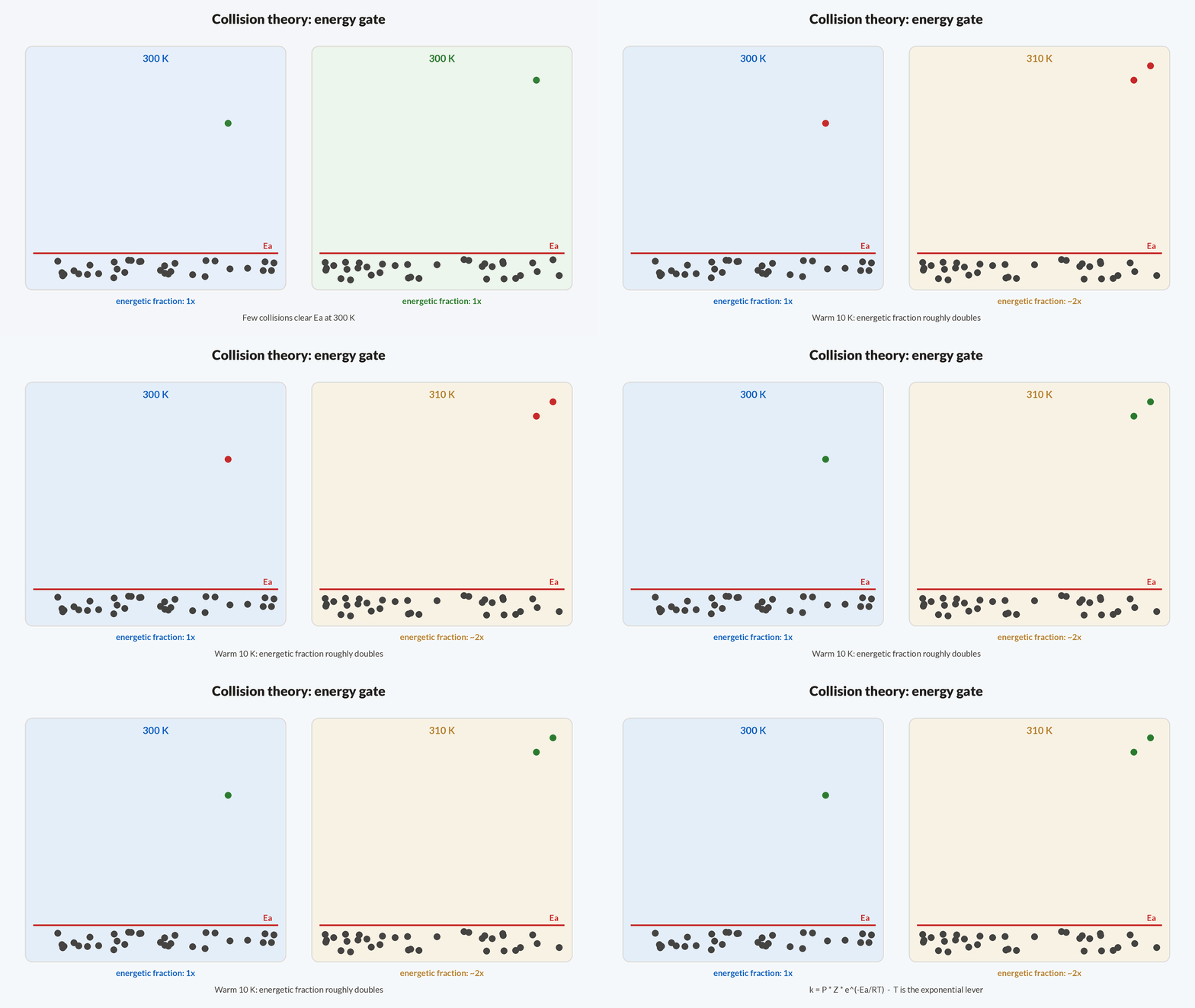
Why 10 degrees doubles the rate
Using Ea = 53.6 kJ mol⁻¹, find the fraction of collisions able to react at 300 K and at 310 K, and compare them.
- Ea/RT at 300 K = 53600/(8.314 × 300)21.490
- fraction = e⁻²¹·⁴⁹⁰4.6 × 10⁻¹⁰
- At 310 K, Ea/RT = 20.797, fraction = e⁻²⁰·⁷⁹⁷9.3 × 10⁻¹⁰
- Ratio = e^(21.490 − 20.797) = e^0.6932.00 — the rate doubles
Pro tip. Nothing about the molecules' speed doubled: √(310/300) = 1.0165, so they are only 1.7% faster. What doubled is the population out in the tail of the distribution, because an exponential in 1/T responds far more sharply to temperature than any speed does. Both fractions are around 10⁻⁹, and the reaction is still fast — that is how large the collision frequency is.
Warming a reaction from 300 K to 310 K roughly doubles its rate. The main reason is that
- The molecules are moving about 1.7% faster, so they collide more often
- The fraction of collisions carrying at least Ea roughly doubles
- Ea itself falls as the temperature rises
Mean speed goes as √T, so 300 → 310 K is only a 1.7% increase in speed and collision frequency — nothing like a doubling. The doubling is entirely in e^(−Ea/RT), whose exponent shifts from 21.490 to 20.797, a difference of exactly ln 2. Ea is a property of the barrier and does not depend on temperature.
8Catalysis
A catalyst does not push the old reaction harder; it opens a different route with a lower barrier. Everything else follows from that one sentence. Lowering Ea by 25 kJ mol⁻¹ at 300 K multiplies k by e^(25000/RT) ≈ 2.3 × 10⁴, which is why a pinch of catalyst turns a reaction that would take a month into one that takes about two minutes.
What a catalyst cannot do is shift the equilibrium. The new route lowers the forward and reverse barriers by exactly the same amount, because both are measured to the same transition state, so k_f and k_r are multiplied by the same factor and K = k_f/k_r is untouched. ΔH is fixed by the reactant and product energies, which the catalyst never touches at all.
Figure. Energy runs up the page, so the higher barrier is the upper hump: the solid uncatalysed peak sits above the dashed catalysed one. Both curves leave the same reactant level and arrive at the same product level, 30 kJ below it — that is what 'a catalyst does not change ΔH' looks like drawn. The two barrier heights, 75 and 50 kJ, are to scale against that 30 kJ drop.
Reading the profile
- Two plateausReactants on the left, products on the right. The gap between them is ΔH, and no catalyst moves either end.
- Two humpsEach path's maximum is its transition state; the climb from the left plateau to it is Ea in the forward direction.
- One differenceThe catalysed peak sits 25 kJ lower — and it is 25 kJ lower measured from the right-hand plateau too.
How much a catalyst buys, and what it does not
A catalyst lowers Ea from 75 to 50 kJ mol⁻¹ for a reaction with ΔH = −30 kJ mol⁻¹ at 300 K. By what factor does the forward rate constant rise, and what happens to K?
- ΔEa = 75 − 5025 kJ mol⁻¹
- k_cat/k = e^(ΔEa/RT) = e^(25000/2494)2.3 × 10⁴
- Reverse barriers: 75 − (−30) = 105 falls to 50 − (−30) = 80also down 25 kJ mol⁻¹
- K = k_f/k_r, both multiplied by 2.3 × 10⁴K unchanged
Pro tip. The reverse barrier is always the forward barrier minus ΔH, so for an exothermic reaction it is the larger of the two — 105 against 75 here. That is the arithmetic behind 'a catalyst reaches equilibrium sooner but does not move it': it multiplies both rate constants by the identical factor, and equilibrium only ever cares about their ratio.
A catalyst lowers the activation energy of a reversible reaction by 25 kJ mol⁻¹. The equilibrium constant K
- Rises by a factor e^(25000/RT)
- Is unchanged
- Falls, because the reverse reaction is also faster
Both barriers drop by the same 25 kJ mol⁻¹, so k_f and k_r are multiplied by the same factor and their ratio is fixed. Equilibrium is thermodynamics — it depends on ΔG, which the catalyst does not touch. The catalyst changes only how quickly equilibrium is reached.
Notes
- Rate law: rate =k[A]^x[B]^y; overall order =x+y is found experimentally (not from stoichiometry), while molecularity counts the species in an elementary step.
- Zero order: rate is independent of concentration, [A]=[A]_0-kt, and k has units of mol L^{-1} s^{-1}.
- First order: k=\frac{2.303}{t}\log\frac{[A]_0}{[A]}, with half-life t_{1/2}=\frac{0.693}{k} independent of initial concentration.
- Arrhenius equation: k=Ae^{-E_a/RT}; the rate roughly doubles for every 10^\circC rise, and E_a is the activation energy barrier.
- Collision theory and catalysis: a reaction needs sufficient energy and correct orientation; a catalyst provides an alternative path with lower E_a without changing \Delta H.
Formulas
- First order: k=\frac{2.303}{t}\log\frac{[A]_0}{[A]}
- t_{1/2}=\frac{0.693}{k} (first order)
- Zero order: t_{1/2}=\frac{[A]_0}{2k}
- k=Ae^{-E_a/RT}
- \log\frac{k_2}{k_1}=\frac{E_a}{2.303R}\left(\frac{1}{T_1}-\frac{1}{T_2}\right)
Exam traps & shortcuts
- For a first-order reaction, time for 99.9% completion =10\,t_{1/2} and 75% completion =2\,t_{1/2}.
- Half-life vs order: t_{1/2}\propto[A]_0^{(1-n)} — constant for 1st order, decreasing for 2nd order, increasing for zero order.
- Units of k are (\text{mol L}^{-1})^{1-n}\text{s}^{-1}; use them to deduce the overall order n.
Reference tables
Three independent ways to read the order off a single experiment — the plot that comes out straight, how successive half-lives behave, and the units k is forced to carry. They always agree, so use whichever the question hands you.
| Order n | Integrated law | Straight-line plot | t₁/₂ | Units of k |
|---|---|---|---|---|
| 0 | [A] = [A]₀ − kt | [A] against t | [A]₀/2k — halves each time | mol L⁻¹ s⁻¹ |
| 1 | ln[A] = ln[A]₀ − kt | ln[A] against t | 0.693/k — constant | s⁻¹ |
| 2 | 1/[A] = 1/[A]₀ + kt | 1/[A] against t | 1/k[A]₀ — doubles each time | L mol⁻¹ s⁻¹ |
Every line should be reconstructible from the concept it came from, not merely recalled.
| Quantity | Relation | Watch for |
|---|---|---|
| Rate of reaction | −(1/a)d[A]/dt = (1/p)d[P]/dt | Divide by the coefficient |
| Rate law | rate = k[A]ˣ[B]ʸ, n = x + y | x and y are measured, not read off |
| Zero order | [A] = [A]₀ − kt | Reactant actually gone at [A]₀/k |
| First order | k = (2.303/t) log([A]₀/[A]) | Only the ratio matters |
| First-order half-life | t₁/₂ = 0.693/k | No [A]₀ in it — first order only |
| Zero-order half-life | t₁/₂ = [A]₀/2k | Proportional to [A]₀ |
| Half-life fingerprint | t₁/₂ ∝ [A]₀^(1−n) | Rises, flat, falls for n = 0, 1, 2 |
| Units of k | (mol L⁻¹)^(1−n) s⁻¹ | The concentration part gives n; the time unit is just t's |
| Completion shortcuts | 75% = 2 t₁/₂, 99.9% ≈ 10 t₁/₂ | First order only; 10 t₁/₂ leaves 1/1024 |
| Arrhenius | k = Ae^(−Ea/RT) | ln k against 1/T, slope −Ea/R |
| Two temperatures | log(k₂/k₁) = (Ea/2.303R)(1/T₁ − 1/T₂) | T₁ first inside the bracket |
| Boltzmann fraction | e^(−Ea/RT) | The whole temperature effect sits here |
| Catalyst | Lowers Ea forward and reverse alike | ΔH and K unchanged |
Recap
Read only this the night before.
- Rate
- One number for the whole reaction. Divide every species' slope by its stoichiometric coefficient first.
- Order
- Measured, never read off an overall balanced equation — only an elementary step's coefficients are its exponents. Molecularity counts an elementary step's colliding species and stops at 3.
- Zero order
- [A] against t is the straight line, the rate is flat at k, and the reactant is genuinely gone at 2 t₁/₂.
- First order
- ln[A] against t is the straight line, slope −k. t₁/₂ = 0.693/k, so 75% is two half-lives and 99.9% about ten.
- Fingerprint
- t₁/₂ ∝ [A]₀^(1−n). Successive half-lives halve for n = 0, repeat for n = 1, double for n = 2.
- Arrhenius
- ln k against 1/T, slope −Ea/R. The slope is negative, Ea never is. The 10 °C doubling rule holds only near room temperature.
- Catalyst
- Lowers Ea in both directions by the same amount. ΔH and K unmoved; only the time taken changes.
Practise Chemical Kinetics
Reading is free and needs no account. Practice, mocks and progress live in the app.
- 5 exam-style questions on this topic, with explanations
- A 5-question practice set that ends the chapter
- Timed mocks scored with the real marking scheme
- Readiness tracked per topic, kept on your device