JEE Main (Engineering) · Physics (JEE & NEET)
Current Electricity
Ohms law, resistivity, series and parallel circuits, Kirchhoff rules, Wheatstone bridge, potentiometer and electrical measuring instruments.
Nine concepts. Each one stated, drawn, then worked out with real numbers — because in JEE Advanced the marks sit in the manipulation, not the statement.
- JEE Main (Engineering)
- Medium level
- 9 concepts
- 5 practice questions
1Current and drift
Current is charge crossing a section per second, I = dq/dt. Inside a metal the free electrons already move at about 10⁵ m s⁻¹ in random directions; the applied field only adds a tiny systematic drift on top. Between collisions the field accelerates an electron for a mean free time τ, so v_d = eEτ/m and I = neAv_d.
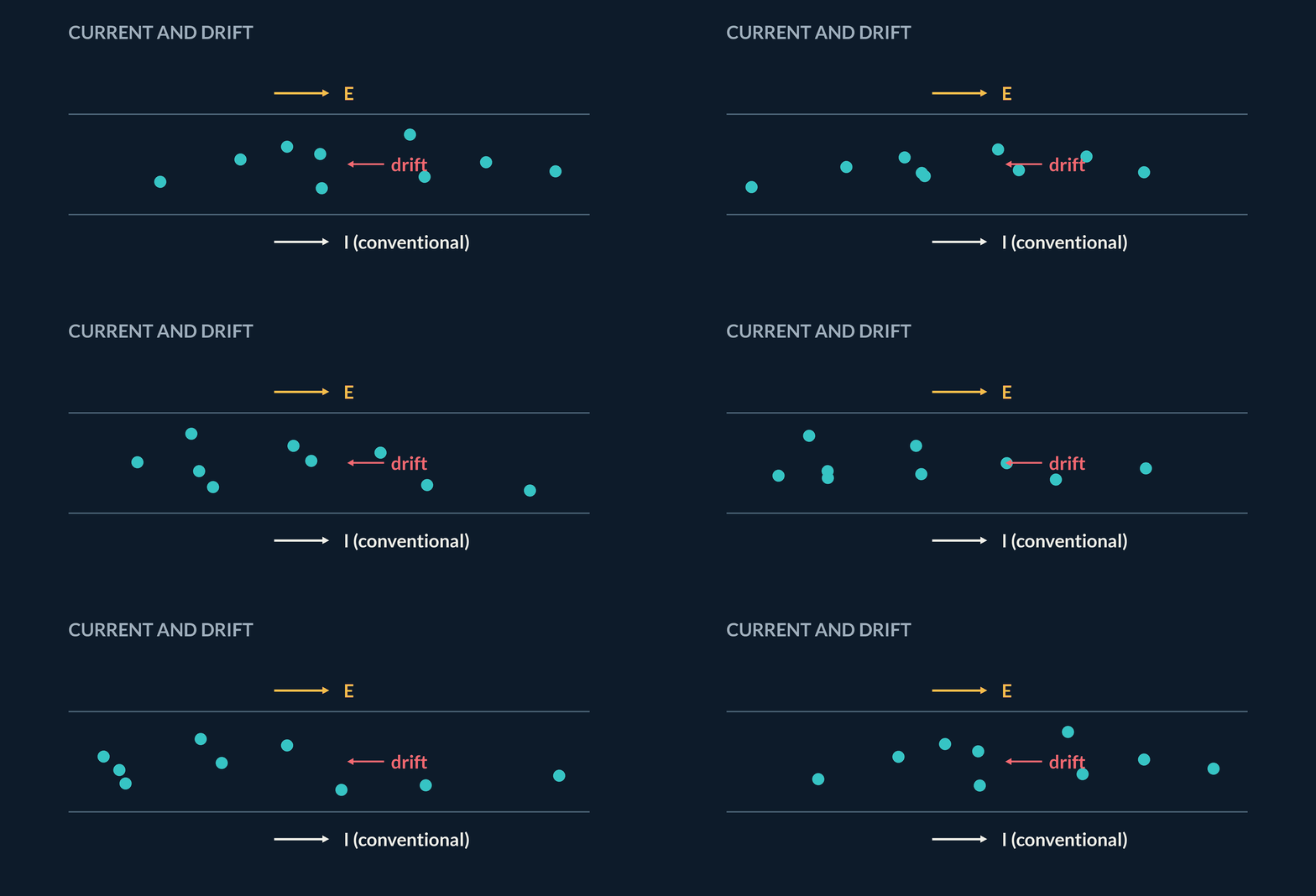
How it works
- Field appliedThe battery sets up E = V/L along the wire, essentially instantly.
- Accelerate, collideEach electron gains speed for a time τ, then scatters and loses it.
- Steady driftThe average settles at v_d = eEτ/m, giving a steady current.
How slow is the drift?
A copper wire of cross-section 1 mm² carries 1 A, with n = 8.5 × 10²⁸ m⁻³.
- neA = 8.5×10²⁸ × 1.6×10⁻¹⁹ × 10⁻⁶1.36 × 10⁴
- v_d = I / neA7.4 × 10⁻⁵ m s⁻¹
- Time to cross a 1 m wire≈ 3.8 hours
Pro tip. The electrons crawl at 0.07 mm s⁻¹, yet the bulb lights instantly — because every electron in the loop starts drifting at once. Double the current and v_d doubles; halve the area and it doubles again.
2Resistance and resistivity
Ohm's law is properly a statement about the material: J = σE with σ = ne²τ/m. Integrate over a uniform conductor and you recover V = IR with R = ρL/A. Resistivity belongs to the substance; resistance belongs to the particular piece of wire in front of you.
Figure. Stretching at constant volume lengthens and thins at once, so both factors push R the same way: R ∝ L².
| Change | ρ | R |
|---|---|---|
| Stretch the wire, volume fixed | unchanged | ∝ L² — four-fold for double length |
| Cut the wire in half | unchanged | halved |
| Raise the temperature of a metal | rises | rises |
| Change the material | different | different |
The stretched wire
A wire of resistance 2 Ω is drawn out until its length is trebled, the volume staying constant.
- Volume fixed: AL = A′L′ with L′ = 3LA′ = A/3
- R′ = ρ(3L)/(A/3)9 ρL/A
- R′ = 9R18 Ω
Pro tip. One line — R ∝ L² at fixed volume — answers a whole family of questions.
3Temperature dependence
Heat a metal and the lattice vibrates harder, τ falls, resistivity rises: ρ = ρ₀(1 + αΔT) with α small and positive. Heat a semiconductor and it liberates far more carriers than it costs in scattering, so n climbs steeply and resistivity falls. Same equation, opposite physics.
Figure. The metal line is straight, slope ρ₀α. The semiconductor curve falls steeply — never fit a straight line to it.
Why bulbs blow at switch-on
A tungsten filament measures 20 Ω cold at 20 °C. With α = 4.5 × 10⁻³ K⁻¹, find R when glowing at 2020 °C.
- ΔT2000 K
- 1 + αΔT = 1 + 4.5×10⁻³ × 200010
- R = 20 × 10200 Ω
Pro tip. At 240 V the hot filament draws 1.2 A, but the instant you flip the switch it is still cold at 20 Ω and pulls 12 A. That ten-fold inrush is why filaments fail at switch-on rather than in steady use.
4Series and parallel
Two resistors are in series when the same current has nowhere else to go, and in parallel when they bridge the same pair of nodes and so stand at the same voltage. That one question — which quantity is shared — settles the rest. In series the voltages add, so the resistances add, R_eq = R₁ + R₂ + …, and the combination is never less than the largest resistance in the chain. In parallel the currents add, so the conductances add, 1/R_eq = 1/R₁ + 1/R₂ + …, and the combination is never more than the smallest.
Power answers to the same question. A resistance dissipates P = VI, and Ohm's law turns that into P = I²R or P = V²/R — one quantity written three ways, with the arrangement deciding which form is the easy one. In series I is common, so P = I²R and the largest resistance runs hottest; in parallel V is common, so P = V²/R and the smallest does. Move the same two resistors from series to parallel and the hotter one swaps, though neither resistance has changed.
Figure. Reducing a network is redrawing it. The two 6 Ω branches bridge the same pair of nodes, so they become one 3 Ω; what is left is a 3 Ω and a 2 Ω carrying the same current, and A to B is 5 Ω.
Reducing a network
- Name what is sharedSame current through both means series; both ends on the same pair of nodes means parallel.
- Collapse one groupReplace the group by a single resistance and redraw. If the redrawing stalls, the network is not series–parallel, and that is what Kirchhoff and symmetry are for.
- Walk back outwardsR_eq gives the total current; then divide current at each parallel split and voltage at each series drop until every element has its own I and V.
| Question | Series | Parallel |
|---|---|---|
| What is shared | The current I | The voltage V |
| What adds | Resistances: R_eq = ΣR_i | Conductances: 1/R_eq = Σ1/R_i |
| Where R_eq lands | Never less than the largest R | Never more than the smallest R |
| Easier power form | P = I²R | P = V²/R |
| Which resistor runs hottest | The largest | The smallest |
Which resistor runs hottest?
Two 6 Ω resistors in parallel are joined in series with a 2 Ω resistor across a 10 V battery of negligible internal resistance. Find the current drawn and the power in each resistor.
- R_eq = 6 × 6/(6 + 6) + 25 Ω
- I = V/R_eq = 10/52 A
- The pair drops 2 × 3 = 6 V, so each 6 Ω carries 6/61 A
- P = I²R: 2² × 2 in the 2 Ω, 1² × 6 in each 6 Ω8 W and 6 W
Pro tip. The smallest resistance runs the hottest here, and it does not contradict "which resistor runs hottest": the 2 Ω is in series with the pair, not with either 6 Ω, and the pair does take more — 12 W against 8 W. Close the books two ways: P = VI = 10 × 2 = 20 W for the circuit, and 8 + 6 + 6 = 20 W for the parts.
Two identical resistors are connected across a fixed supply, first in series and then in parallel. The power the supply delivers in the parallel case is
- A quarter of the series value
- The same as the series value
- Four times the series value
With V fixed the supply delivers P = V²/R_eq. Series gives R_eq = 2R and parallel gives R/2, so the resistance falls by four and the power rises by four. Neither resistor changed — only what they share did.
5EMF and internal resistance
EMF is the work a source does per unit charge — not a voltage across anything. What the terminals show is V = ε − Ir, always below ε while discharging and above it while charging. The circuit is really ε driving R + r in series.
The internal resistance sits inside the source, in series with it. Shorting the cell (R → 0) gives the maximum current ε/r.
Figure. Terminal voltage falls linearly with current: intercept ε, slope −r. At I = 0 the cell shows its EMF; at the short-circuit current the terminals are at zero.
Maximum power transfer
A cell of ε = 12 V, r = 2 Ω feeds a variable R. For which R is the power in R greatest, and how much is it?
- P = ε²R/(R + r)²; set dP/dR = 0R = r
- I = 12/(2 + 2)3 A
- P_max = ε²/4r = 144/818 W
Pro tip. At the maximum the efficiency is only 50% — half the power is burnt inside the cell. Peak power and peak efficiency are different questions; read which one is asked.
A cell delivers maximum power to an external resistance when
- R is as small as possible
- R equals the internal resistance r
- R is very much larger than r
R = r maximises P = ε²R/(R + r)². Small R maximises the current, large R maximises the efficiency — neither maximises the power.
6Kirchhoff's laws
Two conservation statements. At a junction, charge cannot pile up: \Sigma I = 0. Around a closed loop, the potential returns to where it started: \Sigma \Delta V = 0. Everything else in circuit analysis is bookkeeping — and the bookkeeping is where marks are lost.
Two independent loops and one node equation are exactly what a two-mesh network needs. Count unknowns first — you need as many independent equations.
Figure. KCL is charge conservation at a node: currents in equal currents out. Loop voltages sum to zero separately — this figure carries the junction half that every mesh shares.
The sign convention that saves you
- Assume a directionAssume a direction for every unknown current and keep it, even if it turns out negative.
- Walking through RWalking along the current through R, the potential drops by IR; against it, it rises.
- Entering a cellEntering a cell at − and leaving at + is +ε, whatever the current does.
Two cells opposing
Cells of 10 V (r = 1 Ω) and 4 V (r = 1 Ω) are connected in series but in opposition, across R = 3 Ω. Find I and the terminal voltage of the weaker cell.
- Net EMF = 10 − 46 V
- Total resistance = 3 + 1 + 15 Ω
- I = 6/51.2 A
- Weaker cell: V = 4 + Ir = 4 + 1.25.2 V
Pro tip. The 4 V cell is being charged, so its terminal voltage exceeds its EMF — a plus sign, not a minus. Getting that sign right is the whole question.
7Bridge and potentiometer
Both instruments work by nulling. A Wheatstone bridge is balanced when P/Q = R/S: the galvanometer arm then carries no current and may be removed or short-circuited at will. A potentiometer taps a uniform wire so that the unknown EMF exactly opposes the drop along it — at balance no current flows from the source, so its internal resistance never enters the answer.
Figure. At balance the bridge is insensitive to the battery and to the galvanometer's resistance. Swapping the cell and the galvanometer leaves the condition unchanged.
Internal resistance by potentiometer
A cell balances at 75 cm on open circuit. With a 2 Ω shunt across it, balance shifts to 60 cm. Find r.
- ℓ₁ ∝ ε, ℓ₂ ∝ V75, 60 cm
- r = R(ℓ₁ − ℓ₂)/ℓ₂ = 2 × 15/600.5 Ω
- Check: V/ε = 60/750.8 ✓
Pro tip. The whole method rests on lengths being proportional to potential — which requires the driver cell's EMF to exceed the one being measured, and the wire to be uniform.
A balanced Wheatstone bridge has its galvanometer replaced by a wire of zero resistance. The currents in P, Q, R, S will
- Stay exactly the same
- All double
- Become indeterminate
At balance the two mid-points are already at the same potential, so shorting them changes nothing. This is the standard trick for collapsing a balanced bridge.
8Symmetry in networks
Advanced network problems are rarely meant to be solved by writing six mesh equations. Look for nodes that must be at the same potential by symmetry: join them, and the network collapses. Two nodes at equal potential can be merged; a resistor between them carries no current and can be deleted.
Figure. Test for symmetry by mirroring the network about the line joining the input and output terminals. B and C are mirror images, so they sit at equal potential and can be merged into one node — which turns this into two resistors in parallel followed by two more, R/2 + R/2 = R, with no mesh equation written.
Cube of twelve resistors
Twelve equal resistors R form the edges of a cube. Find the resistance across a body diagonal by symmetry alone.
- Current I splits into 3 equal edges at the entry cornerI/3 each
- Then each splits into two middle edgesI/6 each
- V = (I/3)R + (I/6)R + (I/3)R5IR/6
- R_eq = V/I5R/6
Pro tip. Three results worth memorising for the cube: 5R/6 across a body diagonal, 3R/4 across a face diagonal, 7R/12 along an edge.
9RC circuits
Charge cannot appear on a capacitor instantly, so the circuit has a memory of duration τ = RC. Charging gives q = CV(1 − e⁻ᵗ/ᴿᶜ); discharging gives q = q₀e⁻ᵗ/ᴿᶜ. In the steady state the capacitor branch carries no current, and at the first instant an uncharged capacitor behaves like a plain wire.
Figure. One time constant reaches 63% of the final charge; 5τ is 99%. The tangent at t = 0 would finish the job in exactly τ.
Energy is not conserved
A 10 μF capacitor charges through 100 kΩ from a 20 V battery. Find τ, the final energy stored, and the energy the battery supplied.
- τ = RC = 10⁵ × 10⁻⁵1 s
- U = ½CV² = ½ × 10⁻⁵ × 4002 mJ
- W = QV = CV²4 mJ
- Dissipated in R, whatever its value2 mJ
Pro tip. Exactly half the battery's work always ends up as heat in the resistance — independent of R. Changing R changes only how long the heating takes.
Immediately after the switch closes, an initially uncharged capacitor behaves like
- A short circuit
- An open circuit
- A resistance equal to R
With q = 0 the voltage across it is zero, so it is momentarily a wire. Long afterwards, with no current flowing, it is an open circuit.
Notes
- Ohm's law and resistance: V=IR, where resistance R=\dfrac{\rho L}{A} depends on resistivity, length and area. Drift gives I=neAv_d, and current density \vec{J}=\sigma\vec{E}.
- Series and parallel resistors: In series resistances add, R_{eq}=\sum R_i and current is common; in parallel \dfrac{1}{R_{eq}}=\sum\dfrac{1}{R_i} and voltage is common. Power dissipated is P=VI=I^2R=\dfrac{V^2}{R}.
- Kirchhoff's rules: The junction rule (\sum I=0) expresses charge conservation, and the loop rule (\sum V=0) expresses energy conservation around any closed loop. These solve any multi-loop network.
- EMF and internal resistance: A real cell of emf \varepsilon and internal resistance r delivers terminal voltage V=\varepsilon-Ir. Maximum power transfer to a load occurs when the load resistance equals r.
- Wheatstone bridge and potentiometer: A Wheatstone bridge is balanced when \dfrac{P}{Q}=\dfrac{R}{S}, giving no galvanometer current. A potentiometer measures emf without drawing current by balancing against a known potential gradient.
Formulas
- Ohm's law: V=IR,\quad R=\dfrac{\rho L}{A},\quad I=neAv_d
- Combinations: series R_{eq}=\sum R_i, parallel \dfrac{1}{R_{eq}}=\sum\dfrac{1}{R_i}
- Power: P=VI=I^2R=\dfrac{V^2}{R}
- Cell: V=\varepsilon-Ir,\quad I=\dfrac{\varepsilon}{R+r}
- Wheatstone balance: \dfrac{P}{Q}=\dfrac{R}{S}
- Kirchhoff: \sum I_{junction}=0,\quad \sum V_{loop}=0
Exam traps & shortcuts
- For two resistors in parallel use R_{eq}=\dfrac{R_1R_2}{R_1+R_2}; for n equal resistors R in parallel it is simply R/n.
- Identical bulbs: in series the largest-resistance bulb glows brightest (P=I^2R), while in parallel the smallest-resistance bulb glows brightest (P=V^2/R).
- At a balanced Wheatstone bridge the galvanometer arm carries no current, so you can remove it and simplify the remaining series-parallel network.
Reference tables
Every line here should be reconstructible from the concept above it, not merely recalled.
| Quantity | Relation | Watch for |
|---|---|---|
| Drift speed | v_d = I/neA = eEτ/m | Not the signal speed |
| Conductivity | σ = ne²τ/m | τ falls as T rises in metals |
| Ohm's law | V = IR | Only where R is constant |
| Resistance | R = ρL/A | R ∝ L² at fixed volume |
| Temperature | ρ = ρ₀(1 + αΔT) | α negative for semiconductors |
| Series | R_eq = ΣR_i, I common | Never less than the largest R |
| Parallel | 1/R_eq = Σ1/R_i, V common | Never more than the smallest R |
| Power | P = VI = I²R = V²/R | I²R in series, V²/R in parallel |
| Terminal voltage | V = ε − Ir | Plus sign while charging |
| Maximum power | R = r, P = ε²/4r | Efficiency only 50% |
| Bridge balance | P/Q = R/S | G's resistance is irrelevant |
| Internal r by potentiometer | r = R(ℓ₁ − ℓ₂)/ℓ₂ | Driver EMF must exceed ε |
| Charging | q = CV(1 − e⁻ᵗ/ᴿᶜ) | 63% at one τ |
| Heat in charging | ½CV², independent of R | Half the battery's work |
Recap
Read only this the night before.
- Drift
- Electrons crawl at fractions of a millimetre per second; the field, not the electron, carries the news.
- Geometry
- ρ is the material, R is the piece. Stretch at fixed volume and R goes as L².
- Combining
- Series adds resistances and shares the current; parallel adds conductances and shares the voltage. Largest R runs hottest in series, smallest R in parallel.
- Sources
- V = ε − Ir while discharging, ε + Ir while charging. Power peaks at R = r, efficiency does not.
- Networks
- Hunt for equal potentials before writing equations. Balanced bridge: delete or short the middle arm.
- Cube
- 5R/6 body diagonal, 3R/4 face diagonal, 7R/12 edge.
- Transients
- At t = 0 an empty capacitor is a wire; long after, an open circuit. Half the battery's work is always heat.
Practise Current Electricity
Reading is free and needs no account. Practice, mocks and progress live in the app.
- 5 exam-style questions on this topic, with explanations
- A 6-question practice set that ends the chapter
- Timed mocks scored with the real marking scheme
- Readiness tracked per topic, kept on your device