NEET UG (Medical Entrance) · Biology (Botany & Zoology)
Biotechnology and Its Applications
Principles and processes of biotechnology, recombinant DNA technology, and applications in agriculture, medicine and industry.
Eight concepts. Cut DNA at a palindrome, paste it into a vector that can be selected, amplify when you need more copies, then put the same toolkit to work as Bt cotton, RNAi, insulin and gene therapy — one pipeline, four payoffs.
- NEET UG (Medical Entrance)
- Medium level
- 8 concepts
- 5 practice questions
1Restriction enzymes and sticky ends
Restriction endonucleases are the molecular scissors of recombinant DNA work. Each one inspects a DNA duplex until it finds its recognition sequence — a short palindrome that reads the same on both strands when both are read 5' to 3' — then cuts the sugar-phosphate backbone of each strand at a fixed offset from the centre. EcoRI, named from Escherichia coli strain RY13, recognises 5'-GAATTC-3' / 3'-CTTAAG-5' and cuts between G and A on each strand.
Those offset cuts leave short single-stranded overhangs called sticky ends. Sticky ends from the same enzyme can base-pair with each other, and DNA ligase then seals the nick. Cut the gene of interest and the vector with the same restriction enzyme and the overhangs match; cut them with different enzymes and ligation has nothing complementary to hold. The complementary stickiness is the whole point of using one enzyme on both pieces.
Figure. EcoRI opens the GAATTC palindrome into staggered ends. Matching overhangs from the same cut can anneal; ligase then seals the backbone. Boxes stand for duplex stretches, not atomic bond geometry.
How a sticky end is made
- Find the palindromeThe endonuclease binds only at its recognition sequence — for EcoRI, GAATTC on each strand in the 5'→3' sense.
- Cut off-centreEach strand is cut between the same two bases, a little away from the palindrome centre, so one strand overhangs the other.
- Ligate matchesMatching sticky ends hydrogen-bond; DNA ligase seals the backbone to make a continuous recombinant molecule.
A student cuts a plasmid with EcoRI and a gene fragment with BamHI, then mixes them with ligase. No recombinant circles form. The most likely reason is
- Ligase cannot seal DNA unless a selectable marker is already present
- The sticky ends are not complementary, because the two enzymes leave different overhangs
- EcoRI destroys ligase, so the enzymes can never be used in the same experiment
Sticky ends pair only with the complementary overhang left by the same (or a compatible) cut. EcoRI and BamHI recognise different palindromes and leave different overhangs, so there is nothing for ligase to hold together. Selectable markers matter after transformation, not at the ligation step, and EcoRI does not destroy ligase.
2Cloning vectors: ori, markers and insertional inactivation
A cloning vector is a DNA molecule that can carry alien DNA into a host and still replicate. Three features do the work. An origin of replication (ori) lets the molecule copy itself — and the insert — inside the host. A selectable marker, usually an antibiotic-resistance gene, lets you keep only cells that took up a vector: plate on ampicillin and untransformed E. coli die. Cloning sites are short sequences recognised by restriction enzymes so the insert can be ligated in at a chosen place.
pBR322 carries ampR and tetR. Insert foreign DNA at the BamHI site inside tetR and tetracycline resistance is lost while ampicillin resistance remains — insertional inactivation of one marker. Transformants grow on ampicillin; recombinants then fail on tetracycline, while non-recombinants grow on both. A second screen uses lacZ: insertional inactivation of β-galactosidase turns blue colonies white on a chromogenic substrate. For plants, the Ti plasmid of Agrobacterium tumefaciens has been disarmed into a delivery vector that no longer causes tumours.
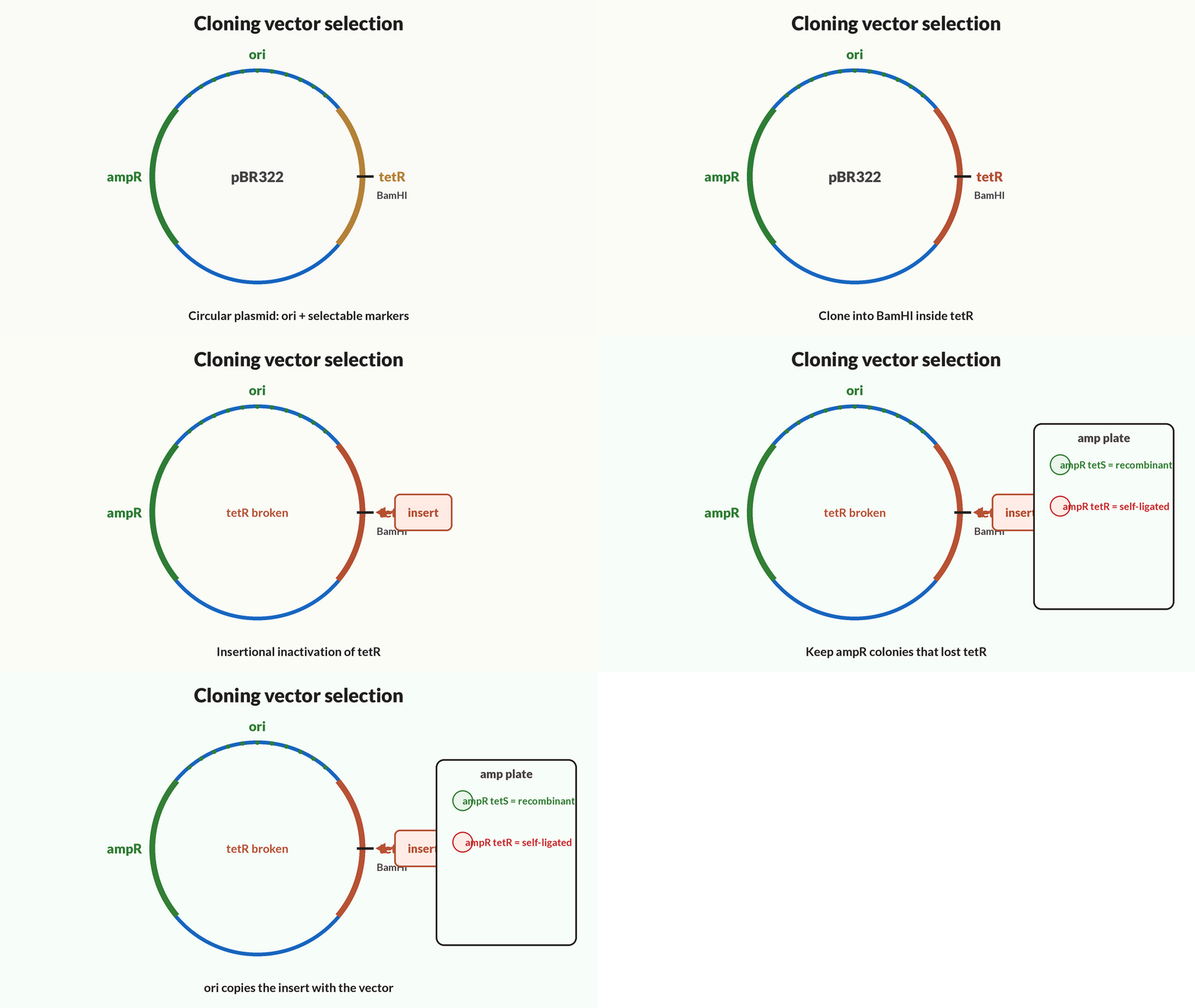
Selecting a BamHI insert in pBR322
- Ligate into tetROpen pBR322 at BamHI inside the tetracycline-resistance gene and insert the foreign fragment.
- Select transformantsPlate on ampicillin: only cells that took up a plasmid (ampR intact) form colonies.
- Screen recombinantsReplica-plate onto tetracycline: recombinants fail (tetR interrupted); non-recombinants grow on both.
| Feature | Job | pBR322 example |
|---|---|---|
| ori | Autonomous replication of vector + insert | ori; rop aids copy control |
| Selectable marker | Kill or mark cells that lack the vector | ampR, tetR |
| Cloning site | Where restriction enzymes open the vector | BamHI inside tetR; EcoRI, HindIII, SalI… |
| Plant delivery | Move T-DNA into plant cells | Disarmed Ti plasmid of Agrobacterium |
After ligating an insert into the BamHI site of pBR322, a colony grows on ampicillin but dies on tetracycline. The honest reading is
- The cell never took up any plasmid
- The cell carries a recombinant plasmid: ampR works, tetR was interrupted by the insert
- The cell carries an empty pBR322 that spontaneously lost tetR
Growth on ampicillin means ampR is present and expressed, so a plasmid entered the cell. Failure on tetracycline is exactly what insertional inactivation of tetR predicts when BamHI cuts inside that gene. An empty pBR322 would still be tetR and would grow on both antibiotics; no plasmid at all would die on ampicillin.
3The recombinant DNA pipeline
Recombinant DNA technology is one ordered pipeline, not a bag of separate tricks. Isolate DNA from the source and from the vector in pure form. Cut both with the same restriction enzyme and check the fragments on an agarose gel — DNA is negatively charged, so fragments run toward the anode and separate by size. Ligate the gene of interest into the opened vector. Introduce the recombinant molecule into a competent host, then select transformants with the vector's selectable marker. Finally express the foreign gene so the host makes the desired recombinant protein, scaled up from a flask to a bioreactor when production demands it.
Every later application in this chapter — a Cry protein in cotton, an insulin chain in E. coli, an ADA cDNA in a lymphocyte — is this same pipeline aimed at a different product. Miss the 'same enzyme on both pieces' step and ligation fails; miss selection and you culture mostly empty cells.
Figure. Left-to-right pipeline only — not a scale drawing of any molecule. The two annotations name the failure points: unmatched cuts before ligase, and plating without a selectable marker after transformation.
Order of operations
- IsolateExtract and purify DNA from the donor organism and from the vector.
- Cut and checkDigest with the chosen restriction enzyme; confirm fragment sizes by agarose gel electrophoresis toward the anode.
- LigateMix insert and cut vector with DNA ligase to form recombinant DNA.
- Transform and expressIntroduce into a competent host, select transformants, then induce expression of the recombinant protein.
A ligation mixture is transformed into E. coli and plated without antibiotic. Lawns of colonies appear, but almost none carry the insert. What was skipped?
- Gel electrophoresis of the restriction digest
- Selection with the vector's antibiotic-resistance marker
- Denaturation of the DNA before ligation
Without antibiotic, untransformed cells grow freely and drown out the rare transformants. The selectable marker exists precisely so only cells that took up a plasmid survive. Checking the digest on a gel is useful quality control but does not replace selection, and ligation does not require a denaturation step.
4PCR: denature, anneal, extend
The polymerase chain reaction amplifies a chosen DNA segment in vitro without cloning it into a living cell first. Two chemically synthesised primers flank the region of interest. Each cycle has three steps: the double helix is denatured by heat into single strands; the temperature is lowered so primers anneal to their complementary ends; a DNA polymerase then extends the primers, copying the flanked stretch. Repeat the cycle and every newly made strand becomes a template for the next round.
The polymerase must survive the denaturation heat. Taq polymerase from the thermophile Thermus aquaticus stays active through those high-temperature steps, which is why PCR can be automated on a thermal cycler. NCERT notes that repeated cycling can amplify a segment about a billion-fold — enough that the product can be ligated into a vector for cloning, or used directly to detect a scarce pathogen sequence.
Figure. Three steps in a row, return arrow outside the boxes — a rectangular cycle, not a curved ring. Temperatures are omitted; NCERT names the steps, not a required °C table.
One PCR cycle
- DenatureHeat separates the template into two single strands.
- AnnealCool so each primer binds its complementary flanking sequence.
- ExtendTaq polymerase extends the primers, copying the target; the products feed the next cycle.
Doubling per cycle
Start with one double-stranded template molecule. Assuming every cycle doubles the number of double-stranded copies of the amplicon, how many molecules are present after 5 complete cycles? After n cycles?
- after 1 cycle2 molecules
- after 2 cycles4 = 2^2
- after 5 cycles2^5 = 32
- after n cycles2^n
- check: 2^{30}~1.07×10^9 (order of NCERT's 'billion')
Pro tip. Early cycles are not perfectly efficient in a real tube, but the exam model is geometric doubling — so 'billion-fold' is the same claim as roughly thirty ideal cycles.
A PCR protocol uses a polymerase that denatures irreversibly at the temperature needed to separate DNA strands. Amplification fails after the first cycle because
- Primers cannot bind single-stranded DNA
- There is no enzyme left to extend primers in later cycles
- Ligase is required to join Okazaki fragments between cycles
Denaturation is repeated every cycle, so the polymerase itself must tolerate that heat — which is why Taq from Thermus aquaticus is used. Primers are chosen exactly so they can bind single strands after denaturation. PCR extension is continuous from each primer; it is not an Okazaki-fragment ligation process.
5Bt cotton: protoxin to activated Cry toxin
Bacillus thuringiensis (Bt) produces crystal proteins during sporulation that are toxic to certain insect larvae. The crystals hold inactive protoxins. In the bacterium itself nothing happens; the toxin stays inert. When a susceptible larva eats plant tissue that expresses the Cry protein, the alkaline midgut solubilises the crystals and activates the toxin. The active form binds gut epithelial cells, punches pores, and the larva dies.
That pH gate is why the same protein is harmless in a human stomach — acidic, not alkaline. Specific cry genes target specific pests: cryIAc and cryIIAb against cotton bollworms, cryIAb against corn borer. Bt cotton is a plant carrying one or more of those genes so it makes its own bio-pesticide in the tissue the bollworm eats.
Figure. Pathway of activation, not anatomy of a cotton boll. The alkaline-gut arrow is the load-bearing step that keeps the same protein inert in Bt and lethal in the larva.
Why the larva dies and the bacterium does not
- Protoxin storedBt (or a Bt crop) presents Cry protein as an inactive protoxin crystal.
- Alkaline activationThe insect midgut's alkaline pH solubilises the crystal and converts protoxin to active toxin.
- Gut perforationActive toxin pores the midgut epithelium; the larva stops feeding and dies.
| Gene | Crop context | Insects controlled |
|---|---|---|
| cryIAc | Bt cotton | Cotton bollworms |
| cryIIAb | Bt cotton | Cotton bollworms |
| cryIAb | Bt corn / related | Corn borer |
A student argues Bt cotton must be toxic to humans because it contains a bacterial toxin gene. The argument fails because
- Humans lack midgut receptors and an alkaline gut that activates the protoxin
- cry genes are removed from the plant before harvest
- The toxin is only produced in roots, never in the boll
Activation needs the alkaline insect midgut; a human stomach is acidic and does not run that conversion, and the toxin is insect-group specific. The cry gene remains in the plant tissues that express it — that is the point of Bt cotton — and expression is not confined to roots.
6RNAi protection against root-knot nematode
Meloidogyne incognita is a root-knot nematode that parasitises tobacco roots and cuts yield. The defence NCERT develops is RNA interference (RNAi): a cellular silencing pathway in which a complementary double-stranded RNA binds a matching mRNA and blocks its translation. Using Agrobacterium vectors, nematode-specific gene sequences are introduced so the plant cell makes both sense and antisense RNA of that target. The two complementary strands form dsRNA, RNAi fires, and the nematode's matching mRNA is silenced.
The parasite cannot survive on a host that is expressing that interfering RNA, so the transgenic plant protects itself. The same Agrobacterium delivery toolkit from the vectors concept is aimed here at a silencing trigger rather than at a Cry protein.
Figure. Mechanism boxes only — not root anatomy. Protection requires both transcripts so dsRNA can form; one strand alone does not start this RNAi trigger.
How the plant silences the nematode
- Deliver nematode DNAAgrobacterium vectors carry nematode-specific sequences into the tobacco cells.
- Make both strandsThe insert is arranged so sense and antisense RNA are both transcribed.
- Form dsRNAComplementary transcripts anneal to double-stranded RNA and trigger RNAi.
- Silence and protectThe matching nematode mRNA is silenced; the parasite cannot sustain itself on the transgenic host.
A tobacco line produces only the sense transcript of a nematode gene, never the antisense. RNAi-based resistance is expected to fail because
- Agrobacterium cannot infect tobacco
- dsRNA never forms, so the silencing trigger is missing
- Sense RNA alone poisons the plant's own ribosomes
RNAi here starts from dsRNA made by annealing sense to antisense. Sense alone leaves no double strand to initiate silencing of the nematode mRNA. Agrobacterium is the delivery vector NCERT uses for this strategy, and the sense transcript is not described as a general plant poison.
7Recombinant human insulin
Mature insulin is two short peptide chains, A and B, joined by disulphide bridges. In humans it is first made as a prohormone that also carries a C peptide; maturation cuts C out and leaves the A–B hormone. Animal insulin from slaughtered cattle or pigs worked but could provoke immune reactions. Recombinant production aims at human sequence made in microbes instead.
The hard step was not spelling the gene — it was assembling mature insulin. In 1983 Eli Lilly put separate DNA sequences for the A and B chains into E. coli plasmids, grew the chains apart, then joined them by forming the disulphide bonds. C peptide never appears in that bacterial route; the mature structure is built by combining purified chains. The product matches human insulin without an animal pancreas.
Figure. Schema of domain order, not atomic coordinates. C peptide is present in the prohormone and absent from mature A–B insulin held by disulphide bridges.
From prohormone logic to E. coli chains
- Native pathHuman β-cells make proinsulin (A–C–B); C is removed during maturation to A–B insulin.
- Separate chainsSynthetic A-chain and B-chain coding sequences are expressed separately in E. coli.
- Disulphide joinPurified A and B chains are combined by forming disulphide bridges to yield mature human insulin.
Why was producing insulin in E. coli harder than simply cloning 'the insulin gene' as one open reading frame?
- E. coli cannot form peptide bonds
- Mature insulin is two chains linked by disulphides after C peptide is removed — the assembly, not the coding alphabet, was the bottleneck
- Insulin must be glycosylated, and bacteria never glycosylate
NCERT's point is maturation: proinsulin carries C peptide that mature insulin lacks, and the functional hormone is an A–B disulphide assembly. Eli Lilly therefore made the chains separately and joined them. Peptide-bond formation is ordinary translation, and the textbook account here is about chain assembly, not glycosylation.
8ADA gene therapy and early molecular diagnosis
Gene therapy delivers a functional gene into cells to compensate for a defective one. The first clinical case, in 1990, treated a four-year-old with adenosine deaminase (ADA) deficiency — a deletion that cripples immune function. Lymphocytes were cultured, a functional ADA cDNA was inserted with a retroviral vector, and the cells were returned to the patient. Because lymphocytes are not immortal, infusions must be repeated; introducing the gene into early embryonic cells would be required for a permanent fix. Bone marrow transplant and enzyme replacement help some children but are not completely curative.
Early diagnosis needs more than waiting for symptoms. PCR can amplify pathogen nucleic acid when titres are still tiny — including HIV in suspected AIDS cases — and can flag gene mutations in suspected cancer. ELISA detects antigen or antibody by antigen–antibody binding. A radioactive nucleic-acid probe can hybridise to a clone and reveal a matching sequence by autoradiography; a mutated target that no longer matches the probe stays blank on the film.
Figure. Clinical sequence for the 1990 lymphocyte protocol, not a drawing of a retrovirus. The top note is the exam-critical limit: temporary correction unless the gene is placed in lasting stem or embryonic cells.
First clinical ADA protocol
- CultureGrow the patient's lymphocytes outside the body.
- Insert ADA cDNAUse a retroviral vector to deliver functional ADA cDNA into those cells.
- Return cellsInfuse the corrected lymphocytes; repeat periodically because the cells do not last forever.
| Method | What it senses | NEET-facing use |
|---|---|---|
| PCR | Pathogen or mutant nucleic acid at low copy number | HIV; gene mutations |
| ELISA | Antigen or antibody via immune binding | Infection status |
| Probe + autoradiography | Sequence complementarity to a labelled probe | Clone with matching vs mutated gene |
A child with ADA deficiency receives genetically corrected lymphocytes and improves, then worsens months later without further infusions. The pattern fits because
- The retroviral vector permanently edits every cell in the bone marrow on first contact
- Corrected lymphocytes die out over time, so the functional ADA gene is lost unless infusions are repeated
- ELISA removes the ADA protein from blood between visits
NCERT's limitation on this protocol is exactly that lymphocytes are not immortal, so periodic infusion is required. A one-time lymphocyte treatment does not equal germline or early-embryo correction. ELISA is a diagnostic assay, not a therapy that clears ADA.
Notes
- Recombinant DNA technology cuts DNA with restriction endonucleases (molecular scissors), joins it with DNA ligase, inserts it into a vector (plasmid) and clones it in a host cell.
- Key tools are restriction enzymes (which recognise palindromic sequences), vectors (plasmids such as pBR322) and host cells (*E. coli*, and *Agrobacterium* for plants).
- PCR (polymerase chain reaction) amplifies DNA using primers and heat-stable Taq polymerase through repeated denaturation, annealing and extension cycles.
- Agricultural applications include Bt cotton (a *Bacillus thuringiensis* toxin gene for pest resistance), Golden Rice (enriched in provitamin A) and RNAi for nematode resistance.
- Medical applications include recombinant insulin (Humulin), gene therapy (for ADA deficiency) and molecular diagnostics such as ELISA and PCR for early detection.
Formulas
- PCR steps: denaturation (~94 °C) → annealing (~55 °C) → extension (~72 °C, Taq polymerase)
- Restriction enzymes cut palindromic sequences leaving sticky ends
- First recombinant protein drug: human insulin (Humulin, 1982)
- Bt toxin (Cry proteins) from *Bacillus thuringiensis* kills insect larvae
- Ti plasmid of *Agrobacterium tumefaciens* is a natural plant genetic engineer
Exam traps & shortcuts
- Restriction enzymes are named for their source organism: EcoRI comes from *E. coli* strain R, first enzyme isolated.
- Sticky (staggered) ends allow complementary base pairing during ligation of DNA fragments.
- Bt toxin exists as an inactive protoxin in the bacterium and is activated by the alkaline pH of the insect gut.
Reference tables
One recombinant toolkit, several products. Golden rice is NCERT's named example of nutritional enhancement (Vitamin A–enriched rice); GEAC is the Indian clearance body for genetic-engineering proposals.
| Application | What was engineered | Payoff |
|---|---|---|
| Bt cotton | cry genes from Bacillus thuringiensis | Bollworm-resistant cotton tissue |
| RNAi tobacco | Nematode-specific sense + antisense RNA | Root-knot nematode silenced |
| Golden rice | Vitamin A enrichment pathway | Nutritionally enhanced rice |
| Humulin | A and B chains in E. coli | Human insulin without animal pancreas |
| ADA therapy | Functional ADA cDNA in lymphocytes | Temporary immune correction |
| PCR / ELISA | Amplification or antigen–antibody read-out | Early pathogen or mutation detection |
Recap
Read only this the night before.
- Same enzyme
- Cut insert and vector with the same restriction enzyme so sticky ends match; ligase seals the nick.
- Palindrome
- Recognition sites read the same 5'→3' on both strands. EcoRI: GAATTC. Offset cuts leave sticky ends.
- pBR322 screen
- BamHI insert into tetR: grow on amp, die on tet. Empty plasmid grows on both. No plasmid dies on amp.
- PCR
- Denature → anneal primers → extend with Taq. Each cycle can double copies: about 2^n after n ideal cycles.
- Bt gate
- Cry protein is an inactive protoxin until the alkaline insect midgut activates it. Acidic human stomach does not.
- cry names
- cryIAc and cryIIAb: cotton bollworms. cryIAb: corn borer.
- RNAi
- Plant makes sense and antisense of a nematode gene → dsRNA → silences the parasite's mRNA.
- Insulin
- Mature hormone is A–B with disulphides; C peptide is removed from proinsulin. Lilly made A and B separately in E. coli (1983).
- ADA
- 1990 lymphocyte protocol needs repeat infusions. Permanent cure would need earlier stem or embryonic correction.
Practise Biotechnology and Its Applications
Reading is free and needs no account. Practice, mocks and progress live in the app.
- 5 exam-style questions on this topic, with explanations
- A 5-question practice set that ends the chapter
- Timed mocks scored with the real marking scheme
- Readiness tracked per topic, kept on your device