RRB NTPC (Railways) · General Intelligence & Reasoning
Venn Diagrams
Representing relationships between groups and solving set-based logical questions using diagrams.
A Venn question is two jobs in one picture. First decide how the named groups sit in the real world — subset, overlap, or disjoint — by asking whether one real item can wear two labels at once. Then, when the stem gives counts, fill the patches of the circular picture from the centre out: the all-three cell, then each exactly-two lens, then each only-one petal, then neither. The exam draws circles; the load-bearing skill is the relation test plus that fill order, not shading a pretty diagram.
- RRB NTPC (Railways)
- Easy level
- 6 concepts
- 45 practice questions
1Ask whether one item can belong to both
Every class-relationship question collapses to one test: can a single real item sit in two of the named groups at once? Yes means the circles must overlap; no means they stay separate. Containment is the third answer — when every member of A is already a member of B, A lies entirely inside B rather than beside it. Pick a concrete person or object and try the labels on it: a mother who is a doctor, a wooden chair, a male engineer.
The trap is inventing an overlap from the shapes in the options instead of from the world. Doctors and engineers can both be women, so those circles may cross the Women circle; a table and a chair are never the same object, so those two stay disjoint even though both sit inside Furniture. Teachers, Males, Females is the same test twice: a teacher can be male or female (overlap), and no person is both male and female (disjoint). Lock each pair by membership, not by how the option booklet drew its circles.
Figure. The exam draws circles; this graph carries the same three answers without pretending to be a Venn. Solid subset, dashed may-overlap, and a disjoint edge are the only relations the best-fit questions ever need.
How it works
- Name a concrete itemPick one real person or object that could wear the labels — a mother who is a doctor, a wooden chair, a male engineer. Abstract circle-talk without an item is how invented overlaps sneak in.
- Test pairwise membershipFor each pair of labels, ask whether that item can carry both at once. Yes → overlap; no → separate circles. A teacher can be male: overlap. A male cannot be female: disjoint.
- Check full containmentIf every A is necessarily a B (every mother is female), draw A inside B before you touch the overlapping categories. Subset is not a polite overlap; it is a forced nest.
| Relation | Test | Picture the exam wants |
|---|---|---|
| Subset | Every A is a B | A entirely inside B |
| Overlap | Some item can be both A and B | Circles cross; shared lens exists |
| Disjoint | No item can be both | Separate circles, no shared region |
For the terms Teachers, Males, Females, which relation is forced?
- Males and Females overlap; Teachers may cross both
- Males and Females are disjoint; Teachers may overlap either
- Teachers sit inside Males; Females is separate
No person is both male and female, so those two circles never share a region. A teacher can be either, so the Teachers circle may cross each of them. Option A invents a male–female overlap the world forbids; option C forces every teacher to be male.
2Fix definite subsets, then add overlaps
Best-fit diagram questions give three terms and ask which picture matches the real world. Lock every forced containment first — all mothers are females — then place independent categories as circles that may cross those regions. Do not force a doctor to be a mother, and do not force a mother to be a doctor. For Females, Mothers, Doctors the Mothers circle lies entirely inside Females. Doctors is a separate circle that overlaps Females and can therefore reach the Mothers lens inside it, but need not.
That 'can, but need not' is the whole independence. A doctor may be male, so Doctors is not nested inside Females. A mother may not be a doctor, so Mothers is not nested inside Doctors. Because Doctors crosses Females, some of that overlap can sit on the Mothers region — a mother-doctor is possible — without requiring every mother to be a doctor. Force the subset, treat Doctors as free to cross, and allow the Mothers lens as possible rather than required.
Figure. Forced skeleton only: Mothers inside Females, Doctors free to cross Females. The exam's overlapping circles are the same claim drawn with arcs the vocabulary cannot make.
Order of attack
- Force the subsetAll mothers are females, so Mothers sits entirely inside Females. That nest is not optional and is not an overlap you might skip.
- Treat Doctors as independentA doctor may or may not be female, and a female or mother may or may not be a doctor — so Doctors overlaps Females rather than nesting inside or outside it.
- Allow the Mothers lensBecause Doctors crosses Females, it can also cover part of the Mothers region inside Females; that overlap is possible, not required for every mother.
Which statement must be true of the best diagram for Females, Mothers, Doctors?
- Every doctor is drawn inside Mothers
- Mothers lies entirely inside Females; Doctors overlaps Females
- Mothers, Females and Doctors are three mutually separate circles
Mothers ⊂ Females is forced. Doctors is independent of both sex and parenthood, so it overlaps Females (and may reach Mothers) rather than nesting inside Mothers or sitting apart from both.
3Two-set union, then neither
When the stem gives two group sizes and their overlap, the union is |A\cup B| = |A| + |B| - |A\cap B|. Subtracting the intersection once is what stops the both-region being counted twice. In a class of 40, 25 play cricket, 20 play football, and 8 play both: |C\cup F| = 25 + 20 - 8 = 37. Neither is then the universal total minus that union: 40 - 37 = 3.
The same arithmetic splits the picture into named patches if you need them: only cricket is 25 - 8 = 17, only football is 20 - 8 = 12, both is the given 8, and those three plus neither (3) rebuild the 40. Work the arithmetic before you trust a sketched diagram: the numbers decide the regions; the picture only labels them. Adding 25 and 20 without subtracting 8 would count the 8 twice and invent a union of 45, which cannot fit in a class of 40.
Figure. Union is |A| + |B| - |A and B|. The intersection is subtracted once so the overlap is not counted twice.
How it works
- Form the unionAdd the two set sizes and subtract the both-count once. 25 + 20 − 8 = 37 is the number who play at least one of the two sports.
- Subtract from the totalNeither = universal total − |A\cup B|. Here 40 − 37 = 3 people play neither cricket nor football.
- Optional region splitOnly A = |A| - |A\cap B|; only B = |B| - |A\cap B|; both = the given intersection. Only cricket 17, only football 12, both 8, neither 3 rebuild the class of 40.
Neither sport in a class of 40
In a class of 40, 25 play cricket, 20 play football, and 8 play both. How many play neither?
- |C\cup F| = |C| + |F| - |C\cap F| = 25 + 20 - 837
- Neither = total − union = 40 - 373
Pro tip. Subtract the both-count once via inclusion-exclusion before subtracting the union from the total — that is the whole path to the neither region.
In a group of 50, 30 like tea, 25 like coffee, and 10 like both. How many like neither?
- 5
- 15
- 20
Union = 30 + 25 - 10 = 45; neither = 50 - 45 = 5. 15 is the coffee-only region mistaken for neither; 20 forgets to subtract the overlap and computes 50 - (30+25-0) style errors.
4Fill three-set counts from the centre out
A numerical three-set stem hands you totals for single sets and for intersections. The safe fill order is the centre first: write |A\cap B\cap C| in the triple-overlap, then peel each pairwise intersection by subtracting that centre so the pairwise lens holds only the exactly-two count, then peel each single set down to its only-A / only-B / only-C region. Filling an only-set first with a set total is the classic error — that total still includes the lenses and the centre.
A worked fill, using one consistent figure. Centre |A\cap B\cap C| = 5. Pairwise totals |A\cap B| = 12, |A\cap C| = 7, |B\cap C| = 7, so the exactly-two lenses are 12-5=7, 7-5=2, 7-5=2. Set totals |A|=18, |B|=20, |C|=12 then peel to only-A =18-12-7+5=4, only-B =20-12-7+5=6, only-C =12-7-7+5=3. The same peel is the quick identity |A\cap B| - |A\cap B\cap C|: if you are given 11 and 4, the region 'A and B but not C' is 7.
Inclusion-exclusion cross-checks the finished diagram: |A\cup B\cup C| = |A|+|B|+|C| - |A\cap B| - |B\cap C| - |C\cap A| + |A\cap B\cap C|. Here 18+20+12 - 12 - 7 - 7 + 5 = 29. If that union disagrees with the universal total minus neither, a region was double-counted. Sum every filled region (4+6+3+7+2+2+5=29) and compare.
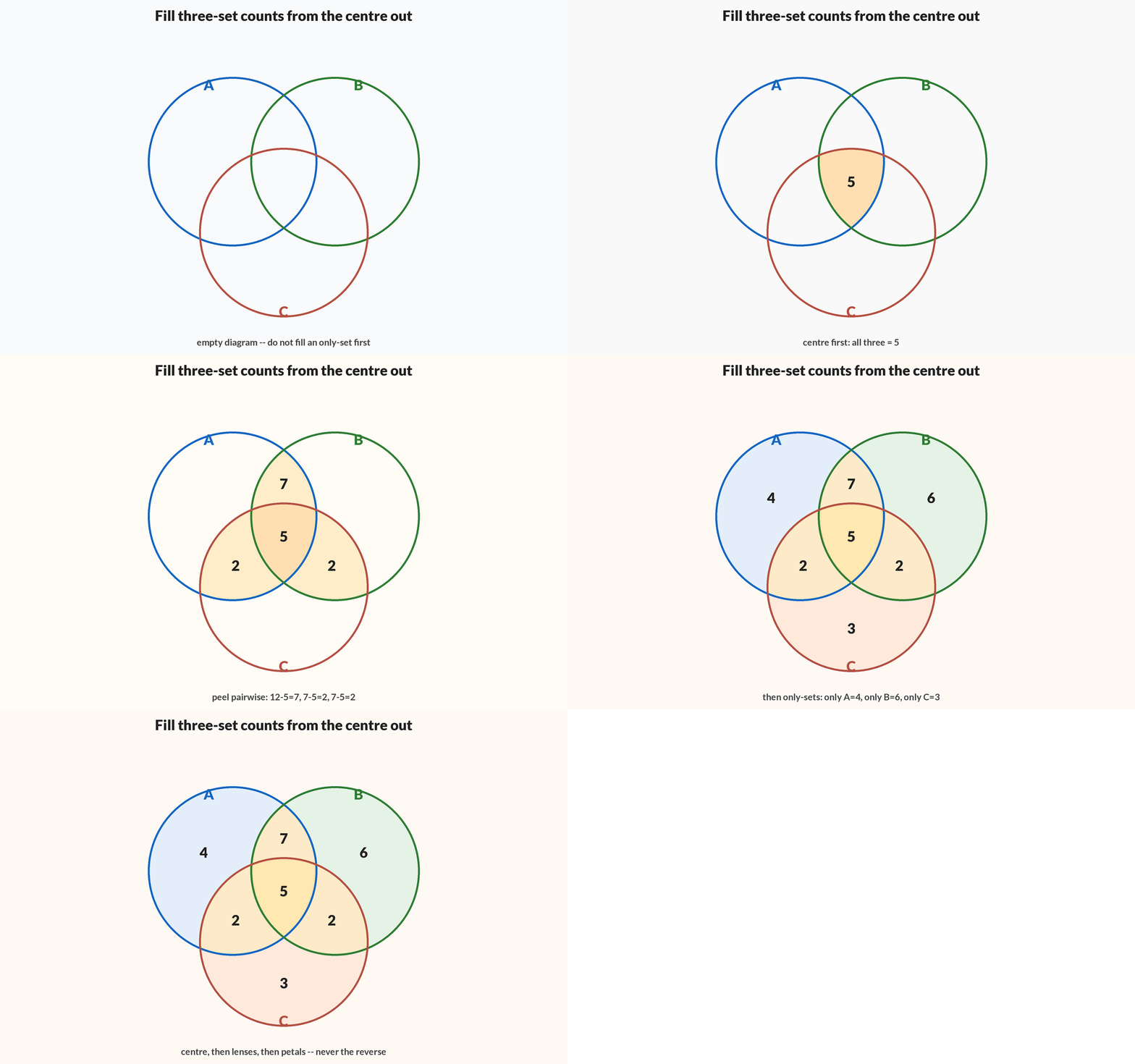
Fill order
- CentrePlace the all-three count in the middle region first. Here that count is 5. Nothing else is filled until this cell is written.
- Pairwise lensesEach exactly-two region is that pairwise intersection minus the centre. |A\cap B|=12 minus 5 leaves 7 in 'A and B but not C'; the other two lenses peel to 2 and 2.
- Only-one petalsOnly A = |A| minus both pairwise lenses that touch A minus the centre (equivalently |A| - |A\cap B| - |A\cap C| + |A\cap B\cap C|). Here only A is 18 − 12 − 7 + 5 = 4.
- Cross-checkSum every filled region and compare with inclusion-exclusion against the given universal total. 4+6+3+7+2+2+5 = 29, matching 18+20+12-12-7-7+5.
| Region | In set language | Fill from |
|---|---|---|
| All three | |A\cap B\cap C| | Given centre count |
| A and B, not C | |A\cap B| - |A\cap B\cap C| | Pairwise minus centre |
| Only A | |A| - |A\cap B| - |A\cap C| + |A\cap B\cap C| | Set total minus shared parts |
| Exactly two (any pair) | Sum of pairwise − 3|A\cap B\cap C| | After all three pairwise lenses |
| Neither | Universal − |A\cup B\cup C| | After the union is known |
You are given |A\cap B\cap C| = 4 and |A\cap B| = 11. The region "A and B but not C" should be filled with
- 15
- 7
- 4
The pairwise total 11 already includes the centre 4, so the exactly-two lens is 11 - 4 = 7. Adding them (15) double-counts the centre; writing 4 copies the centre into the wrong region.
5Name the region before you read its value
Each distinct patch of a Venn answers one English question: only A, A and B but not C, all three, neither. Misreading the stem as the wrong patch is a more common error than arithmetic. Label the patch in words first, then look up or compute its count. On the filled figure from the centre-out concept, 'only A' is the petal 4, 'A and B but not C' is the lens 7, and 'all three' is the centre 5 — three different English questions, three different numbers.
"A and B" in a three-set stem is ambiguous until you know whether C is allowed in — it may mean the full pairwise intersection (including the centre) or the exactly-two lens. The stem's "only" / "but not" wording is the decider. If the stem says "A and B" with no "only" / "not C", it usually wants the full |A\cap B| including those who are also in C (12 on that figure, not 7). Speak the patch before grabbing a number from the stem.
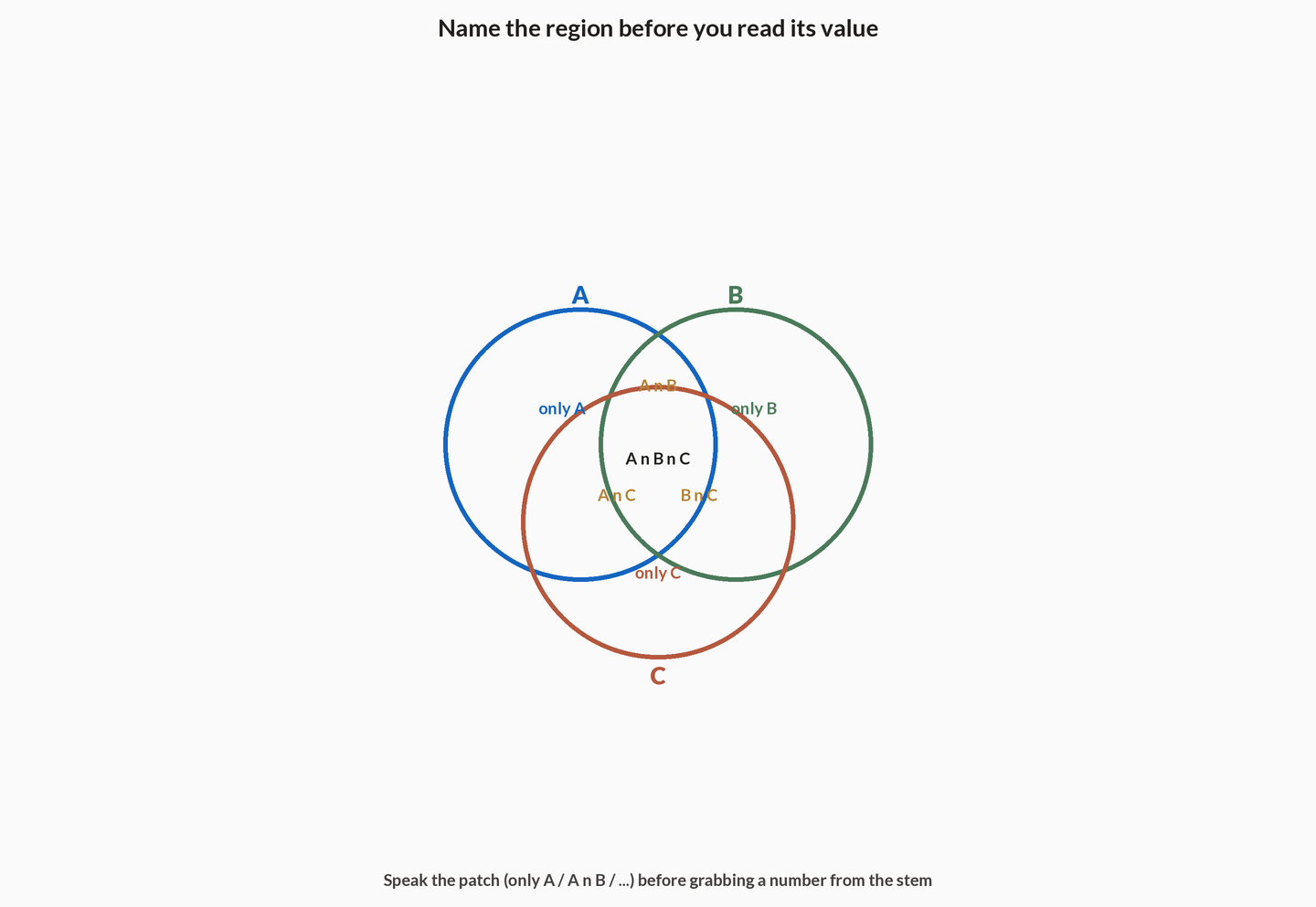
How it works
- Translate the stemRewrite "only A", "both but not the third", "all three", or "neither" onto one named patch. 'A and B but not C' is the exactly-two lens, not the centre and not the full pairwise total.
- Check "and" vs "only"If the stem says "A and B" with no "only" / "not C", it usually wants the full |A\cap B| including those who are also in C. On the filled figure that is 12, not the lens 7.
- Then take the numberRead the count from the filled diagram or from the matching identity in the region table. Naming first, number second — never the reverse, even when the number is sitting in the picture.
In a three-set Venn, the phrase "A and B but not C" names which patch?
- The full pairwise intersection |A\cap B|, including the centre
- The lens shared by A and B that excludes the all-three centre
- The only-A petal
"But not C" strips the centre out of |A\cap B|, leaving the exactly-two lens. The full pairwise intersection is what "A and B" means when C is not excluded; the only-A petal excludes B as well as C.
6Subsets need not overlap each other
A common trap is assuming every pair of categories overlaps. Real-world mutual exclusion still applies inside a shared parent: Table and Chair are both Furniture, yet no object is a table and a chair at once, so those two circles sit separate inside the Furniture circle. Containment under a parent never invents a sibling overlap. The same pattern appears with Fathers and Mothers inside Parents, or with Odd numbers and Even numbers inside Integers.
Place the parent first — Furniture is the outer set that can hold the others. Test the siblings with the same membership question as the opening concept: can one object be both a table and a chair? No. Nest both sibling circles inside the parent with empty intersection. A picture that lets Table and Chair cross inside Furniture has invented an object the world does not contain.
Figure. Two subset edges into Furniture and a disjoint edge between Table and Chair — the trap of inventing a sibling overlap has nowhere to hide.
How it works
- Place the parentFurniture (or Parents, or Integers) is the outer set that can hold the others. Both siblings will sit inside it; that is the nest, not the overlap.
- Test the siblingsAsk whether one object can be both siblings at once. Table and chair: no — keep them disjoint. Fathers and mothers: no. Odd and even: no.
- Nest without crossingDraw both sibling circles inside the parent with empty intersection. Subset into Furniture plus disjoint between Table and Chair is the whole diagram.
Which diagram matches Table, Chair, Furniture?
- Three pairwise-overlapping circles of equal status
- Table and Chair as separate circles, both inside Furniture
- Table inside Chair inside Furniture
Every table and every chair is furniture, but nothing is both a table and a chair, so the two child circles are disjoint subsets of Furniture. Equal-status overlaps invent a table-chair hybrid; nesting Table inside Chair claims every table is a chair.
Notes
- Class-Relationship Venn: Represent categories as circles based on real-world containment. e.g. 'Doctors, Women, Engineers' - doctors and engineers can overlap with women but usually not with each other unless stated.
- Best-Fit Diagram Questions: Choose the diagram that correctly shows how three given terms relate (all separate, one inside another, or partial overlap). Ask 'can an item belong to two of these at once?' to decide overlaps.
- Numerical Venn (Two/Three Sets): Fill region counts from the innermost intersection outward, subtracting overlaps so each region is counted once. Use the inclusion-exclusion principle for totals.
- Interpreting Regions: Each distinct region answers a specific 'only A', 'A and B but not C', or 'all three' question; label them before reading values.
- Common trap: Assuming two categories overlap when the real-world relationship makes them mutually exclusive (e.g. 'Table, Chair, Furniture' - table and chair are separate subsets of furniture, they do not overlap each other).
Formulas
- Two sets: |A\cup B| = |A| + |B| - |A\cap B|.
- Three sets: |A\cup B\cup C| = |A|+|B|+|C| - |A\cap B| - |B\cap C| - |C\cap A| + |A\cap B\cap C|.
- 'Only A' = |A| - |A\cap B| - |A\cap C| + |A\cap B\cap C|.
- Exactly two sets = (\text{sum of pairwise intersections}) - 3\times|A\cap B\cap C|.
- Neither region = universal total - |A\cup B\cup C|.
Exam traps & shortcuts
- Ask 'can one thing be in two groups simultaneously?' - yes means overlap, no means separate circles.
- For number problems, always start filling from the central (all-three) region and work outward.
- For 'best diagram' questions, sketch the real-world containment (subset vs overlap vs disjoint) before matching options.
- Use inclusion-exclusion to cross-check the total against the given universal count.
Reference tables
The identities the numerical stems actually use. Recompute the union before you trust a neither count.
| Claim | Identity |
|---|---|
| Two-set union | |A\cup B| = |A| + |B| - |A\cap B| |
| Three-set union | |A\cup B\cup C| = |A|+|B|+|C| - |A\cap B| - |B\cap C| - |C\cap A| + |A\cap B\cap C| |
| Only A (three sets) | |A| - |A\cap B| - |A\cap C| + |A\cap B\cap C| |
| Exactly two (any pairs) | Sum of pairwise intersections -\, 3|A\cap B\cap C| |
| Neither | Universal total -\, |A\cup B\cup C| |
Recap
The night-before pegs.
- One-item test
- Can one real item wear two labels at once? Yes → overlap; no → separate; every A is B → subset.
- Subsets first
- Lock forced containment (Mothers inside Females) before placing independent overlapping categories (Doctors).
- Union then neither
- |A\cup B| = |A|+|B|-|A\cap B|; neither = total − union. Subtract the both-count once.
- Centre out
- Three-set fills start at all-three, then exactly-two lenses, then only-one petals; cross-check with inclusion-exclusion.
- Name the patch
- "A and B but not C" is the exactly-two lens, not the full pairwise intersection and not only-A.
- Sibling trap
- Two subsets of one parent can still be disjoint — Table and Chair inside Furniture do not overlap.
Practise Venn Diagrams
Reading is free and needs no account. Practice, mocks and progress live in the app.
- 45 exam-style questions on this topic, with explanations
- A 5-question practice set that ends the chapter
- Timed mocks scored with the real marking scheme
- Readiness tracked per topic, kept on your device