SBI PO · Quantitative Aptitude
Pipes & Cisterns
Filling and emptying of tanks by inlet and outlet pipes, an application of time and work.
Five concepts, and one reframe: a tank is a job, an inlet is a worker, and a leak or outlet is a worker who undoes the job. Signed rates plus the LCM capacity trick turn every pipes question into integer arithmetic.
- SBI PO
- Medium level
- 5 concepts
- 42 practice questions
1Inlets add, outlets subtract
A pipe that fills a tank in x hours does +\frac{1}{x} of the tank per hour. A pipe or leak that empties the same tank in y hours does -\frac{1}{y} per hour. There is no separate "emptying" logic — outlets are negative workers, and the net rate is just the sum of the signed rates.
The tank fills only when that sum is positive. If the outlet is as fast as the inlet, or faster, the net rate is zero or negative and the tank never fills, no matter how long you wait.
Figure. On a capacity of 30 units, the inlet contributes +3 units an hour and the outlet removes 2. The net bar is their algebraic sum, not a third pipe — and because it sits above the dashed empty line, the tank fills. Swap the magnitudes so the outlet is -3 and the inlet +2, and the net bar flips below that line: same figure, opposite verdict.
How it works
- Write every rate with a signFill in x hours becomes +1/x per hour; empty in y hours becomes -1/y.
- Add the signed ratesHelpers and inlets add; drains and leaks subtract. One number remains.
- Invert only if the net is positiveTime to fill is 1 divided by the net rate. A zero or negative net means the tank does not fill.
One inlet against one outlet
A pipe fills a tank in 10 hours and another empties it in 15 hours. If both are open, how long does the tank take to fill?
- Capacity = LCM(10, 15)30 units
- Inlet = +30/10, outlet = −30/15+3 and −2 units/h
- Net rate = 3 − 2+1 unit/h
- Time = 30 ÷ 130 hours
Pro tip. The same answer falls out of the fractions: 1/10 - 1/15 = 1/30, so the tank fills in 30 hours. The LCM route is preferred only because larger problems stay in whole units — the sign rule is identical either way.
A pipe fills a tank in 8 hours and an outlet empties it in 12 hours. With both open, the tank fills in
- 24 hours
- 10 hours
- 4 hours
Net rate = 1/8 - 1/12 = 1/24, so the tank fills in 24 hours. Taking LCM(8,12)=24 gives inlet +3 and outlet -2, net +1, same answer. 10 averages the times and 4 subtracts them; both ignore that rates, not times, combine.
2Net fill time from one inlet and one outlet
When a single inlet of x hours runs against a single outlet of y hours and y > x, the net rate is \frac{1}{x}-\frac{1}{y} and the time to fill is \frac{xy}{y-x}. The denominator is the difference of the times, not their sum — swapping that sign is the standard wrong answer on this formula.
The condition y > x is not decoration. If the outlet is faster (y < x), the same expression goes negative and correctly reports that the tank is draining. Two filling pipes use the sibling formula \frac{xy}{x+y}, where the denominator adds because both rates are positive.
Figure. Concrete case of the fill formula xy/(y-x) with x=5, y=20: on a 20-unit tank the inlet adds 4 an hour and the outlet removes 1, so the net bar is +3 and the tank fills in 20/3 hours. The outlet bar sits below the dashed empty line because its rate is negative; if it were taller than the inlet the net would flip below that line and the tank would drain.
How it works
- Confirm the outlet is the slower pipeNeed y > x. Otherwise the tank drains and "time to fill" is the wrong question.
- Write \frac{xy}{y-x}Product of the two times over the outlet-minus-inlet difference.
- Cross-check with signed ratesNet = 1/x - 1/y; invert. The two routes must agree.
The formula you reach for depends on which pipe is faster — and on whether the second pipe fills or empties.
| Case | Net rate | Time to fill |
|---|---|---|
| Outlet slower (y > x) | 1/x - 1/y | xy/(y-x) |
| Outlet equal (y = x) | 0 | never fills |
| Outlet faster (y < x) | negative | drains, does not fill |
| Two inlets (x and y) | 1/x + 1/y | xy/(x+y) |
Fill against a leak
A pipe fills a tank in 5 hours, but a leak at the bottom empties it in 20 hours. With both open, how long does the tank take to fill?
- Formula: xy/(y − x) with x = 5, y = 20100/15
- 100/1520/3 hours
- Check: capacity LCM(5, 20) = 20; rates +4 and −1net +3 units/h
- Time = 20 ÷ 320/3 hours
Pro tip. 20/3 hours is 6 hours 40 minutes — write the improper fraction in the exam unless minutes are asked. The trap option \frac{xy}{x+y} = 4 hours treats the leak as a second inlet; that answer is faster than the inlet alone, which is impossible when something is draining.
A pipe fills a tank in 4 hours and a leak empties it in 12 hours. With both open, the tank fills in
- 6 hours
- 3 hours
- 8 hours
\frac{4 \times 12}{12-4} = \frac{48}{8} = 6 hours. 3 hours is \frac{xy}{x+y}, which would need two inlets rather than an inlet and a leak. 8 averages the times and exceeds the inlet's own 4 hours, so it fails on sight.
3Take capacity as the LCM of the pipe times
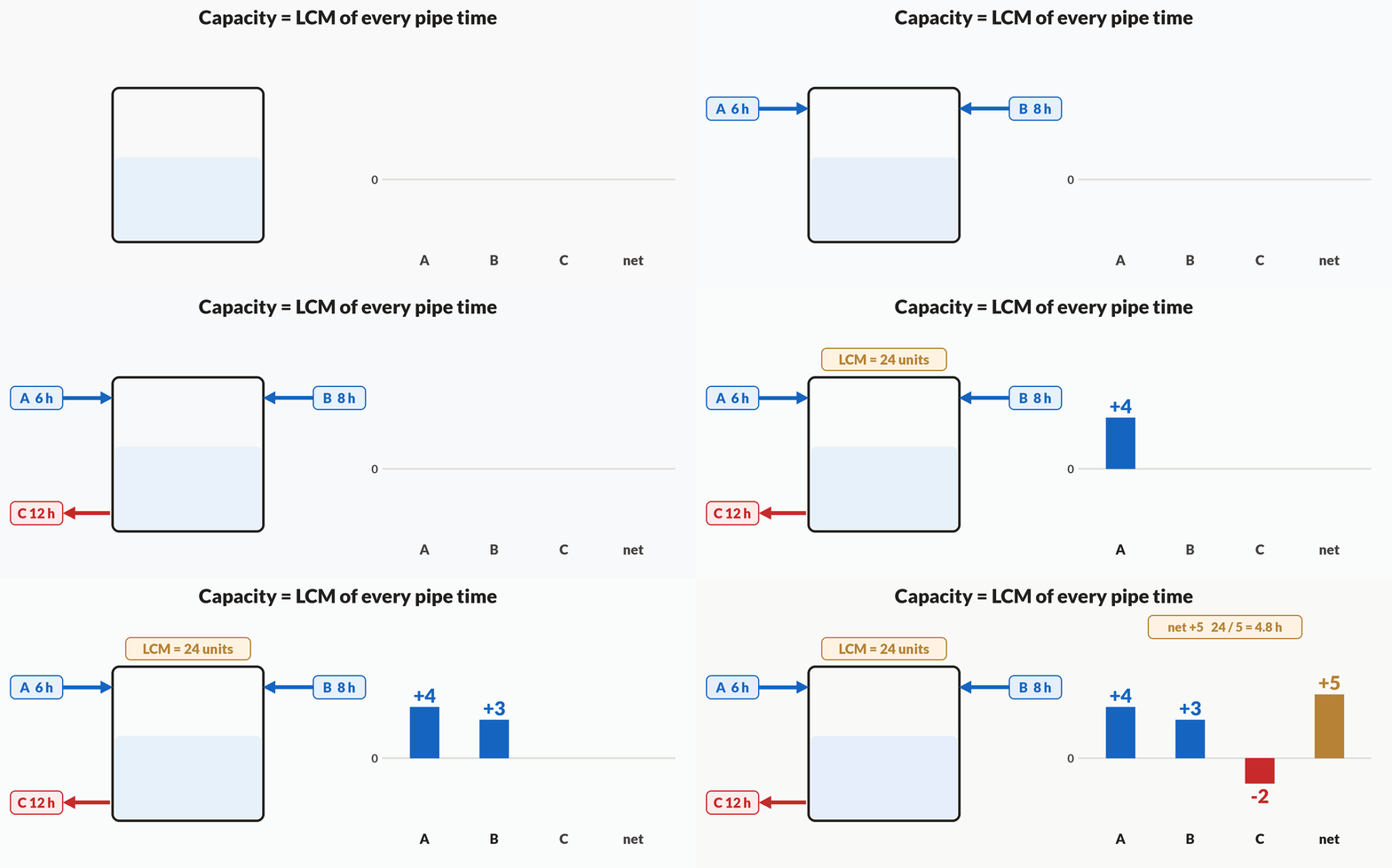
Fractions slow pipes problems the same way they slow ordinary work problems. Call the tank's capacity the LCM of every pipe's time — inlet and outlet alike — and each hourly flow becomes a whole number of units. Filling pipes get a positive integer; emptying pipes get a negative one.
The choice of capacity never appears in the answer, because you divide by the net rate at the end. What you gain is that two inlets and an outlet, or a pipe closed halfway, stay in integer units until that final division.
The LCM route
- Capacity = LCM of all timesInclude every inlet and every outlet mentioned in the question.
- Rate = ± capacity ÷ own timePlus for a filling pipe, minus for an emptying pipe or leak.
- Net, then divideAdd the signed rates; time is capacity divided by that net, provided the net is positive.
Two inlets and one outlet
Pipe A fills a tank in 6 hours and pipe B in 8 hours, while outlet C empties it in 12 hours. If all three are open together, how long does the tank take to fill?
- Capacity = LCM(6, 8, 12)24 units
- Rates: A = +24/6, B = +24/8, C = −24/12+4, +3, −2 units/h
- Net rate = 4 + 3 − 2+5 units/h
- Time = 24 ÷ 54.8 hours
Pro tip. Subtract the outlet's units from the inlets' units — a negative net means the tank never fills. Here 4.8 hours is less than A's own 6, which is the sanity check: two helpers against one drain must still beat the fastest inlet alone.
Pipes A and B fill a tank in 8 and 12 hours; outlet C empties it in 24 hours. All open together, the tank fills in
- 6 hours
- 4 hours
- 8 hours
Capacity LCM(8,12,24)=24: rates +3, +2, -1, net +4, time 24/4 = 6 hours. Forgetting to subtract C gives net 5 and 4.8, which is not among the options; treating C as an inlet gives net 6 and 4 hours — faster than A alone, and impossible with a drain open.
4Finding how long a leak takes to empty
If a pipe alone fills a tank in a hours, but with a leak the same fill takes b hours and b > a, the leak is the missing negative rate. Its emptying time for a full tank is \frac{ab}{b-a} hours — the same shape as the net-fill formula, read for the leak instead of for the tank.
The leak's rate is fill rate minus effective rate: \frac{1}{a}-\frac{1}{b}. Inverting that difference is exactly \frac{ab}{b-a}. Use the shortcut directly rather than setting up two rate equations from scratch every time.
Figure. On a 30-unit tank the clean inlet is +3 an hour and the slowed fill is only +2, so the leak is the missing -1. Inverting that rate empties 30 units in 30 hours — the same \frac{ab}{b-a} the ledger used. The figure's point is the subtraction of rates, not of times: the gap between the first two bars is the third bar's magnitude.
How it works
- Name a and ba is the clean fill time; b is the slowed fill time with the leak. Need b > a.
- Write \frac{ab}{b-a}That is the leak's time to empty a full tank on its own.
- Check with LCM unitsCapacity LCM(a,b); leak rate = clean rate − slowed rate; invert.
Finding a leak's emptying time
A pipe fills a tank in 10 hours, but due to a leak it takes 15 hours. How long will the leak alone take to empty a full tank?
- Leak time = ab/(b − a) with a = 10, b = 15150/5
- 150/530 hours
- Check: capacity 30; clean +3/h, with leak +2/hleak −1 unit/h
- Full tank ÷ 1 unit/h30 hours
Pro tip. The leak's rate is (fill rate − effective rate); the \frac{ab}{b-a} shortcut packages this in one step. Do not answer b - a = 5 hours — that subtracts times and has no meaning as a rate.
A tank fills in 8 hours normally, but with a leak it takes 12 hours. The leak alone empties a full tank in
- 24 hours
- 4 hours
- 10 hours
\frac{8 \times 12}{12-8} = \frac{96}{4} = 24 hours. 4 is b-a, which subtracts times rather than rates. 10 averages a and b and answers a question the stem did not ask.
5Pipes open for only part of the time
When a pipe is opened late or closed early, do not invent a single combined rate for the whole question. Split the timeline into intervals, compute the units each pipe contributes over the hours it is actually open, and sum to one full tank.
The LCM capacity makes this bookkeeping mechanical: each open hour of a pipe adds or subtracts a fixed integer. Work interval by interval until the remaining units are a clean multiple of the rate still running, then finish with one division.
Figure. Work done against time for the worked example: A alone for the first 3 hours (shallower slope), then A and B together (steeper). The kink is the only geometric fact that matters — each segment's slope is the rate in force during that interval, and the horizontal position of the top point is the total clock time 8.4 hours. Axes are the renderer's default frame; both series ends sit on them: empty at the origin, full at the top of the y-axis.
How it works
- Fix capacity as the LCMEvery pipe then has an integer units-per-hour rate.
- Credit each interval separatelyUnits = rate × hours open in that stretch. Sum what has been filled so far.
- Finish the remainder at the final rateRemaining units divided by whoever is still open — that is the last stretch of time.
One pipe starts alone, then a second joins
Pipe A fills a tank in 12 hours and pipe B in 18 hours. A is opened alone for 3 hours, then B joins. How long in total does the tank take to fill?
- Capacity = LCM(12, 18)36 units
- A alone for 3 h at +3 units/h9 units filled
- Remaining = 36 − 9; both at +5 units/h27 units left
- Together 27 ÷ 5, plus the opening 3 h5.4 + 3 = 8.4 hours
Pro tip. The answer is total clock time from the first opening, not the time after B joins. Mark schemes that want "how much longer after B opens" are asking for the 5.4 alone — read the last clause of the stem before boxing either number.
A fills a tank in 10 hours and B in 15 hours. A runs alone for 2 hours, then both run. The remaining time together is
- 4.8 hours
- 6 hours
- 2 hours
Capacity 30: A does +3 an hour, so 2 hours put 6 units in and leave 24. Together they do +5 an hour, so 24/5 = 4.8 hours remain. 6 hours would be the time if both had run from the start on a full tank; 2 repeats the solo stretch.
Notes
- Filling as Positive Work: An inlet pipe filling a tank in x hours does +\frac{1}{x} of the tank per hour; an outlet (drain) pipe emptying in y hours does -\frac{1}{y} per hour.
- Net Rate When Both Open: When inlet and outlet run together, add their signed rates; the tank fills only if the inlet rate exceeds the outlet rate, otherwise it drains.
- LCM Capacity Method: Take tank capacity as the LCM of all pipe times so each pipe's hourly flow is a whole number of units, mirroring the time-and-work LCM trick.
- Leak Problems: If a pipe fills in a hours but with a leak takes b hours (b>a), the leak alone empties the full tank in \frac{ab}{b-a} hours.
- Partial-Time Openings: When a pipe is opened late or closed early, compute the work each pipe does over the hours it is actually open and sum to one full tank.
Formulas
- Inlet rate =+\frac{1}{x} per hour; Outlet rate =-\frac{1}{y} per hour
- Net rate (both open) = \frac{1}{x}-\frac{1}{y}; time to fill =\frac{xy}{y-x} (if y>x)
- Two inlets together: time =\frac{xy}{x+y}
- Leak empties full tank in \frac{ab}{b-a} hours (fills in a, with leak in b)
- Tank capacity (LCM method) = LCM of individual times
Exam traps & shortcuts
- Set tank capacity = LCM of the pipe times so each rate is an integer; the messy fractions disappear.
- Treat outlet pipes as negative workers and simply add signed rates — no separate 'emptying' logic needed.
- For a leak that slows filling, use \frac{ab}{b-a} directly rather than solving two rate equations.
Reference tables
Signed rates first; the named shortcuts are the two-pipe special cases of that sum.
| Situation | Formula | Watch for |
|---|---|---|
| Inlet in x hours | rate = +1/x | Positive work |
| Outlet in y hours | rate = -1/y | Negative work — no separate emptying logic |
| Inlet x against outlet y (y > x) | fill time = xy/(y-x) | Difference in the denominator, not sum |
| Two inlets x and y | fill time = xy/(x+y) | Must be less than the faster inlet alone |
| Fills in a, with leak in b | leak empties in ab/(b-a) | Leak rate = clean rate − slowed rate |
| Several pipes, mixed signs | capacity = LCM of times | Integer ± rates, then net ÷ into capacity |
Recap
Read only this the night before.
- Signs
- Inlet +1/x, outlet -1/y. Add the signed rates. Zero or negative net means the tank never fills.
- One inlet, one outlet
- Fill time xy/(y-x) when the outlet is slower. Two inlets use xy/(x+y) instead — sum in the denominator.
- LCM
- Capacity = LCM of every pipe time. Each rate is ± capacity/time. Time = capacity / net.
- Leak
- Fills in a, with leak in b: leak alone empties in ab/(b-a). Never answer b-a.
- Part-time
- Split the timeline. Credit units per interval at whoever is open, then finish the remainder at the final rate.
Practise Pipes & Cisterns
Reading is free and needs no account. Practice, mocks and progress live in the app.
- 42 exam-style questions on this topic, with explanations
- A 5-question practice set that ends the chapter
- Timed mocks scored with the real marking scheme
- Readiness tracked per topic, kept on your device