SBI PO · General Intelligence & Reasoning
Analogy & Classification
Identifying relationships and odd-one-out among semantic, symbolic, number and figural elements.
Two skills share this topic, and both come down to saying a rule out loud before touching the options. Analogy (Carpenter : Saw :: Surgeon : ?) asks you to name the exact relation inside the finished pair and replay it on the unfinished one. Classification (121, 144, 169, 150) asks you to name the one property most of the items share and drop the single item that breaks it. Every concept below is a version of the same discipline: state the relation or property in an actual sentence, test it on every item it claims to cover, and refuse any option that is merely 'related'. The marks sit in the stating, not the staring.
- SBI PO
- Easy level
- 5 concepts
- 119 practice questions
1Name the A–B relation before you touch C
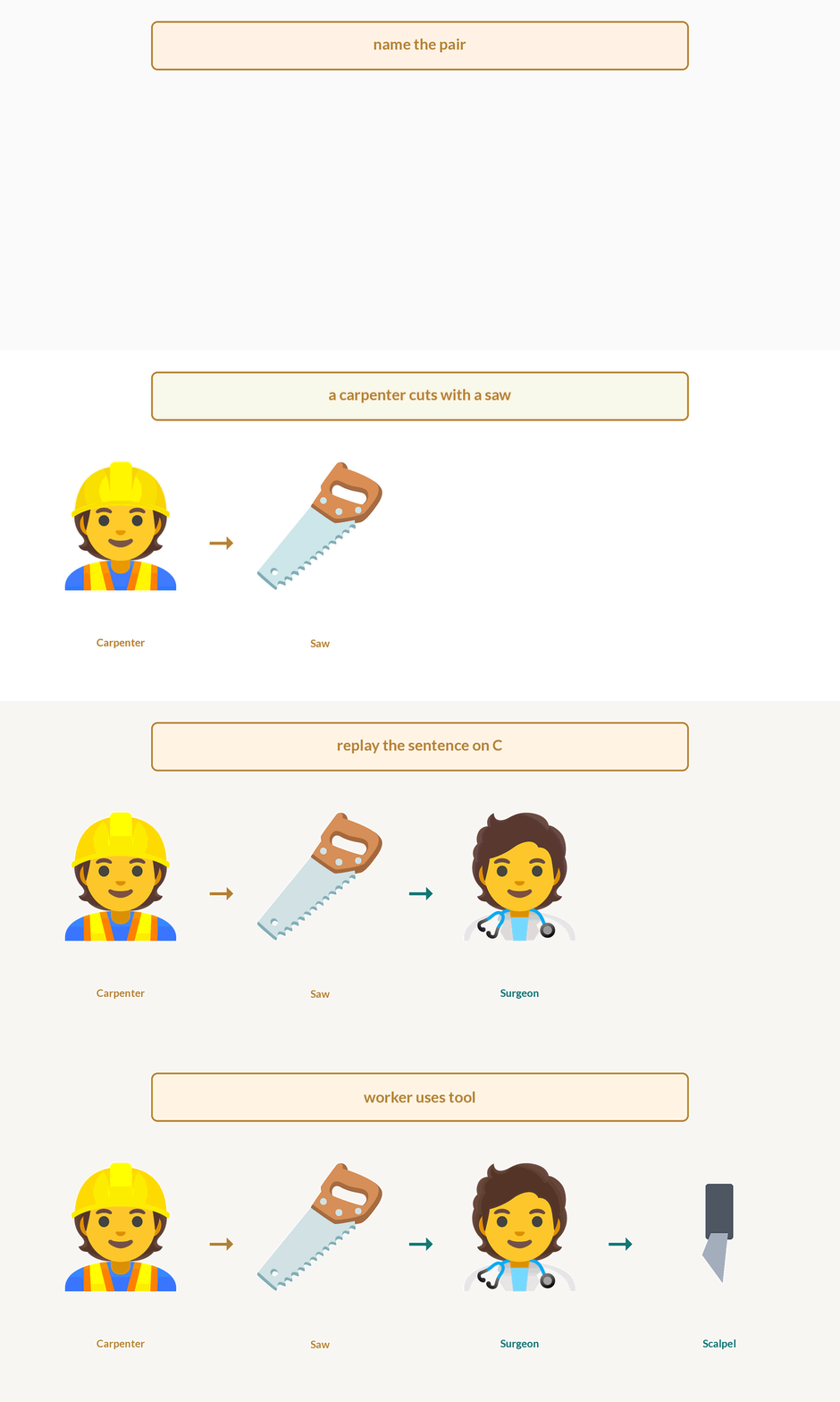
An analogy question hands you one finished pair and one unfinished pair: A : B :: C : ?, read aloud as 'A is to B as C is to what?'. Take a concrete stem and hold it for the whole concept: Carpenter : Saw :: Surgeon : ?. Suppose the options are Hospital, Patient, Scalpel and Operation. Every one of those words is genuinely connected to a surgeon — which is exactly why guessing by 'feels related to C' fails. The work does not start at C at all. First name the exact relationship between A and B, and name it in an actual sentence with both words in it: 'a carpenter cuts with a saw — the saw is the tool of the carpenter's trade.' That sentence is the question's rule. Everything after it is just replaying the rule.
Now carry the sentence, word for word, over to the second pair: 'a surgeon cuts with a ___ — the ___ is the tool of the surgeon's trade.' Only Scalpel completes it. Hospital is where a surgeon works (a person–workplace relation), Patient is who a surgeon treats (person–object of work), Operation is what a surgeon performs (person–activity). Each of those is a true association, and each names a different relation from worker–tool — so each is wrong. That is the whole discipline in one line: an option that is merely related to C, without matching the A–B relation, is a trap set precisely for the reader who skipped the sentence.
Two conventions guard the sentence. The first is that order matters: Saw : Carpenter is not the same pair as Carpenter : Saw. Read your sentence forward ('a carpenter uses a saw') and then backward ('a saw is used by a carpenter') so you know which direction the stem fixed — and keep C's pair pointing the same way. If the stem runs tool-first, the answer must run tool-first. The second convention is keeping part–whole apart from category–member, because both get lazily read as 'A belongs to B'. Petal : Flower is part–whole: a petal is a physical piece of a flower. Rose : Flower is category–member: a rose is a kind of flower, not a piece of one. The test is a single question — is A a piece of B, or a kind of B? A pair answered across that line (matching Petal : Flower with Rose : Garden) fails even though every word sounds botanical.
The 'Relation types to scan' table is your scan list, not a derivation. On a timed paper you do not invent relation names from scratch; you recognise which row the A–B sentence lands in — worker–tool for the carpenter — and then hunt the same row starting from C.
Order of attack
- Sentence the pairSay the A–B link as one full sentence containing both words: 'a carpenter cuts with a saw'. If you cannot finish that sentence, you have not found the relation yet — stay off the options until you can.
- Fix the directionRead the sentence forward and backward once to see which way the stem points — worker → tool or tool → worker. Carpenter : Saw and Saw : Carpenter are different pairs, and your answer must run in the stem's direction.
- Replay the sentence on CPut C in A's seat and read the identical sentence: 'a surgeon cuts with a ___'. The word that completes it is the answer shape; now find that word among the options.
- Reject associatesStrike every option that is connected to C but completes a different sentence — Hospital (workplace), Patient (object of work), Operation (activity). Related-to-C is not the test; same-relation-as-A–B is.
| Type | Reading |
|---|---|
| Synonym / antonym | Same meaning, or opposite meaning |
| Part–whole | A is a constituent of B (or B of A) |
| Worker–tool | Person and the instrument of the trade |
| Cause–effect | A produces B (or B follows from A) |
| Category–member | Class and an instance of that class |
| Function | Object and what it is for |
In an analogy stem A : B :: C : ?, the first move that keeps you off a vague guess is to
- List every word associated with C, then pick the closest option
- Name the exact A–B relationship in words, then apply that same relation to C
- Pick the option that is a synonym of C, because analogies are about vocabulary
The pair defines one relation. Associations of C alone ignore that relation; a synonym of C is only correct when A–B itself was synonymy.
2Number analogy: test square and cube first
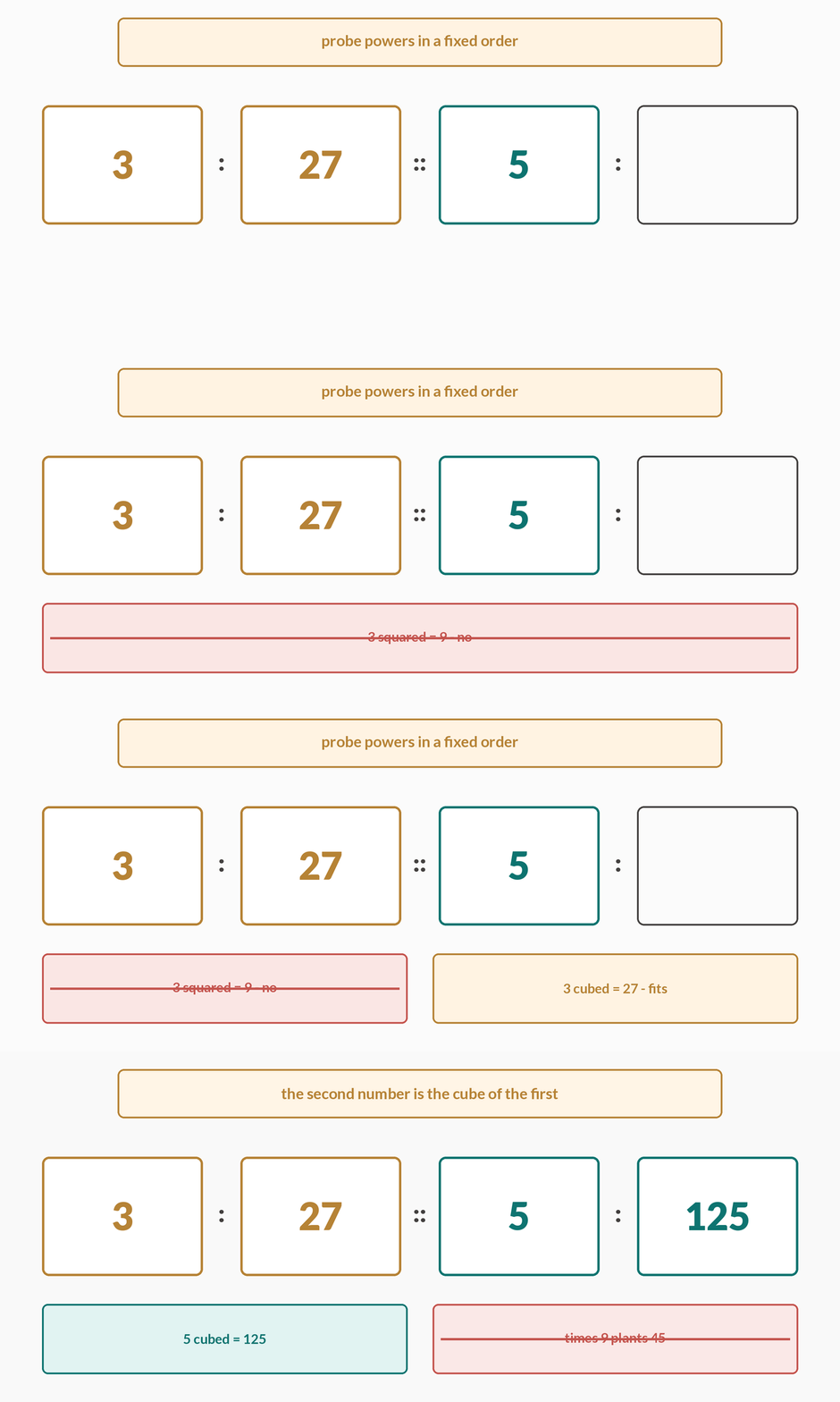
A number analogy works exactly like a word analogy, with arithmetic standing in for meaning: in 3 : 27 :: 5 : ?, some rule turns 3 into 27, and your job is to name that rule and apply it — unchanged — to 5. The rules that actually appear are a short list: square (B = A^2), cube (B = A^3), a near-square such as B = A^2 + 1 or B = A^2 - 1, a constant shift (B = A + k), or a constant product (B = A \times k). Before you invent anything exotic, test squares and cubes: they are the patterns SSC uses most often. Here 3^2 = 9 misses, but 3^3 = 27 hits exactly — so the rule is 'cube it', and the answer is 5^3 = 125.
State the rule to yourself in words or algebra — 'the second number is the cube of the first' — because a rule you have not stated is a rule you cannot test, and rules must be tested: more than one map can fit a single pair. 3 \times 9 is also 27. If the rule were 'multiply by 9', the answer would be 5 \times 9 = 45, and 45 will happily sit among the options as a trap. Two defences. When the stem gives two complete pairs, the rule must clear both: in 2 : 8 :: 3 : 27, 'multiply by 4' explains 2 \to 8 but collapses on the second pair (3 \times 4 = 12, not 27), while 'cube' clears both (2^3 = 8, 3^3 = 27) — so cube is the rule. When only one pair is given, SSC's intended reading is the power rule: a clean square or cube outranks a multiplication that happens to land on the same number.
Work the probes in a fixed order so nothing gets skipped under time pressure: powers first (A^2, A^3, then A^2 \pm 1), then the linear maps (A + k, A \times k). The moment a probe fits, stop and run it on C once. What you must never do is bend the rule between the pairs: a candidate answer that needs 'square' on the first pair but 'square plus one' on the second is not an answer. The pair defines one rule, and the rule does not flex.
How it works
- Probe powers firstAsk whether B is A^2, A^3 or A^2 \pm 1. In 3 : 27, 3^2 = 9 fails but 3^3 = 27 fits — stop there. A clean power is the intended SSC rule even when some \times k also lands on B.
- Fall back to linear mapsOnly if no power fits, try a constant shift (B = A + k) and a constant product (B = A \times k), solving for the k the given pair forces.
- Demand one rule for all pairsWhen two pairs are given, the rule must clear both: in 2 : 8 :: 3 : 27, multiply-by-4 fits only the first pair; cube fits both. A rule that fits one pair is a coincidence, not the relation.
- Apply once, unchangedRun the confirmed rule on C exactly as stated: 5^3 = 125. Then spot the trap option built from the rejected rule (5 \times 9 = 45) and leave it alone.
Number analogy by cubing
Find the missing term: 3 : 27 :: 5 : ?
- Relation on the first pair: 3^327
- Same rule on 5: 5^3125
- Reject \times 9: 3\times 9=27 but 5\times 945 (not the cube pattern)
Pro tip. Always test square and cube relationships first; they account for most SSC number analogies.
The note's own pattern 2 : 8 :: 3 : 27 works because each second term is
- The first term multiplied by 4
- The cube of the first term
- One less than the square of the first term
2^3=8 and 3^3=27. Multiplying by 4 fits 2\to 8 but turns 3 into 12, not 27; n^2-1 gives 3 and 8, not the pair.
3Letter analogy is gap arithmetic
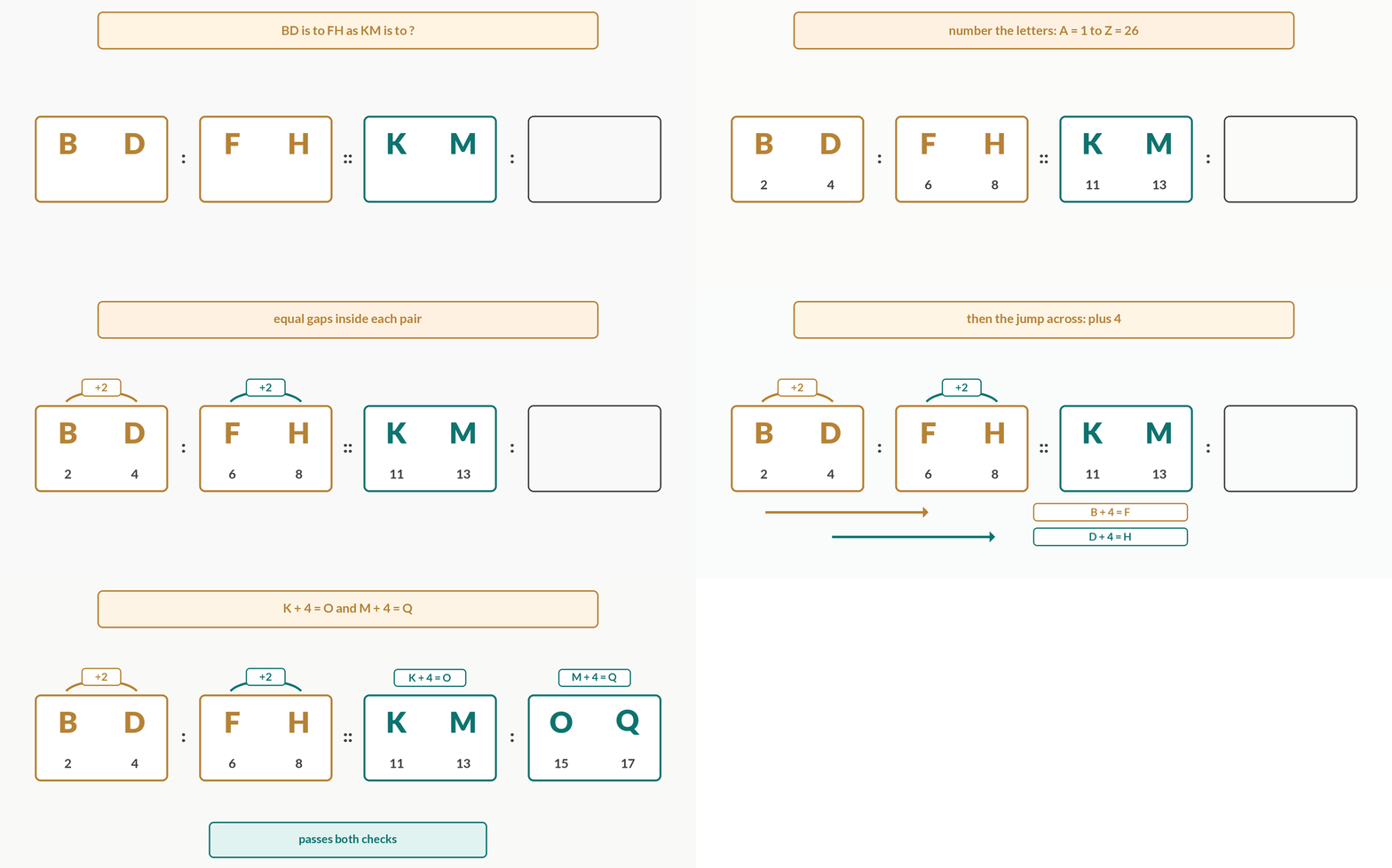
Letter analogies look verbal but they are arithmetic in disguise. Write A = 1, B = 2, and so on to Z = 26 under every letter, and each cluster turns into a short list of numbers; the relation becomes a difference you can compute rather than a shape you squint at. Take the pair BD and FH. Numbered, BD is 2, 4 and FH is 6, 8. Inside each cluster the step from first letter to second is the internal gap: B to D is +2, and F to H is +2. Equal gaps mean the same pattern — that shared +2 is what makes BD and FH analogous, exactly the way 'cube' made 3 : 27 and 5 : 125 analogous in the number concept.
Two different gaps live in one stem, so always name which one you are reading. The internal gap runs inside a cluster (B to D, +2). The across-pair shift runs from the first cluster to the second, matching letter by matching letter: B to F is +4, and D to H is +4. A full analogy usually honours both. In BD : FH :: KM : ?, the answer must carry KM's internal gap (K = 11, M = 13, so +2) and sit +4 ahead of it (K + 4 gives O, M + 4 gives Q) — which forces OQ, a cluster that passes both checks. Direction is part of the gap: +2 forward and -2 backward are different relations, so subtract in the order the letters are written, never 'whichever way comes out positive'.
The other stock relation is the mirror pair: A pairs with Z, B with Y, C with X — each letter with its opposite counted from the other end of the alphabet. The arithmetic signature is that the two positions always sum to 27: A + Z = 1 + 26 = 27 and B + Y = 2 + 25 = 27. If gap-testing a cluster gives you nothing, run the sum — a pair adding to 27 is a mirror, and the analogous cluster must mirror too. Only when a shift pushes past Z does the alphabet circle come in (a +3 step from Y wraps around to B); treat wrapping as a last resort the stem forces, never a default reading.
How it works
- Number the lettersWrite positions under every letter, A = 1 through Z = 26. BD becomes 2, 4 and FH becomes 6, 8; all pattern-hunting happens on these numbers, not on the letters.
- Read the internal gap, with signSubtract inside each cluster in written order: B to D is +2, F to H is +2. Keep the sign — a backward step of -2 is a different relation, not the same one.
- Read the across-pair shiftMatch letters position by position between clusters: B to F and D to H are both +4. The answer to KM : ? must copy that shift as well — K + 4 gives O, M + 4 gives Q, so OQ.
- If gaps fail, test the mirrorSum each pair's two positions. A total of 27 (A with Z, B with Y) means mirror pairs, and the analogous cluster must be a mirror pair too.
| Cluster | Positions | Internal gap |
|---|---|---|
| BD | B = 2, D = 4 | +2 |
| FH | F = 6, H = 8 | +2 |
BD and FH are analogous letter pairs because each has an internal alphabet gap of
- +1
- +2
- +3
B = 2, D = 4 and F = 6, H = 8; both differences are +2. That shared internal gap is the relation the note names.
4Odd one out: one property, one exception
A classification question flips the analogy around: instead of copying a relation, you are shown four or five items of which all but one share a single property, and the outsider is the answer. Take the set 121, 144, 169, 150 and hold it through the concept. The wrong way in is to stare at each item asking 'what is strange about you?' — everything is strange about something. Find the common category first, then eliminate the item that breaks it: ask what most of the items share, name that property out loud, and only then go looking for the one that fails it.
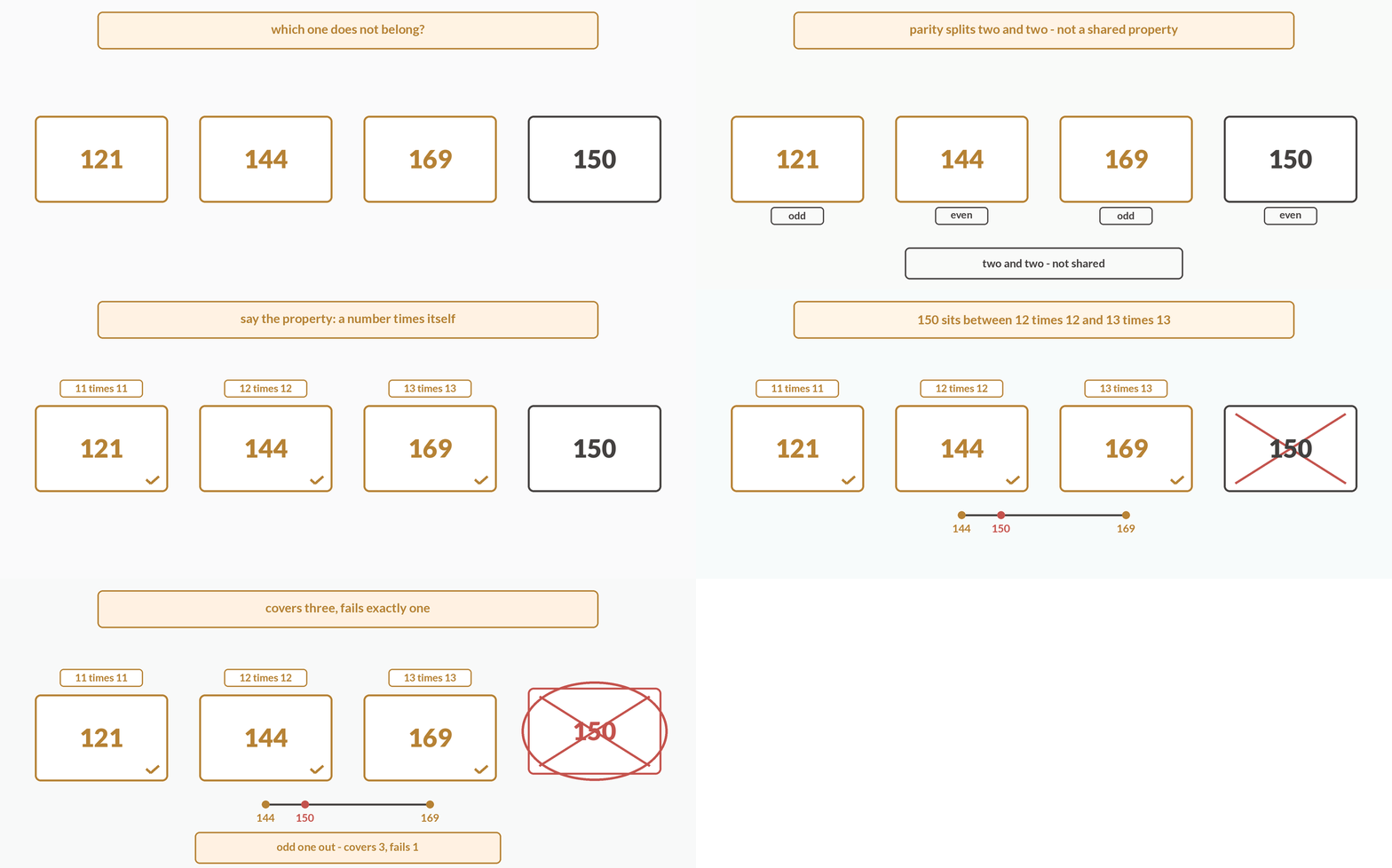
Run it on the set. Are they all even? No — 121 and 169 are odd, so parity is not a property this group shares at all. Are they perfect squares? 121 = 11^2, 144 = 12^2, 169 = 13^2 — three clean hits. Now test the last item against the same rule instead of assuming: 150 sits strictly between 144 = 12^2 and 169 = 13^2, so no whole number squares to it. The property 'perfect square' covers exactly three items and fails on exactly one, so 150 is the odd one out. Notice the finish: you did not stop at 'three are squares' — you checked every item against the named property and confirmed that exactly one falls. That per-item check is the convention; skipping it is how a second, unnoticed failure sneaks through.
For number sets, the landmark lists make the majority property visible in one pass: the squares 1, 4, 9, 16, 25, 36, 49, 64, 81, 100 — with 11^2 = 121, 12^2 = 144, 13^2 = 169 just past them — and the small primes 2, 3, 5, 7, 11, 13, 17, 19, 23, 29. Scan the set against squares, then primes, then plain divisibility, before trying anything clever. The intended property is nearly always this boring; the clever reading that isolates a different item is usually the two-candidates trap that the majority rule settles.
Order of attack
- Name a majority propertyAsk what three or four items share — perfect square, prime, mammal — before asking why any single item looks odd. In 121, 144, 169, 150 the shared property is 'perfect square'.
- Scan the landmarksTest number sets in a fixed order: squares 1, 4, 9, 16, 25, 36, 49, 64, 81, 100 (then 11^2, 12^2, 13^2), the primes 2, 3, 5, 7, 11, 13, 17, 19, 23, 29, then plain divisibility. Boring properties are the intended ones.
- Test every item, count failuresCheck each item against the named property one by one: 121, 144 and 169 pass as squares; 150 falls between 12^2 and 13^2 and fails. Exactly one item must fail — confirm it is exactly one.
- If two fail, rename the propertyTwo failures mean the property is wrong, not that the question is broken. Go back to the landmark scan and name another property; the intended rule always leaves a single exception.
Classification / odd-one-out
Choose the odd one: (a) 121 (b) 144 (c) 169 (d) 150
- 121, 144, 169 as squares11^2, 12^2, 13^2
- 150 between 144 and 169not a perfect square
- Property 'perfect square' holds for three items150 is the odd one
Pro tip. Identify the property common to the majority first, then the exception becomes obvious.
In the set 121, 144, 169, 150, the odd one is 150 because
- It is the only even number in the set
- It is the only number that is not a perfect square
- It is larger than 100
121, 144 and 169 are 11^2, 12^2 and 13^2; 150 is not a square. Evenness would also flag 144, so it is not the majority property.
5When two items look odd, keep the majority rule
Sooner or later a set offers you two 'odd' items, each odd under a different reading, and what settles it is a counting rule, not a debate. Take 4, 9, 16, 25, 20. A quick eye says 9 and 25 stand out — they are the only odd numbers in the set. Another eye says 20 stands out — it is the only non-square, since 4 = 2^2, 9 = 3^2, 16 = 4^2 and 25 = 5^2, while 20 sits between 4^2 and 5^2. Both observations are true; only one is the answer. The intended rule is the property that groups exactly three (or the maximum) together and leaves a single exception.
So count each reading's group. 'Odd number' covers 9 and 25 — a group of two, leaving three items outside. As a classification that reading splits the set and points at two candidates at once, so it cannot name the odd one out. 'Perfect square' covers 4, 9, 16 and 25 — four items — and leaves exactly one outside. Four beats two, and one exception beats three: the answer is 20. This is the contract every odd-one-out question signs — one property, one outsider. A reading that leaves two or three items outside is not a cleverer answer; it is a wrong property.
When two items compete, then, do not argue about which feels 'more odd'. Write down the property that would make each candidate odd, count how many items each property covers, and keep the property with the largest group and a single exception. A 2–2 split — two items sharing one trait, the other two sharing another — fails the contract outright and means you restart from the landmark lists. The exam's intended property is almost always the plainer one that covers the most items; the seductive side-difference that isolates a different item is placed there deliberately.
Figure. When two items look odd, count each reading. Odd-number covers two and splits the set; perfect-square covers four and leaves one exception. Keep the majority.
How it works
- Write a property per candidateFor each item that looks odd, state the property that would make it odd. In 4, 9, 16, 25, 20 the candidates are '9 and 25 are the only odd numbers' and '20 is the only non-square'.
- Count each property's groupPerfect square covers four items and leaves one outside; odd-number covers two and leaves three outside. Keep the property with the biggest group and exactly one exception; discard any reading that strands two or more.
- Name the lone exceptionThe answer is the single item outside the winning majority — here 20 — never every item that differs somehow. If no property leaves exactly one item out, the intended rule has not been found yet.
| Reading | Group size | Keep? |
|---|---|---|
| One property covers three items | 3 + 1 exception | Yes — standard odd-one-out |
| Two properties each cover two items | 2 + 2 | No — no unique odd one |
| A side difference on every item | No stable majority | No — restart with landmarks |
Four numbers are given. Under property P, three fit and one fails; under property Q, the set splits two-and-two. The odd one out is
- Either of the two that fail Q, since both look unusual
- The single item that fails P
- None — the question is invalid whenever two properties exist
The intended rule leaves exactly one exception. A 2–2 split under Q does not identify a unique odd item, so Q is discarded even if it feels clever.
Notes
- Analogy - Relationship Identification: In A : B :: C : ?, first name the exact relationship between A and B (e.g. tool-worker, cause-effect, synonym, part-whole) and apply the identical relationship to C. State the relationship in words to avoid vague guesses.
- Number Analogy: The pair is linked by an arithmetic rule such as square, cube, +n, ×n, or (n, n²+1). e.g. 2 : 8 :: 3 : 27 uses cubing. Test squares/cubes first since they are the most common SSC patterns.
- Classification (Odd-One-Out): Four items share one property and one does not; find the common category (all primes, all perfect squares, all mammals) then eliminate the exception. The odd one differs on exactly the intended property, not on trivial differences.
- Letter/Alphabet Analogy: Groups relate by position gaps or mirror pairs; check the difference between letter positions within each cluster (e.g. BD, FH share a +2 internal gap).
- Common trap: More than one item may look odd; choose the property that groups exactly three (or the maximum) together, since the intended rule leaves only one exception.
Formulas
- Number-analogy checks: test n^2, n^3, n^2+1, n^2-1, and constant +k or \times k before exotic rules.
- Letter gap rule: convert letters to positions and compare internal differences; equal differences indicate the pattern.
- Perfect-square landmarks: 1,4,9,16,25,36,49,64,81,100 for spotting square-based classifications.
- Prime landmarks: 2,3,5,7,11,13,17,19,23,29 to test 'all primes except one' classifications.
- Relationship types to scan: synonym, antonym, part-whole, worker-tool, cause-effect, category-member, function.
Exam traps & shortcuts
- Frame the first pair as a sentence ('A is the B of...') and read it with the third term to pick the answer.
- For number sets, list squares and cubes mentally; if three fit a rule and one breaks it, that one is the odd item.
- In classification, if two options seem odd, re-read the group for the single property covering the most items.
- For letter groups, always number the alphabet (A=1) so gaps become obvious arithmetic differences.
Reference tables
Try these maps on A→B before inventing a rarer rule. Squares and cubes clear most Tier-1 stems.
| Probe | Form |
|---|---|
| Square | B = A^2 |
| Cube | B = A^3 |
| Near-square | B = A^2+1 or A^2-1 |
| Constant shift | B = A+k |
| Constant product | B = A\times k |
Memorised lists make the majority property visible in one pass on number odd-one-out sets.
| Family | Landmarks |
|---|---|
| Perfect squares | 1, 4, 9, 16, 25, 36, 49, 64, 81, 100 |
| Small primes | 2, 3, 5, 7, 11, 13, 17, 19, 23, 29 |
Recap
Read only this the night before.
- Analogy
- Name A–B in a sentence; apply that sentence to C. Vague association is not a relation.
- Numbers
- Test n^2 and n^3 first, then +k / \times k. One rule must fit both pairs.
- Letters
- A = 1. Equal internal gaps (BD and FH both +2) are the pattern.
- Odd one out
- Find the property three share; the one that breaks it is the answer.
- Trap
- If two items look odd, keep the property that still leaves a single exception — never a 2–2 split.
Practise Analogy & Classification
Reading is free and needs no account. Practice, mocks and progress live in the app.
- 119 exam-style questions on this topic, with explanations
- A 8-question practice set that ends the chapter
- Timed mocks scored with the real marking scheme
- Readiness tracked per topic, kept on your device