SSC CGL · Quantitative Aptitude
Geometry
Properties of lines, angles, triangles, circles, quadrilaterals and polygons including centres and similarity.
Eight concepts covering the plane-geometry facts SSC and banking papers actually ask: angle sums, Pythagoras, triangle centres, Heron and the two radii, similarity of areas, circle angles, tangents and intersecting chords. Mensuration — area and volume formulas for solids — lives in its own topic; this one is properties and relations.
- SSC CGL
- Hard level
- 8 concepts
- 158 practice questions
1Angle sums in triangles and polygons
The interior angles of a triangle sum to 180^\circ, and an exterior angle equals the sum of the two remote interior angles — never the adjacent interior. For an n-sided polygon the interior angles sum to (n-2)\times 180^\circ; each exterior angle of a regular n-gon is \frac{360^\circ}{n}, and the exteriors of any convex polygon sum to 360^\circ whether the polygon is regular or not.
Figure. Right isosceles \triangle ABC with the right angle at B; equal legs are drawn to true length under aspect 2 (\Delta x = \Delta y / 2). Side BC is extended (dashed) past C. The exterior at C is the sum of the remotes at A and B, not the 45^\circ sitting next to it.
How it works
- Close the triangleThree interiors add to 180^\circ. If two are known, the third is forced.
- Exterior from remotesAn exterior angle equals the sum of the two interiors that do not touch it — the remote pair.
- Polygon by trianglesAn n-gon splits into n-2 triangles from one vertex, so interiors sum to (n-2)\times 180^\circ.
Exterior angle of a right isosceles triangle
In right isosceles \triangle ABC with \angle B = 90^\circ and \angle A = \angle C = 45^\circ, side BC is extended beyond C. Find the exterior angle at C.
- Remote interiors at A and B45^\circ + 90^\circ
- Exterior at C = sum of remotes135^\circ
- Check: adjacent interior at C is 45^\circ180^\circ - 45^\circ = 135^\circ
- Exterior angle at C135^\circ
Pro tip. The adjacent-interior check (180^\circ minus the angle next to the exterior) is the same answer written backwards. If the two routes disagree, you have named the wrong pair of remotes.
In \triangle ABC, \angle A = 40^\circ and \angle B = 70^\circ. Side BC is extended beyond C. The exterior angle at C is
- 70^\circ
- 110^\circ
- 140^\circ
Remotes are \angle A and \angle B: 40^\circ + 70^\circ = 110^\circ. Taking the adjacent interior \angle C = 70^\circ as the exterior gives 70^\circ; doubling \angle A gives 140^\circ. The exterior equals the remote sum, not the neighbour and not twice either acute angle.
2Pythagoras and the triples worth knowing
In a right triangle, \text{hyp}^2 = \text{base}^2 + \text{height}^2. The exam almost never wants you to square and root from scratch: it plants a Pythagorean triple — 3,4,5; 5,12,13; 8,15,17; 7,24,25 — or a multiple of one, and the mark is for recognising it on sight.
Any positive multiple of a triple is still a right triangle: 6,8,10 and 9,12,15 are both 3,4,5 scaled. Spot the common factor first, reduce, then read the hypotenuse off the list.
Figure. A 3-4-5 right triangle with legs to true length under aspect 2: vertical \Delta y = 0.48, horizontal \Delta x = 0.32, so the physical base-to-height ratio is 4:3. The right angle sits at the lower left; the hypotenuse is the slant.
How it works
- Name the right angleThe side opposite the right angle is the hypotenuse — the only one that can sit alone on the left of Pythagoras.
- Look for a tripleDivide out a common factor and match against 3-4-5, 5-12-13, 8-15-17, 7-24-25.
- Scale back upMultiply the looked-up hypotenuse by the factor you divided out.
| Triple | ×2 | ×3 |
|---|---|---|
| 3, 4, 5 | 6, 8, 10 | 9, 12, 15 |
| 5, 12, 13 | 10, 24, 26 | 15, 36, 39 |
| 8, 15, 17 | 16, 30, 34 | — |
| 7, 24, 25 | 14, 48, 50 | — |
A scaled 3-4-5
A right triangle has legs 9 cm and 12 cm. Find the hypotenuse.
- Common factor of 9 and 123
- Reduced legs3 and 4
- Triple 3-4-5, so reduced hyp5
- Scale by 3: hypotenuse15 cm
Pro tip. Check by Pythagoras only when the sides refuse the list: 9^2 + 12^2 = 81 + 144 = 225 = 15^2. If a question hands you 7, 24 and asks for the third side, write 25 before reaching for a calculator.
The hypotenuse of a right triangle with legs 5 cm and 12 cm is
- 13 cm
- 17 cm
- \sqrt{119} cm
5-12-13 is a primitive triple, so the hypotenuse is 13 cm with no rooting. 17 is the hypotenuse of 8-15-17; \sqrt{119} is what you get by subtracting instead of adding under the root.
3Centroid, incentre and circumcentre
Three centres of a triangle earn their own questions. The centroid is where the medians meet; it divides each median in the ratio 2:1, with the longer part toward the vertex — so the vertex-to-centroid stretch is \frac{2}{3} of the median. The incentre is where the angle bisectors meet and is equidistant from the three sides. The circumcentre is where the perpendicular bisectors meet and is equidistant from the three vertices.
Figure. Medians concurrent at the centroid G. On median AM, the brackets mark the 2:1 split — longer toward A, shorter toward M. The drawn ratio is exact: AG:GM = 2:1 in figure coordinates. The incentre and circumcentre are not drawn; each needs a circle the vocabulary cannot make.
How it works
- Centroid from a medianCut the median 2:1 from the vertex. Vertex-to-G is \frac{2}{3}; G-to-midpoint is \frac{1}{3}.
- Incentre from the sidesEqual perpendicular distance to every side — that common length is the inradius r.
- Circumcentre from the verticesEqual distance to every vertex — that common length is the circumradius R.
Centroid on a median of length 12
A median of a triangle is 12 cm long. Find the distance from the vertex to the centroid, and from the centroid to the midpoint of the opposite side.
- Centroid divides median2:1 from vertex
- Vertex to G = (2/3) × 128 cm
- G to midpoint = (1/3) × 124 cm
- Check: 8 + 412 cm
Pro tip. Halving the median gives 6, which is neither piece — the split is 2:1, not 1:1. If a question gives vertex-to-G and asks for the median, multiply by \frac{3}{2}, not by 2.
A median is 15 cm. The longer segment created by the centroid is
- 5 cm
- 7.5 cm
- 10 cm
Longer part is toward the vertex: \frac{2}{3}\times 15 = 10 cm. 7.5 is half the median; 5 is the shorter piece \frac{1}{3}\times 15.
4Heron's formula, inradius and circumradius
Given three sides a, b, c and no height, the area is Heron's formula: with semi-perimeter s = \frac{a+b+c}{2}, Area = \sqrt{s(s-a)(s-b)(s-c)}. Once the area is known, the two radii drop out of identities — inradius r = \frac{\text{Area}}{s} and circumradius R = \frac{abc}{4\times\text{Area}} — with no further geometry.
Figure. Sides 13, 14, 15 give semi-perimeter s=21. Heron then yields Area =\sqrt{21\cdot 8\cdot 7\cdot 6}=84. From that area, r=\mathrm{Area}/s and R=abc/(4\cdot\mathrm{Area}) drop out — the triangle is to scale; the inscribed and circum circles are not drawn.
How it works
- Form sAdd the three sides and halve: s = (a+b+c)/2.
- Heron under the rootMultiply s(s-a)(s-b)(s-c) and take the positive square root.
- Radii from Arear = \text{Area}/s and R = abc/(4\times\text{Area}).
Area via Heron's formula
Find the area of a triangle with sides 13, 14 and 15.
- s = (13+14+15)/221
- Area = √[21(21−13)(21−14)(21−15)]√(21×8×7×6)
- 21×8×7×67056
- √705684
Pro tip. The 13–14–15 triangle (area 84) is a recurring SSC favourite — worth memorising. The same numbers give r = 84/21 = 4 and R = 13\times 14\times 15/(4\times 84) = 8.125 if a follow-up asks for a radius.
A triangle has sides 13, 14, 15 and area 84. Its inradius is
- 4
- 6
- 8.125
r = \text{Area}/s with s = 21, so 84/21 = 4. 8.125 is the circumradius R = abc/(4\times\text{Area}) for the same triangle; 6 is a distractor from averaging the sides.
5Similar triangles and the square on the sides
If two triangles are similar with corresponding-side ratio a:b, their areas are in the ratio a^2:b^2. Corresponding medians, altitudes and perimeters stay in the linear ratio a:b — only area (and every other two-dimensional measure) picks up the square. The trap is reading an area ratio as if it were a side ratio, or taking a square root the wrong way when the question starts from areas.
Figure. Two similar triangles with corresponding bases 3 and 6 — exact ratio 1:2 in figure coordinates (0.24 against 0.48). Heights are 0.28 and 0.56, the same 1:2, so areas scale as 1:4. Linear labels stay with the side ratio; only the area annotations carry the square.
How it works
- Confirm similarityAAA, proportional sides, or an exam statement — then corresponding sides share one ratio.
- Linear measuresSides, medians, altitudes, perimeters: all scale as a:b.
- Area scales as the squareArea ratio = (a/b)^2. From areas back to sides, take the positive square root.
Areas from a side ratio
Two similar triangles have corresponding sides in the ratio 3:4. The smaller has area 36 cm^2. Find the area of the larger.
- Side ratio a:b3:4
- Area ratio a²:b²9:16
- Larger / smaller = 16/916/9
- Larger area = 36 × 16/964 cm²
Pro tip. Going the other way — areas 9:16, find sides — the side ratio is 3:4, not 9:16. If the options include both, the squared pair is the bait.
Two similar triangles have areas in the ratio 9:16. Their corresponding sides are in the ratio
- 9:16
- 3:4
- 81:256
Sides are the square root of the area ratio: \sqrt{9}:\sqrt{16} = 3:4. Copying 9:16 treats area as length; 81:256 squares the area ratio again.
6Central angle, inscribed angle and the semicircle
The angle subtended by an arc at the centre is twice the angle subtended by the same arc at any point on the remaining circumference. Angles in the same segment — standing on the same arc, on the same side of the chord — are equal. The angle in a semicircle is 90^\circ: an angle standing on a diameter, with its vertex on the circle, is a right angle.
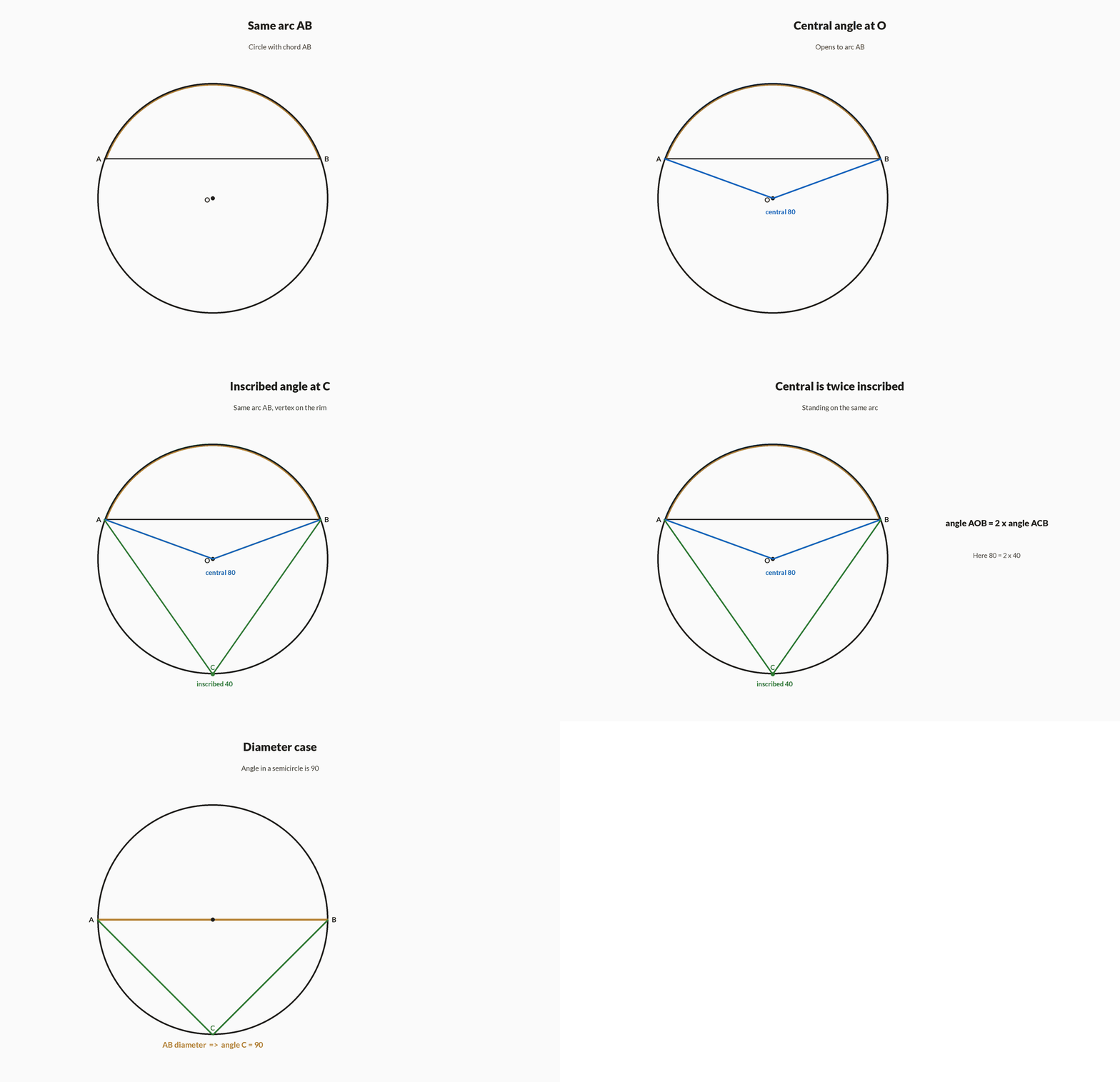
How it works
- Name the arcCentral and inscribed angles only compare when they stand on the same arc.
- Apply the factor of twoCentral = 2 \times inscribed. Convert before writing any equation.
- Semicircle shortcutIf one side of the angle is a diameter and the vertex is on the circle, the angle is 90^\circ.
Inscribed angle from a central angle
An arc of a circle subtends an angle of 120^\circ at the centre. What angle does it subtend at any point on the major arc?
- Same arc, centre vs circumferenceinscribed = half central
- Central angle120^\circ
- Inscribed = (1/2) × 120°60^\circ
- Angle on the major arc60^\circ
Pro tip. Central = 2 \times inscribed on the same arc — a single relation solves most circle-angle questions. Doubling the other way (240^\circ) answers a different arc; leaving the angle at 120^\circ forgets the factor of two.
An arc subtends 100^\circ at the centre. The angle it subtends at a point on the remaining circumference is
- 50^\circ
- 100^\circ
- 200^\circ
Inscribed is half the central angle on the same arc: 50^\circ. Copying 100^\circ skips the factor of two; doubling to 200^\circ applies the factor the wrong way.
7Tangent perpendicular to radius, and equal tangents
A tangent to a circle is perpendicular to the radius at the point of contact — so the triangle formed by the centre, the external point and the contact point is right-angled at the contact, and Pythagoras applies. Two tangents drawn from the same external point are equal in length; the line from the centre to that external point bisects the angle between them.
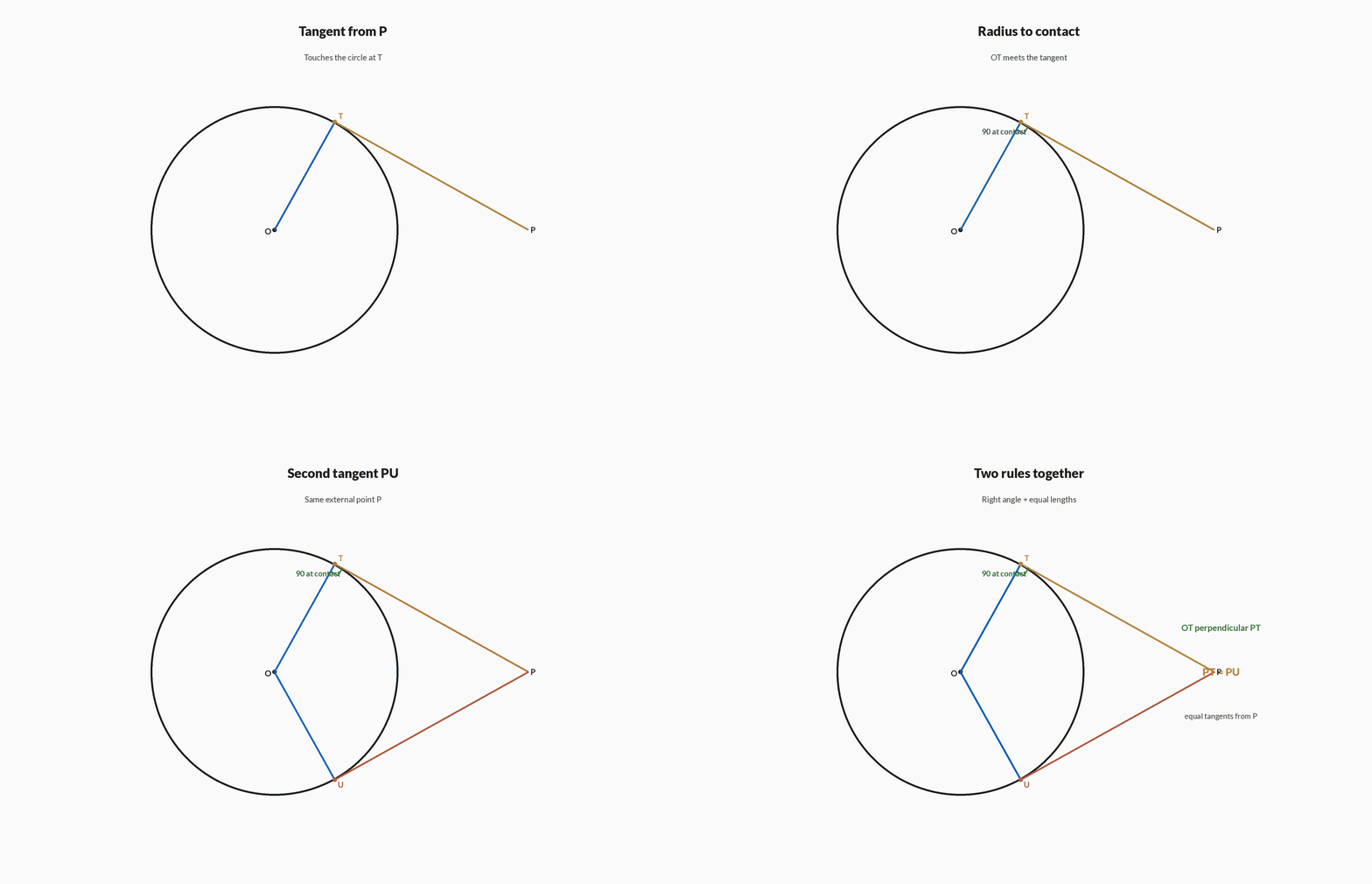
How it works
- Radius meets tangent at 90°At the point of contact, radius \perp tangent. Mark that right angle before computing lengths.
- Equal tangents from one pointFrom external point P, tangents touching at A and B satisfy PA = PB.
- Pythagoras on OPWith radius r and OP = d, each tangent length is \sqrt{d^2 - r^2}.
Tangent length from an external point
From a point P outside a circle of radius 5 cm, the distance to the centre O is 13 cm. Find the length of the tangent from P to the point of contact.
- Radius ⊥ tangent at contactright triangle OTP
- Legs: radius and tangent; hyp OP5 and ?, hyp 13
- Tangent² = 13² − 5²169 − 25 = 144
- Tangent length12 cm
Pro tip. 5-12-13 again — the same triple from the Pythagoras concept, now as radius, tangent and line to centre. If both tangents from P are drawn, each is 12 cm; you do not compute the second one separately.
Two tangents from an external point to a circle are 9 cm and x cm. The value of x is
- 9
- 18
- Cannot be determined
Tangents from the same external point are equal, so x = 9. Doubling treats them as a diameter segment; "cannot be determined" would be right for two tangents from different points, not from one.
8Intersecting chords
Two chords AB and CD intersecting inside a circle at P satisfy PA \times PB = PC \times PD. The products of the segments of each chord are equal — not the chords themselves, and not the sums. Write the product identity before substituting numbers; adding the known pieces is the usual wrong move.
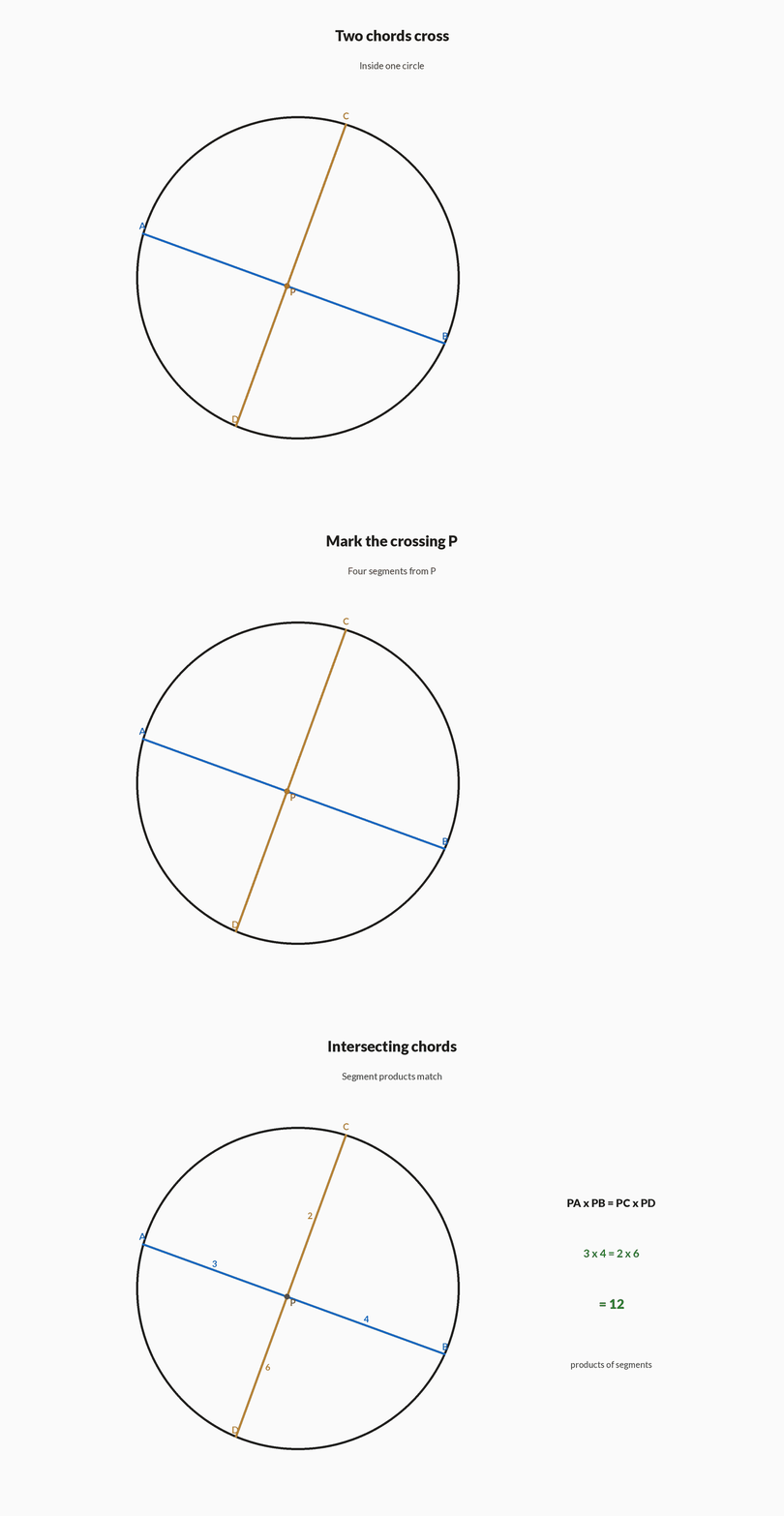
How it works
- Name the four segmentsFrom the intersection, each chord splits into two pieces — four lengths, one unknown.
- Write the productsPA \times PB = PC \times PD. Same chord's two pieces multiply; the other chord matches.
- Solve for the unknownOne multiplication and one division. Do not add the segments.
One missing chord segment
Chords AB and CD intersect at P inside a circle. PA = 4 cm, PB = 6 cm, PC = 3 cm. Find PD.
- Intersecting chordsPA × PB = PC × PD
- 4 × 6 = 3 × PD24 = 3 × PD
- PD = 24/38 cm
- Check: 3 × 824
Pro tip. Adding the known pieces (4+6=10) or equating whole chords never answers this. The product form is the whole method — write it before substituting.
Chords intersect at P with PA = 2, PB = 12, PC = 4. Then PD equals
- 6
- 8
- 10
2 \times 12 = 4 \times PD gives PD = 6. 8 averages the known segments; 10 adds 2+8 style noise. Products, not sums.
Notes
- Angle Sum Properties: The interior angles of a triangle sum to 180^\circ and an exterior angle equals the sum of the two remote interior angles; for an n-sided polygon interior angles sum to (n-2)\times180^\circ.
- Triangle Centres: The centroid divides each median in ratio 2:1 from the vertex; the incentre is equidistant from the sides and the circumcentre equidistant from the vertices.
- Similarity & Areas: If two triangles are similar with side ratio a:b, their areas are in ratio a^2:b^2 and corresponding medians/perimeters in ratio a:b.
- Circle Theorems: The angle subtended by an arc at the centre is twice that at the circumference, and angles in the same segment are equal; the angle in a semicircle is 90^\circ.
- Tangent Properties: A tangent is perpendicular to the radius at the point of contact, and two tangents drawn from an external point are equal in length.
Formulas
- Sum of interior angles of n-gon: (n-2)\times180^\circ; each exterior angle of regular n-gon =\frac{360^\circ}{n}
- Pythagoras: \text{hyp}^2 = \text{base}^2 + \text{height}^2
- Area of triangle (Heron): \sqrt{s(s-a)(s-b)(s-c)}, where s=\frac{a+b+c}{2}
- Circumradius: R = \frac{abc}{4\times\text{Area}}; Inradius: r = \frac{\text{Area}}{s}
- Ratio of areas of similar triangles = (\text{ratio of sides})^2
- Intersecting chords: PA\times PB = PC\times PD
Exam traps & shortcuts
- Recognise Pythagorean triples (3,4,5; 5,12,13; 8,15,17; 7,24,25) on sight to avoid squaring and rooting.
- For the centroid, remember it splits medians 2:1, so the vertex-to-centroid part is \frac{2}{3} of the median length.
- In circle problems, convert a central angle to an inscribed angle (or vice versa) using the factor of 2 before setting up equations.
Reference tables
The identities this topic uses. Area formulas for rectangles, circles and solids sit in Mensuration; only triangle and circle relations are here.
| Relation | Formula | Use when |
|---|---|---|
| Triangle interiors | A+B+C = 180^\circ | Third angle from two known |
| Exterior angle | sum of two remote interiors | Side extended beyond a vertex |
| n-gon interiors | (n-2)\times 180^\circ | Polygon angle sum |
| Regular exterior | 360^\circ/n | One exterior of a regular n-gon |
| Pythagoras | \text{hyp}^2 = \text{base}^2 + \text{height}^2 | Right triangle; prefer triples |
| Heron | \sqrt{s(s-a)(s-b)(s-c)}, s=(a+b+c)/2 | Three sides, no height |
| Inradius | r = \text{Area}/s | After area is known |
| Circumradius | R = abc/(4\times\text{Area}) | After area is known |
| Similar areas | (a:b)^2 when sides are a:b | Area from side ratio or reverse |
| Central / inscribed | central = 2 \times inscribed | Same arc |
| Intersecting chords | PA\times PB = PC\times PD | Two chords cross inside a circle |
Recap
Read only this the night before.
- Angle sums
- Triangle interiors 180^\circ; exterior = remote interiors, not the adjacent one. n-gon interiors (n-2)\times 180^\circ; regular exterior 360^\circ/n.
- Pythagoras
- Know 3-4-5, 5-12-13, 8-15-17, 7-24-25 and their multiples on sight. Square and root only when the list fails.
- Centroid
- Medians meet at G, split 2:1 with the longer part toward the vertex — \frac{2}{3} of the median, not half.
- Heron and radii
- 13-14-15 has area 84. Then r = \text{Area}/s and R = abc/(4\times\text{Area}) — for that triangle, 4 and 8.125.
- Similarity
- Sides a:b give areas a^2:b^2. From areas back to sides, take the square root.
- Circle
- Central = 2\times inscribed on the same arc; angle in a semicircle is 90^\circ. Tangent \perp radius; equal tangents from one external point. Intersecting chords: products of segments.
Practise Geometry
Reading is free and needs no account. Practice, mocks and progress live in the app.
- 158 exam-style questions on this topic, with explanations
- A 6-question practice set that ends the chapter
- Timed mocks scored with the real marking scheme
- Readiness tracked per topic, kept on your device