SSC MTS & Havaldar · General Intelligence & Reasoning
Series (Number, Alphabet & Figural)
Finding the missing or next term in number, alphabet, alphanumeric and figural series.
A series question prints a short list of numbers, letters, or shapes and a blank: 2, 5, 10, 17, 26, ?. The list is not a riddle to stare at. Something changes from each term to the next, and your job is to write that change down — a difference, a ratio, a mixed multiply-then-add, two chains sharing odd and even seats, or one attribute of a figure turning — then extend it one more step. Confirm the same change on every given jump before you trust it; a rule that fits only the first pair is a trap, not the series.
- SSC MTS & Havaldar
- Medium level
- 8 concepts
- 157 practice questions
1Write the differences first
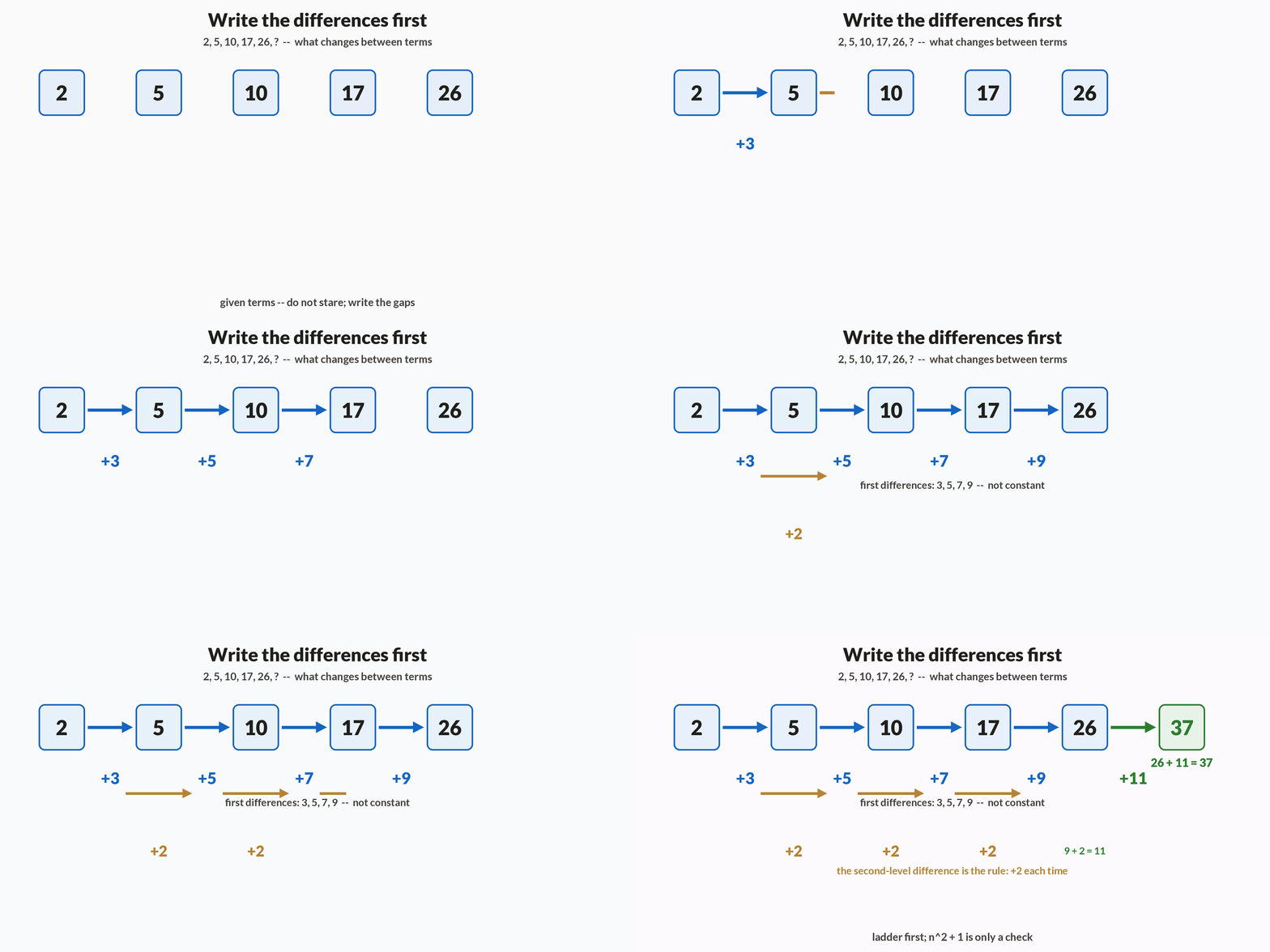
Start with a printed list you can hold: 2, 5, 10, 17, 26, and a blank. Staring at those numbers will not tell you what belongs in the blank. The fastest first move is to write, under the list, what changed from each term to the next — the successive differences. 5 minus 2 is 3; 10 minus 5 is 5; 17 minus 10 is 7; 26 minus 17 is 9. So the first-difference row is 3, 5, 7, 9. Those four numbers are not a mess: they themselves go up by 2 each time. That second row — the differences of the differences — is the second-level difference, and here it is the constant +2.
A constant first difference would have meant an arithmetic progression with common difference d, and the next term would be the last term plus d. Here the first differences are not constant, so the series is not linear. When the first differences themselves form a pattern — for example +2,+4,+6 or +3,+5,+7 — the second-level difference is the rule, and the series is quadratic rather than linear. Extend that second-level +2 one more step: the next first difference must be 9 + 2 = 11, so the blank is 26 + 11 = 37.
You can, after the ladder has already named 37, check a closed form. Index the given terms as n = 1, 2, 3, 4, 5: 1^2+1=2, 2^2+1=5, 3^2+1=10, 4^2+1=17, 5^2+1=26, so n^2+1 at n=6 is 36+1=37, matching. Matching a second-difference pattern to an n^2 form (or n^2\pm1) is a check, not a substitute for the difference ladder: the ladder finds the next term even when you have not yet named the closed form.
Order of attack
- Difference ladderSubtract consecutive terms and write the first differences under the series. For 2, 5, 10, 17, 26 that row is 3, 5, 7, 9 — 5−2, 10−5, 17−10, 26−17. The given terms stay in view; the new information is the row of gaps.
- Constant or patternedIf the differences are constant, add that constant. If they form their own arithmetic pattern — here +2 each step — extend that pattern by one more difference: 9 + 2 = 11, then 26 + 11 = 37.
- Optional closed formWhen first differences rise by a constant 2 each time, try n^2 or n^2\pm1 indexed from the first term. Here n^2+1 at n=6 is 37 — it confirms the next term the ladder already forced, and is not a substitute for the ladder.
Quadratic number series
Find the next term: 2, 5, 10, 17, 26, ?
- First differences: 5−2, 10−5, 17−10, 26−173, 5, 7, 9
- Second differences of 3,5,7,9+2 each step → next first difference = 11
- 26 + 1137
- Closed form check: n^2+1 at n=66^2+1 = 37
Pro tip. When first differences form their own arithmetic pattern, the series is quadratic — match it to an n^2 form only after the ladder has already named the next term.
The series 1, 2, 5, 10, 17, ? has first differences 1, 3, 5, 7. The next term is
- 24
- 26
- 28
The differences rise by 2, so the next difference is 9 and 17+9=26. Indexed as n^2+1 from n=0: 0,1,4,9,16 plus one gives the stem, so the next is 25+1=26. Adding the last difference again (17+7=24) treats the series as arithmetic and is the common miss.
2Ratios, then mixed × and +
When the first-difference row looks erratic — jumping in size with no second-level constant — stop adding and start dividing. Take 3, 7, 15, 31. First differences: 4, 8, 16. Those double each time, which is a clue that multiplication is involved, but the ratios of the original terms 7/3, 15/7, 31/15 are not one number r. A near-constant ratio would have meant a geometric progression with common ratio r, and the next term would be the last term times r. Here no single r fits, so the series is not a pure geometric progression either.
Many exam series mix multiplication and addition in a fixed alternation — ×2 then +1, or ×3 then −2. Two shapes of that mix. The first uses the same two-step map on every jump: 3 × 2 + 1 = 7, 7 × 2 + 1 = 15, 15 × 2 + 1 = 31, so 3, 7, 15, 31 is ×2 then +1 throughout, and the next term would be 31 × 2 + 1 = 63. The second alternates two different operations, ×2 on one jump and +1 on the next, so the ratio test fails on every other step and the mixed rule only appears once you write both the product and the addend for each jump.
The trap is forcing a single arithmetic difference when the author interleaved a multiply with an add. If neither pure differences nor pure ratios settle in two steps, write the operation that takes each term to the next explicitly before guessing a closed form. A mixed rule is real only when that named map holds for every consecutive pair you were given — one agreeing jump is a coincidence.
Figure. Ratios of 3, 7, 15, 31 wobble, but every jump is ×2 then +1: 3×2+1=7, 7×2+1=15, 15×2+1=31, so the next term is 31×2+1=63.
How it works
- Try ratiosDivide consecutive terms. A steady ratio is geometric; stop and multiply through. On 3, 7, 15, 31 the ratios 7/3, 15/7, 31/15 wobble, so you do not have a common r.
- Name each jumpIf ratios wobble, write the exact map term→next (×k, then +c, or alternate) instead of inventing a single d. Here every jump is ×2 then +1: 3×2+1=7, 7×2+1=15, 15×2+1=31.
- Confirm on three jumpsA mixed rule is real only when the same ×-then-+ (or +-then-×) pattern holds for every consecutive pair you were given. Three jumps agreeing on ×2+1 is a rule; one jump agreeing is not.
| What you see | Try | Next term |
|---|---|---|
| Constant difference | Arithmetic (d) | last + d |
| Constant ratio | Geometric (r) | last × r |
| Differences rise by a fixed step | Second difference / n^2-type | extend the difference ladder |
| Ratios and differences both wobble | Mixed × then + (or reverse) | apply the named two-step map |
A series goes 3 → 7 → 15 → 31. The rule that fits every jump is
- Add 4 each time
- ×2 then +1 each time
- ×3 then −2 each time
3×2+1=7, 7×2+1=15, 15×2+1=31. Adding 4 only covers the first jump. ×3−2 gives 3×3−2=7 but then 7×3−2=19, not 15.
3Primes, squares and cubes inside the terms
Hold the same list 2, 5, 10, 17, 26. The difference ladder already produced 37. Look at the terms another way: they are 1^2+1, 2^2+1, 3^2+1, 4^2+1, 5^2+1. Some series are not built from a difference rule on the printed numbers — they are a familiar integer sequence with a fixed offset. Embedded primes (2, 3, 5, 7, …), squares (1, 4, 9, 16, …) and cubes (1, 8, 27, 64, …) appear either raw or as n^2\pm1, n^3\pm1, or prime+1. Recognising the embedded sequence is the whole move; grinding differences on an already-named square series wastes time and can invent a false second-difference story that still happens to fit four terms.
The check is to index the position: if term k looks like k^2+1 for every given k, the next term is forced by the same formula. Here every given term fits n^2+1, so the term after 26 is 6^2+1=37 — the same 37 the ladder found, reached by recognising the list rather than by extending gaps. If only some terms match, you do not have that embedding — fall back to the difference ladder.
The common embeddings to scan before building a long difference table: 2, 3, 5, 7, 11 is the primes (next 13); 1, 4, 9, 16, 25 is n^2 (next 36); 0, 7, 26, 63 is n^3-1 (next 5^3-1=124). Write n=1,2,3,… under the series and test those three families against every given term, not just the first two.
Figure. Write n = 1, 2, 3, 4, 5 under 2, 5, 10, 17, 26. Each term is n²+1, so the term after 26 is 6²+1 = 37.
How it works
- Scan for known listsAsk whether the terms (or terms±1) are primes, squares or cubes before building a long difference table. 2, 5, 10, 17, 26 is n^2+1 once you look; 2, 3, 5, 7, 11 is the primes themselves.
- Index from the first termWrite n=1,2,3,… under the series and test n^2, n^2+1, n^3-1 against every given term. For n^2+1, n=1 through 5 must all match before you trust n=6.
- All or nothingThe embedding counts only if every given term fits. A near-miss — four squares and one 50 — means return to differences or interleaving; do not force the fifth term into n^2.
| Printed look | Underlying list | Example stem |
|---|---|---|
| 2, 5, 10, 17, 26 | n^2+1 | next = 6^2+1=37 |
| 2, 3, 5, 7, 11 | primes | next = 13 |
| 1, 4, 9, 16, 25 | n^2 | next = 36 |
| 0, 7, 26, 63 | n^3-1 | next = 5^3-1=124 |
The series 2, 5, 10, 17, 26 continues as n^2+1. The term after 26 is therefore
- 35
- 37
- 39
Positions n=1..5 give 1+1,4+1,9+1,16+1,25+1. At n=6, 36+1=37. 35 is n^2-1 at the wrong index; 39 adds the last first-difference twice without extending the second-difference pattern.
4Letters become position numbers
An alphabet series is a number series in disguise. Convert each letter to its position (A=1, B=2, …, Z=26), then apply the same difference, ratio or mixed attack you would on digits. Take C, F, I, L. Positions 3, 6, 9, 12 — first differences all +3, so the next letter sits at 15, which is O. Patterned gaps (+2, −3, +2, −3, …) become obvious only after the conversion; staring at the letters alone hides the arithmetic.
Wrap-around after Z is modular: the next position after 26 is 1 again, using (\text{pos}-1)\bmod 26 + 1. The letter Y is position 25; a +3 step lands on 28, and 28 wraps to 2, which is B. Forgetting the wrap turns a clean +3 alphabet chain into an apparent dead end at the end of the alphabet. The position-anchor table (E=5, M=13, T=20) cuts the counting so no chain starts from A every time.
Once the letters are numbers, nothing new is invented: a constant gap is arithmetic, a constant ratio is geometric, a wobbling pair of operations is mixed, two chains on odd and even seats is interleaved. Convert, run the number attack, convert the answer back to a letter — and wrap if the step would pass 26 or fall below 1.
Figure. Convert C, F, I, L to 3, 6, 9, 12. The gaps are all +3, so the next position is 15, which is O.
How it works
- Map to numbersWrite A=1 … Z=26 under every letter in the stem (and under options if the answer is a letter). C, F, I, L becomes 3, 6, 9, 12. The anchors E=5, M=13, T=20 locate any letter within a few steps.
- Run a number attackDifferences, ratios or interleaved rules — the same tools as a digit series. Here the first differences are all +3, so the next position is 15, which is O.
- Wrap if neededIf a step would pass 26 or fall below 1, reduce modulo 26 back into 1…26 before converting to a letter. Y is 25; 25+3=28 wraps to 2, which is B — the letter after Y under a +3 rule.
| Letter | Position | Letter | Position |
|---|---|---|---|
| A | 1 | M | 13 |
| B | 2 | N | 14 |
| E | 5 | T | 20 |
| Z | 26 | wrap after Z | → A (=1) |
In an alphabet series that advances +3 in letter position each time, the letter after Y is
- B
- A
- Z
Y is 25; 25+3=28; (28-1)\bmod 26 + 1 = 2, which is B. Answering A treats the wrap as +1 past Z; answering Z stops at the alphabet end instead of wrapping.
5Two series sharing one line
When no single rule fits every consecutive pair, the list is often two series sharing one line. Hold 3, 12, 6, 24, 12, 48, and a blank. Consecutive ratios 12/3=4, then 6/12=0.5, then 24/6=4 — they wobble, so a unified rule has failed. Split the stem into the odd-positioned terms and the even-positioned terms and solve each subsequence on its own. Odd positions: 3, 6, 12 — each ×2. Even positions: 12, 24, 48 — each ×2. Odd positions often follow one simple rule while even positions follow another — commonly both geometric (each ×2) or both arithmetic with different differences.
The blank is position 7, which is odd (count 1, 2, 3, … from the left), so it continues the odd chain: after 12, 12 × 2 = 24. That 24 is not 'the next even number' and not 48 × 2; it belongs to whichever subsequence owns that seat. The asked next term almost always continues only one of the two chains — read the position of the blank before you extend.
The common trap is concluding that the series has no pattern because a unified difference ladder looked erratic. Check every second term before you abandon the question: two interleaved series are very common in Tier-1 papers. A single consecutive-pair story that fails is not evidence of chaos; it is evidence to split.
Figure. Split 3, 12, 6, 24, 12, 48 into odd seats 3, 6, 12 and even seats 12, 24, 48. Both chains ×2. The blank is seat 7 (odd), so 12 × 2 = 24.
Order of attack
- Fail the unified ruleIf one difference or ratio story does not hold across consecutive terms, stop forcing it. On 3, 12, 6, 24, 12, 48 the consecutive ratios 4, 0.5, 4 already wobble — that is the signal to split, not to invent a heavier polynomial.
- Split odd and evenWrite the odd-position subsequence and the even-position subsequence as two short series. Here odd is 3, 6, 12 (each ×2) and even is 12, 24, 48 (each ×2). Solve each chain with the ordinary difference or ratio attack.
- Extend the asked chainThe next term continues whichever subsequence owns that position — usually the odd chain when the stem length is even and the blank is next. Position 7 is odd, after 12 on the odd chain, so 12 × 2 = 24.
Alternating (interleaved) series
Find the next term: 3, 12, 6, 24, 12, 48, ?
- Odd positions: 3, 6, 12each ×2
- Even positions: 12, 24, 48each ×2
- Position 7 is odd; after 12 on the odd chain12 × 2 = 24
- Next term24
Pro tip. If a single rule fails, split the series into alternate terms — two simple interleaved series are very common.
In 5, 10, 7, 14, 9, 18, ? the two interleaved rules are +2 on odd places and ×2 on even places. The next term is
- 11
- 20
- 36
Odd chain: 5, 7, 9 → next 11. Even chain: 10, 14, 18 would continue to 22, but the blank is position 7 (odd). 20 invents a single +something rule; 36 multiplies the last term by 2 as if the whole series were geometric.
6Split a mixed letter-and-number term
A mixed alphanumeric series writes a letter and a number in the same term — A2, C6, E12, or 2A, 4C, 8F. Banking papers put two or three of these in a typical set; CGL writes the same idea as a letter-number line. The object of study is one printed token that is secretly two series sharing a seat: the letters have their own rule, and the digits have theirs. You never add A to 2. You split the token first.
Take A2, C6, E12, G20, ?. The letter half is A, C, E, G. Number the alphabet like a ruler (A=1, C=3, E=5, G=7) and the gaps are +2, +2, +2, so the next letter is I. The number half is 2, 6, 12, 20. First differences 4, 6, 8 climb by 2, so the next difference is 10 and the next number is 30. Glue the two halves back: I30. The same split works when the number leads the letter (2A, 4C): peel the digits into one line and the letters into another, then reassemble in the original order.
The trap is treating the printed token as one object — multiplying A2 by something, or forcing a single difference across A2 to C6. Those jumps mix a letter move with a number move, so they look erratic on purpose. Name the letter rule in words, name the number rule in words, and only then write the next token. If either half has no rule, you do not yet have a mixed series; you may be looking at an interleaved number series instead.
Figure. Peel A2, C6, E12, G20 into A, C, E, G (+2 → I) and 2, 6, 12, 20 (differences +4, +6, +8, next +10 → 30). Reassemble as I30.
Split then extend
- Peel the tokenWrite the letters on one line and the numbers on another, keeping their order. A2, C6, E12, G20 becomes A C E G and 2 6 12 20.
- Name each ruleLetters: convert with A=1 and read the gaps. Numbers: differences or ratios, the same tests as a plain number series. Say both rules in words before computing the next term.
- ReassembleBuild the next token in the same letter-then-number (or number-then-letter) order the stem used. I then 30 is I30, not 30I.
| Half | Given | Rule | Next |
|---|---|---|---|
| Letters | A, C, E, G | +2 in A=1 positions | I |
| Numbers | 2, 6, 12, 20 | differences +4, +6, +8 | 30 |
Letter-then-number term
Find the next term: A2, C6, E12, G20, ?
- Letter half A, C, E, G as positions1, 3, 5, 7 (gaps +2)
- Next letter position 7+29 → I
- Number half 2, 6, 12, 20; first differences4, 6, 8
- Second differences +2; next first difference 10; 20+1030
- Reassemble in stem order (letter then number)I30
Pro tip. If the first differences of the number half themselves climb by a constant, extend that ladder — do not hunt a closed form until the next number is already named.
The mixed series 2A, 4C, 8F, 16J, ? continues by doubling the number and advancing the letter by +2, then +3, then +4. The next term is
- 32O
- 32K
- 16O
Numbers 2, 4, 8, 16 each double, so the next number is 32. Letters A=1, C=3, F=6, J=10 have gaps +2, +3, +4, so the next gap is +5 and J+5 is O. 32K keeps a fixed +1 letter gap; 16O forgets to double the number.
7Fill blanks in a repeating letter block
Some alphabet questions do not ask for the next letter. They print a long line with gaps and ask which option, dropped into those gaps from left to right, completes a repeating block. CGL 2024 wrote it as M N _ O J K M _ Q O J K _ N Q _ J K M N Q O _ K M N. The object of study is the hidden block that tiles the whole line — not a +2 jump on consecutive letters.
Count the letters plus the blanks first. Here that total is 26. A block of 6 tiles four full copies plus a two-letter stub (24+2), which is the length you try first. Look at the letters already printed: they force the six-letter string MNQOJK, because position 1 is M, 2 is N, 4 is O, 5 is J, 6 is K, and the same six letters then reappear starting at M in position 7. The five blanks sit at positions 3, 8, 13, 16 and 23 of that tiling, which are Q, N, M, O, J — the option QNMOJ.
The trap is picking an option that matches the first blank and then wandering. QNMJO also puts Q in the first gap, so it looks right for one second; the fourth blank then becomes J and the line reads NQJJK, which is not the block. Fill every blank from the candidate block, then read the finished line in chunks of the block length. Every chunk must be the same string. One mismatched chunk kills the option, even if the first two chunks looked perfect.
Figure. The 26-letter CGL line is four copies of MNQOJK plus a two-letter stub MN. The five blanks sit at Q, N, M, O, J — the option QNMOJ.
Find the tile
- Count then guess lengthLetters plus blanks give the line length. Prefer a block length that divides most of that length (here 6 into 26 leaves a two-letter stub MN).
- Read the printed lettersThe given letters are constraints on the block. M N _ O J K already names five of six letters of MNQOJK; later copies of M, Q, O, J, K confirm it.
- Drop each option inFill every blank, split the finished line into chunks, and keep only the option whose every chunk equals the same block. Near-miss options usually fail on the third or fourth chunk.
| Chunk | Letters | Matches block? |
|---|---|---|
| 1 | MNQOJK | yes |
| 2 | MNQOJK | yes |
| 3 | MNQOJK | yes |
| 4 | MNQOJK | yes |
| stub | MN | start of the same block |
CGL 2024 repeating block
Select the letters that fill the blanks from left to right: M N _ O J K M _ Q O J K _ N Q _ J K M N Q O _ K M N. Options: QMNJO, QNJMO, QNMOJ, QNMJO.
- Letters + 5 blanksline length 26
- Try block length 6 (4 full copies + stub of 2)printed letters force MNQOJK
- Blanks at positions 3, 8, 13, 16, 23 of MNQOJK tilingQ, N, M, O, J
- QNMOJ fills to MNQOJK four times + MN; QNMJO breaks on chunk 3QNMOJ
Pro tip. A first-blank match is not a solution. Split the filled line into equal chunks and demand that every chunk is identical.
The line A B _ D A _ C D _ B C D is a repeating ABCD block. The letters that fill the three blanks from left to right are
- CBA
- BCD
- CAB
ABCD ABCD ABCD. The blanks are the third letter of copy 1 (C), the second of copy 2 (B), and the first of copy 3 (A). BCD would fill the first copy as ABBD; CAB fills it as ABAD. Only CBA tiles.
8Name the line-rule before you compute
A missing-number figure prints numbers at the corners, edge-midpoints or centre of a triangle or circle, with one cell marked '?'. The question is not 'what arithmetic feels nice'. It is 'which line of the figure already obeys one rule, and what does that rule force in the empty cell'. Until you can point at the line — a side of the triangle, a diameter, a row through the centre — you are guessing.
A three-vertex triangle with a number at each midpoint is the cleanest case. Put 3 at the top, 5 at the bottom-left, 7 at the bottom-right, 8 on the left side, 10 on the right side, and '?' on the bottom side. Name the rule on a finished side first: the left midpoint 8 is 3+5, the right midpoint 10 is 3+7. Both sides are 'midpoint equals the sum of its two vertices'. Only then compute the empty bottom: 5+7=12. A product rule would have written 15 and 21 on those midpoints, so you would have rejected sum before touching the question mark.
The trap is multiplying or adding every number you can see, including numbers that do not share a line. 3×5×7 and 3+5+7+8+10 both produce a number you can bubble, and both ignore the figure. Cover the '?' and ask: along which drawn line are two given numbers already determining a third? That line is the rule. Then slide the same rule onto the line that holds the '?'.
Figure. Each finished side already shows midpoint = sum of its vertices (3+5=8, 3+7=10). The empty bottom is 5+7=12.
Line first, then arithmetic
- Cover the question markLook only at complete lines — a side with both vertices and its midpoint, or a diameter with both ends and the centre.
- Name the rule in wordsSay 'midpoint is the sum of the vertices' or 'centre is the product of the two ends' before you compute the empty cell. If two complete lines disagree, the hypothesis is wrong.
- Apply to the incomplete lineOnly after the rule has matched every finished line do you fill '?'. Do not mix a sum on one side with a product on another.
Triangle, missing midpoint
A triangle has 3 at the top vertex, 5 at the bottom-left vertex, 7 at the bottom-right vertex, 8 at the left-side midpoint, 10 at the right-side midpoint, and '?' at the bottom-side midpoint. Find '?'.
- Finished left side: vertices 3 and 5, midpoint 88 = 3+5 (sum, not product 15)
- Finished right side: vertices 3 and 7, midpoint 1010 = 3+7 (same sum rule)
- Bottom side: vertices 5 and 7, midpoint ?5+7 = 12
Pro tip. If the finished sides had been 15 and 21, the rule would have been product and the bottom would be 35. Name the rule from complete sides; do not try both operations on the '?'.
Four numbers sit on a plus: 6 above a centre '?', 2 below it, 4 to the left, 3 to the right. The two complete lines through the centre are products of their ends. The centre is
- 12
- 5
- 24
The vertical line is 6 and 2, product 12. The horizontal line is 4 and 3, product 12. The centre is that shared product. 5 is the sum of 2 and 3 (numbers that do not share a line). 24 multiplies 6 by 4, another pair that does not sit on one line.
Notes
- Number Series - Difference Method: Compute successive differences; if they are constant it is arithmetic, if they form a pattern (e.g. +2,+4,+6) the second-level difference gives the rule. This is the fastest first step for any number series.
- Multiplicative / Mixed Series: Terms may follow ×2, ×3, or alternate operations (×2 then +1). Ratios between terms reveal geometric progressions; watch for series mixing addition and multiplication alternately.
- Prime, Square, Cube Series: Recognise embedded sequences like 2,3,5,7 (primes) or 1,4,9,16 (squares) possibly with an offset; e.g. 2,5,10,17 is n^2+1.
- Alphabet Series: Letters advance by fixed or patterned position gaps; convert to numbers (A=1) and treat as a number series, remembering to wrap around after Z.
- Common trap: In alternate series two independent sequences are interleaved (odd positions one rule, even positions another); check every second term before concluding no pattern exists.
Formulas
- Arithmetic term: a_n = a_1 + (n-1)d where d is the common difference.
- Geometric term: a_n = a_1 r^{\,n-1} where r is the common ratio.
- Square-based pattern: recognise n^2, n^2\pm1; e.g. 2,5,10,17,26 is n^2+1.
- Second difference: if first differences change linearly, the series is quadratic (e.g. n^2-type).
- Alphabet-to-number: A=1 ... Z=26; wrap using (\text{pos}-1)\bmod 26 + 1.
Exam traps & shortcuts
- Write the differences below the series first; a constant or patterned difference solves most questions immediately.
- If differences are erratic, test the ratio of consecutive terms for a geometric or ×-then-+ rule.
- For long/irregular series, check alternate terms separately - it is often two interleaved series.
- Convert alphabet series to position numbers so the numeric pattern becomes visible.
Reference tables
Run these tests in order before you invent a exotic closed form.
| Test | What it catches | Stop when |
|---|---|---|
| First differences | AP and many quadratic series | Differences constant or themselves arithmetic |
| Ratios / named jumps | GP and mixed ×-then-+ | Same map fits every consecutive pair |
| Known embeddings | Primes, n^2, n^3 with offset | Every term fits one indexed formula |
| Letter → number | Alphabet and alphanumeric stems | The number series resolves (wrap at 26) |
| Odd / even split | Two interleaved series | Each subsequence has a simple rule |
Recap
The night-before sheet for series.
- Differences first
- Write the first differences before anything else. Constant → AP. Patterned second level → quadratic; then check n^2 or n^2\pm1.
- Ratios and mixed
- Erratic differences → try ratios. If ratios also wobble, name each jump (× then +) and confirm on every pair.
- Embeddings
- Primes, squares, cubes, n^2\pm1 — recognise the list, index from the first term, demand a fit on every given term.
- Letters
- A=1 … Z=26, then treat as numbers. Wrap with (\text{pos}-1)\bmod 26 + 1.
- Interleaved
- No single rule → split odd and even positions. Solve each chain; the blank continues only its own chain.
- Figural
- Track orientation, count, shading and mark position separately. One broken attribute kills an option.
Practise Series (Number, Alphabet & Figural)
Reading is free and needs no account. Practice, mocks and progress live in the app.
- 157 exam-style questions on this topic, with explanations
- A 5-question practice set that ends the chapter
- Timed mocks scored with the real marking scheme
- Readiness tracked per topic, kept on your device