AP EAPCET (Agriculture & Pharmacy) · Biology (Botany & Zoology)
Principles of Inheritance and Variation
Mendelian inheritance, deviations from Mendelism, chromosomal theory, sex determination, linkage and human genetic disorders.
Eight concepts, and nearly every one is a counting problem in disguise: write the gametes along the edges of a grid, multiply the probabilities that are independent, and Mendel's famous ratios stop being things you memorise.
- AP EAPCET (Agriculture & Pharmacy)
- Medium level
- 8 concepts
- 5 practice questions
1Mendel's method and his three laws
Mendel spent seven years crossing the garden pea, Pisum sativum, because it gave him true-breeding varieties, seven pairs of sharply contrasting traits and flowers he could pollinate by hand. His real innovation was arithmetic: he counted every plant in the F2 instead of describing the typical one, and the counts came back as small whole-number ratios.
Three statements came out of that counting. The Law of Dominance: of a pair of alleles, one expresses itself in the hybrid while the other stays hidden. The Law of Segregation: the two alleles of a pair separate cleanly during gamete formation, so every gamete carries one and only one — this one follows straight from meiosis, and unlike the other two it is not broken by any of the deviations in this chapter. The Law of Independent Assortment: alleles of different gene pairs are dealt into gametes independently of one another.
Figure. The dwarf form vanishes completely in the F1 and returns in a quarter of the F2. That reappearance is the evidence that the two alleles stay separate inside the hybrid instead of blending.
How the cross is set up
- Start true-breedingChoose lines that give only the parental form generation after generation — TT tall, tt dwarf.
- Cross them (P)Remove one parent's anthers and dust its stigma with the other's pollen. Every F1 plant is Tt.
- Let the F1 selfThe hybrid pollinates itself, so the cross is Tt × Tt and the two alleles get a second chance to meet.
- Count the F2The dwarf form returns in about a quarter of the plants — proof it was never lost, only masked.
Which of Mendel's laws cannot be tested with a single gene pair?
- The Law of Dominance
- The Law of Segregation
- The Law of Independent Assortment
Independent assortment is a statement about how two gene pairs behave relative to each other, so it needs a dihybrid — and it fails when the two genes sit close together on one chromosome. Dominance and segregation are both statements about one pair of alleles and are read off a monohybrid cross.
2The monohybrid cross: 3 : 1 and 1 : 2 : 1
Tt × Tt is the whole of Mendelism in one line. Each parent makes two kinds of gamete in equal numbers, T and t, so the four combinations in the grid are equally likely: TT, Tt, Tt, tt. Three of the four carry at least one T and stand tall; only tt is dwarf. The same four cells therefore read two different ways — 3 : 1 if you count what you can see, 1 : 2 : 1 if you count what the plants actually carry — and a question will always be asking for one of them, not both.
Figure. Every cell of the grid is one fertilisation, and all four are equally likely because both gametes of each parent are made in equal numbers. Count the cells one way for the phenotype, another way for the genotype.
Reading one grid two ways
Two heterozygous tall pea plants (Tt) are crossed. Find the chance of each genotype in the F2, and then the phenotypic ratio.
- Gametes from each parent1/2 T, 1/2 t
- P(tt) = 1/2 × 1/21/4
- P(TT) = 1/4, P(Tt) = 2 × 1/41 : 2 : 1
- P(tall) = 1 − 1/43/4, so 3 : 1
Pro tip. The 2 in 1 : 2 : 1 is there because a heterozygote can be assembled two ways round — T from the pollen with t from the egg, or t from the pollen with T from the egg. Dropping that factor of two is the commonest slip in probability questions on crosses.
In the F2 of a monohybrid cross, 3 : 1 and 1 : 2 : 1 are respectively the
- Genotypic and phenotypic ratios
- Phenotypic and genotypic ratios
- F1 and F2 phenotypic ratios
3 : 1 counts what you can see, and it is only 3 : 1 because TT and Tt look identical; 1 : 2 : 1 counts the genotypes hiding behind those appearances. The F1 is not a ratio at all — every F1 plant is Tt and tall.
3The test cross
A tall pea is either TT or Tt, and nothing about its appearance will tell you which. Cross it with a dwarf, tt. The tester can only contribute t, so whatever the unknown parent puts into a gamete shows up directly in the offspring's phenotype: an all-tall progeny points to TT, while a 1 : 1 split of tall and dwarf proves the parent was Tt. The same trick checks a dihybrid, where RrYy × rryy gives four classes in 1 : 1 : 1 : 1 — and it is how recombinants get counted in linkage work.
Figure. Both testers are the same dwarf, so the two progenies differ only because of what the unknown parent could put into a gamete. One column is all the tester ever offers, which is exactly what makes the result readable.
How many offspring is enough?
A tall plant of unknown genotype is test-crossed with a dwarf. Four offspring appear and all four are tall. Is the parent TT?
- If the parent is Tt: offspring Tt or tt1 : 1
- P(one offspring tall) if Tt1/2
- P(all four tall) = (1/2)⁴1/16
- Chance of calling it TT wronglyabout 6 %
Pro tip. A single dwarf offspring settles the question for good, but a run of tall ones only makes TT likely. Ten tall offspring bring the chance of a wrong call down to (1/2)¹⁰, about 1 in 1024 — which is why real test crosses are scored on large progenies.
To decide whether a tall pea is TT or Tt, the partner in the cross should be
- A dwarf plant, tt
- A true-breeding tall plant, TT
- Another tall plant of unknown genotype
Only tt contributes nothing but t, so each offspring's appearance reports the gamete the unknown parent made. A TT partner makes every offspring tall whatever the unknown is, so it tells you nothing at all; an unknown tall partner can throw dwarfs, but only if both parents happen to be Tt and then only in 1/4 of the offspring instead of 1/2, so it is a far weaker test.
4Independent assortment and the product rule
Two gene pairs on different chromosomes are dealt into gametes independently, so RrYy makes four kinds of gamete — RY, Ry, rY, ry — in equal numbers, and the F2 of RrYy × RrYy comes out 9 : 3 : 3 : 1. You almost never need to draw those sixteen cells. Each gene taken by itself still gives 3 : 1, so you can simply multiply: the fraction in any combined class is the product of its single-gene fractions. A forked-line diagram is that multiplication drawn out, and it scales to three or four genes where a grid does not.
Figure. Branch on one gene, then on the other, and multiply along each path. The upper branches are yellow (3/4) and the lower ones green (1/4); R_ means RR or Rr. Four paths, four products, and they are the 9 : 3 : 3 : 1 ratio.
| Heterozygous pairs n | Gamete types 2ⁿ | F2 genotypes 3ⁿ | F2 phenotype classes 2ⁿ |
|---|---|---|---|
| 1 (Tt) | 2 | 3 | 2 |
| 2 (RrYy) | 4 | 9 | 4 |
| 3 (AaBbCc) | 8 | 27 | 8 |
Round and green, without the grid
In the cross RrYy × RrYy, what fraction of the offspring are round-seeded and green?
- Seed shape alone: P(round, R_)3/4
- Seed colour alone: P(green, yy)1/4
- P(round and green) = 3/4 × 1/43/16
- Out of every 16 offspring3 — the first 3 in 9 : 3 : 3 : 1
Pro tip. Check that the four classes add to one: 9/16 + 3/16 + 3/16 + 1/16 = 16/16. The same multiplication answers questions a grid cannot — for AaBbCc selfed, the F1 makes 2³ = 8 kinds of gamete and the F2 holds 3³ = 27 genotypes, which is 64 cells nobody is going to draw.
A dihybrid F2 gives 9 : 3 : 3 : 1 only when
- The two genes lie on different chromosomes, or far apart on one
- Both genes show incomplete dominance
- The P generation was homozygous dominant
The ratio is the product of two independent 3 : 1 splits, and that independence is exactly what linkage destroys — linked genes return an excess of parental classes instead. Incomplete dominance at both genes would give nine phenotype classes in 1:2:1:2:4:2:1:2:1, not four; and the P generation is irrelevant, since the ratio comes from selfing the dihybrid F1 however that F1 was produced.
5When one allele does not simply win
Dominance is a property of a particular pair of alleles, not a law of nature, and two patterns break it. In incomplete dominance the heterozygote is intermediate: a red snapdragon (RR) crossed with a white one (rr) gives pink F1 plants, and the F2 comes out 1 red : 2 pink : 1 white — the phenotypic ratio has collapsed onto the genotypic one, because now every genotype looks different. In codominance neither allele is diluted; both are expressed fully and at the same time.
The ABO blood groups show codominance and multiple allelism together. One gene has three alleles in the population — I^A, I^B and i — though any one person still carries only two of them. I^A and I^B are codominant, so an I^AI^B person builds both A and B antigens on the same red cell rather than something in between, while i is recessive to both.
Figure. Four cells, four different blood groups — the cross that most cleanly separates the three alleles. Only the AB cell shows codominance; the A and B cells show ordinary dominance of I^A or I^B over i, and the O cell has no dominant allele present to express.
| Pattern | The heterozygote shows | F2 phenotypic ratio | Example |
|---|---|---|---|
| Complete dominance | Only the dominant form | 3 : 1 | Tall vs dwarf pea |
| Incomplete dominance | Something in between the two | 1 : 2 : 1 | Pink snapdragon |
| Codominance | Both parental forms at once | 1 : 2 : 1 | AB blood group |
Can these parents have an O child?
A man of blood group A with genotype I^Ai marries a woman of group B with genotype I^Bi. Which groups can their children be, and in what proportion?
- Father's gametes I^A or i; mother's I^B or i2 × 2 = 4 cells
- The four combinationsI^AI^B, I^Ai, I^Bi, ii
- Read as blood groupsAB, A, B, O
- All four cells equally likely1 : 1 : 1 : 1, so P(O) = 1/4
Pro tip. Three alleles allow six genotypes — three homozygotes plus the three ways of pairing two different alleles — but only four phenotypes, because I^Ai reads as group A and I^Bi as group B. Two group-A parents can have an O child; two AB parents never can.
In codominance, the heterozygote
- Shows a blend lying between the two parental forms
- Shows both parental forms at the same time
- Shows only the dominant parent's form
An AB person carries both A and B antigens on every red cell — nothing is averaged. The blend is incomplete dominance, the pink snapdragon; showing just one parent's form is ordinary complete dominance. Both codominance and incomplete dominance give an F2 of 1 : 2 : 1, so the ratio alone will not tell them apart — only the appearance of the heterozygote does.
6Linkage, recombination and map distance
Independent assortment quietly assumes the two genes ride on different chromosomes. Genes on the same chromosome travel together, and Morgan's crosses in Drosophila melanogaster showed it plainly: parental combinations came back far more often than recombinant ones. Crossing over in meiosis I is what breaks the association, and the further apart two genes sit, the likelier a crossover falls between them.
That makes recombination frequency a measure of distance. One per cent recombinants is defined as one map unit, or centimorgan, and Sturtevant used exactly this to build the first genetic maps. Morgan found white eye and yellow body so tightly linked that only 1.3 per cent of the progeny were recombinant, while white and miniature wing gave 37.2 per cent.
Recombinants can never exceed half the progeny. Once two genes are far enough apart for a crossover to fall between them almost every time, the four classes even out, and 50 per cent recombination is indistinguishable from independent assortment. That is also why short intervals add along a map but long ones read short: a second crossover in a long interval puts the parental combination back together, and goes uncounted.
Figure. Three of Morgan's X-linked genes drawn to scale: y is yellow body, w white eye, m miniature wing. y and w are so close that a crossover almost never separates them, while w and m are far enough apart that more than a third of the progeny come back recombinant. Map distances add, which is how 1.3 and 37.2 place y and m 38.5 units apart — and why that sum is a better estimate of the separation than a single y-to-m cross, which would score lower for the reason the text gives.
From counts to map units
A fly heterozygous for two linked genes is test-crossed. The progeny are 450 and 440 of the two parental types, and 60 and 50 of the two recombinant types. How far apart are the genes?
- Total progeny = 450 + 440 + 60 + 501000
- Recombinants = 60 + 50110
- RF = 110 / 100011 %
- 1 % recombination = 1 map unit11 map units
Pro tip. The counting is only this easy because it is a test cross: the homozygous recessive parent adds nothing to the phenotype, so every offspring reports the gamete the heterozygote made. Notice also that the two parental classes are near-equal and the two recombinant classes are near-equal — if they were not, you would suspect the progeny had been misclassified.
Two genes on the same chromosome are found to give 50 % recombinants. This means
- They are tightly linked
- They are so far apart that they assort as though unlinked
- The result is impossible and the cross must have failed
50 % is the ceiling, and it is also exactly what independent assortment produces, so genes at opposite ends of one chromosome are indistinguishable from genes on different chromosomes by this test alone. Tight linkage means a small frequency — 1.3 % for Morgan's white and yellow. And the result is not impossible; what is impossible is a frequency above 50 %.
7Sex determination and X-linked traits
In humans the female is XX and the male XY, so it is the sperm that decides the sex of a child: half carry an X, half a Y, and the ratio of boys to girls is expected to be 1 : 1. Grasshoppers manage with XX/XO, and in birds and butterflies the arrangement is reversed — the female is the heterogametic sex, ZW against the male's ZZ.
A gene on the X has no partner on the Y, so a male carries only one copy of it and a single recessive allele is enough to show. That is why haemophilia and red-green colour blindness are far commoner in men, why they reach half the sons of a carrier mother, and why a father can never pass one to his son — what he gives a son is a Y.
Figure. The father's two gametes are not two versions of one thing: the X^H column is his daughters and the Y column is his sons. Reading down a single column is what turns one in four of the children into one in two of the sons.
A carrier mother's arithmetic
A woman who carries haemophilia (X^HX^h) marries a man who does not have it (X^HY). What fraction of their children is affected — and what fraction of their sons?
- Mother's gametes X^H or X^h; father's X^H or Y4 equally likely cells
- The four cellsX^HX^H, X^HX^h, X^HY, X^hY
- Affected is X^hY alone1/4 of all children
- Sons are half the children: (1/4) ÷ (1/2)1/2 of the sons
Pro tip. One in four and one in two are the same result counted over different populations, so read whether the question says children or sons. Half the daughters are carriers and none is affected, because every daughter receives her father's normal X^H.
A haemophilic man marries a woman who is neither affected nor a carrier. Their children will be
- All daughters carriers, all sons unaffected
- Half the sons haemophilic
- All the sons haemophilic, all the daughters unaffected
He has one X and it carries the allele, so every daughter receives it and is a carrier; every son receives his Y instead and cannot inherit the condition from him. Half the sons would be affected only if the mother were a carrier, which she is not — the mother is the sole source of a son's X.
8Reading pedigrees, and the disorders they trace
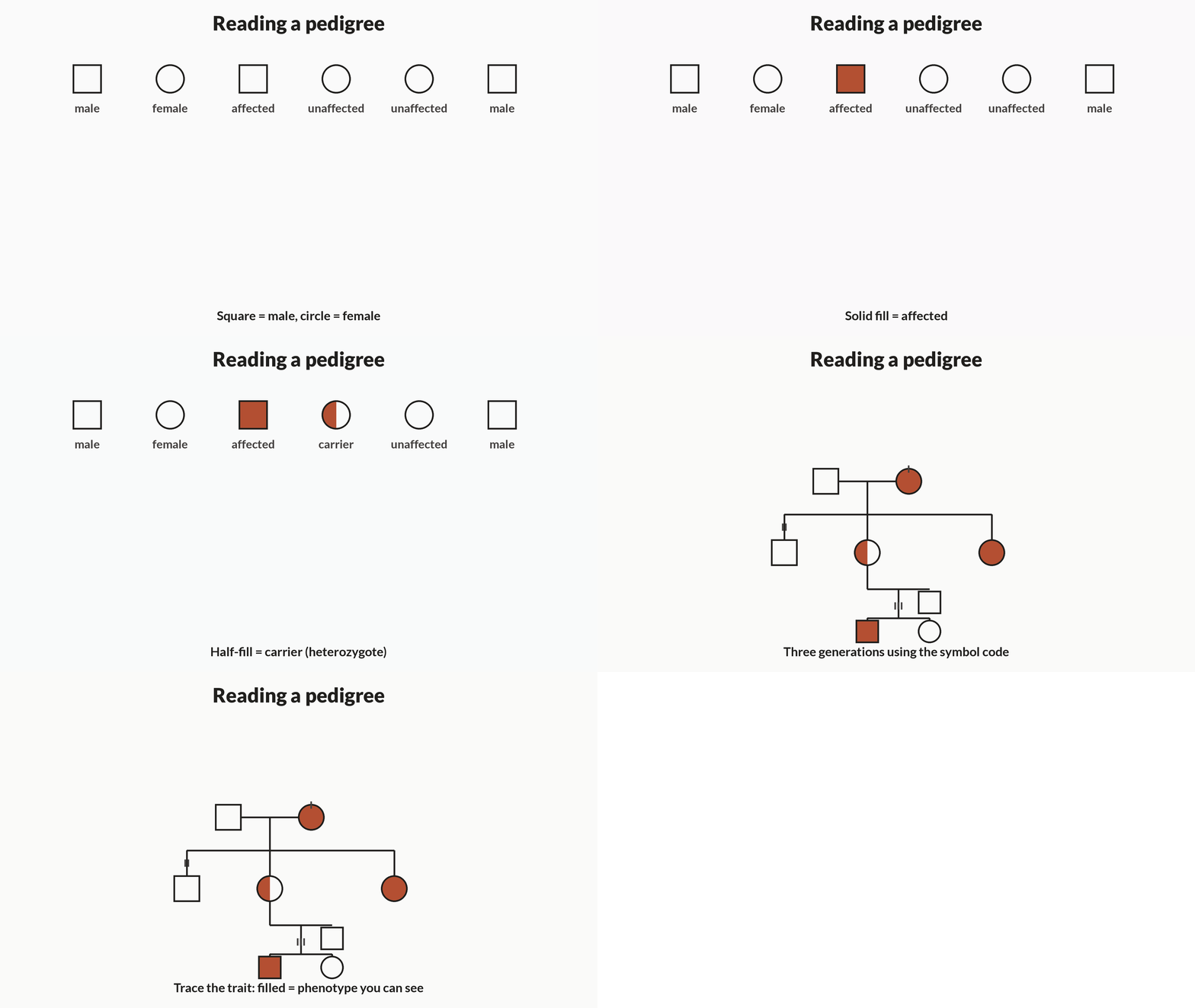
You cannot arrange crosses in humans, so human genetics is read backwards, off a family tree. A pedigree draws each male as a square and each female as a circle, joins a couple with a horizontal line, hangs their children beneath it, fills in the symbol of anyone affected, half-fills a circle for a known carrier and numbers the generations I, II, III down the left margin. What you are hunting for is a pattern, and each mode of inheritance leaves its own signature.
Not everything inherited is an allele, though. Down's syndrome comes from non-disjunction in meiosis: the two copies of chromosome 21 fail to separate, a gamete carries both, and the child ends up with three — a trisomy, 47 chromosomes in all, and the risk of that error rises with the mother's age. Klinefelter's syndrome (47, XXY) and Turner's syndrome (45, X0) arise the same way from the sex chromosomes. None of these segregates as a Mendelian allele, so none of them gives a Mendelian ratio.
| Pattern | Signature in the pedigree | Example |
|---|---|---|
| Autosomal dominant | Appears in every generation; an affected child usually has an affected parent; sons and daughters alike | Huntington's disease |
| Autosomal recessive | Skips generations; two unaffected parents can have an affected child; sons and daughters alike | Sickle-cell anaemia |
| X-linked recessive | Mostly males; never passes father to son; arrives through unaffected carrier mothers | Haemophilia |
| Chromosomal, from non-disjunction | Usually no family history — the error is fresh in one gamete; no Mendelian ratio | Down's syndrome |
Down's syndrome differs in kind from haemophilia because it
- Is caused by an extra copy of chromosome 21 rather than by an allele
- Is X-linked, whereas haemophilia is autosomal
- Appears in every generation of an affected family
Down's syndrome is a trisomy — 47 chromosomes, produced by non-disjunction — so there is no allele to segregate and no Mendelian ratio to predict. The second option has it backwards: haemophilia is the X-linked one and chromosome 21 is an autosome. The third describes autosomal dominant inheritance; a trisomy usually arises fresh, with no family history at all.
Notes
- Mendel's laws: the Law of Dominance, the Law of Segregation (paired alleles separate during gamete formation), and the Law of Independent Assortment (genes on different chromosomes assort independently).
- A monohybrid cross gives an F2 phenotypic ratio of 3:1 and a genotypic ratio of 1:2:1, while a dihybrid cross gives 9:3:3:1.
- Deviations from Mendelism include incomplete dominance (snapdragon flower colour, 1:2:1 phenotype), codominance (ABO blood groups) and multiple alleles.
- Linkage and recombination: genes on the same chromosome tend to be inherited together, and recombination frequency (Morgan's Drosophila work) measures the distance between them.
- Sex determination and disorders: humans are XX/XY; haemophilia and colour blindness are X-linked recessive, while Down's syndrome is trisomy of chromosome 21.
Formulas
- Monohybrid F2 phenotypic ratio =3:1
- Dihybrid F2 phenotypic ratio =9:3:3:1
- Test cross ratio (heterozygote × recessive) =1:1
- Number of gamete types =2^n (n = heterozygous gene pairs)
- Incomplete dominance F2 ratio =1:2:1 (phenotype = genotype)
Exam traps & shortcuts
- A test cross with a homozygous recessive reveals whether a dominant-phenotype individual is homozygous or heterozygous.
- In ABO blood groups I^A and I^B are codominant and both dominant over i, giving four phenotypes from three alleles.
- X-linked recessive traits (haemophilia, colour blindness) appear more often in males, passing from a carrier mother to her sons.
Reference tables
Each of these should be reconstructible from a grid in about fifteen seconds; the third column is what the ratio quietly assumes.
| Cross | Ratio | True only when |
|---|---|---|
| Monohybrid F2, phenotype | 3 : 1 | One gene, complete dominance |
| Monohybrid F2, genotype | 1 : 2 : 1 | Whenever the F1 is heterozygous — dominance is irrelevant to it |
| Test cross, one gene | 1 : 1 | Unknown is heterozygous; tester is homozygous recessive |
| Dihybrid F2, phenotype | 9 : 3 : 3 : 1 | Two unlinked genes, both fully dominant |
| Dihybrid test cross | 1 : 1 : 1 : 1 | Two unlinked genes |
| Incomplete dominance F2 | 1 : 2 : 1 | Phenotype and genotype coincide |
| Gamete types from n heterozygous pairs | 2ⁿ | Those n genes assorting independently |
| F2 genotypes from n heterozygous pairs | 3ⁿ | Those n genes assorting independently |
| Recombination frequency | 1 % = 1 map unit | Additive over short intervals; never above 50 % |
The dividing line that matters is the one between a faulty allele and a faulty chromosome count.
| Disorder | Genetic basis | How it shows |
|---|---|---|
| Haemophilia | X-linked recessive | Blood fails to clot; almost always male |
| Red-green colour blindness | X-linked recessive | Red and green confused; far commoner in men |
| Sickle-cell anaemia | Autosomal recessive; glutamic acid replaced by valine at the sixth position of the β-globin chain | Red cells sickle when oxygen is low |
| Phenylketonuria | Autosomal recessive; phenylalanine hydroxylase missing | Phenylalanine accumulates and is excreted as its derivatives; mental impairment if untreated |
| Thalassaemia | Autosomal recessive | Too little α or β globin made, so anaemia |
| Down's syndrome | Trisomy of chromosome 21, so 47 in all | Non-disjunction; risk rises with the mother's age |
| Klinefelter's syndrome | 47, XXY | Male, sterile, with some feminine development |
| Turner's syndrome | 45, X0 | Female, sterile, ovaries rudimentary |
Recap
Read only this the night before.
- Two ratios
- 3 : 1 is what you can see, 1 : 2 : 1 is what the plants carry. Only a test cross separates TT from Tt, and it gives 1 : 1.
- Multiply
- Independent genes multiply: round and green is 3/4 × 1/4 = 3/16. From n heterozygous pairs come 2ⁿ gamete types and 3ⁿ F2 genotypes.
- Broken dominance
- Pink snapdragon is incomplete dominance; AB blood is codominance, both antigens on one cell. Both give 1 : 2 : 1, so judge by the heterozygote, not the ratio. Three alleles, six genotypes, four groups.
- Linkage
- Linked genes give fewer recombinants than 50 %, and never more. 1 % recombination = 1 map unit; Morgan's flies gave 1.3 for yellow–white and 37.2 for white–miniature.
- X-linked
- A carrier mother affects 1/4 of her children but 1/2 of her sons, and half her daughters are carriers. No father passes an X-linked trait to a son.
- Not everything is an allele
- Down's (trisomy 21, 47), Klinefelter's (47, XXY) and Turner's (45, X0) come from non-disjunction and obey no Mendelian ratio.
Practise Principles of Inheritance and Variation
Reading is free and needs no account. Practice, mocks and progress live in the app.
- 5 exam-style questions on this topic, with explanations
- A 5-question practice set that ends the chapter
- Timed mocks scored with the real marking scheme
- Readiness tracked per topic, kept on your device