AP Exams (Advanced Placement) · Mathematics (JEE & NDA)
Permutations and Combinations
Fundamental principle of counting, arrangements and selections, and simple applications to counting problems.
Seven concepts. Counting is one skill with two forks — order matters, or it does not — and almost every JEE trap is choosing the wrong fork, or forgetting a repeat that overcounts.
- AP Exams (Advanced Placement)
- Medium level
- 7 concepts
- 5 practice questions
1Multiply for and, add for or
If one task can be done in m ways and an independent second task in n ways, doing both together can be done in m\times n ways. Mutually exclusive alternatives add: choose route A or route B and the total is m+n. The whole of permutations and combinations is this principle applied to ordered slots or to unordered groups.
Independence is the condition that costs marks. If choosing the first object changes how many choices remain for the second, you are already in the falling-factorial world of {}^nP_r, not a free m\times n product of fixed sizes.
Figure. A letter from \{A,B,C\} and then a digit from \{0,\ldots,9\} multiplies: 3\times10=30. Adding 3+10=13 would count an or of exclusive cases, not both tasks together.
How it works
- Name the tasksSplit the counting into successive decisions, each with a clear number of options.
- And versus orMultiply when every decision must be made; add only when the cases partition the total and cannot overlap.
- Watch dependenceIf an earlier choice removes options later, write the product as n(n-1)(n-2)\cdots, not as a constant m times a constant n.
A code has a letter from \{A,B,C\} then a digit from \{0,1,\ldots,9\}. The number of codes is
- 3+10=13
- 3\times10=30
- 3^{10}
Both a letter and a digit are required, and the choices are independent, so multiply: 3\times10=30. Adding would treat letter-or-digit as alternatives; 3^{10} invents a wrong exponential.
2Permutations count ordered arrangements
The number of ordered arrangements of r objects chosen from n distinct objects is {}^nP_r=\dfrac{n!}{(n-r)!}=n(n-1)\cdots(n-r+1). Order matters: AB and BA are different permutations.
When some of the n objects are identical — say p of one kind, q of another — the distinct linear arrangements of all n are \dfrac{n!}{p!\,q!\,\cdots}. Dividing by each repeat's factorial removes the swaps that look the same.
Figure. Ordered fillings of 3 seats from 5 objects: first seat 5 choices, then 4, then 3. The falling product is 5\times4\times3=60, matching 5!/(5-3)!.
How it works
- Fill seats in orderFirst place has n choices, second n-1, and so on down to n-r+1 for the r-th place.
- Compact as a factorialThe falling product is \dfrac{n!}{(n-r)!}. Use this form when a calculator or a later cancellation wants factorials.
- Divide out identical swapsIf p letters are the same, those p! internal swaps were never distinguishable — divide by p!, and likewise for every other repeated kind.
Falling product equals factorial form
Evaluate {}^5P_3 from the product definition and check it against \dfrac{5!}{(5-3)!}.
- {}^5P_3 = 5\times4\times360
- \dfrac{5!}{(5-3)!} = \dfrac{120}{2}60
- Both forms{}^5P_3 = 60
Pro tip. If a question asks for arrangements of r out of n and the seats are labelled (president, secretary, …), you want {}^nP_r, not {}^nC_r.
{}^6P_2 equals
- 15
- 30
- 12
6\times5=30, or \dfrac{6!}{4!}=30. 15 is {}^6C_2 — the unordered count — and 12 is 6\times2.
3Identical letters shrink the arrangement count
For a word whose letters are not all distinct, the distinct permutations of all letters are \dfrac{n!}{p!\,q!\,\cdots}, where n is the length and p,q,\ldots are the frequencies of the repeated letters. Skipping any one of those denominators overcounts by swapping identical letters that the eye cannot tell apart.
Figure. MISSISSIPPI has 11 letters with I four times, S four times and P twice. Distinct arrangements are 11!/(4!\,4!\,2!)=39916800/1152=34650.
How it works
- Count every letterList the frequency of each distinct character; n is the sum of those frequencies.
- Write n! in the numeratorThat would be the answer if every letter were distinct.
- Divide by each repeatFor each letter that appears k times, divide by k!. Omit a factor and you have counted invisible swaps.
Arrangements of a word with repeats
How many distinct arrangements are there of the letters of the word \text{MISSISSIPPI}?
- Letters: M(1), I(4), S(4), P(2); total n11
- Arrangements =\dfrac{11!}{1!\,4!\,4!\,2!}\dfrac{39916800}{1152}
- \dfrac{39916800}{1152}34650
Pro tip. Divide the total factorial by the factorial of each repeated letter's count; skipping any repeat overcounts the arrangements.
Distinct arrangements of the letters of \text{BOOK} equal
- 24
- 12
- 6
4 letters with O repeated twice: \dfrac{4!}{2!}=12. 24 is 4! with the repeat forgotten; 6 divides by an extra 2!.
4Combinations ignore order
The number of unordered selections of r objects from n distinct objects is {}^nC_r=\dfrac{n!}{r!(n-r)!}. Order does not matter: the pair {A, B} is one combination, whether you picked A first or B first.
Two identities are used constantly: {}^nC_r={}^nC_{n-r} (choosing who is in is choosing who is out), and Pascal's rule {}^nC_r+{}^nC_{r-1}={}^{n+1}C_r (a selection of r from n+1 either contains a fixed element or it does not).
C(n,r)=P(n,r)/r! drops order; the quotient is the definition, not a diagram.
How it works
- Decide order is irrelevantCommittees, teams and subsets use {}^nC_r. Ranked posts use {}^nP_r.
- Use symmetryPrefer {}^nC_r or {}^nC_{n-r}, whichever has the smaller r — the values are equal.
- Pascal when building larger nTo relate neighbouring rows of Pascal's triangle, split on whether a distinguished element is included.
| Ask for | Use | Link |
|---|---|---|
| Arrangements of r from n | {}^nP_r | {}^nP_r=r!\,{}^nC_r |
| Selections of r from n | {}^nC_r | {}^nC_r={}^nC_{n-r} |
| All distinct permutations of n | n! | Same as {}^nP_n |
Pascal's rule on small numbers
Verify {}^5C_2+{}^5C_1={}^6C_2.
- {}^5C_2=\dfrac{5!}{2!\,3!}10
- {}^5C_1=5; sum 10+515
- {}^6C_2=\dfrac{6!}{2!\,4!}15
Pro tip. Prefer the side of Pascal that has the smaller r: {}^nC_r={}^nC_{n-r}, so {}^10C_8 is just {}^10C_2.
{}^7C_2 equals
- 21
- 42
- 14
\dfrac{7\times6}{2}=21. 42 is {}^7P_2 — order kept — and 14 is 7\times2.
5Multiply combinations across groups
When a selection must take a fixed number from each of several groups — exactly k women from one pool and r-k men from another — choose inside each group with a combination, then multiply. The groups are independent once the quota for each is fixed.
For 'at least one' conditions on selections from n distinct objects, the clean route is the complement: total non-empty selections equal 2^n-1, because each object is in or out and the all-out case is forbidden.
Figure. Fix the quotas, then multiply: {}^5C_2=10 ways to choose the women and {}^7C_2=21 ways to choose the men, so 10\times21=210 committees. Adding the two combination counts would pick one group or the other, not both.
How it works
- Fix the quotaTranslate 'exactly two women' into {}^5C_2 for women and {}^7C_2 for the remaining seats among men, or whatever the pools are.
- Multiply across groupsIndependent combination counts multiply. Do not add them — that would choose a women-committee or a men-committee, not both.
- Prefer complement for 'at least'Compute total selections minus the forbidden all-excluded (or all-from-one-group) case, rather than summing many overlapping 'at least' cases.
Committee selection
From 7 men and 5 women, how many committees of 4 contain exactly 2 women?
- Women: {}^5C_210
- Men: {}^7C_221
- Total =10\times21210
Pro tip. When a fixed number from each group is required, multiply the independent combinations — order does not matter in a committee.
The number of non-empty subsets of a 4-element set is
- 15
- 16
- 8
2^4-1=15. 16 includes the empty set; 8 is 2^3.
6Circular arrangements fix one seat
Arranging n distinct objects in a circle gives (n-1)! distinct arrangements, not n!. Rotations of the same cyclic order are the same seating: fix one person's position and arrange the other n-1 in the remaining seats.
If reflections are identified — a necklace that can be flipped — divide by 2 as well, giving \dfrac{(n-1)!}{2} when n\ge3 and no extra symmetry intervenes.
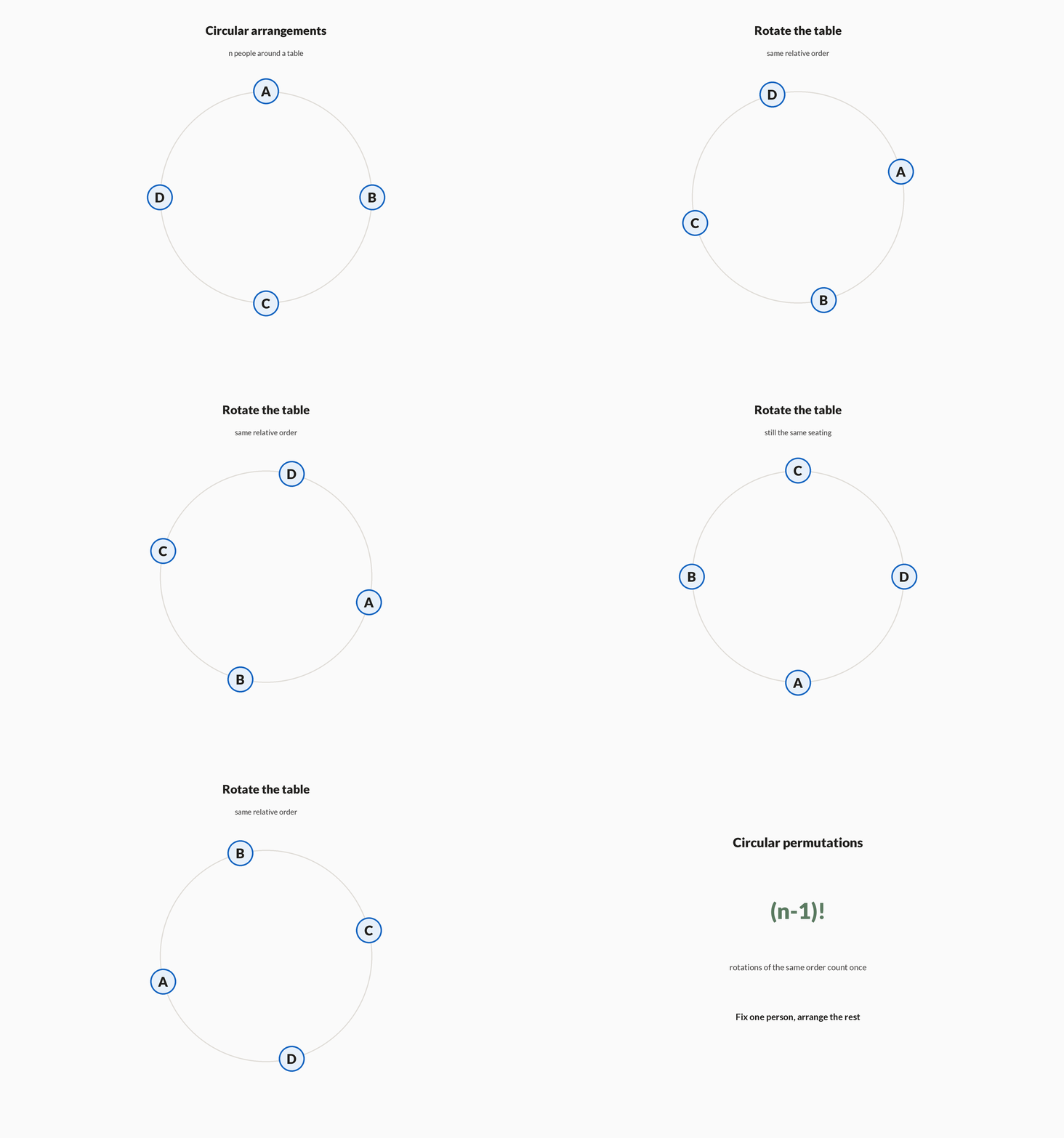
How it works
- Fix one objectPin one person (or bead) to remove the rotational copies.
- Arrange the restThe remaining n-1 objects may be permuted in (n-1)! ways around the circle.
- Flip only if askedDivide by 2 when the problem treats clockwise and anticlockwise as the same object (necklace, bracelet).
Distinct ways to seat 5 people around a round table (rotations same, flips different) equal
- 120
- 24
- 12
(5-1)!=24. 120 is 5! with rotation forgotten; 12 is the necklace count \dfrac{4!}{2}.
7Blocks, gaps, and identical distributions
Three standard restrictions reuse the same counting tools. To keep certain items together, tie them into a single block, arrange the blocks, then multiply by the internal arrangements of the block. For no-two-together constraints, arrange the unrestricted items first and place the restricted ones in the gaps between them (the gap method).
Distributing n identical objects into r distinct boxes with each box allowed zero or more is the stars-and-bars count {}^{n+r-1}C_{r-1}. That is a combination in disguise — the objects are identical, so only how many land in each box matters.
Glue items into a block (one super item) or place gaps between fixed items — the counting cases live in the steps.
How it works
- Together → one blockGlue the items that must stay together into a super item, arrange the super item with the others, then multiply by the internal permutations of the glue.
- Apart → gapsSeat the free items first; k free items in a line create k+1 gaps (including ends). Choose gaps for the restricted items so no two share a gap when the rule forbids adjacency.
- Identical into distinct boxesWrite {}^{n+r-1}C_{r-1} when objects are identical, boxes are distinct, and empty boxes are allowed.
| Restriction | Move | Typical factor |
|---|---|---|
| Items must stay together | One block | Internal k! for a block of k |
| No two of a type adjacent | Gap method | Place free items, then choose gaps |
| n identical, r distinct boxes, \ge0 each | Stars and bars | {}^{n+r-1}C_{r-1} |
The number of ways to distribute 5 identical sweets into 3 distinct boxes (empty allowed) is
- {}^5C_3=10
- {}^7C_2=21
- 3^5=243
Stars and bars with empties allowed: {}^{5+3-1}C_{3-1}={}^7C_2=21. {}^5C_3 ignores the +r-1 shift; 3^5 would count if the sweets were distinct.
Notes
- Fundamental principle of counting: If one task can be done in m ways and a second in n ways, both together can be done in m\times n ways (multiplication for 'and'); mutually exclusive choices add (m+n for 'or').
- Permutations: The number of ordered arrangements of r objects from n distinct objects is {}^nP_r=\dfrac{n!}{(n-r)!}. Arrangements of n objects with repetitions p,q,\dots alike are \dfrac{n!}{p!\,q!\dots}.
- Combinations: The number of unordered selections of r from n is {}^nC_r=\dfrac{n!}{r!(n-r)!}, satisfying {}^nC_r={}^nC_{n-r} and Pascal's rule {}^nC_r+{}^nC_{r-1}={}^{n+1}C_r.
- Circular permutations and grouping: Arranging n distinct objects in a circle gives (n-1)! ways (and \dfrac{(n-1)!}{2} if reflections coincide, as with a necklace). To keep certain items together, treat them as one block.
- Distribution and selection with restrictions: The number of ways to distribute n identical objects into r distinct boxes (each \ge0) is {}^{n+r-1}C_{r-1}. The total number of ways to select at least one from n distinct objects is 2^n-1.
Formulas
- Permutations: {}^nP_r=\dfrac{n!}{(n-r)!}
- Combinations: {}^nC_r=\dfrac{n!}{r!(n-r)!},\quad {}^nC_r={}^nC_{n-r}
- Pascal's rule: {}^nC_r+{}^nC_{r-1}={}^{n+1}C_r
- With repetition alike: \dfrac{n!}{p!\,q!\,\dots}
- Circular: (n-1)! arrangements
- Identical into boxes: {}^{n+r-1}C_{r-1}
Exam traps & shortcuts
- Use the 'gap method' for no-two-together problems: arrange the unrestricted items first, then place the restricted ones in the gaps between them.
- For 'at least one' conditions, subtract the forbidden cases from the total (2^n-1 for selections) rather than adding many cases.
- Whenever specific objects must stay together, tie them into a single block, arrange the blocks, then multiply by the internal arrangements of the block.
Reference tables
Closed forms this chapter actually uses. Reach for {}^nP_r when order matters and {}^nC_r when it does not.
| Name | Formula | Use when |
|---|---|---|
| Permutations | {}^nP_r=\dfrac{n!}{(n-r)!} | Ordered arrangements of r from n |
| Combinations | {}^nC_r=\dfrac{n!}{r!(n-r)!} | Unordered selections; also {}^nC_r={}^nC_{n-r} |
| Pascal | {}^nC_r+{}^nC_{r-1}={}^{n+1}C_r | Relating neighbouring binomial rows |
| With repeats alike | \dfrac{n!}{p!\,q!\,\cdots} | Distinct permutations of a multiset |
| Circular | (n-1)! | Rotations identified; \dfrac{(n-1)!}{2} if flips too |
| Identical into boxes | {}^{n+r-1}C_{r-1} | n identical, r distinct, empty allowed |
| Non-empty selections | 2^n-1 | At least one from n distinct objects |
Recap
Read only this the night before.
- And / or
- Independent successive choices multiply; mutually exclusive cases add. Dependence turns a constant product into a falling factorial.
- Order
- {}^nP_r keeps order; {}^nC_r throws it away. Link: {}^nP_r=r!\,{}^nC_r.
- Repeats
- Divide n! by each repeated letter's factorial — MISSISSIPPI is 34650, not 11!.
- Circle
- (n-1)! seatings; halve again only when the problem identifies reflections.
- Restrictions
- Together → block; apart → gaps; 'at least one' → complement (2^n-1 for subsets).
- Identical goods
- Stars and bars {}^{n+r-1}C_{r-1} when objects match and boxes do not.
Practise Permutations and Combinations
Reading is free and needs no account. Practice, mocks and progress live in the app.
- 5 exam-style questions on this topic, with explanations
- A 6-question practice set that ends the chapter
- Timed mocks scored with the real marking scheme
- Readiness tracked per topic, kept on your device