AP Exams (Advanced Placement) · Physics (JEE & NEET)
Electromagnetic Waves
Displacement current, transverse nature of electromagnetic waves, their speed in vacuum and the electromagnetic spectrum from radio waves to gamma rays.
Six concepts — the whole chapter, and the shortest in the syllabus. It is worth about one question in Main and that question is almost always a substitution, so the mark turns on a factor of two: which ½ is the average of a square, which 2 is a reflection, and whether the symbol in front of you is an amplitude or the field right now.
- AP Exams (Advanced Placement)
- Easy level
- 6 concepts
- 5 practice questions
1Displacement current
Ampère's law in its original form contradicts itself the moment a capacitor charges. Take a loop around the lead wire. Stretch a flat surface across it and the conduction current pierces that surface; bulge the same surface sideways into the gap between the plates and nothing pierces it at all — yet the loop has not moved, so the law must give two different answers. Maxwell's repair was a second source of magnetic field: a changing electric flux. I_d = ε₀ dΦ_E/dt, and the line integral of B around the loop becomes μ₀(I + I_d).
Nothing crosses the gap. No charge moves there at all, and the word current is pure bookkeeping — but the term is exactly the right size to close the gap, and adding it made the four equations consistent and immediately predicted waves.
Figure. Charge arrives at the left plate and stops. The field between the plates grows to take over, and the flux term it generates is the same size as the current that stopped — so a magnetometer swept along the outside of this figure would find nothing special happening at the gap.
How it works
- Charge stops at the plateConduction current runs up the wire to the plate and no further; charge piles up there.
- The field growsThat piling charge raises E = q/ε₀A between the plates, so the electric flux climbs.
- Flux takes overε₀ dΦ_E/dt picks up exactly where the conduction current stopped, so B is continuous across the gap.
The current that carries no charge
A parallel-plate capacitor with circular plates of radius 6.0 cm is charged by a steady current of 0.15 A. Find the rate at which the field between the plates grows, the displacement current, and the magnetic field 12 cm from the axis.
- A = π(0.06)²1.131 × 10⁻² m²
- dE/dt = I/(ε₀A) = 0.15/(8.85×10⁻¹² × 1.131×10⁻²)1.50 × 10¹² V m⁻¹ s⁻¹
- I_d = ε₀A (dE/dt)0.15 A — the lead current exactly
- At r = 12 cm, beyond the plate edge: B = μ₀I_d/2πr2.5 × 10⁻⁷ T
Pro tip. You never needed the first two rows. Put E = q/ε₀A into I_d = ε₀A(dE/dt) and the ε₀A cancels, leaving dq/dt — the lead current, whatever the plate area or separation. That cancellation is the whole content of the idea: the extra term was built to be exactly the size that keeps the current continuous.
While a capacitor charges with 2 A flowing in its leads, the displacement current in the gap between the plates is
- Zero, because no charge crosses the gap
- 2 A, equal to the conduction current in the leads
- 2 A divided by ε₀, since the gap is empty
No charge does cross the gap — that part of the first option is true, and it is why the option is tempting. But I_d = ε₀A(dE/dt) with E = q/ε₀A collapses to dq/dt = 2 A. The displacement current is not made of moving charge; it is a changing field that produces a magnetic field just as a real current would.
2Transverse fields and the direction of travel
An electromagnetic wave is transverse twice over: E is perpendicular to the direction of travel, B is perpendicular to it, and the two fields are perpendicular to each other. The order matters — the wave travels along E × B, never along B × E. Nothing material oscillates, only the fields, so no medium is required; and because the fields carry momentum as well as energy, the wave pushes on whatever stops it.
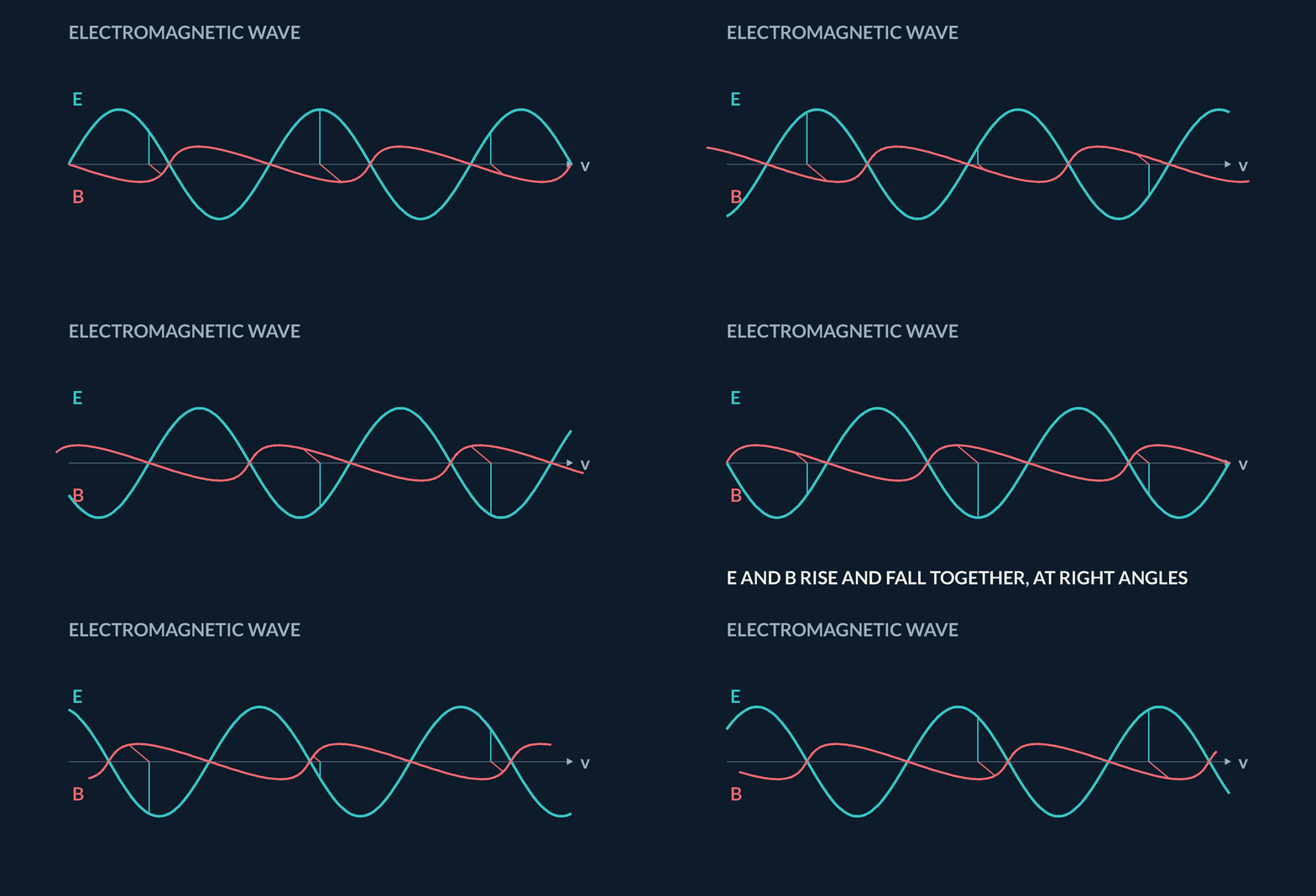
For a plane wave in vacuum the two fields are in phase. They peak together and vanish together, so the energy density the wave carries pulses at twice the wave's own frequency rather than staying constant.
The right-hand rule, in three moves
- Fingers along EHold your right hand flat with the fingers pointing the way the electric field points.
- Curl toward BCurl them through the right angle into the magnetic field's direction — never the other way.
- Thumb is the travelYour thumb now lies along E × B, which is where the wave and its energy are going.
Reading a wave off its equation
A plane wave in vacuum has E = 30 sin(1.5×10⁷ z − 4.5×10¹⁵ t) V m⁻¹, pointing along x̂. Find the direction of travel, confirm the medium, find the direction of B and its amplitude.
- Phase is (kz − ωt), so a crest keeps z rising with ttravel along +z
- ω/k = 4.5×10¹⁵/1.5×10⁷3 × 10⁸ m s⁻¹, so vacuum
- E along x̂ with E × B along ẑ, and x̂ × ŷ = ẑB along +y
- B₀ = E₀/c = 30/(3×10⁸)1 × 10⁻⁷ T
Pro tip. Row one is the whole trick: a minus sign inside the bracket sends the wave toward +z, a plus sign toward −z. Everything else is then forced — B cannot be chosen, it is whichever of ±ŷ makes E × B point where the wave is going. Two free checks come with this wave: ω/k must equal c, and 2π/k = 419 nm puts it at the violet end of the visible band, which is the sort of sanity you get for nothing.
A plane electromagnetic wave travels along +z. At one instant its magnetic field at a point is along +x. The electric field there is along
- +y
- −y
- +z
Keep the order: it is E × B that must point along +z, not B × E. Try E along +y and you get ŷ × x̂ = −ẑ, which sends the wave backwards — so E is along −y, giving (−ŷ) × x̂ = +ẑ. Swapping the two vectors in a cross product reverses it, and that is the commonest way to drop this mark. +z is impossible outright: E is transverse, so it never lies along the travel.
3Speed, and the ratio of the two amplitudes
Maxwell's equations fix the speed with no wave anywhere in sight: c = 1/√(μ₀ε₀), assembled out of one constant measured with capacitors and another measured with current-carrying wires. It comes out at 3 × 10⁸ m s⁻¹, and that coincidence with the measured speed of light is the entire reason anyone believed light was an electromagnetic wave. In a medium the same argument gives v = 1/√(με) = c/n.
At every point and every instant the two field magnitudes are locked together, E = cB, so the amplitudes obey E₀ = cB₀. Inside a medium it becomes E₀ = vB₀: the ratio is the wave's own speed, not c.
Figure. A snapshot along the direction of travel. Every peak of E sits directly above a peak of B and every zero above a zero — the two fields are in phase, not a quarter cycle apart. The two traces are drawn on separate vertical scales, each about its own zero line: on a common scale B would be flat, because B₀ = E₀/c.
How it works
- Two constants, one speedμ₀ comes from magnetostatics and ε₀ from electrostatics; their product alone fixes c.
- Amplitudes are lockedE₀ = cB₀, so in SI numbers B₀ is smaller than E₀ by a factor of three hundred million.
- Slower in matterv = c/n. The source fixes the frequency, so it is the wavelength that shrinks, λ′ = λ/n.
How small is the magnetic field?
A plane electromagnetic wave in vacuum has an electric field amplitude of 60 V m⁻¹. Find B₀ and the ratio of the two amplitudes, check c against the two constants, and say what changes in glass of refractive index 1.5.
- B₀ = E₀/c = 60/(3×10⁸)2 × 10⁻⁷ T = 0.2 μT
- B₀/E₀ = 1/c3.3 × 10⁻⁹ s m⁻¹
- c = 1/√(μ₀ε₀) = 1/√(1.257×10⁻⁶ × 8.85×10⁻¹²)3.00 × 10⁸ m s⁻¹
- In glass, v = c/n and E₀/B₀ = v2 × 10⁸ m s⁻¹, not c
Pro tip. The ratio in row two is 1/c = 3.3 × 10⁻⁹, not 10⁻⁸ — worth pinning down, because a rule of thumb quoted a factor of three out will not save you on a two-mark substitution. In practice: divide by 3 × 10⁸ and expect microtesla or less. If B₀ comes back anywhere near a tesla you multiplied by c instead of dividing.
An electromagnetic wave travels through glass of refractive index 1.5. Inside the glass the ratio E₀/B₀ is
- 3 × 10⁸ m s⁻¹, since E₀ = cB₀ always
- 2 × 10⁸ m s⁻¹
- 4.5 × 10⁸ m s⁻¹
The ratio of the field amplitudes is the speed of the wave in whatever it is travelling through, so in glass it is v = c/n = 2 × 10⁸ m s⁻¹. E₀ = cB₀ is the vacuum special case of E₀ = vB₀, and reading it as universal is the standard slip here. Multiplying by n instead of dividing gives the third option.
4Energy density, and where the halves go
A field stores energy: ½ε₀E² per cubic metre in the electric field and B²/2μ₀ in the magnetic. In a plane wave those two are equal at every point and every instant, because B = E/c and c² = 1/μ₀ε₀ turn the second expression into the first. So the total is u = ε₀E² — and that E is the field right now, not the amplitude.
Average over a cycle and the mean of sin² is ½, so u_avg = ½ε₀E₀². Two different halves are loose in this chapter and they are not the same half: one comes from splitting the energy between two fields, the other from averaging a square over time.
Figure. Energy density never goes negative — it follows sin², so it has twice as many humps as the field itself, touching zero where the field passes through zero. The dashed line is the mean, and it sits at exactly half the peak. That halving, and nothing else, is where the ½ in ½ε₀E₀² comes from.
How it works
- Add the two storesu = ½ε₀E² + B²/2μ₀, the same two expressions as for a capacitor and an inductor.
- They are always equalu_B/u_E = c²B²/E² = 1 for any plane wave, so u is just twice either one: u = ε₀E².
- Then averageE swings as a sine, so ⟨E²⟩ = ½E₀² and the average density is ½ε₀E₀².
Splitting the energy in two ways
The same wave, with E₀ = 60 V m⁻¹ and therefore B₀ = 2 × 10⁻⁷ T. Find the peak and average energy densities, then check the electric and magnetic shares separately.
- Peak: u_max = ε₀E₀² = 8.85×10⁻¹² × 36003.19 × 10⁻⁸ J m⁻³
- Average: u_avg = ½ε₀E₀²1.59 × 10⁻⁸ J m⁻³
- Electric share of the average: ε₀E₀²/47.97 × 10⁻⁹ J m⁻³
- Magnetic share: B₀²/4μ₀ = (2×10⁻⁷)²/(5.03×10⁻⁶)7.96 × 10⁻⁹ J m⁻³
Pro tip. The last two rows differ by a tenth of a percent, and the whole of that residue is because B₀ was found with c rounded to 3 × 10⁸. Equal halves is not a property of this particular wave: u_B/u_E = (B²/2μ₀)/(½ε₀E²) = c²B²/E², which is 1 for every plane wave in vacuum. So you may always work with the electric field alone and double it — but double the instantaneous ½ε₀E², not the average, or you land a factor of two out.
A plane wave in vacuum has electric field amplitude E₀. Its average total energy density is
- ε₀E₀²
- ½ε₀E₀²
- ¼ε₀E₀²
ε₀E₀² is the peak, reached twice a cycle and not the average. ¼ε₀E₀² is the average of the electric part alone — right quantity, half the answer, because the magnetic field stores exactly as much again. Averaging sin² over a cycle gives ½, so the total average is ½ε₀E₀².
5Intensity, momentum and radiation pressure
Intensity is the energy crossing unit area per second. The wave sweeps its average energy density along at speed c, so a column of length c passes every second and I = u_avg c = ½ε₀cE₀². The same ½ as before, and the same warning attached to it: E₀ is the amplitude.
An electromagnetic wave carries momentum too — U/c for every U of energy. A black surface absorbs the energy and with it all the momentum, so the pressure on it is I/c. A mirror sends the momentum back the way it came, so the change is twice as large and the pressure is 2I/c, even though the mirror keeps none of the energy.
Figure. Left: the momentum arrives and stops, one unit of change. Right: it arrives and leaves the other way, two units. Both beams are at normal incidence — the outgoing arrow is drawn below the incoming one only so the two do not lie on top of each other.
How it works
- Density times speedEverything within c metres of a surface arrives within a second, so I = u_avg c.
- Energy brings momentumEach joule delivered carries U/c of momentum, and force is momentum delivered per second.
- Reflection doubles itStopping momentum is one unit of change; reversing it is two. Hence I/c against 2I/c.
| Where it appears | The expression | Where the factor comes from |
|---|---|---|
| Total energy density, instantaneous | u = ε₀E² | The magnetic half equals the electric half, so the ½ doubles away |
| Total energy density, averaged | u_avg = ½ε₀E₀² | The mean of sin² over a cycle is ½ |
| Intensity | I = u_avg c = ½ε₀cE₀² | The same ½; c only converts a density into a flux |
| Pressure on a black surface | p = I/c | The momentum arriving is stopped |
| Pressure on a mirror | p = 2I/c | The momentum is reversed, so the change is doubled |
The push of sunlight
Sunlight reaches the top of the atmosphere with an intensity of 1.4 kW m⁻². Find the electric and magnetic field amplitudes, and the pressure it exerts on a perfectly black surface and on a mirror.
- E₀ = √(2I/ε₀c) = √(2×1400/(8.85×10⁻¹² × 3×10⁸))1.03 × 10³ V m⁻¹
- B₀ = E₀/c3.4 × 10⁻⁶ T
- Black surface: p = I/c = 1400/(3×10⁸)4.7 × 10⁻⁶ Pa
- Mirror: p = 2I/c9.3 × 10⁻⁶ Pa
Pro tip. Nine micropascals against an atmosphere of 10⁵ Pa — about ten billion times smaller, which is why nobody has ever felt sunlight push. It also explains the shape of a solar sail: with 9 μPa to work with, the only way to a useful force is square kilometres of it. And note what row four does not say: the mirror keeps none of the energy and still feels twice the push, because pressure is about momentum changed, not energy kept.
A beam of intensity I falls normally on a perfectly reflecting mirror. The radiation pressure on it is
- I/c, the same as on a black surface
- 2I/c
- I/2c, because the mirror absorbs nothing
Each second, momentum I/c arrives on unit area. The mirror does not merely stop it, it sends it back, so the momentum change is 2I/c per second — and force is momentum change per second. Absorbing nothing makes the push larger, not smaller: the third option gets the physics exactly backwards.
6The spectrum
One family, eighteen decades wide. In order of rising frequency: radio, microwave, infrared, visible, ultraviolet, X-rays, gamma rays. All of them travel at c in vacuum and all obey c = fλ, so the same list read left to right is wavelength falling. What genuinely changes along the range is how they are made and what they interact with — oscillating charge in an aerial at the bottom, molecular vibration in the infrared, outer-electron transitions in the visible, inner-electron transitions for X-rays, and the nucleus itself for gamma rays.
Visible light, the band that named optics and built every eye on the planet, is about a quarter of one decade out of the eighteen.
Figure. The scale is logarithmic in frequency, eighteen decades from 10⁴ Hz to 10²² Hz, and the tick marks are the conventional band edges laid down at their true positions. The two ticks that almost touch are the edges of the visible band: everything human sight has ever been built on is that sliver.
How it works
- Order by frequencyRadio, micro, infra, visible, ultra, X, gamma. Frequency and photon energy rise together.
- Wavelength runs backwardsc = fλ with c fixed, so every step up in frequency is a step down in wavelength.
- The source climbs with fCircuits, then molecules, then outer electrons, then inner electrons, then nuclei.
An oven and a leaf, five decades apart
A microwave oven runs at 2.45 GHz. Find its wavelength in vacuum, and compare it with green light of wavelength 550 nm.
- λ = c/f = 3×10⁸/2.45×10⁹0.122 m, i.e. 12.2 cm
- Green light: f = c/λ = 3×10⁸/5.5×10⁻⁷5.45 × 10¹⁴ Hz
- Ratio of the frequencies2.2 × 10⁵
- Speed of each of them in vacuum3 × 10⁸ m s⁻¹, identical
Pro tip. The oven door is a metal sheet punched with holes about a millimetre across, and it works because of row one. Radiation of 12 cm wavelength cannot pass an aperture a hundred times smaller than itself, so it is reflected; 550 nm light is two thousand times smaller than a hole and strolls through, which is how you watch your dinner. One door, one speed, opposite behaviour — decided by λ alone.
A beam of red light passes from air into glass. Which of its properties is unchanged?
- Its wavelength
- Its frequency
- Its speed
The source sets the frequency and the boundary cannot alter it — the field on one side has to keep step with the field on the other. Speed drops to c/n and wavelength drops with it, λ′ = λ/n. This is also why a band assignment is permanent: glass slows red light, but it does not turn it into infrared.
Notes
- Displacement current: Maxwell added a term I_d=\varepsilon_0\dfrac{d\Phi_E}{dt} to Ampere's law so that a changing electric field (as between capacitor plates) also produces a magnetic field, making the laws consistent and predicting EM waves.
- Nature of EM waves: Electromagnetic waves are transverse, with \vec{E} and \vec{B} mutually perpendicular and both perpendicular to the propagation direction \hat{k} (along \vec{E}\times\vec{B}). They need no medium and carry momentum as well as energy.
- Speed and field relation: In vacuum c=\dfrac{1}{\sqrt{\mu_0\varepsilon_0}}\approx3\times10^8\text{ m/s}; in a medium v=\dfrac{1}{\sqrt{\mu\varepsilon}}=\dfrac{c}{n}. The field amplitudes obey E_0=cB_0.
- Energy and intensity: The energy density is shared equally between electric and magnetic fields, u=\tfrac12\varepsilon_0E^2+\dfrac{B^2}{2\mu_0}. Intensity is I=\dfrac12\varepsilon_0 c E_0^2, and radiation exerts pressure \dfrac{I}{c} (absorbing) or \dfrac{2I}{c} (reflecting).
- Electromagnetic spectrum: In order of increasing frequency: radio, microwave, infrared, visible, ultraviolet, X-rays and gamma rays. All travel at c in vacuum but differ in wavelength, energy and how they are produced and detected.
Formulas
- Displacement current: I_d=\varepsilon_0\dfrac{d\Phi_E}{dt}
- Speed: c=\dfrac{1}{\sqrt{\mu_0\varepsilon_0}},\quad v=\dfrac{c}{n}
- Field ratio: E_0=cB_0,\quad c=\dfrac{E_0}{B_0}
- Energy density: u=\tfrac12\varepsilon_0E^2+\dfrac{B^2}{2\mu_0}
- Intensity: I=\tfrac12\varepsilon_0 c E_0^2
- Radiation pressure: P=\dfrac{I}{c} (absorbed), \dfrac{2I}{c} (reflected)
Exam traps & shortcuts
- Remember the field amplitude ratio E_0=cB_0: since c\approx3\times10^8, the magnetic amplitude is tiny compared with the electric one for the same wave.
- Order the spectrum with a mnemonic (Radio, Micro, Infra, Visible, Ultra, X, Gamma) - frequency and photon energy increase left to right while wavelength decreases.
- Electric and magnetic energy densities in an EM wave are always equal, so the total energy density is simply \varepsilon_0 E^2 (or B^2/\mu_0).
Reference tables
Boundaries are conventional and the bands overlap at their edges — an X-ray and a gamma ray of the same frequency differ only in where they were made. Every row satisfies λ = c/f with c = 3 × 10⁸ m s⁻¹; check any one of them.
| Band | Frequency | Wavelength in vacuum | Made by, and used for |
|---|---|---|---|
| Radio | below 10⁹ Hz | above 30 cm | Oscillating charge in an aerial; broadcasting, television, mobile telephony |
| Microwave | 10⁹ – 3 × 10¹¹ Hz | 1 mm – 30 cm | Magnetrons and klystrons; radar, ovens, satellite links |
| Infrared | 3 × 10¹¹ – 4 × 10¹⁴ Hz | 750 nm – 1 mm | Hot bodies and molecular vibration; heating, remote controls, thermal imaging |
| Visible | 4 × 10¹⁴ – 7.5 × 10¹⁴ Hz | 400 – 750 nm | Outer-electron transitions; sight and photosynthesis |
| Ultraviolet | 7.5 × 10¹⁴ – 3 × 10¹⁶ Hz | 10 – 400 nm | The Sun, arcs and sparks; sterilising — ozone absorbs most of it before it lands |
| X-rays | 3 × 10¹⁶ – 3 × 10¹⁹ Hz | 10 pm – 10 nm | Fast electrons stopped in a metal target; imaging bone, crystal structure |
| Gamma rays | above 3 × 10¹⁹ Hz | below 10 pm | Nuclear transitions and radioactive decay; radiotherapy, sterilising |
Every line here should be reconstructible from the concept above it, not merely recalled.
| Quantity | Relation | Watch for |
|---|---|---|
| Displacement current | I_d = ε₀ dΦ_E/dt | In a capacitor gap it equals the lead current exactly |
| Ampère–Maxwell | ∮B·dl = μ₀(I + I_d) | Both terms, or the two surfaces disagree |
| Speed in vacuum | c = 1/√(μ₀ε₀) | Two static constants, no wave needed |
| Speed in a medium | v = 1/√(με) = c/n | f is fixed by the source; λ′ = λ/n |
| Field amplitudes | E₀ = cB₀ | In a medium it is E₀ = vB₀, not cB₀ |
| Direction of travel | along E × B | Never B × E; both fields are transverse |
| Energy density, instantaneous | u = ½ε₀E² + B²/2μ₀, and = ε₀E² for a plane wave | E here is the field now, not E₀ |
| Energy density, averaged | u_avg = ½ε₀E₀² | The ½ is the mean of sin², not the field split |
| Intensity | I = u_avg c = ½ε₀cE₀² = cB₀²/2μ₀ | Amplitude squared, and only one ½ |
| Momentum delivered | p = U/c | Energy and momentum arrive together |
| Radiation pressure | at normal incidence, I/c absorbing and 2I/c reflecting | The mirror keeps no energy and feels twice the push |
| Whole spectrum | c = fλ in vacuum, every band | Gamma rays are not faster, only shorter |
Recap
Read only this the night before.
- Displacement current
- A changing electric flux is a current as far as Ampère's law cares. In a charging capacitor's gap, ε₀dΦ_E/dt equals the lead current exactly, so the magnetic field is continuous across the gap although no charge crosses it.
- Geometry
- E ⊥ B ⊥ travel, and the wave goes along E × B. The two fields are in phase: they peak together and vanish together.
- Speed
- c = 1/√(μ₀ε₀) = 3 × 10⁸ m s⁻¹. E₀ = cB₀, so B₀ is 1/c = 3.3 × 10⁻⁹ times E₀ in SI numbers. In a medium the ratio is v = c/n, not c.
- Energy
- u = ε₀E² instantaneously, ½ε₀E₀² on average. The electric and magnetic halves are always equal, however tiny B looks.
- Intensity and push
- I = u_avg c = ½ε₀cE₀². Pressure is I/c on a black surface and 2I/c on a mirror — momentum reversed is twice momentum stopped.
- Spectrum
- Radio, micro, infra, visible, ultra, X, gamma: f up, λ down, c the same for all. Visible is a quarter of a decade out of eighteen.
Practise Electromagnetic Waves
Reading is free and needs no account. Practice, mocks and progress live in the app.
- 5 exam-style questions on this topic, with explanations
- A 5-question practice set that ends the chapter
- Timed mocks scored with the real marking scheme
- Readiness tracked per topic, kept on your device