CLAT (Common Law Admission Test) · General Intelligence & Reasoning
Cubes & Dice
Problems on dice faces, opposite faces and counting painted or cut cubes.
Cubes-and-dice questions split into two skills that share one object: a cube. The first skill reads opposite faces from two or more views of a die — you never need a 3D sketch if you fix the face that appears in both views and list everything that sits next to it. The second skill counts painted small cubes after an n\times n\times n cut — four position classes, four formulae in n. Hold two running objects through this topic: a die that shows 2 on top in both views (3 then 5 on the front), and a cube painted on all six faces then cut into a 3\times 3\times 3 of 27 unit cubes. Dice first, paint second; do not reach for sum-to-7 on a die whose views already forbid it.
- CLAT (Common Law Admission Test)
- Medium level
- 6 concepts
- 45 practice questions
1Opposite faces from shared views
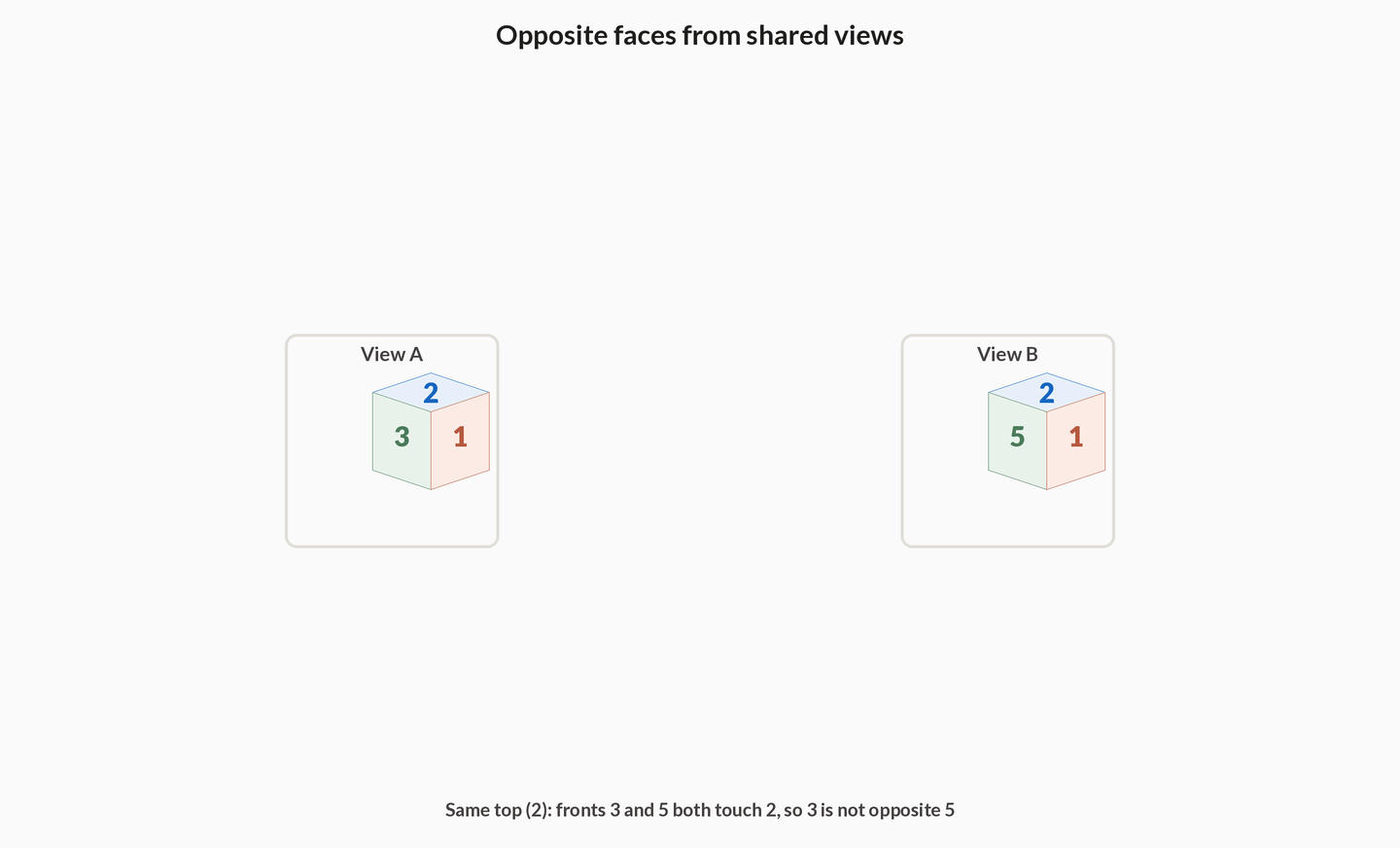
A die question shows you two or three pictures of the same cube, each revealing three faces that meet at a corner. The pictures are different rotations of one object, not different dice. When two or more views of a die share a common face, every face that appears next to that common face is adjacent to it — so none of those neighbours can be its opposite. Adjacent means they share an edge; opposite means they never touch. Six faces, three opposite pairs. Name the shared face, then name everything the pictures put beside it.
Hold the running die. View 1: 2 on top, 3 facing front. View 2: 2 on top, 5 facing front. The common face is 2, fixed on top in both pictures. In view 1, 3 sits on the front wall under that 2, so 3 shares an edge with 2 — adjacent, never opposite. In view 2, 5 sits on the front wall under that same 2, so 5 is also adjacent to 2. The opposite of 2 is whichever face never appears next to it. 3 and 5 are both neighbours; neither can be the opposite.
Faces that take the same slot (for example front) while the common face stays fixed are both adjacent to that common face; whether they are adjacent or opposite to each other depends on the turn between views, so do not treat "same slot" as proof they neighbour each other. 3 and 5 both sat in the front slot under a fixed 2; that proves each touches 2, not that 3 touches 5 or that 3 is opposite 5. Do not reach for sum-to-7 here: these views put 2 next to 5, which a standard die forbids.
Order of attack
- Anchor the common faceFind the face that appears in both views and treat its position as fixed. Here that face is 2, on top in view 1 and on top in view 2. If no face is shared, you do not yet have a common-face question.
- List the beltCollect every face that appears beside the common face across the views — those are adjacent to it, never opposite it. View 1 puts 3 next to 2; view 2 puts 5 next to 2. The belt of 2 includes 3 and 5.
- Name what the views forceThe opposite of the common face is whichever face never appears next to it. 3 and 5 are both neighbours of 2, so neither is opposite 2. Naming the opposite of a belt face needs more views, or a standard-die stem whose views do not put a sum-7 pair on adjacent faces.
Neighbours of a shared face
Two positions of a die show: view 1 has 2 on top with 3 facing front; view 2 has 2 on top with 5 facing front. Which numbers cannot be opposite 2?
- Common face across both views2 fixed on top
- View 1: 3 on front with 2 on top3 adjacent to 2
- View 2: 5 on front with 2 on top5 adjacent to 2
- Opposite of 2neither 3 nor 5 — both are neighbours; opposite is the unseen face
Pro tip. Fix the common face across views; every face that appears beside it is adjacent to it. Do not reach for sum-to-7 here — these views put 2 next to 5, which a standard die forbids.
Two views keep 4 on top. View 1 shows 2 in front; view 2 shows 6 in front. Which statement must be true?
- 2 is opposite 6
- 2 and 6 are both adjacent to 4
- 4 is opposite 2
Anything that appears beside the fixed top face is adjacent to it, so 2 and 6 are both neighbours of 4 and neither can be opposite 4. Whether 2 is opposite 6 depends on the turn between the views; the stem does not force that.
2Standard die opposites sum to 7
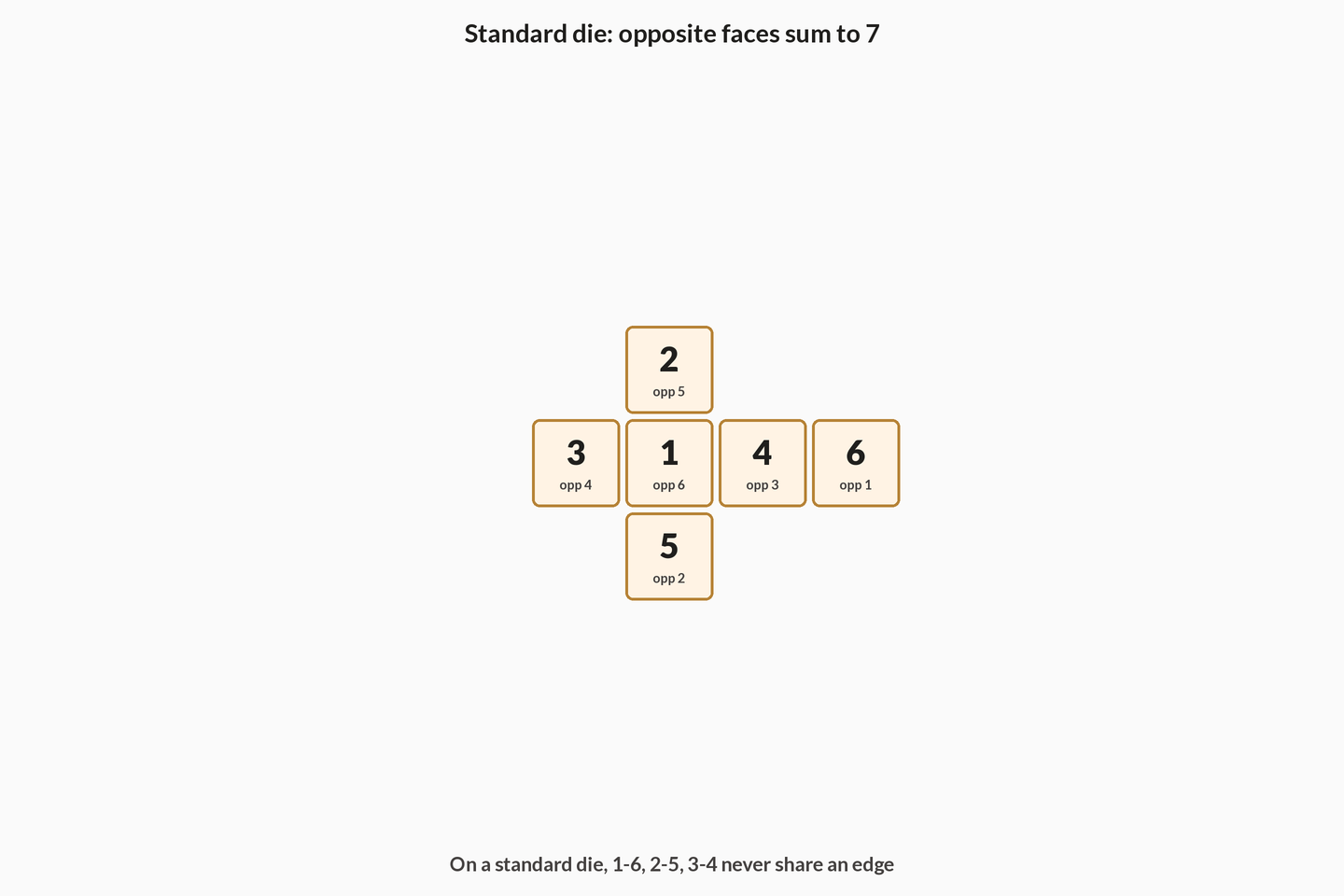
Some dice are manufactured so that opposite faces sum to 7. That is a factory convention, not a law of cubes, and it is the only reason the pairs 1–6, 2–5 and 3–4 are worth memorising. On a standard die the three opposite pairs are 1–6, 2–5 and 3–4: each pair sums to 7. When a stem says the die is standard (or gives no conflicting numbering), reading the partner of a face is one subtraction from 7. Opposite of 2 is 7-2=5. Opposite of 6 is 1. The Standard opposite pairs table is that lookup.
Use this only as a shortcut after the stem allows it — never invent a pairing the views contradict. The running die from the previous concept already contradicts it: those views put 2 next to 5, and on a standard die 2 and 5 are opposites, so they cannot share an edge. If a view already shows k next to 7-k, the die is not standard — fall back to the common-face method and ignore the sum. Reaching for 7 on that stem is the defect this concept exists to stop.
Confirm standard first. Either the stem calls the die standard, or the given views never place a sum-7 pair on adjacent faces. Then subtract: opposite of k is 7-k for k\in\{1,2,3,4,5,6\}. Then cross-check adjacency: if any picture shows a forbidden pair sharing an edge, stop using 7. The shortcut is a stored pairing, not a deduction from the pictures. The pictures, when they conflict, win.
How it works
- Confirm standardCheck that the stem calls the die standard, or that the given views never place a sum-7 pair on adjacent faces. The running die with 2 on top and 5 on the front already fails this check — 2 next to 5 is illegal on a standard die.
- Subtract from 7Opposite of k is 7-k for k\in\{1,2,3,4,5,6\}. Opposite of 2 is 5; opposite of 1 is 6; opposite of 3 is 4. The table is the same three pairs written twice.
- Cross-check adjacencyIf a view already shows k next to 7-k, the die is not standard — fall back to the common-face method. Never invent a pairing the views contradict.
| Face | Opposite | Sum |
|---|---|---|
| 1 | 6 | 7 |
| 2 | 5 | 7 |
| 3 | 4 | 7 |
On a standard die, the face opposite 2 is
- 3
- 5
- 6
Opposite pairs sum to 7, so opposite of 2 is 5. 3 pairs with 4; 6 pairs with 1.
3Painted faces after an n\times n\times n cut
Now the second skill, and a different cube. Take a wooden cube, paint all six outer faces, and slice it into an n\times n\times n grid of unit cubes. Paint only ever touched the outside. After the cut, some small cubes carry paint on three faces, some on two, some on one, and some on none. A cube painted on all six outer faces and cut into n\times n\times n unit cubes sorts into four classes by how many faces still carry paint: corners (three faces), edge cubes that are not corners (two faces), face-centre cubes (one face), and completely inner cubes (zero faces).
The class is fixed by position on the big cube, not by counting paint stroke by stroke. A small cube at a corner met three outer faces, so it has three faces painted. A small cube in the middle of an edge met two. A small cube in the open middle of a face met one. A small cube buried inside met none. Position is the criterion; the Painted-face classes table is the four rows.
Hold n=3, the running painted cube: 27 unit cubes, every class visible. Eight corners, three faces painted. Twelve edges, each with one cube between its corners, so 12 with two faces painted. Six faces, each with one centre cube, so 6 with one face painted. One cube dead in the middle, zero paint. The four numbers 8, 12, 6, 1 are the taxonomy at n=3; later concepts turn those into formulae in n.
Figure. For n = 3 the four paint-count classes are 8 corners, 12 edge cubes, 6 face centres and 1 inner cube — position fixes the class.
How it works
- CornersEight corners of the big cube each meet three painted faces → three faces painted. At every n there are still exactly eight corners, so the three-painted class is always 8.
- Edges excluding cornersEach of the twelve edges contributes the unit cubes between its two corners → two faces painted. On the n=3 cube that is one cube per edge, twelve cubes.
- Face centres and interiorThe open (n-2)\times(n-2) square on each of six faces → one face painted; the inner (n-2)^3 block → zero. At n=3 that is 6 face centres and 1 inner cube.
| Painted faces | Where on the big cube | Count in n |
|---|---|---|
| 3 | Corners | 8 (always) |
| 2 | Edges, not corners | 12(n-2) |
| 1 | Face centres | 6(n-2)^2 |
| 0 | Inner block | (n-2)^3 |
After a painted cube is cut into unit cubes, a small cube from the middle of an edge (not a corner) has how many faces painted?
- 1
- 2
- 3
An edge cube that is not a corner meets exactly two outer faces of the big cube. One face is a face-centre position; three faces is a corner.
4Exactly two faces painted: 12(n-2)
Cubes with exactly two faces painted lie on the twelve edges but exclude the eight corners (those have three). That exclusion is the whole formula. Each edge of the big cube is n unit cubes long. The two cubes at the ends of the edge are corners, already counted in the three-painted class. What remains on that edge is n-2 cubes that each meet exactly two outer faces. Twelve edges, so the count is 12(n-2).
Plug in the running cube. n=3, so n-2=1, and 12\times 1=12. Each of the twelve edges contributes the single middle cube. The standing trap is to count all edge cubes including corners, or to treat "two faces painted" as if corners somehow qualify. Corners have three faces painted, not two. Counting 12n would be twelve full edges with the corners still attached; at n=3 that wrongly gives 36. Mixing corners into the two-painted class is how 32 appears as a distractor on a 4\times 4\times 4.
At n=4, 12(4-2)=24. At n=5, 12(5-2)=36. At n=2 the edges have no middle: n-2=0, so zero two-painted cubes — a 2\times 2\times 2 is eight corners and nothing else. The formula handles that without a special case. Name the twelve edges, drop the two corners from each, multiply.
Figure. Exactly two faces painted: 12(n − 2). At n = 3 that is 12 edge cubes; corners are excluded because they carry three faces.
How it works
- Name the edgesA cube has twelve edges; only the open middle of each edge has exactly two painted faces. Corners sit at the ends of those edges and belong to a different class.
- Drop the cornersEach edge loses its two corner cubes, leaving n-2 two-painted cubes per edge. On the n=3 cube that is 3-2=1 cube per edge.
- MultiplyTwelve edges give 12(n-2). At n=3 that is 12; at n=4 that is 24. Do not count 12n, and do not let a corner sneak into this class.
Painted cube counting
A cube painted on all faces is cut into 3\times3\times3 = 27 small cubes. How many small cubes have exactly two faces painted?
- Class for exactly two painted facesedge cubes excluding corners
- Formula 12(n-2) with n=312(3-2)
- 12 \times 112
- Small cubes with exactly two faces painted12
Pro tip. Apply the standard painted-cube formulas directly in terms of n rather than counting cube by cube.
A cube painted on all faces is cut into 4\times4\times4 unit cubes. How many have exactly two faces painted?
- 24
- 32
- 16
12(4-2)=24. 32 counts twelve edges of length n without dropping corners (12\times4 would be 48; a common miss is 8+12\times2=32 mixing corners into the two-painted class). 16 is 8\times2, inventing a half-count.
5One face and zero faces painted
Face-centre cubes sit in the open (n-2)\times(n-2) square on each of the six faces, so one-face-painted cubes number 6(n-2)^2. Picture one face of the big cube as an n\times n square of unit faces. The border of that square is one cube thick: the four edges and four corners of that face. Strip the border and what remains is an (n-2)\times(n-2) window of cubes that each touch paint on this face only. Six faces, six windows, so 6(n-2)^2.
Cubes with no paint form the inner (n-2)\times(n-2)\times(n-2) block and number (n-2)^3. Strip one layer from every face of the big cube — top, bottom, and the four walls — and what remains is a smaller cube that never saw the brush. Both formulae need n\ge 2; for n=2 the inner block and face centres vanish and only corners remain, because n-2=0.
On the running 3\times 3\times 3, (n-2)^2=1, so each face contributes exactly one centre cube, and 6\times 1=6 one-painted cubes. The inner block is (3-2)^3=1: the single cube in the very middle, zero paint. For n=4, one-painted is 6(2)^2=24 and zero-painted is 2^3=8. For n=4 the zero-painted count 8 is (4-2)^3, not the eight corners; corners are a different class with three faces painted. 1 would be the n=3 inner cube copied onto a 4-cube by mistake; 27 is 3^3 or (5-2)^3 copied onto the wrong n.
Figure. On a 3×3×3: six face-centre cubes (one face painted) and one completely inner cube (zero). Formulas 6(n−2)² and (n−2)³.
How it works
- Face centresOn each face drop a one-cube border; the remaining square is (n-2)^2, times six faces. At n=3 that is 6\times 1=6 — the centre of each face.
- Inner blockStrip one layer from every face of the big cube; what remains is an (n-2)^3 unpainted cube. At n=3 that is 1; at n=4 that is 8.
- Sanity at small nFor n=2, (n-2)=0 so both counts are 0 — only the eight corners exist. A negative count means n was too small for this cut.
Face centres on a 3\times3\times3
A cube painted on all faces is cut into 3\times3\times3 unit cubes. How many small cubes have exactly one face painted?
- Formula 6(n-2)^2 with n=36(3-2)^2
- (3-2)^21
- 6 \times 16
- Exactly one face painted6 (the centre of each face)
Pro tip. On a 3\times3\times3, each face contributes exactly one centre cube — six faces, six one-painted cubes.
For an n\times n\times n painted cut with n=4, the number of small cubes with zero faces painted is
- 8
- 1
- 27
(4-2)^3=8. 1 is the n=3 inner cube; 27 is (5-2)^3 or a mis-copied 3^3.
6Corners stay 8; classes sum to n^3
Every painted cube, whatever n, has exactly eight corner small cubes with three faces painted. A cube has eight corners the way a room has eight corners: growing n adds cubes along edges and faces, not extra corners. The three-painted count is 8 for every n\ge 2. Answering 12 (the edge-count factor) or answering n itself is confusing this class with a different formula.
The four class counts must add to the total number of small cubes n^3. That is a partition, not a coincidence: every unit cube sits in exactly one class. Checking 8 + 12(n-2) + 6(n-2)^2 + (n-2)^3 = n^3 catches arithmetic slips before you trust a single class answer. If the four counts miss n^3, recompute before answering — one of the four formulae was plugged in wrong.
Verify on the running 3\times 3\times 3. Three painted: 8. Two painted: 12(3-2)=12. One painted: 6(3-2)^2=6. Zero painted: (3-2)^3=1. Sum: 8+12+6+1=27=3^3. The partition closes. At n=4 the same check is 8+24+24+8=64=4^3. At n=5 the three-painted class is still 8, not 12 and not 5, even though 5^3=125 and the other three classes have grown.
Figure. Corners stay 8 for every n. For n = 3 the four classes 8 + 12 + 6 + 1 sum to 27 = n³ — the partition check.
How it works
- CornersThree-painted count is 8 for every n\ge 2 — a cube always has eight corners. On a 5\times 5\times 5 it is still 8, not 12 and not 5.
- Write all fourCompute two-painted, one-painted and zero-painted from the formulae in n. At n=3 that is 12, 6 and 1 beside the 8 corners.
- Add to n^3If the four counts miss n^3, recompute before answering. 8+12+6+1=27=3^3 is the partition check on the running cube.
Check a 3\times3\times3 partition
For a painted cube cut into 3\times3\times3 unit cubes, verify that the four paint-count classes add to 27.
- Three painted (corners)8
- Two painted 12(3-2)12
- One painted 6(3-2)^26
- Zero painted (3-2)^31
- 8+12+6+127 = 3^3
Pro tip. When a class count looks suspicious, recompute the other three and demand the sum equal n^3.
A painted cube is cut into 5\times5\times5 unit cubes. How many small cubes have three faces painted?
- 8
- 12
- 5
Corners are always 8, independent of n. 12 is the edge count factor in 12(n-2), not the corner count; 5 confuses n with the corner total.
Notes
- Dice - Opposite Faces: From two or more views showing a common face, the faces NOT adjacent to it are opposite. If a face appears with four different faces around it, the sixth (unseen) face is its opposite.
- Standard Dice Rule: In two views, if one face is common and in the same position, the other two changing faces are compared; a face that never appears adjacent to a given face is opposite to it.
- Painted Cube Cutting: A cube painted on all faces and cut into n×n×n smaller cubes gives corner cubes (3 painted faces), edge cubes (2), face-centre cubes (1), and inner cubes (0 painted).
- Counting Formula Use: The counts depend only on n; e.g. exactly-two-painted cubes lie along edges (excluding corners), numbering 12(n-2).
- Common trap: Forgetting that corner cubes are counted separately from edge cubes - 'exactly two faces painted' excludes the 8 corners (which have three).
Formulas
- Dice: sum of opposite faces on a standard die is 7 (1-6, 2-5, 3-4).
- Total small cubes from an n\times n\times n cut = n^3.
- Three faces painted (corners) = 8 always.
- Two faces painted (edges) = 12(n-2).
- One face painted (face centres) = 6(n-2)^2; zero faces = (n-2)^3.
Exam traps & shortcuts
- For dice, find the face common to both views; the faces around it cannot be its opposite - the remaining one is.
- Remember opposite faces of a standard die sum to 7 to shortcut number-dice questions.
- For painted cubes, apply the fixed formulas in terms of n instead of imagining every small cube.
- Always subtract the 8 corners when asked for 'exactly two faces painted'.
Reference tables
All six faces painted, then cut into n\times n\times n. Plug n — do not invent a sketch.
| Class | Formula | At n=3 |
|---|---|---|
| 3 faces (corners) | 8 | 8 |
| 2 faces (edges) | 12(n-2) | 12 |
| 1 face (face centres) | 6(n-2)^2 | 6 |
| 0 faces (inner) | (n-2)^3 | 1 |
| Total | n^3 | 27 |
Use views first; reach for sum-to-7 only when the die is standard.
| Move | When | Result |
|---|---|---|
| Fix common face | Two or more views share a face | Neighbours of that face are not opposite it |
| Same slot, fixed common | Front (or side) changes while top stays | Each changing face is adjacent to the common face (not proof they neighbour each other) |
| Sum to 7 | Standard die, and no view shows a sum-7 pair adjacent | Opposite of k is 7-k |
Recap
The night-before sheet for cubes and dice.
- Common face
- Faces that appear next to a shared face are adjacent to it — none of those neighbours is its opposite. Same front slot does not by itself mean the two belt faces neighbour each other.
- Standard pairs
- 1–6, 2–5, 3–4 only when the die is standard and no given view puts a sum-7 pair on adjacent faces.
- Two-painted
- 12(n-2) on the edges; corners have three faces and are not in this class.
- One and zero
- 6(n-2)^2 face centres; (n-2)^3 inner. Both vanish at n=2.
- Corners and total
- Three-painted is always 8. The four classes must sum to n^3.
Practise Cubes & Dice
Reading is free and needs no account. Practice, mocks and progress live in the app.
- 45 exam-style questions on this topic, with explanations
- A 5-question practice set that ends the chapter
- Timed mocks scored with the real marking scheme
- Readiness tracked per topic, kept on your device