JEE Advanced (IIT Entrance) · Mathematics (JEE & NDA)
Coordinate Geometry: Straight Lines and Circles
Cartesian coordinates, distance and section formulas, equations of straight lines, and the geometry of circles.
Eight concepts from distance and section through lines to circles: each formula read once, then used on a number you can check — because JEE marks live in the sign of g and whether S_1 is positive.
- JEE Advanced (IIT Entrance)
- Medium level
- 8 concepts
- 5 practice questions
1Distance and section
The distance between (x_1,y_1) and (x_2,y_2) is \sqrt{(x_2-x_1)^2+(y_2-y_1)^2}. A point dividing the same segment in the ratio m:n (internally) is \left(\dfrac{mx_2+nx_1}{m+n},\dfrac{my_2+ny_1}{m+n}\right) — weighted averages with the nearer endpoint carrying the larger weight.
Figure. P sits one-third of the way from A to B when the ratio is 1:2 — closer to the endpoint whose weight is larger in the complementary sense.
Reading the segment
- Distance firstSquare the differences of the coordinates, add, and take the positive square root — distance is never signed.
- Ratio nextFor a point dividing A:B in m:n, weight B's coordinates by m and A's by n, then divide by m+n.
- Check the nearer endIf m>n the section point sits closer to B; swapping m and n swaps which end it hugs.
Distance, then the section point
Find the distance between A(1,2) and B(4,6), and the point that divides AB in the ratio 1:2.
- d=\sqrt{(4-1)^2+(6-2)^2}\sqrt{9+16}=5
- Section 1:2: x=\dfrac{1\cdot 4+2\cdot 1}{3}x=2
- y=\dfrac{1\cdot 6+2\cdot 2}{3}(2,\tfrac{10}{3})
Pro tip. The ratio 1:2 puts the point twice as close to A as to B — so it is one-third of the way from A to B, not halfway.
The point dividing (0,0) and (6,3) in the ratio 2:1 is
- (2,1)
- (4,2)
- (3,1.5)
x=(2\cdot 6+1\cdot 0)/3=4, y=(2\cdot 3+1\cdot 0)/3=2. Answering (2,1) swaps the weights; (3,1.5) is the midpoint (1:1).
2Line forms and the angle between them
Three writings of the same line: slope-intercept y=mx+c, point-slope y-y_1=m(x-x_1), and general ax+by+c=0 with slope -a/b when b\neq 0. The angle between lines of slopes m_1 and m_2 is \tan\theta=\left|\dfrac{m_1-m_2}{1+m_1m_2}\right|; they are parallel when m_1=m_2 and perpendicular when m_1m_2=-1. The product test decides perpendicular — do not reach for the tangent formula once the slopes already multiply to minus one.
Figure. Both lines share the origin. The steeper series is slope 2; the shallow series is slope 1/2 — the pair used in the worked tan θ.
From form to angle
- Read the slopeFrom ax+by+c=0, m=-a/b. From y=mx+c, the slope is already m.
- Plug into the tangent formulaCompute \tan\theta=|(m_1-m_2)/(1+m_1m_2)|. If the denominator is zero the lines are perpendicular.
- Name the special casesEqual slopes mean parallel; product -1 means perpendicular — no need to evaluate \theta.
Angle from two slopes
Find \tan\theta for the lines of slopes m_1=2 and m_2=\tfrac{1}{2}.
- 1+m_1m_2=1+2\cdot\tfrac{1}{2}2
- m_1-m_2=2-\tfrac{1}{2}\tfrac{3}{2}
- \tan\theta=\left|\dfrac{3/2}{2}\right|\dfrac{3}{4}
Pro tip. If 1+m_1m_2=0, stop — the lines are perpendicular and \tan\theta is undefined, which is the right answer, not an error.
The slope of 3x+4y-5=0 is
- \tfrac{3}{4}
- -\tfrac{3}{4}
- -\tfrac{4}{3}
m=-a/b=-3/4. The positive 3/4 drops the minus; -4/3 is the slope of a perpendicular, not of this line.
3Distance from a point to a line
The perpendicular distance from (x_1,y_1) to ax+by+c=0 is \dfrac{|ax_1+by_1+c|}{\sqrt{a^2+b^2}}. Between parallel lines ax+by+c_1=0 and ax+by+c_2=0 the gap is \dfrac{|c_1-c_2|}{\sqrt{a^2+b^2}} — same denominator, difference of the constants only.
Figure. The dashed segment is the perpendicular from the point to the line — its length is the formula, not the slant along the axes.
Perpendicular distance
- Plug the point into SEvaluate |ax_1+by_1+c| — the absolute value keeps distance positive on either side of the line.
- Divide by the normDivide by \sqrt{a^2+b^2}, the length of the normal vector (a,b).
- Parallel linesWhen the a,b coefficients match, only |c_1-c_2| changes in the numerator.
Distance from a point to a line
Find the perpendicular distance from (2,3) to the line 3x+4y-5=0.
- |3(2)+4(3)-5||6+12-5|=13
- \sqrt{3^2+4^2}5
- d=13/52.6 units
Pro tip. Keep the absolute value in the numerator; distance is always positive regardless of which side of the line the point lies.
The distance between x+y-1=0 and x+y-4=0 is
- 3
- \dfrac{3}{\sqrt{2}}
- \sqrt{2}
|c_1-c_2|/\sqrt{a^2+b^2}=|-1-(-4)|/\sqrt{2}=3/\sqrt{2}. Answering 3 forgets the norm; \sqrt{2} is the reciprocal slip.
4Perpendicular to ax+by+c=0
Perpendicular lines have slopes whose product is -1. For a line ax+by+c=0 any perpendicular has the form bx-ay+k=0 — swap the coefficients, flip one sign, and leave the constant free to fix the particular line through a given point.
Figure. Slopes −3/4 and 4/3 multiply to −1 at the marked meeting point. The free constant k only slides the second line until it passes through the point you need.
Writing a perpendicular
- Start from ax+by+c=0Read a and b. The perpendicular family is bx-ay+k=0.
- Fix k if neededPass the line through a given point (x_0,y_0) to solve for k=ay_0-bx_0.
- Check the slopesOriginal slope -a/b; new slope b/a; product -1 when both are defined.
A perpendicular through a point
Write the line through (1,1) perpendicular to 3x+4y-5=0.
- Perpendicular family4x-3y+k=0
- Through (1,1): 4(1)-3(1)+k=0k=-1
- Equation4x-3y-1=0
Pro tip. Do not flip both signs — bx-ay and -bx+ay are the same family up to multiplying by -1, but bx+ay is parallel, not perpendicular.
A line perpendicular to 2x-y+3=0 has the form
- 2x-y+k=0
- x+2y+k=0
- x-2y+k=0
a=2, b=-1, so bx-ay+k=(-1)x-2y+k=0, or x+2y+k=0 after multiplying by -1. The first option is parallel; x-2y+k=0 flips the wrong coefficient.
5Foot of the perpendicular
The foot of the perpendicular from (x_1,y_1) to ax+by+c=0, and the image of the point in the line, both come from one parametric step: \dfrac{x-x_1}{a}=\dfrac{y-y_1}{b}=-\dfrac{ax_1+by_1+c}{a^2+b^2}. The shared value of that parameter is the signed travel along the normal; the foot is one step, the image is two.
Figure. One dashed normal from P through F to the image P′. F is the midpoint of P and P′ — that is what “the image is two steps” means on the page.
Foot, then image
- Form the parameterCompute t=-(ax_1+by_1+c)/(a^2+b^2). The same t feeds both coordinates.
- Step once for the footx=x_1+at, y=y_1+bt is the foot on the line.
- Step twice for the imageThe reflection is (x_1+2at,\,y_1+2bt), equivalently 2\cdot\mathrm{foot}-(x_1,y_1).
Foot from a point to a line
Find the foot of the perpendicular from (2,3) to 3x+4y-5=0.
- t=-\dfrac{3(2)+4(3)-5}{3^2+4^2}t=-13/25=-0.52
- x=2+3t, y=3+4tx=0.44, y=0.92
- Foot(0.44,\,0.92)
Pro tip. Reuse the same ax_1+by_1+c you already computed for the distance formula — the numerator is shared; only the power in the denominator changes.
If the foot from P to a line is F, the image of P in the line is
- the midpoint of P and F
- the point F itself
- 2F-P
Reflection doubles the step from P through F, so the image is 2F-P. The midpoint of P and its image is F, not the other way around.
6Centre and radius from the general circle
The standard circle is (x-h)^2+(y-k)^2=r^2. Expanded, the general form x^2+y^2+2gx+2fy+c=0 has centre (-g,-f) and radius \sqrt{g^2+f^2-c} — provided g^2+f^2-c>0. Read g and f as half the coefficients of x and y; the centre is their negatives, and that sign flip is the usual miss.
Figure. Standard form (x-h)^2+(y-k)^2=r^2 is a round locus about the centre; here h=k=0, r=6. The general-form centre (-g,-f) is the same reading after completing the square.
Reading the general circle
- Halve the linear termsCompare with x^2+y^2+2gx+2fy+c=0: g is half the x-coefficient, f half the y-coefficient.
- Centre is the negativesCentre =(-g,-f). Sign-flipping here is the standard exam trap.
- Radius from g,f,cr=\sqrt{g^2+f^2-c}. If the quantity under the root is negative there is no real circle.
Centre and radius of a circle
Find the centre and radius of the circle x^2+y^2-6x+8y-11=0.
- 2g=-6,\ 2f=8,\ c=-11g=-3,\ f=4
- Centre =(-g,-f)(3,-4)
- r=\sqrt{g^2+f^2-c}=\sqrt{9+16+11}\sqrt{36}=6
Pro tip. Read g and f as half the coefficients of x and y; the centre is their negatives, a step students often sign-flip.
For x^2+y^2+4x-2y-4=0 the centre is
- (2,-1)
- (-2,1)
- (4,-2)
2g=4 so g=2, 2f=-2 so f=-1; centre =(-g,-f)=(-2,1). Answering (2,-1) forgets both minus signs; (4,-2) uses the raw coefficients.
7Point position via S_1
Write the circle as S\equiv x^2+y^2+2gx+2fy+c=0. To test a point (x_1,y_1), evaluate S_1=x_1^2+y_1^2+2gx_1+2fy_1+c: positive means outside, zero on the circle, negative inside. The same S_1 later becomes the square of the tangent length from an external point.
Figure. For S=x^2+y^2-25, a test point with S_1<0 lies inside the circle and one with S_1>0 lies outside — the sign of S_1 is the position test.
| S_1 | Position | Tangent length |
|---|---|---|
| >0 | outside | \sqrt{S_1} real |
| =0 | on the circle | 0 |
| <0 | inside | not real |
For S\equiv x^2+y^2-6x+8y-11=0, the point (0,0) is
- outside the circle
- on the circle
- inside the circle
S_1 at (0,0) is c=-11<0, so the origin is inside. Outside would need S_1>0; on the circle needs S_1=0.
8Tangents and tangent length
A line is tangent to a circle when its distance from the centre equals the radius. The tangent to x^2+y^2=r^2 at (x_1,y_1) on the circle is xx_1+yy_1=r^2. From an external point the length of either tangent is \sqrt{S_1} — the same S_1 that tested position. Equal tangent lengths are a theorem, not a second computation.
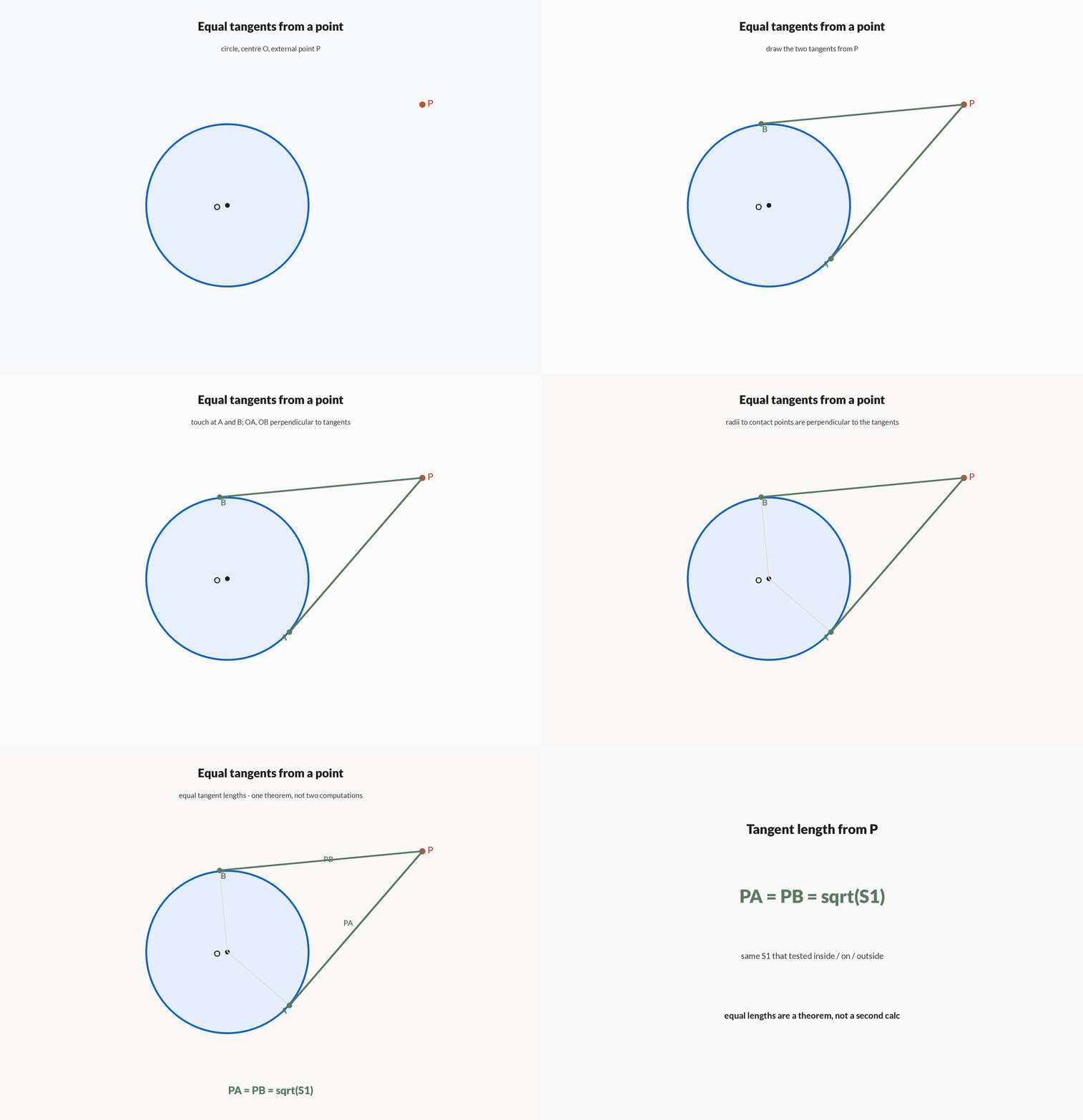
Tangent length from a point
- Confirm outsideEvaluate S_1. If S_1\le 0 there is no real tangent pair from that point.
- Take the rootLength =\sqrt{S_1}=\sqrt{x_1^2+y_1^2+2gx_1+2fy_1+c}.
- At a point on x^2+y^2=r^2The contact chord / tangent is xx_1+yy_1=r^2, not the polar of an outside point.
Tangent length from an external point
Find the length of the tangent from (5,0) to the circle x^2+y^2=9.
- S_1=5^2+0^2-916
- Length =\sqrt{S_1}4
- Check: S_1>0point is outside, length real
Pro tip. For x^2+y^2=r^2, S_1=x_1^2+y_1^2-r^2 — do not add a linear 2gx term that is not there.
A line at distance 5 from the centre of a circle of radius 5 is
- a secant
- a tangent
- external, no meeting
Distance from centre equals radius means exactly one meeting point — a tangent. Distance less than r is a secant; greater than r misses the circle.
Notes
- Distance and section: The distance between points is \sqrt{(x_2-x_1)^2+(y_2-y_1)^2}. A point dividing the segment joining (x_1,y_1) and (x_2,y_2) in ratio m:n is \left(\dfrac{mx_2+nx_1}{m+n},\dfrac{my_2+ny_1}{m+n}\right).
- Equations of a line: Slope-intercept y=mx+c, point-slope y-y_1=m(x-x_1), and general ax+by+c=0 with slope -a/b. The angle between two lines is \tan\theta=\left|\dfrac{m_1-m_2}{1+m_1m_2}\right|; lines are parallel if m_1=m_2 and perpendicular if m_1m_2=-1.
- Distance from a point to a line: The perpendicular distance from (x_1,y_1) to ax+by+c=0 is \dfrac{|ax_1+by_1+c|}{\sqrt{a^2+b^2}}, and the distance between parallel lines ax+by+c_1=0 and ax+by+c_2=0 is \dfrac{|c_1-c_2|}{\sqrt{a^2+b^2}}.
- Circle equations: The standard circle is (x-h)^2+(y-k)^2=r^2; the general form x^2+y^2+2gx+2fy+c=0 has centre (-g,-f) and radius \sqrt{g^2+f^2-c}.
- Tangents and lines meeting circles: A line is tangent to a circle when its distance from the centre equals the radius. The tangent to x^2+y^2=r^2 at (x_1,y_1) is xx_1+yy_1=r^2, and the length of a tangent from an external point is \sqrt{S_1}.
- Family-of-lines L_1+\lambda L_2=0 passes through the intersection of L_1,L_2 for all \lambda; use it to force a line through a fixed point.
- The equation S_1=0 (circle) plus S_1+\lambda L=0 generates the family of circles through the intersection of a circle and a line; S_1+\lambda S_2=0 gives circles through two circles' intersection (radical axis at \lambda=-1).
- Distance/foot-of-perpendicular and reflection formulae should be automatic; reflection of a point in a line is a common sub-step.
- Locus problems: express the moving point coordinates via a parameter, then eliminate the parameter.
Formulas
- Distance / section: d=\sqrt{(x_2-x_1)^2+(y_2-y_1)^2}, ratio m:n point formula
- Line forms: y=mx+c,\quad ax+by+c=0
- Angle between lines: \tan\theta=\left|\dfrac{m_1-m_2}{1+m_1m_2}\right|
- Point-to-line distance: \dfrac{|ax_1+by_1+c|}{\sqrt{a^2+b^2}}
- Circle: centre (-g,-f), radius \sqrt{g^2+f^2-c}
- Tangent length from point: \sqrt{x_1^2+y_1^2+2gx_1+2fy_1+c}
- Radical axis of S_1=0,S_2=0: S_1-S_2=0
- Foot of perpendicular from (x_1,y_1) to ax+by+c=0: shift by -\dfrac{ax_1+by_1+c}{a^2+b^2}(a,b)
- Family of lines through L_1\cap L_2: L_1+\lambda L_2=0
Exam traps & shortcuts
- Perpendicular lines have slopes whose product is -1; for a line ax+by+c=0 any perpendicular has the form bx-ay+k=0.
- To test a point's position relative to a circle S=0, evaluate S_1: positive means outside, zero on the circle, negative inside.
- The foot of perpendicular and image of a point in a line are found fastest with the formula \dfrac{x-x_1}{a}=\dfrac{y-y_1}{b}=-\dfrac{ax_1+by_1+c}{a^2+b^2}.
- To show a variable line passes through a fixed point, rearrange into the form A+\lambda B=0 and solve A=0,B=0.
- Use the director circle / auxiliary constructions to reduce angle conditions to distance conditions.
Reference tables
The identities this topic keeps using. Distance and section first; lines next; circle centre, S_1 and tangent length last.
| Name | Formula |
|---|---|
| Distance | \sqrt{(x_2-x_1)^2+(y_2-y_1)^2} |
| Section m:n | \left(\dfrac{mx_2+nx_1}{m+n},\dfrac{my_2+ny_1}{m+n}\right) |
| Line slope | ax+by+c=0\Rightarrow m=-a/b |
| Angle of lines | \tan\theta=\left|\dfrac{m_1-m_2}{1+m_1m_2}\right| |
| Point–line distance | \dfrac{|ax_1+by_1+c|}{\sqrt{a^2+b^2}} |
| Circle centre / radius | (-g,-f), \sqrt{g^2+f^2-c} |
| Tangent length | \sqrt{S_1} |
Recap
Read only this the night before.
- Section weights
- Dividing A:B in m:n weights B by m and A by n. The larger weight pulls toward the opposite endpoint.
- Slope of ax+by+c=0
- m=-a/b. Parallel means equal slopes; perpendicular means product -1, or the form bx-ay+k=0.
- Point–line distance
- |ax_1+by_1+c|/\sqrt{a^2+b^2}. Absolute value stays; for parallel lines only the constants differ.
- Centre signs
- From x^2+y^2+2gx+2fy+c=0, centre is (-g,-f) — half the coefficients, then negate.
- S_1 trichotomy
- Outside / on / inside as S_1 is positive / zero / negative. Tangent length is \sqrt{S_1} when outside.
Practise Coordinate Geometry: Straight Lines and Circles
Reading is free and needs no account. Practice, mocks and progress live in the app.
- 5 exam-style questions on this topic, with explanations
- A 5-question practice set that ends the chapter
- Timed mocks scored with the real marking scheme
- Readiness tracked per topic, kept on your device