JEE Advanced (IIT Entrance) · Mathematics (JEE & NDA)
Three Dimensional Geometry
Coordinates in space, direction cosines and ratios, equations of lines and planes, and distances and angles between them.
Seven concepts from direction cosines through lines and planes to angles and distances in space — each formula used on a number you can check, because honest 3D figures are not available.
- JEE Advanced (IIT Entrance)
- Medium level
- 7 concepts
- 5 practice questions
1Direction cosines and ratios
A line's direction cosines l,m,n satisfy l^2+m^2+n^2=1; direction ratios are proportional to them. The angle between two lines follows from \cos\theta=l_1l_2+m_1m_2+n_1n_2, or the same formula with direction ratios in place of cosines once you normalise by the two magnitudes.
Two directed lines in space with direction ratios marked; \cos\theta is their normalised dot product — the spatial angle itself is what cannot be drawn honestly.
Angle from direction ratios
- Form the dot productCompute a_1a_2+b_1b_2+c_1c_2.
- Form the two magnitudes|\vec{d_1}|=\sqrt{a_1^2+b_1^2+c_1^2} and likewise for \vec{d_2}.
- Divide\cos\theta is the dot product over the product of magnitudes — no need to convert to cosines first.
Angle between two lines
Find the angle between lines with direction ratios (1,1,2) and (2,-1,1).
- Dot product 1(2)+1(-1)+2(1)3
- Magnitudes \sqrt{1+1+4} and \sqrt{4+1+1}\sqrt{6} and \sqrt{6}
- \cos\theta=\dfrac{3}{6}\theta=60^\circ
Pro tip. With direction ratios you can use \cos\theta=\dfrac{\vec{a}\cdot\vec{b}}{|\vec{a}||\vec{b}|} directly; normalising to direction cosines is unnecessary.
Direction cosines (l,m,n) always satisfy
- l+m+n=1
- l^2+m^2+n^2=1
- lmn=1
They are components of a unit direction vector, so the sum of squares is 1.
2Equation of a line in space
A line through \vec{a} with direction \vec{b} is \vec{r}=\vec{a}+\lambda\vec{b}, or in Cartesian form \dfrac{x-x_1}{a}=\dfrac{y-y_1}{b}=\dfrac{z-z_1}{c}. Two lines are parallel when their direction ratios are proportional, and perpendicular when the dot product of those ratios is zero — no need to normalise first.
A point (x_1,y_1,z_1) and a direction (a,b,c) determine the line; imagine the parameter \lambda sliding along that direction in space.
Writing a line
- Pick a pointAny known point on the line becomes (x_1,y_1,z_1) or \vec{a}.
- Pick a directionDirection ratios (a,b,c) or vector \vec{b} — differences of two points work.
- Equate the parametersSet \dfrac{x-x_1}{a}=\dfrac{y-y_1}{b}=\dfrac{z-z_1}{c} (or the vector form).
Two lines with direction ratios (1,2,3) and (2,4,6) are
- perpendicular
- parallel
- skew at right angles
The ratios are proportional (2:4:6=1:2:3), so the lines are parallel.
3Equation of a plane
A plane with normal \vec{n} through \vec{a} is \vec{r}\cdot\vec{n}=\vec{a}\cdot\vec{n}, or ax+by+cz=d. The normal direction is (a,b,c); the intercept form is \dfrac{x}{p}+\dfrac{y}{q}+\dfrac{z}{r}=1. A line lies in the plane when a point of the line satisfies the plane and the direction is perpendicular to the normal.
Figure. Not a general plane in space: only the intercept triangle in the first octant for \dfrac{x}{p}+\dfrac{y}{q}+\dfrac{z}{r}=1, with the three axis intercepts labelled. Depth is schematic.
Reading a plane
- Normal from the coefficientsIn ax+by+cz+d=0, the normal is (a,b,c).
- Intercept formDivide through so the constant is 1; the intercepts are the denominators p,q,r.
- Line in planeNeed both membership of one point and \vec{b}\perp\vec{n}.
The normal to the plane 2x-y+2z+3=0 is
- (2,-1,2)
- (2,1,2)
- (3,2,-1)
Coefficients of x,y,z are the normal components (2,-1,2).
4Angle between planes
The angle between two planes equals the angle between their normals: \cos\theta=\dfrac{\vec{n_1}\cdot\vec{n_2}}{|\vec{n_1}||\vec{n_2}|}. Parallel planes have proportional normals; perpendicular planes have \vec{n_1}\cdot\vec{n_2}=0.
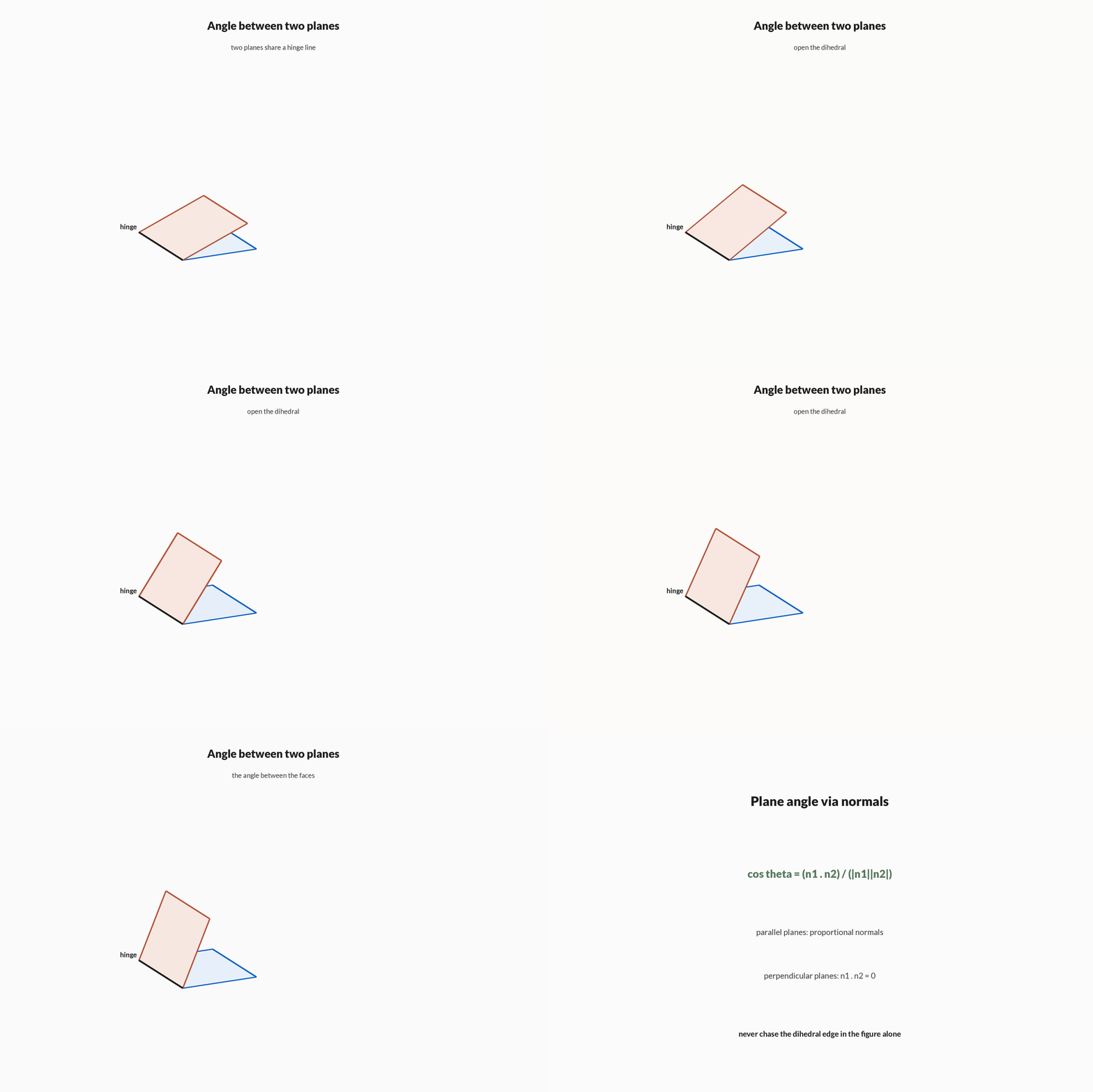
Via the normals
- Read the normalsFrom each plane equation, take \vec{n_1} and \vec{n_2} as the coefficient triples (a,b,c).
- Cosine of the angle\cos\theta=\dfrac{\vec{n_1}\cdot\vec{n_2}}{|\vec{n_1}||\vec{n_2}|}. Parallel planes give proportional normals; \vec{n_1}\cdot\vec{n_2}=0 means the planes are perpendicular.
- Report the acute one when askedIf the cosine comes out negative, the obtuse dihedral is the supplement — many stems want the acute angle between the planes.
Planes with normals (1,0,0) and (0,1,0) are
- parallel
- perpendicular
- the same plane
Dot product of the normals is 0, so the planes meet at right angles.
5Distance from a point to a plane
The distance of (x_1,y_1,z_1) from ax+by+cz+d=0 is \dfrac{|ax_1+by_1+cz_1+d|}{\sqrt{a^2+b^2+c^2}}. The denominator is the magnitude of the normal — the same length that appears in every plane-angle formula.
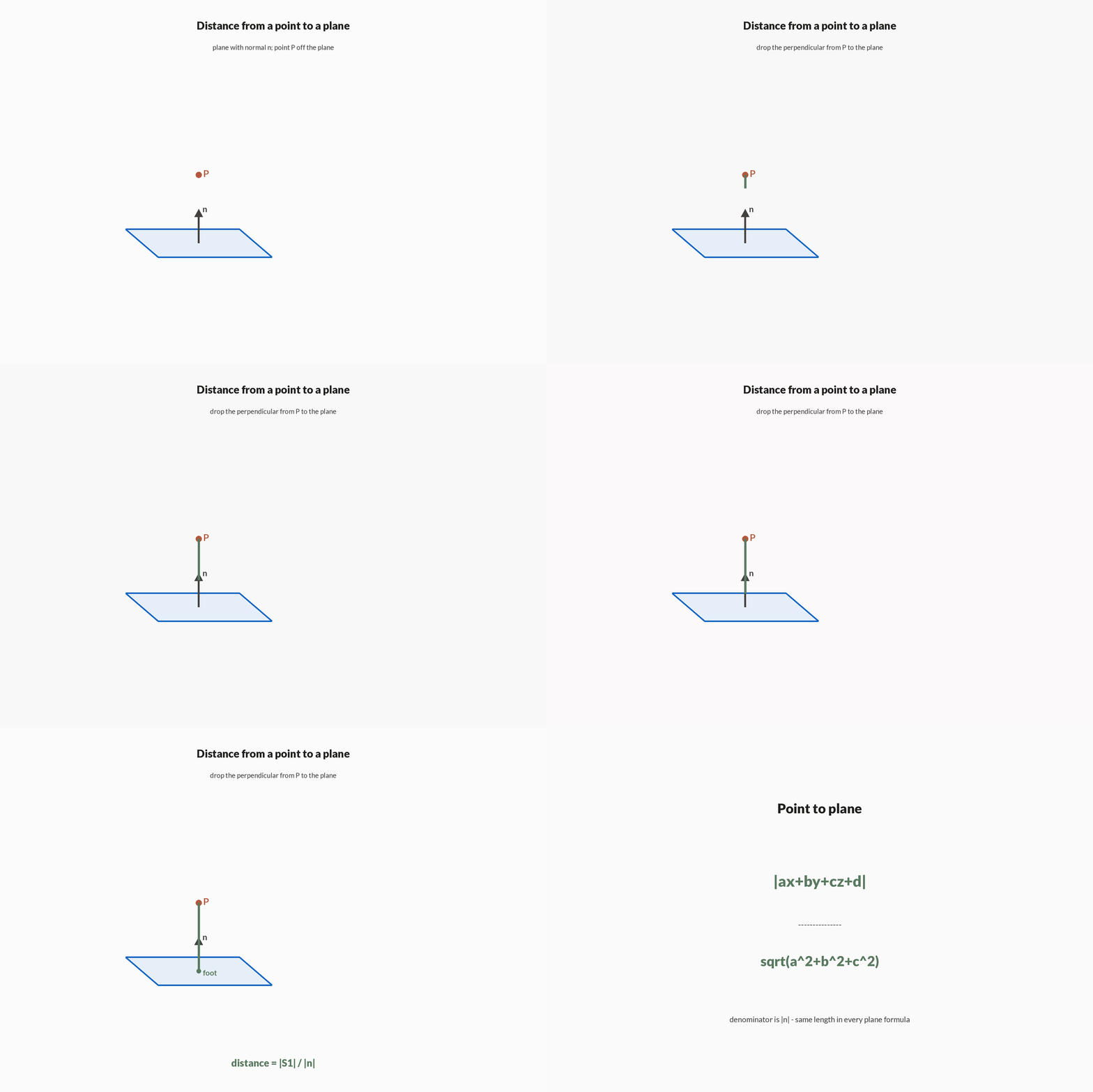
Point-to-plane distance
- Plug into SEvaluate |ax_1+by_1+cz_1+d|.
- Divide by |\vec{n}|Divide by \sqrt{a^2+b^2+c^2}.
- Keep the absolute valueDistance is positive on either side of the plane.
Distance from a point to a plane
Find the distance of the point (1,2,3) from the plane 2x-y+2z+3=0.
- |2(1)-1(2)+2(3)+3||2-2+6+3|=9
- \sqrt{2^2+(-1)^2+2^2}\sqrt{9}=3
- d=9/33 units
Pro tip. The denominator is the magnitude of the normal vector (a,b,c); here \sqrt{9}=3 makes the arithmetic clean.
Distance of (1,2,3) from 2x-y+2z+3=0 is
- 3
- 9
- 1
Numerator 9, denominator 3, so d=3.
6Angle between a line and a plane
If the line has direction \vec{b} and the plane has normal \vec{n}, the angle \phi between line and plane satisfies \sin\phi=\dfrac{|\vec{b}\cdot\vec{n}|}{|\vec{b}||\vec{n}|}. That angle is the complement of the angle between the line and the normal — so a line parallel to the plane has \vec{b}\cdot\vec{n}=0 and \phi=0.
A line meeting a plane; \phi is the elevation from the plane to the line, the complement of the angle the line makes with the normal.
The angle \phi between a line \vec{b} and a plane with normal \vec{n} satisfies
- \cos\phi=\dfrac{|\vec{b}\cdot\vec{n}|}{|\vec{b}||\vec{n}|}
- \sin\phi=\dfrac{|\vec{b}\cdot\vec{n}|}{|\vec{b}||\vec{n}|}
- \phi equals the angle between \vec{b} and \vec{n}
Line–plane angle uses sine of the normalised |\vec{b}\cdot\vec{n}|; cosine would measure the angle with the normal instead.
7Shortest distance between skew lines
Skew lines are neither parallel nor intersecting. The shortest distance between \vec{r}=\vec{a_1}+\lambda\vec{b_1} and \vec{r}=\vec{a_2}+\mu\vec{b_2} is \dfrac{|(\vec{a_2}-\vec{a_1})\cdot(\vec{b_1}\times\vec{b_2})|}{|\vec{b_1}\times\vec{b_2}|} — the absolute scalar projection of the join of the two points onto the common perpendicular.
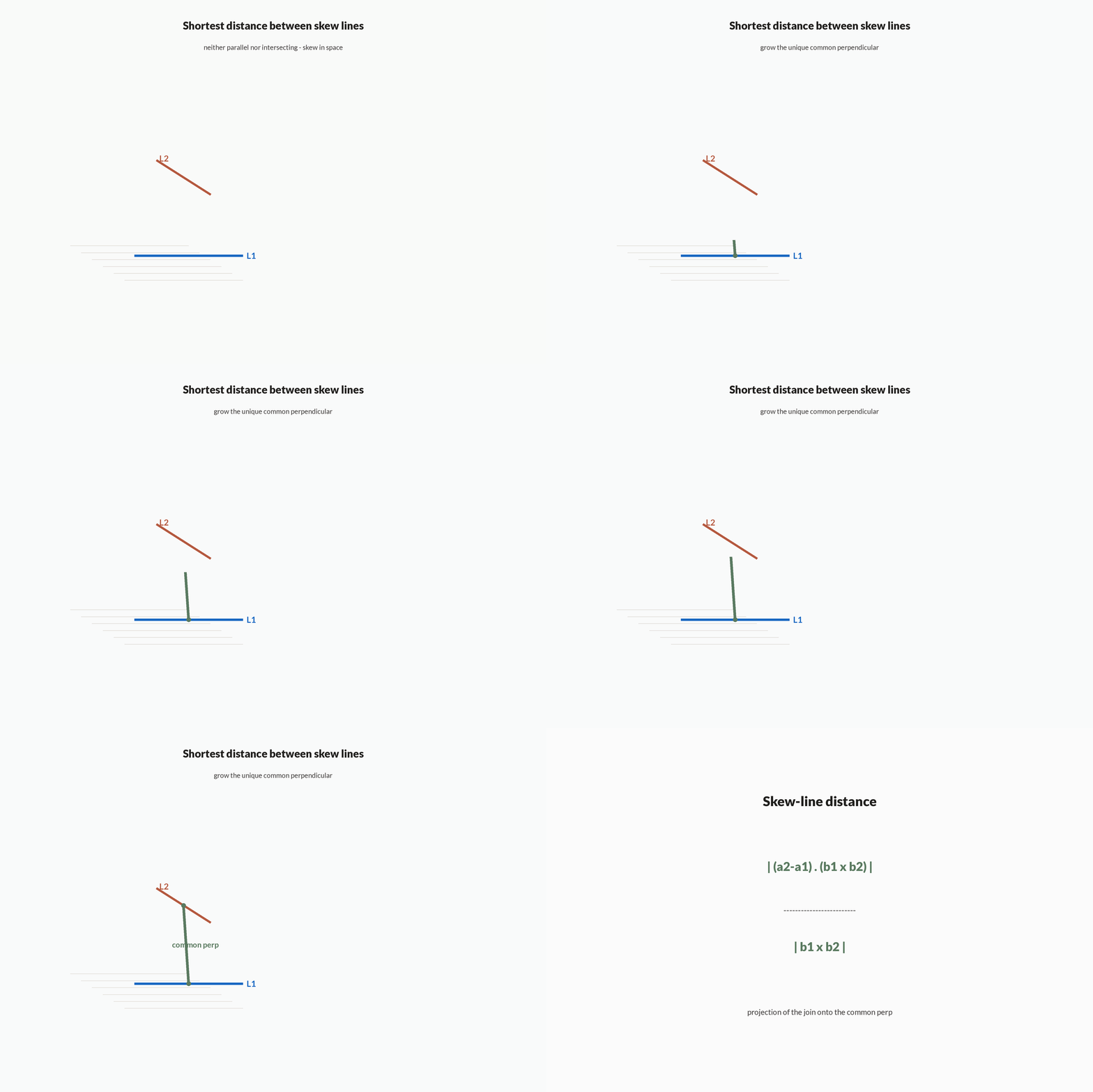
Skew distance
- Confirm skewThe lines are not parallel (\vec{b_1}\times\vec{b_2}\neq\vec{0}) and do not intersect — otherwise the shortest distance is zero or the parallel-plane formula applies instead.
- Form the common-perpendicular direction\vec{b_1}\times\vec{b_2} is perpendicular to both direction vectors.
- Project the joind=\dfrac{|(\vec{a_2}-\vec{a_1})\cdot(\vec{b_1}\times\vec{b_2})|}{|\vec{b_1}\times\vec{b_2}|} — absolute scalar projection of a point-to-point join onto that common perpendicular.
Shortest distance between skew lines uses
- the cross product \vec{b_1}\times\vec{b_2} in the numerator and denominator
- only the dot product \vec{b_1}\cdot\vec{b_2}
- the mid-point formula
The common-perpendicular direction is \vec{b_1}\times\vec{b_2}; its magnitude normalises the absolute triple product in the numerator.
Notes
- Direction cosines and ratios: A line's direction cosines l,m,n satisfy l^2+m^2+n^2=1; direction ratios a,b,c are proportional to them. The angle between two lines with direction cosines follows from \cos\theta=l_1l_2+m_1m_2+n_1n_2.
- Equation of a line: A line through \vec{a} with direction \vec{b} is \vec{r}=\vec{a}+\lambda\vec{b}, or in Cartesian form \dfrac{x-x_1}{a}=\dfrac{y-y_1}{b}=\dfrac{z-z_1}{c}.
- Equation of a plane: A plane with normal \vec{n} through \vec{a} is \vec{r}\cdot\vec{n}=\vec{a}\cdot\vec{n}, or ax+by+cz=d. The normal direction is (a,b,c); the intercept form is \dfrac{x}{p}+\dfrac{y}{q}+\dfrac{z}{r}=1.
- Angles and distances: The angle between two planes equals the angle between their normals, \cos\theta=\dfrac{\vec{n_1}\cdot\vec{n_2}}{|\vec{n_1}||\vec{n_2}|}. The distance of (x_1,y_1,z_1) from ax+by+cz+d=0 is \dfrac{|ax_1+by_1+cz_1+d|}{\sqrt{a^2+b^2+c^2}}.
- Angle between line and plane: If the line has direction \vec{b} and the plane normal \vec{n}, the angle \phi between them satisfies \sin\phi=\dfrac{|\vec{b}\cdot\vec{n}|}{|\vec{b}||\vec{n}|} (complement of the normal angle).
- Vectors are the workhorse in 3D: line \vec r=\vec a+\lambda\vec b, plane \vec r\cdot\vec n=d; distances and angles reduce to dot/cross products.
- Shortest distance between skew lines uses the scalar triple product \dfrac{|(\vec a_2-\vec a_1)\cdot(\vec b_1\times\vec b_2)|}{|\vec b_1\times\vec b_2|}.
- Image of a point in a plane and foot of perpendicular are recurring sub-steps; set up the parametric normal line and solve.
- Coplanarity of two lines is equivalent to the vanishing of a 3\times3 determinant / scalar triple product.
Formulas
- Direction cosines: l^2+m^2+n^2=1
- Line: \vec{r}=\vec{a}+\lambda\vec{b},\quad \dfrac{x-x_1}{a}=\dfrac{y-y_1}{b}=\dfrac{z-z_1}{c}
- Plane: \vec{r}\cdot\vec{n}=d,\quad ax+by+cz=d
- Angle between planes: \cos\theta=\dfrac{\vec{n_1}\cdot\vec{n_2}}{|\vec{n_1}||\vec{n_2}|}
- Point-plane distance: \dfrac{|ax_1+by_1+cz_1+d|}{\sqrt{a^2+b^2+c^2}}
- Line-plane angle: \sin\phi=\dfrac{|\vec{b}\cdot\vec{n}|}{|\vec{b}||\vec{n}|}
- Shortest distance (skew): \dfrac{|(\vec a_2-\vec a_1)\cdot(\vec b_1\times\vec b_2)|}{|\vec b_1\times\vec b_2|}
- Distance point to plane \vec r\cdot\hat n=d: |\,\vec p\cdot\hat n - d\,|
- Angle between planes: \cos\theta=\dfrac{\vec n_1\cdot\vec n_2}{|\vec n_1||\vec n_2|}
Exam traps & shortcuts
- Two lines are perpendicular when the dot product of their direction ratios is zero, and parallel when the ratios are proportional - no need to normalise first.
- A line lies in a plane if a point on the line satisfies the plane and the line's direction is perpendicular to the plane's normal (\vec{b}\cdot\vec{n}=0).
- For the shortest distance between skew lines, use \dfrac{|(\vec{a_2}-\vec{a_1})\cdot(\vec{b_1}\times\vec{b_2})|}{|\vec{b_1}\times\vec{b_2}|}.
- For image-in-plane, move from the point along the plane normal by twice the signed distance.
- Test coplanarity/intersection of lines via the scalar triple product of direction vectors and the join of base points.
Reference tables
Every angle or distance here is a normalised dot or triple product.
| Quantity | Formula |
|---|---|
| Direction cosines | l^2+m^2+n^2=1 |
| Line | \vec{r}=\vec{a}+\lambda\vec{b} |
| Plane | ax+by+cz+d=0, normal (a,b,c) |
| Plane angle | \cos\theta=\dfrac{\vec{n_1}\cdot\vec{n_2}}{|\vec{n_1}||\vec{n_2}|} |
| Point–plane distance | \dfrac{|ax_1+by_1+cz_1+d|}{\sqrt{a^2+b^2+c^2}} |
| Line–plane angle | \sin\phi=\dfrac{|\vec{b}\cdot\vec{n}|}{|\vec{b}||\vec{n}|} |
| Skew distance | \dfrac{|(\vec{a_2}-\vec{a_1})\cdot(\vec{b_1}\times\vec{b_2})|}{|\vec{b_1}\times\vec{b_2}|} |
Recap
Read only this the night before.
- DCs / DRs
- l^2+m^2+n^2=1; angle from normalised dot of direction ratios.
- Line
- \vec{r}=\vec{a}+\lambda\vec{b}. Parallel ↔ proportional DRs; perpendicular ↔ dot zero.
- Plane
- Normal (a,b,c). Line lies in plane if a point fits and \vec{b}\cdot\vec{n}=0.
- Angles
- Plane–plane uses \cos of normals; line–plane uses \sin of |\vec{b}\cdot\vec{n}|.
- Distance
- Point to plane: |S_1|/|\vec{n}|.
- Skew
- Common-perpendicular length is the absolute triple product over |\vec{b_1}\times\vec{b_2}|.
Practise Three Dimensional Geometry
Reading is free and needs no account. Practice, mocks and progress live in the app.
- 5 exam-style questions on this topic, with explanations
- A 6-question practice set that ends the chapter
- Timed mocks scored with the real marking scheme
- Readiness tracked per topic, kept on your device