NEET UG (Medical Entrance) · Physics (JEE & NEET)
Oscillations and Waves
Simple harmonic motion, springs and pendulums, wave propagation, superposition, beats, resonance and the Doppler effect in sound.
Ten concepts. One oscillator — including the damping and resonance every real one shows — then one wave; nearly every mark in the chapter is decided by noticing which of ω, v, f and λ the situation is actually allowed to change.
- NEET UG (Medical Entrance)
- Medium level
- 10 concepts
- 5 practice questions
1What makes a motion simple harmonic
A motion is simple harmonic when the restoring force is proportional to the displacement and points back towards the mean position — equivalently, when a = −ω²x. That one line is the entire definition; everything else in the chapter is its solution. Integrating it gives x = A sin(ωt + φ), and with it v = ωA cos(ωt + φ) = ω√(A² − x²). The speed is greatest at the mean position and zero at the extremes; the acceleration does exactly the opposite.
Figure. Two full periods. Velocity leads displacement by a quarter of a period: the particle is fastest exactly where x = 0 and momentarily at rest at each extreme. The velocity curve is drawn as v/ω so that both fit one axis — its true height is ωA.
How to recognise SHM in a problem
- Find the mean positionLocate where the net force vanishes and measure x from there — not from the spring's natural length or the pivot.
- Linearise the restoring forceShow that F = −(constant) × x for small x. That constant divided by m is ω².
- Read ω off the coefficientω comes from the equation, never from the amplitude, so T = 2π/ω does not care how hard you pushed.
Speed and acceleration at a given displacement
A particle executes SHM of amplitude 5 cm and period 0.628 s. Find its maximum speed, and its speed when it is 3 cm from the mean position.
- ω = 2π/T = 2π/0.62810 rad s⁻¹
- v_max = ωA = 10 × 0.050.50 m s⁻¹
- v = ω√(A² − x²) = 10 × √(0.05² − 0.03²)0.40 m s⁻¹
- Check: (v/v_max)² + (x/A)² = 0.8² + 0.6²1 ✓
Pro tip. Keep v_max = ωA and a_max = ω²A on hand so you never differentiate anything. The check row is the fastest tool in the chapter: (x/A)² + (v/ωA)² = 1 always, so the 3–4–5 triangle says that at 0.6A the particle still holds 0.8 of its top speed. The speed only collapses in the last fifth of the swing, which is why an SHM particle is found near its extremes far more often than near the middle.
A particle moves with acceleration a = −16x, with a in m s⁻² and x in m. Its period is
- π/2 s
- π/4 s
- 8π s
ω² = 16 gives ω = 4 rad s⁻¹, so T = 2π/ω = π/2 ≈ 1.57 s. The amplitude never enters — read ω straight off the coefficient of x.
2Energy in SHM
The total energy E = ½mω²A² = ½kA² never changes; only its division does. Potential energy ½kx² is largest at the extremes, kinetic energy ½k(A² − x²) at the mean position, and each is the other's mirror image in the same parabola.
Because both go as the square of a sinusoid, the exchange runs at twice the frequency of the motion itself: the particle crosses the centre twice per period, so kinetic energy peaks twice per period while the displacement peaks once.
Figure. Two parabolas that sum to a constant at every displacement. They cross at x = ±A/√2, where each holds half the energy; at x = ±A/2 the kinetic share is still three-quarters. Nothing here oscillates in time — this is the energy as a function of where the particle is.
How it works
- Fix E from the amplitudeE = ½kA² = ½mω²A², settled the moment the oscillator and the amplitude are settled.
- Split it with the displacementU = ½kx² and KE = E − U = ½k(A² − x²). No integration is needed anywhere.
- Average only over a whole cyclesin² and cos² each average to ½, so ⟨KE⟩ = ⟨U⟩ = E/2 — as averages, not as an instantaneous truth.
Where the energy sits
A 0.2 kg block on a spring of k = 80 N m⁻¹ oscillates with amplitude 0.1 m. Find the total energy, the kinetic energy at half amplitude, and the displacement at which the split is even.
- E = ½kA² = ½ × 80 × 0.1²0.40 J
- At x = A/2: U = ½kx² = E/40.10 J
- KE = E − U0.30 J, i.e. 3E/4
- KE = U where x = A/√2 = 0.1/1.4140.071 m
Pro tip. At half the amplitude the energy is three-quarters kinetic, not half — U goes as x², so halving x quarters it. The even split happens all the way out at 0.71A. Note also that the block's mass never entered: E depends on k and A alone, and the 0.2 kg only sets how fast the exchange runs.
A particle in SHM is at half its amplitude. The fraction of its total energy that is kinetic is
- 1/4
- 1/2
- 3/4
U = ½kx² = ¼(½kA²) = E/4, so KE = 3E/4. The even split sits at x = A/√2, not at A/2.
3The spring oscillator, and springs in combination
Hooke's law F = −kx is already in the form a = −(k/m)x, so ω = √(k/m) and T = 2π√(m/k). Gravity never appears: hanging the mass vertically moves the mean position down by mg/k and leaves the period untouched, which is why one formula serves a horizontal glider and a vertical spring balance alike.
Combinations follow from what is shared. Springs in parallel share the displacement and add their forces, so stiffness adds: k_eq = Σkᵢ. Springs in series share the force and add their extensions, so compliance adds: 1/k_eq = Σ1/kᵢ. Cutting a spring into two equal halves doubles the stiffness of each half, because k is inversely proportional to the natural length.
Figure. Parallel springs share the displacement → k_eff adds. Series springs share the force → reciprocals add. Period follows √(m/k_eff), so doubling k halves T².
How it works
- Displacement shared, so add kParallel springs stretch by the same x, so their forces add: k_eq = k₁ + k₂.
- Force shared, so add 1/kSeries springs carry the same tension, so their extensions add: 1/k_eq = 1/k₁ + 1/k₂.
- Then one formula covers itFeed k_eq into T = 2π√(m/k_eq). Nothing else about the arrangement matters.
| Arrangement | k_eq | Period of the same mass m |
|---|---|---|
| Two identical springs in parallel | 2k | T/√2 |
| Two identical springs in series | k/2 | T√2 |
| One spring cut into two equal halves | 2k for each half | T/√2 on either half |
| The same spring hung vertically | k, unchanged | T, unchanged — g only moves the mean position |
Period of a loaded spring
A 0.5 kg mass on a spring of constant k = 200 N m⁻¹ executes SHM with amplitude 0.1 m. Find the period and the maximum speed — then repeat with a second identical spring added in parallel.
- ω = √(k/m) = √(200/0.5) = √40020 rad s⁻¹
- T = 2π/ω = 2π/200.314 s
- v_max = ωA = 20 × 0.12.0 m s⁻¹
- Second spring in parallel: k_eq = 400, T′ = T/√20.222 s
Pro tip. Maximum speed is ωA and maximum acceleration is ω²A; keep these handy to avoid recomputing derivatives. And notice that doubling the stiffness did not halve the period — it divided it by √2, from 0.314 s to 0.222 s. Every period in this chapter is a square root, so periods are stubbornly insensitive to the thing you change.
A spring of force constant k is cut into two equal halves, and the same mass m is hung from one half. The new period is
- T√2
- T/√2
- T, unchanged
k is inversely proportional to natural length, so each half has stiffness 2k. T′ = 2π√(m/2k) = T/√2. Shorter spring, stiffer spring, quicker oscillation.
4The simple pendulum
Resolve the bob's weight along and across the string: mg cosθ is balanced by the tension, and mg sinθ is left over as the restoring force. For small θ, sinθ ≈ θ = s/L, so the restoring force is −(mg/L)s — Hooke's law with k = mg/L — and T = 2π√(L/g). The mass cancels, the amplitude cancels, and only the length and the local g survive.
Anything that changes the apparent gravity changes the period through g_eff. In a lift accelerating upward at a, g_eff = g + a; accelerating downward, g − a; in free fall g_eff = 0 and the pendulum does not oscillate at all. The same substitution handles a pendulum in a car rounding a bend, where g_eff is the vector sum of g and the centripetal acceleration.
Figure. Plot T² instead of T and the law straightens into a line through the origin of slope 4π²/g — which is exactly how g is measured in a school laboratory. Halve g and the line doubles in steepness, so the period at any given length grows by √2.
How it works
- Resolve, do not follow the arcOnly mg sinθ restores; mg cosθ goes into the tension and does no restoring work.
- Linearise, and know the costsinθ ≈ θ is what makes the motion harmonic at all; at θ = 20° the true period is already about 0.8% longer.
- Swap g for g_effAny steady acceleration of the support adds vectorially to g. Use the magnitude of that sum, never g itself.
The seconds pendulum, and the same pendulum in a lift
Find the length of a pendulum whose period is exactly 2 s where g = 9.8 m s⁻², then find its period inside a lift accelerating upwards at g/2.
- L = gT²/4π² = 9.8 × 4/39.480.993 m
- Lift accelerating up at g/2: g_eff = 1.5g14.7 m s⁻²
- T′ = 2π√(L/g_eff) = 2/√1.51.633 s
- Same lift in free fall: g_eff = 0no oscillation at all
Pro tip. A seconds pendulum beats once per second but has a period of 2 s — one beat per swing, two swings per period. Its length comes out at very nearly one metre, which is why the seconds pendulum was once proposed as the definition of the metre. To speed up a slow pendulum clock you shorten the rod; the mass of the bob is irrelevant and so is the size of the swing, provided it stays small.
A simple pendulum is carried into a lift that is in free fall. Its period
- is halved
- is unchanged
- becomes infinite — it does not oscillate
g_eff = g − a = 0, so there is no restoring force at all and T = 2π√(L/g_eff) diverges. Bob and lift fall together and the string goes slack.
5Damping, forced oscillation and resonance
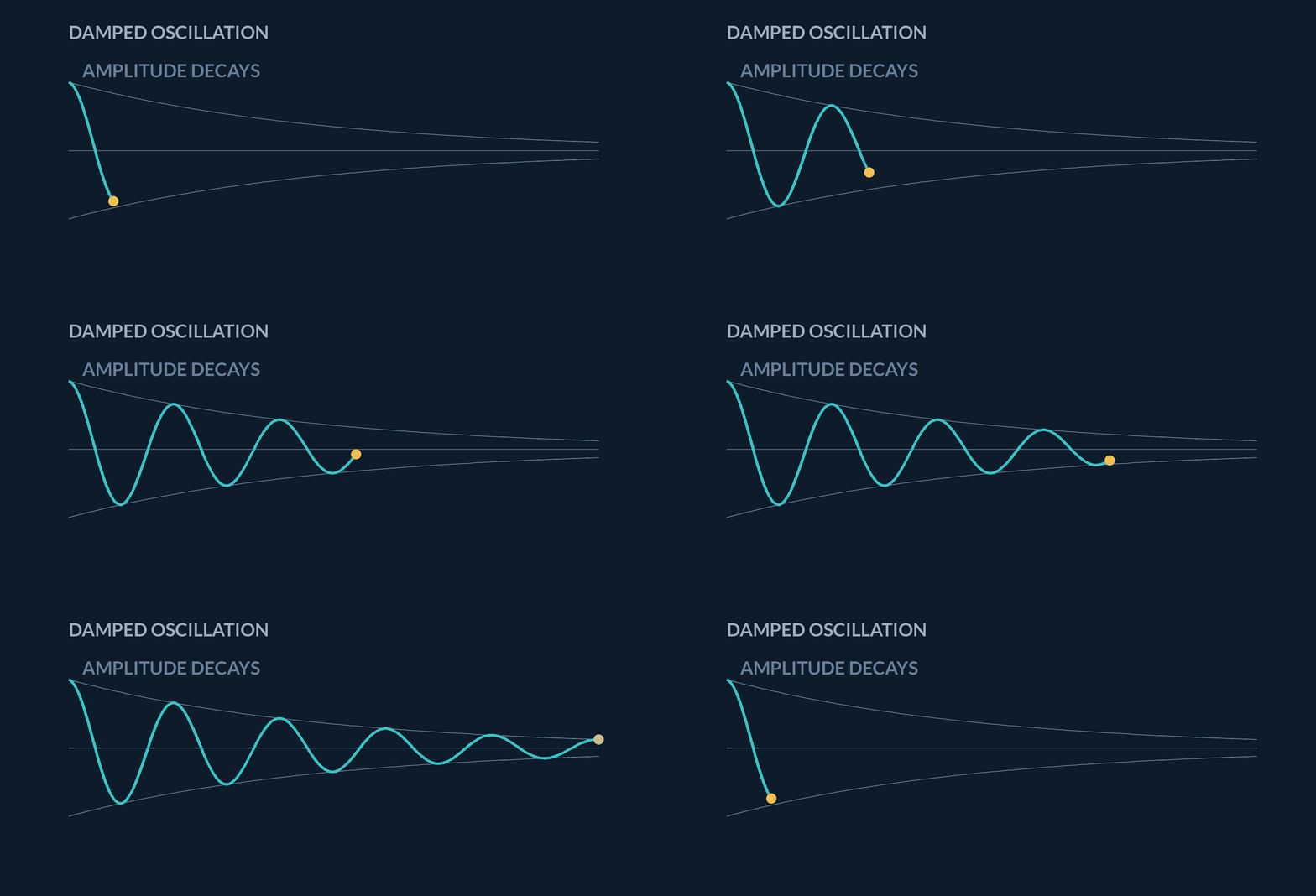
Every real oscillator loses energy. Add a drag force −bv to Hooke's law and the amplitude decays as A₀e^(−bt/2m), while the oscillation slows a little to ω′ = √(ω₀² − (b/2m)²); the energy, going as amplitude squared, falls faster, as e^(−bt/m). For light damping ω′ is barely below ω₀, so the visible effect is the fading, not any change of pitch.
Drive that oscillator with a periodic force and, once the transients die, it settles at the driving frequency, not its own. Its steady-state amplitude, though, depends sharply on how close the driving frequency is to ω₀: it is largest at ω_drive ≈ ω₀, and there its size is limited only by the damping. Light damping gives a tall, narrow resonance peak; heavy damping a low, broad one. This single idea drives a child's swing, tunes a radio's LCR circuit and, at its most destructive, shook apart the Tacoma Narrows bridge.
How it works
- Damping fades and slightly slowsAmplitude decays as e^(−bt/2m); ω′ = √(ω₀² − (b/2m)²), only just below ω₀ for light damping.
- A driven system obeys the driverIn the steady state it oscillates at ω_drive, whatever its own natural ω₀.
- Resonance at a matchThe response amplitude peaks at ω_drive ≈ ω₀; the lighter the damping, the taller and sharper that peak.
A lightly damped mass on a spring
A 0.2 kg mass on a spring of k = 80 N m⁻¹ has a damping coefficient b = 0.04 kg s⁻¹. Find the natural frequency, the damped frequency, and the time for the amplitude to fall to 1/e of its start.
- ω₀ = √(k/m) = √(80/0.2)20 rad s⁻¹
- b/2m = 0.04/0.40.1 s⁻¹
- ω′ = √(20² − 0.1²) = √399.99≈ 20.00 rad s⁻¹
- Amplitude to 1/e when bt/2m = 1, so t = 2m/b10 s
Pro tip. The frequency shift is a few parts per million — for any lightly damped oscillator take ω′ ≈ ω₀ and spend no time on it. Damping's real effect is the decay: this one rings for about 10 s, some thirty full cycles, before its amplitude drops to a third. Only heavy damping (b/2m approaching ω₀) detunes the frequency noticeably, and at b/2m = ω₀ the motion stops oscillating at all — critical damping.
As the damping of a driven oscillator is reduced, the resonance peak in its amplitude-versus-driving-frequency curve becomes
- taller and narrower
- shorter and broader
- unchanged in height, only shifted
At resonance the amplitude is limited by the damping alone, so less damping means a higher peak; the response also falls off faster on either side, so the peak narrows. The peak stays essentially at ω₀ — it is the height and width, not the position, that the damping controls.
6Travelling waves
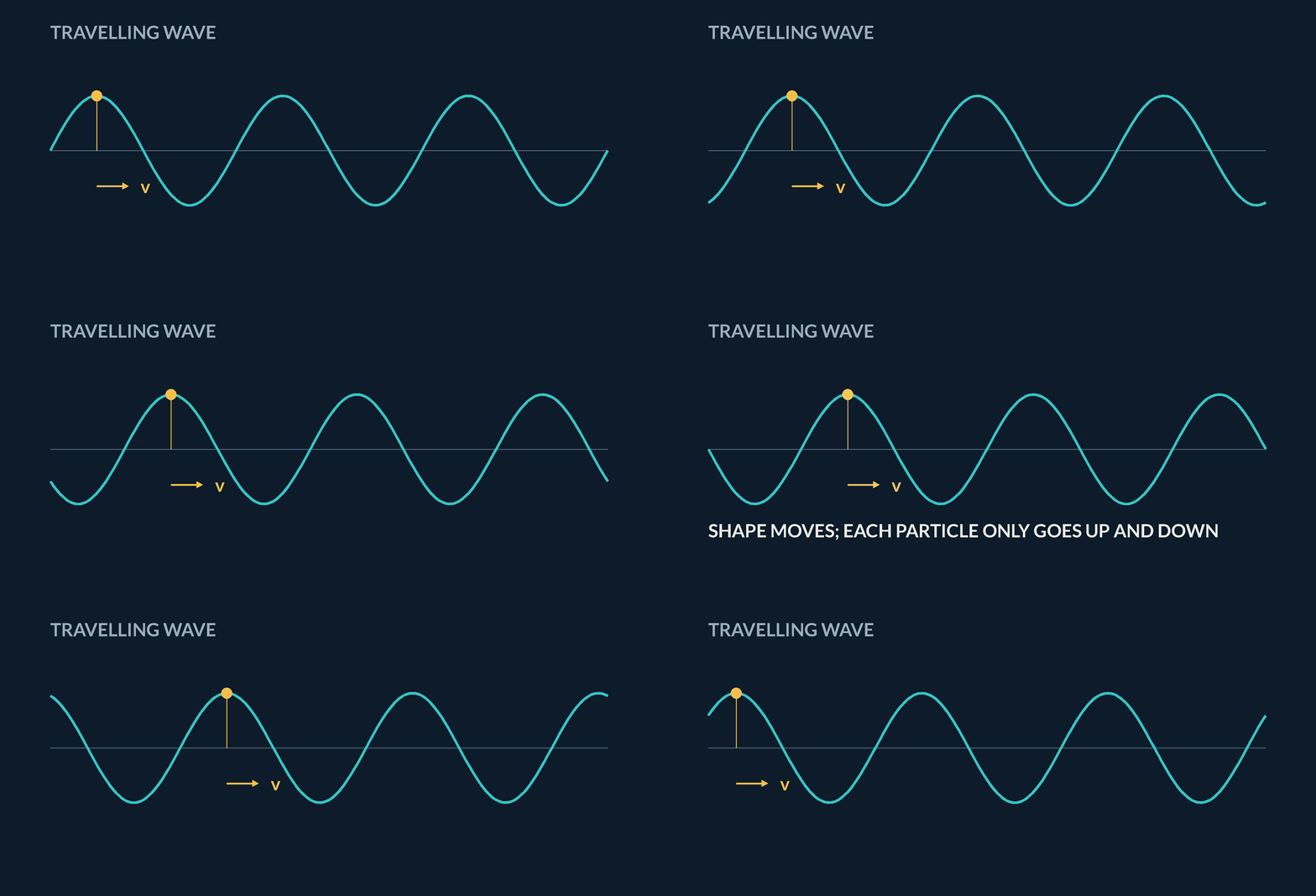
y = A sin(kx − ωt) is a shape moving in the +x direction at speed v = ω/k = fλ; make the two signs agree and it moves in −x instead. Two quite different speeds live inside that one equation. The wave speed v is how fast the pattern advances; the particle speed ∂y/∂t = −ωA cos(kx − ωt) is how fast a piece of the medium moves up and down, and it never exceeds ωA.
The two are tied together by the shape of the snapshot: particle velocity = −(wave speed) × (slope of the y–x curve). A steep stretch of the wave is a fast-moving stretch of the medium, and a crest — where the curve is flat — is momentarily at rest.
How to read a wave function
- Read k and ω off the argumentk = 2π/λ in rad m⁻¹ and ω = 2πf in rad s⁻¹. Both are coefficients, not measurements.
- Divide for the wave speedv = ω/k = fλ. This belongs to the medium and does not contain A anywhere.
- Differentiate for the particle speedThe greatest particle speed is ωA = kAv — large only when the wave is steep.
Reading a wave function
A wave on a string is y = 0.05 sin(5πx − 20πt), in SI units. Find its wavelength, frequency, speed and the greatest speed of a point on the string.
- λ = 2π/k = 2π/5π0.40 m
- f = ω/2π = 20π/2π10 Hz
- v = fλ = ω/k = 20π/5π4.0 m s⁻¹
- v_particle(max) = ωA = 20π × 0.053.14 m s⁻¹
Pro tip. Check the last row by the slope rule instead: the steepest slope of the snapshot is kA = 5π × 0.05 = 0.785, and 0.785 × 4 m s⁻¹ = 3.14 m s⁻¹ — the same number by an independent route. The two speeds happen to be comparable here only because the amplitude was chosen so; shrink A tenfold and the particle crawls at 0.314 m s⁻¹ while the wave still runs at 4 m s⁻¹.
For y = A sin(kx − ωt), the maximum speed of a particle of the medium equals the wave speed when
- A = λ
- λ = 2πA
- the two can never be equal
ωA = ω/k gives A = 1/k = λ/2π, that is λ = 2πA. Amplitude and wavelength are independent, so this is a special case someone has arranged, never a general rule.
7Wave speed belongs to the medium
A mechanical wave's speed is set by the medium's stiffness and its inertia, never by the source. On a stretched string v = √(T/μ), with T the tension and μ the mass per unit length. In a gas v = √(γP/ρ), and putting P/ρ = RT/M turns that into v = √(γRT/M) — the useful form, which says the speed of sound depends on the absolute temperature and on the gas, and not at all on the pressure. Because v ∝ √T, sound gains about 0.61 m s⁻¹ per kelvin near 0 °C: 331 m s⁻¹ at 273 K becomes 347 m s⁻¹ at 300 K. (The letter T is doing triple duty in this chapter — tension, absolute temperature, period. Read it from its neighbours every time.)
Frequency, by contrast, belongs to the source. Send a wave from a light string into a heavy one and the particle at the junction is shared by both, so it can only vibrate at one frequency: f cannot change. The speed does change, so λ = v/f absorbs the entire difference.
Figure. Both curves are square roots, so they flatten as you pull harder: near 100 N another 10 N of tension buys only about 5 m s⁻¹. The heavier string, at four times the mass per unit length, runs at exactly half the speed of the lighter one at every tension — the two curves are the same curve scaled by ½.
How it works
- Stiffness upstairs, inertia downstairsEvery mechanical wave speed is √(restoring quantity / inertia): T over μ, γP over ρ.
- Quadruple to doubleBoth are square roots, so a four-fold change in tension buys only a doubling of the speed.
- At a junction, f survivesFrequency crosses a boundary unchanged because the junction particle is shared; the wavelength does the adjusting.
One source, two strings
A light string of μ = 0.01 kg m⁻¹ is joined to a heavy one of μ = 0.04 kg m⁻¹ and both are held at a tension of 100 N. A 50 Hz source drives the light string. Find the speed and wavelength on each side of the join.
- v = √(T/μ) = √(100/0.01)100 m s⁻¹
- Heavy string, same tension: √(100/0.04)50 m s⁻¹
- λ = v/f on the light string: 100/502.0 m
- λ on the heavy string, f still 50 Hz: 50/501.0 m
Pro tip. Four times the mass per unit length halves the speed, while four times the tension only doubles it — which is why tuning a guitar string is so forgiving near pitch: a 1% error in tension moves the frequency by only 0.5%. And note what did not happen at the join: the frequency stayed at 50 Hz. If a question changes f at a boundary, something has changed the source.
The frequency of the source driving a wave on a given stretched string is doubled. The wave speed
- doubles
- halves
- is unchanged, and the wavelength halves
v = √(T/μ) contains nothing the source can touch. With v fixed and f doubled, λ = v/f must halve.
8Standing waves: strings and pipes
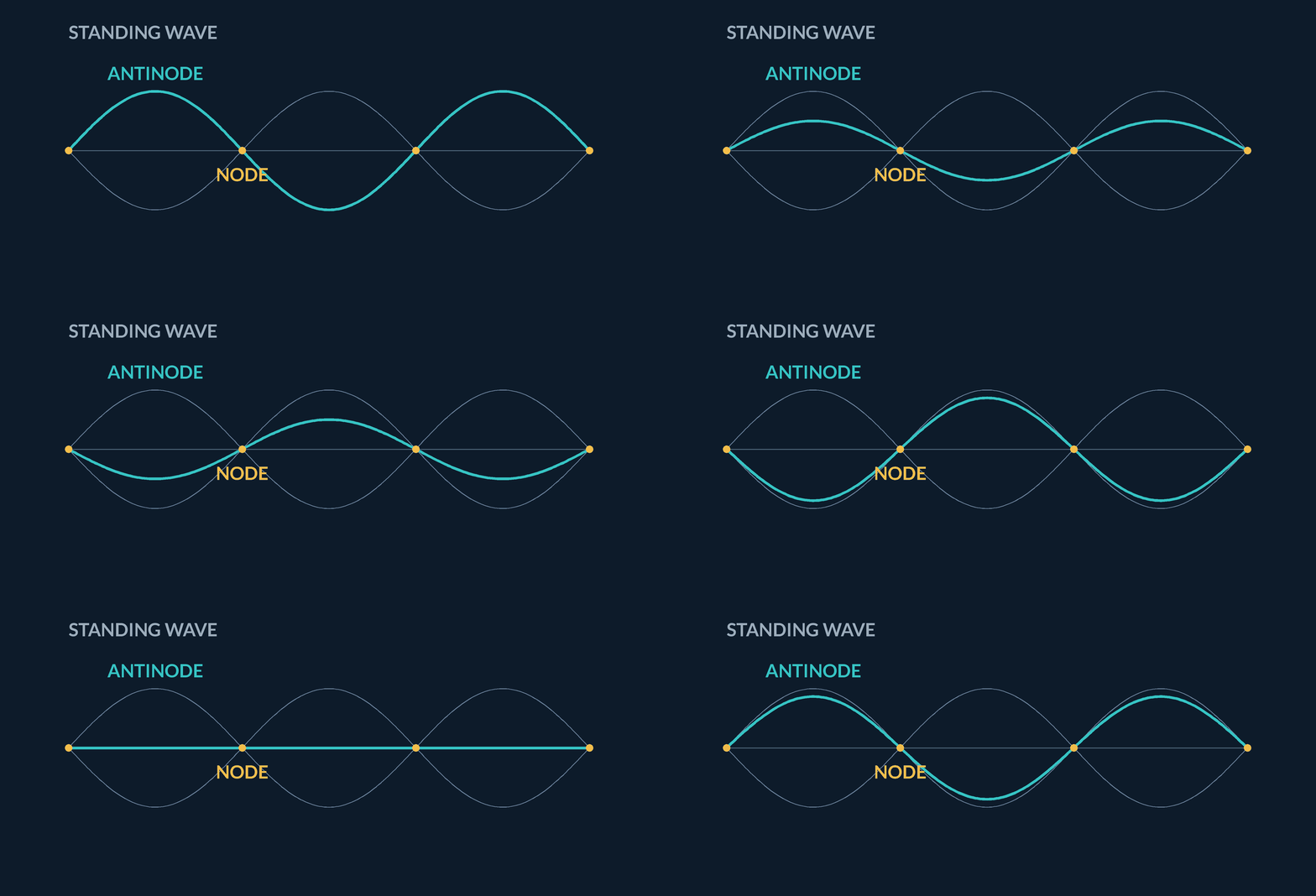
Superpose two identical waves running opposite ways and the x and t dependences separate: y = 2A sin kx · cos ωt. Nothing travels any more. The points where sin kx = 0 never move at all — nodes, spaced λ/2 apart — and halfway between them sit antinodes swinging through 2A. Energy sloshes between neighbouring segments but no longer flows along the medium.
Boundaries decide which wavelengths survive. A string clamped at both ends must carry a node at each, so L = nλ/2 and fₙ = nv/2L, with every harmonic allowed. A pipe open at both ends has a displacement antinode at each and gives the same series. A pipe closed at one end has a node there and an antinode at the mouth, so it fits only a quarter wavelength and its odd multiples: L = (2n − 1)λ/4, hence fₙ = (2n − 1)v/4L.
How it works
- Put nodes where the medium is heldA clamped string end and the closed end of a pipe are displacement nodes; a free end or an open mouth is an antinode.
- Fit whole quarters between themNode to node is λ/2, node to antinode is λ/4. Count how many of those fit into L.
- Convert with f = v/λv is still √(T/μ) or the speed of sound. The boundary chose λ; it never touched v.
| System | Ends | Fundamental | Harmonics present |
|---|---|---|---|
| String fixed at both ends | node, node | v/2L | all: f₁, 2f₁, 3f₁, … |
| Pipe open at both ends | antinode, antinode | v/2L | all: f₁, 2f₁, 3f₁, … |
| Pipe closed at one end | node, antinode | v/4L | odd only: f₁, 3f₁, 5f₁, … |
A wire that a pipe answers
A 1 m wire of mass 10 g is stretched to a tension of 100 N. A pipe 55 cm long and closed at one end stands beside it. Taking the speed of sound as 330 m s⁻¹, find which harmonic of the wire the pipe's fundamental matches.
- μ = 0.01 kg m⁻¹, v = √(100/0.01) = 100; f₁ = v/2L50 Hz
- Third harmonic of the wire: 3f₁150 Hz
- Closed pipe: f₁ = v/4L = 330/(4 × 0.55)150 Hz
- The same pipe with both ends open: v/2L300 Hz
Pro tip. A closed pipe sounds an octave below an open pipe of the same length, and its overtones run 3f₁, 5f₁, 7f₁ — never 2f₁. So read 'second overtone of a closed pipe' as 5f₁, not 3f₁: overtone number and harmonic number part company the moment the even harmonics go missing.
The first overtone of a pipe closed at one end has frequency
- 2f₁
- 3f₁
- 4f₁
Only odd harmonics exist, so the next mode above the fundamental is 3f₁ — the first overtone but the third harmonic. The second overtone is 5f₁.
9Beats
Two waves of nearly equal frequency arriving at the same place add to 2A cos(π(f₁ − f₂)t) · sin(π(f₁ + f₂)t): a tone at the mean frequency whose amplitude is itself slowly oscillating. The envelope 2A cos(πΔf t) passes through zero twice in each of its own cycles, and loudness follows the size of the amplitude rather than its sign, so the ear counts f_beat = |f₁ − f₂| beats per second — twice the envelope's own frequency.
Beats are a difference measurement, and that is exactly their value and exactly their limitation: a 4 Hz beat against a 256 Hz standard pins the unknown to within 4 Hz but leaves two candidates, 252 and 260. Only a deliberate nudge tells you which.
Figure. Four hertz added to six hertz, watched for exactly one second. The carrier runs at the mean of 5 Hz; the dashed envelope 2A cos(2πt) completes just one cycle in that second, but it crosses zero twice — so the ear hears two beats, exactly |6 − 4|. That factor of two between envelope frequency and beat frequency is the whole trap.
How it works
- Add with the sum-to-product identitysin a + sin b = 2 cos((a − b)/2) sin((a + b)/2) — a slow envelope multiplying a fast carrier.
- Count loudness maxima, not envelope cyclesThe envelope's magnitude peaks twice per cosine period, so f_beat = |f₁ − f₂| and not half of it.
- Break the tie with a known perturbationWax lowers a fork's frequency, filing the prongs raises it. Watch which way the beat rate then moves.
Which fork is the higher one?
An unknown fork gives 4 beats per second with a 256 Hz standard. Loaded with a little wax, the unknown then gives only 2 beats per second with the same standard. Find its original frequency.
- |f − 256| = 4f = 252 or 260 Hz
- Wax lowers f, and the beat rate fell 4 → 2f moved towards 256
- So f started above the standard260 Hz
- Check: waxed down to 258, |258 − 256|2 s⁻¹ ✓
Pro tip. Had the unknown been 252 Hz, waxing would have pushed it further from the standard and the beat rate would have risen to 6, not fallen to 2. The beat count alone never carries the sign of the difference — only a controlled change does. Wax down, file up.
A 300 Hz fork gives 5 beats per second with a second fork. Loading the second fork with wax raises the beat rate to 7. The second fork's original frequency was
- 295 Hz
- 305 Hz
- 307 Hz
The candidates are 295 and 305. Wax lowers a frequency, so 305 would have moved towards 300 and the beat rate would have fallen. It rose instead, so the fork was 295 Hz and waxing carried it down to 293 Hz.
10The Doppler effect in sound
Motion along the line joining source and observer changes the rate at which wavefronts arrive: f′ = f(v ± v_o)/(v ∓ v_s), with the signs chosen so that anything closing the gap raises the pitch. Unlike light, sound travels in a medium, so the two motions are genuinely different physical processes — a moving source compresses the wavelength it emits, while a moving observer leaves the wavelength alone and simply meets the existing wavefronts sooner.
The asymmetry shows in the algebra. The observer factor (v ± v_o)/v is linear and stays finite at any speed; the source factor v/(v ∓ v_s) blows up as v_s approaches v. They agree only while both speeds are small compared with v. Motion perpendicular to the line of sight gives no shift at that instant, whichever body is moving.

How it works
- Decide the direction of the shift firstAsk whether the pitch ought to rise or fall, then pick the signs that deliver it. Never the other way round.
- Keep only the component along the lineResolve both velocities along the source–observer line; the perpendicular part contributes nothing.
- Wind moves the medium, not the pitchReplace v by v + w everywhere, w measured from source towards observer. With both bodies at rest, f′ = f however hard it blows.
A train passing, and the same speed handed to the listener
A train sounds a 500 Hz horn while approaching a stationary observer at 30 m s⁻¹, then recedes at the same speed. Take the speed of sound as 330 m s⁻¹. Find both frequencies, and compare with an observer who instead runs at 30 m s⁻¹ towards a stationary horn.
- Approaching: f′ = 500 × 330/(330 − 30)550 Hz
- Receding: f′ = 500 × 330/(330 + 30)458.3 Hz
- Drop heard as the train passes91.7 Hz
- Observer moving instead: 500 × (330 + 30)/330545.5 Hz
Pro tip. An approaching source always raises the pitch, so put the smaller number (v − v_s) in the denominator to get f′ > f. Then look at the last row: the very same 30 m s⁻¹ gives 550 Hz when the source moves but only 545.5 Hz when the observer does. They are not interchangeable, and the gap widens fast — at 150 m s⁻¹ it is 917 Hz against 727 Hz.
A stationary source emits sound of frequency f. An observer runs directly away from it at exactly the speed of sound. The frequency the observer receives is
- zero
- f/2
- f, unchanged
f′ = f(v − v_o)/v with v_o = v gives zero: the observer keeps pace with the wavefronts and never meets a new one. Hand the same speed to a receding source instead and f′ = fv/(v + v) = f/2, which is not zero — the clearest proof that the two motions are different physics. It is an approaching source at the wave speed that makes the formula diverge.
Notes
- Simple harmonic motion: SHM occurs when the restoring force is proportional to displacement, a=-\omega^2 x. The solution is x=A\sin(\omega t+\phi) with velocity v=\omega\sqrt{A^2-x^2} and total energy E=\tfrac12 m\omega^2A^2, constant throughout.
- Spring and pendulum: A mass on a spring oscillates with T=2\pi\sqrt{\dfrac{m}{k}}; a simple pendulum with T=2\pi\sqrt{\dfrac{L}{g}} for small angles. Springs in series add compliance (1/k_{eq}=\sum1/k_i); in parallel stiffness adds (k_{eq}=\sum k_i).
- Travelling waves: A progressive wave y=A\sin(kx-\omega t) has speed v=\dfrac{\omega}{k}=f\lambda. On a stretched string v=\sqrt{\dfrac{T}{\mu}}; sound in a gas travels at v=\sqrt{\dfrac{\gamma P}{\rho}}.
- Superposition, standing waves and beats: Overlapping waves add. A string fixed at both ends resonates at f_n=\dfrac{nv}{2L}; a pipe open at both ends similarly, while a closed pipe gives only odd harmonics f_n=\dfrac{(2n-1)v}{4L}. Two close frequencies produce beats at f_{beat}=|f_1-f_2|.
- Doppler effect: The observed frequency of sound is f'=f\dfrac{v\pm v_o}{v\mp v_s}, using the sign convention that motion reducing the source-observer distance raises the pitch.
Formulas
- SHM: x=A\sin(\omega t+\phi),\quad v=\omega\sqrt{A^2-x^2},\quad E=\tfrac12 m\omega^2A^2
- Periods: T_{spring}=2\pi\sqrt{\dfrac{m}{k}},\quad T_{pendulum}=2\pi\sqrt{\dfrac{L}{g}}
- Wave speed: v=f\lambda=\dfrac{\omega}{k},\quad v_{string}=\sqrt{\dfrac{T}{\mu}},\quad v_{sound}=\sqrt{\dfrac{\gamma P}{\rho}}
- Harmonics: open pipe f_n=\dfrac{nv}{2L}, closed pipe f_n=\dfrac{(2n-1)v}{4L}
- Beats: f_{beat}=|f_1-f_2|
- Doppler: f'=f\,\dfrac{v\pm v_o}{v\mp v_s}
Exam traps & shortcuts
- In SHM kinetic energy is maximum at the mean position and potential energy at the extremes; both average to \tfrac{E}{2} over a cycle and the KE-PE exchange happens at twice the frequency.
- A closed organ pipe supports only odd harmonics, so its overtones are 3f_1,5f_1,\dots; its fundamental is half that of an open pipe of the same length.
- For beats, if loading a tuning fork with wax lowers its frequency and the beat rate changes, use the direction of change to decide which fork was higher.
Reference tables
Every line here should be reconstructible from the concept above it, not merely recalled.
| Quantity | Relation | Watch for |
|---|---|---|
| SHM definition | a = −ω²x | ω comes from the coefficient, not the amplitude |
| Displacement, velocity | x = A sin(ωt + φ), v = ω√(A² − x²) | v_max = ωA, a_max = ω²A |
| Energy | E = ½mω²A² = ½kA² | KE = 3E/4 at x = A/2; even split at A/√2 |
| Periods | T = 2π√(m/k), T = 2π√(L/g) | No g in the first, no m in the second |
| Springs combined | parallel k_eq = Σk, series 1/k_eq = Σ1/k | Cutting a spring in half doubles k |
| Damping, resonance | A = A₀e^(−bt/2m), ω′ = √(ω₀² − (b/2m)²) | Driven system settles at ω_drive; peak at ω₀ |
| Wave function | y = A sin(kx − ωt), v = ω/k = fλ | Particle speed ωA is not the wave speed |
| String, gas | v = √(T/μ), v = √(γP/ρ) = √(γRT/M) | Sound goes as √(absolute T); P and ρ rise together |
| Harmonics | open pipe or string nv/2L, closed pipe (2n − 1)v/4L | Closed pipe: odd multiples only |
| Beats | f_beat = |f₁ − f₂| | Two candidates; wax lowers, filing raises |
| Doppler | f′ = f(v ± v_o)/(v ∓ v_s) | Source and observer motion are not equivalent |
The ± convention is where the marks go. Rather than memorise two signs, memorise the four elementary cases below and read every other situation off them.
| Case | f′ | Pitch |
|---|---|---|
| Source approaches a stationary observer | f v/(v − v_s) | raised |
| Source recedes from a stationary observer | f v/(v + v_s) | lowered |
| Observer approaches a stationary source | f (v + v_o)/v | raised |
| Observer recedes from a stationary source | f (v − v_o)/v | lowered |
| Both closing on each other | f (v + v_o)/(v − v_s) | raised most |
| Either moving at right angles to the line joining them | f | no shift at that instant |
Recap
Read only this the night before.
- SHM
- a = −ω²x is the definition; read ω off the coefficient. v = ω√(A² − x²), v_max = ωA, a_max = ω²A.
- Energy
- E = ½kA² is fixed. At x = A/2 the energy is three-quarters kinetic; the even split waits until A/√2. The exchange runs at 2f.
- Periods
- T = 2π√(m/k) has no g in it; T = 2π√(L/g) has no m in it. Parallel springs stiffen to T/√2, series soften to T√2, and a lift changes only g_eff.
- Speed
- Speed belongs to the medium — √(T/μ) on a string, √(γRT/M) in a gas, going as √(absolute T) and never as P. Frequency belongs to the source and survives every boundary.
- Harmonics
- String and open pipe: nv/2L, every harmonic. Closed pipe: v/4L, odd only — an octave lower, and its second overtone is 5f₁.
- Beats
- f_beat = |f₁ − f₂| leaves two candidates. Wax lowers a fork, filing raises it; the direction the beat rate moves settles which.
- Doppler
- f′ = f(v ± v_o)/(v ∓ v_s) — choose signs so that approach raises the pitch. A moving source and a moving observer are not the same physics.
- Damping & resonance
- Amplitude decays e^(−bt/2m); ω′ = √(ω₀² − (b/2m)²) ≈ ω₀ for light damping. A driven oscillator settles at the driving frequency and responds most strongly when it matches ω₀ — lighter damping, taller and sharper peak.
Practise Oscillations and Waves
Reading is free and needs no account. Practice, mocks and progress live in the app.
- 5 exam-style questions on this topic, with explanations
- A 6-question practice set that ends the chapter
- Timed mocks scored with the real marking scheme
- Readiness tracked per topic, kept on your device