RBI Grade B Officer · General Intelligence & Reasoning
Seating Arrangement & Puzzles
Arranging people or items in linear, circular and complex seating and ordering puzzles.
Seating puzzles hand you a few people, some seats, and a list of clues, and ask you to work out who sits where. One running example threads this whole topic: five friends — P, Q, R, S and T — in a row of five seats, solved clue by clue, then the same style of reasoning moved onto a round table. The marks live in two places most candidates rush past: the facing convention (whose left is that, and which way does it point on your page?) and the order in which you apply clues — definite seats first, neighbours next, eliminations after that, and a branch only when nothing else moves. Not in drawing a prettier sketch than the next candidate.
- RBI Grade B Officer
- Hard level
- 8 concepts
- 43 practice questions
1Linear row: fix, then branch
A linear seating puzzle is the simplest board in this topic: one straight row of seats, one person per seat, and a handful of clues. Before reading any clue, fix the frame, because every clue is measured against it. Number the seats 1 up to n starting from your left as you look at the page. Then check which way the people face. Our row faces north — draw north as up the page — and a person facing north has their left hand on the same side as your left hand. So for a north-facing row, 'third from the left' really is the third box you count on the page, and a person's left and the page's left agree. That one sentence is doing quiet work: when a row faces south instead, every left and right flips, and the double-row concept in this topic deals with exactly that.
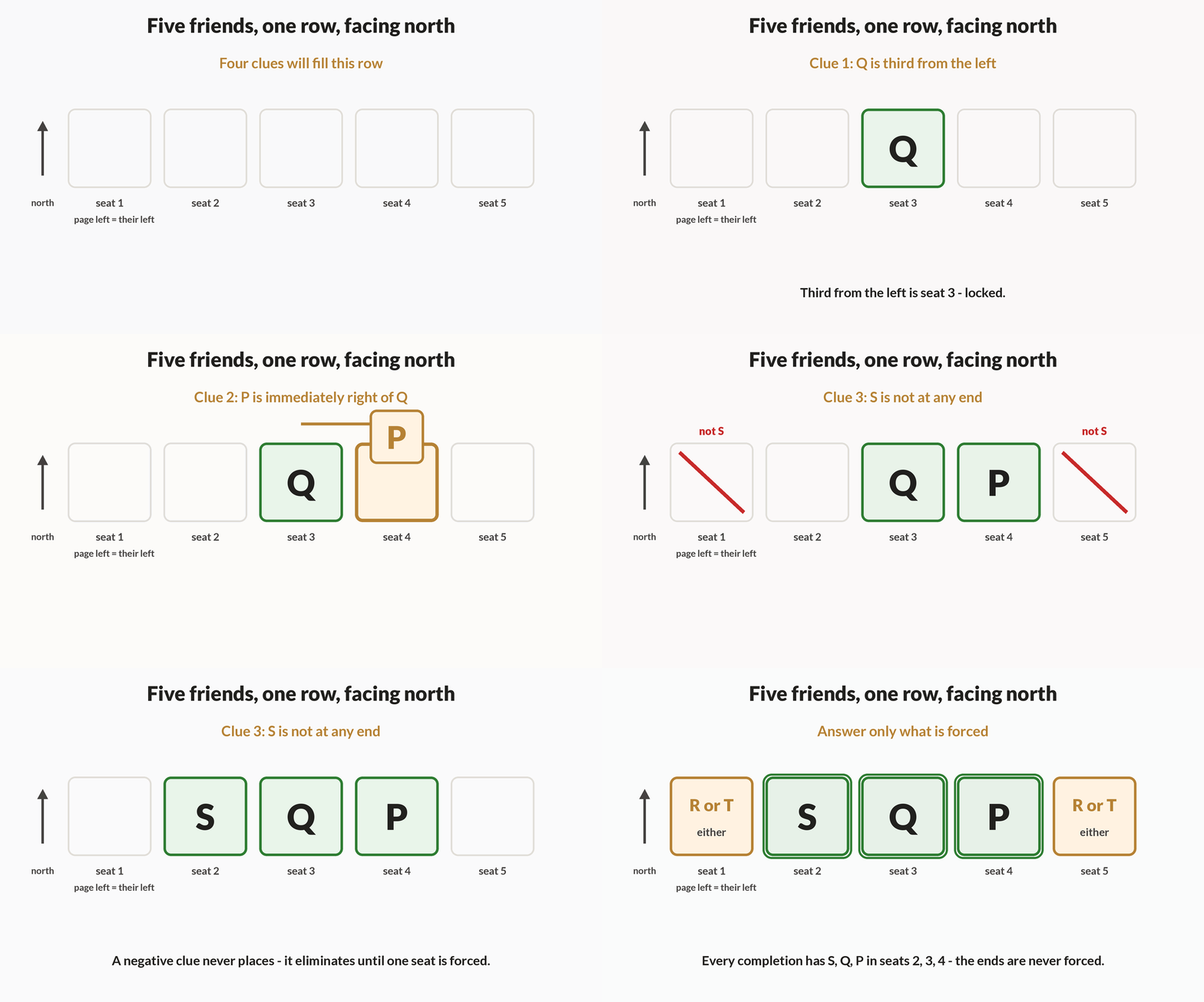
Here is the running example the whole topic returns to. Five friends — P, Q, R, S and T — sit in the row, all facing north, and the stem gives four clues: R sits at one end; Q is third from the left; P is immediately to the right of Q; S is not at any end. Those four clues are not the same kind of thing. 'Q is third from the left' is a definite clue — it names seat 3 outright, no interpretation needed. 'R sits at one end' looks definite but actually names two possible seats, 1 or 5: a two-way clue. 'P is immediately to the right of Q' is an adjacency clue — useless on its own, decisive the instant Q lands, because 'immediately' means the very next seat with nobody between. And 'S is not at any end' is a negative clue: it never places anyone; it only crosses seats out.
Now watch the order of attack earn its name. Definite clue first: Q goes to seat 3, and the board finally has a reference point. Adjacency next: P takes seat 4, the seat immediately to Q's right. Only now does the negative clue become powerful. On an empty board 'S is not at an end' barely narrows anything, but with seats 3 and 4 taken it reads: S cannot sit at 1 or 5, and 3 and 4 are gone — so seat 2 is the only legal chair left for S. A negative clue plus a crowded board equals a forced placement. That leaves seats 1 and 5 for R and T, and 'R at one end' is satisfied whichever end R takes.
Look at what the finished board actually promises. The middle is forced: every legal completion reads R-or-T, S, Q, P, T-or-R, so seats 2, 3 and 4 hold S, Q and P in both of the two completions that exist. The ends are not forced — R and T can swap, and no clue kills the swap. A fair question on this board asks about a forced seat ('who sits second from the left?' — S, always), never about which end R took. If an option set seems to need the ends decided, re-read the stem: either you skipped a clue, or the question only depends on the forced middle. Never invent which end is which. The animation on this card replays exactly this solve — each clue's effect is the thing that moves: the candidate seat lights up, the banned end seats get struck out, and each forced chip slides in and locks.
The attack order is fixed: place every definite seat before you open a branch.
Order of attack
- Anchor definitesConvert 'third from the left' and every named seat into a seat number before touching anything else. Definite clues need no reference point — they create the reference points every other clue leans on. Running row: Q to seat 3.
- Lock adjacency'Immediately left/right' fills the neighbour of an already-placed person — zero seats between. Apply it the moment its anchor lands: P to seat 4, the instant Q takes seat 3.
- Fire negatives on a crowded board'Not at an end' and 'not next to X' place nobody, but every taken seat sharpens them. With seats 3 and 4 gone, 'S is not at an end' leaves exactly one legal chair — seat 2.
- Branch only when two seats stay legalR could take seat 1 or 5: hold that as a short written fork, not two full diagrams. A later clue may kill one branch; if none does, the ends stay interchangeable and only forced seats can be asked.
Five friends in a north-facing row
Five friends P, Q, R, S, T sit in a row facing north. R is at one end. Q is third from the left. P is immediately right of Q. S is not at any end. Who sits second from the left?
- Q is third from the leftQ → seat 3
- P is immediately right of QP → seat 4
- S is not at an end; seats 3 and 4 takenS → seat 2
- R at an end; seats 1 and 5 left for R and Tends {R, T} either order
- Second from the leftS
Pro tip. The same clue set leaves R and T free to swap at the ends — so 'extreme right' is not forced. Ask (or answer) only what the clues uniquely pin; here seat 2 is S in every legal completion.
Five seats facing north. Q is third from the left and P is immediately right of Q. Which seat is P in?
- Seat 2
- Seat 4
- Seat 5
Third from the left is seat 3 for Q; immediately right of that is seat 4. Seat 2 would be immediate left; seat 5 skips a place.
2Circular table, facing the centre
A circular table changes the board, not the logic. There are no ends and no 'third from the left' — every seat has exactly two neighbours and the row wraps around on itself. You draw it as a top view, as if a camera looked straight down at the table: the seats are dots on a ring, and 'facing the centre' means every person's nose points at the middle of the table.
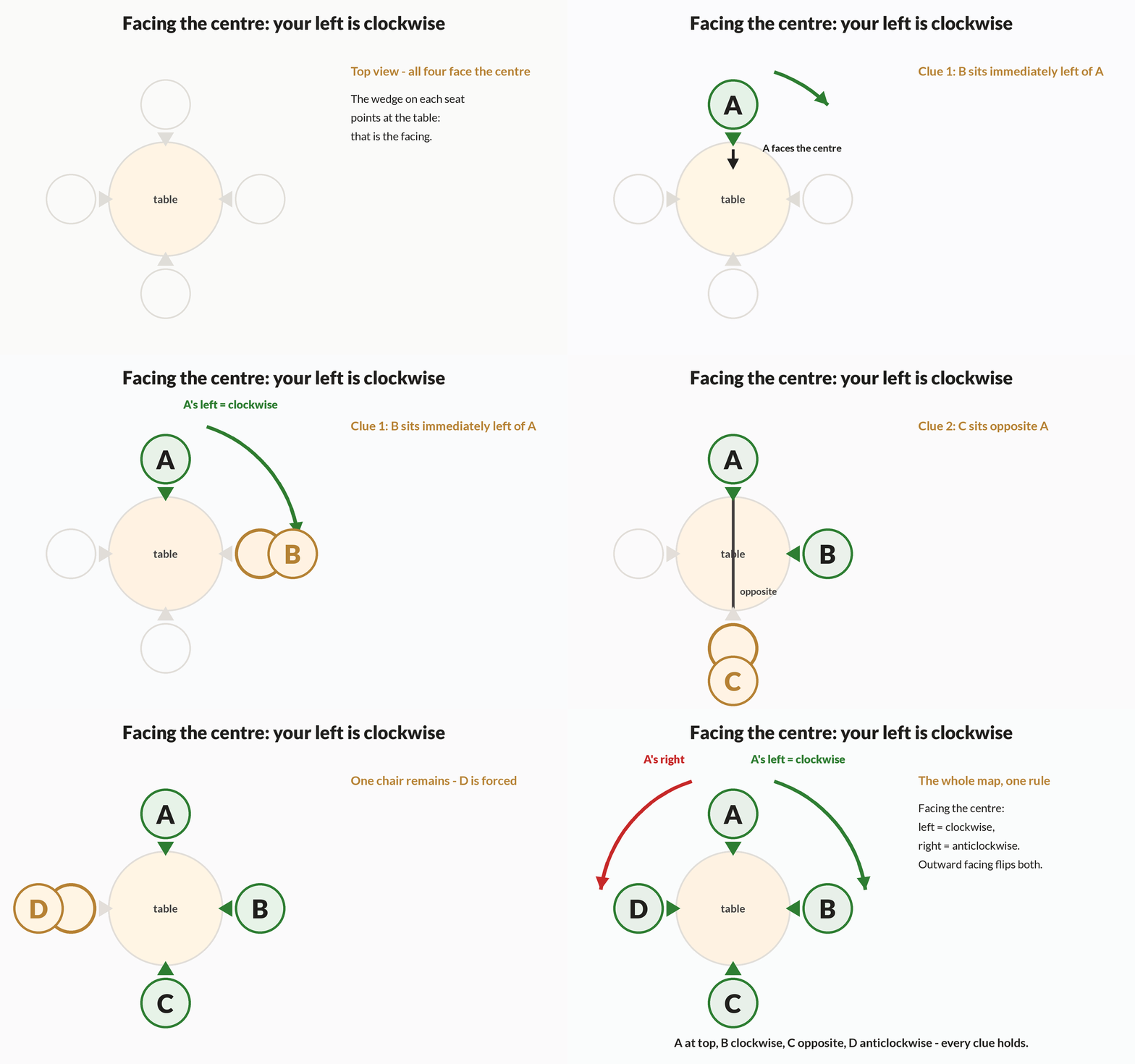
Now the convention that decides every circular question, slowly, because one word of it flips whole arrangements. Put person A at the top of your drawing — the 12 o'clock position — facing the centre. Facing the centre means A looks down the page, toward the table's middle. Stand in A's shoes for a second: when you face down the page, your left hand points toward the page's right — toward the 3 o'clock chair. And walking from 12 o'clock to 3 o'clock is walking clockwise. So for anyone facing the centre, 'to the left' means the clockwise direction around the ring, and 'to the right' means anticlockwise. It feels backwards because A faces the opposite way to you, the reader — trust the hands, not the habit.
Run it on the four-person example this card works: A, B, C, D face the centre; B is to the immediate left of A; C is opposite A. Left of A is one seat clockwise, so B takes the 3 o'clock chair. 'Opposite' means straight across the table — half the ring away, which for four equally spaced people is two seats in either direction — so C takes 6 o'clock. One chair remains, 9 o'clock, and D is forced into it by pure elimination. Then translate the picture back into people-language, because that is what the options speak: 9 o'clock is one seat anticlockwise from A, and anticlockwise is a centre-facer's right — D sits at A's immediate right, directly opposite B.
The trap is silent. Get left and right backwards and nothing complains: the ring still fills, every chair still gets a name — every placement is simply mirrored, and the option-setters keep the mirrored answer waiting among the choices. The animation on this card makes the convention visible before any placement happens: A's facing arrow points at the table, A's left-hand sweep is drawn running clockwise, and only then does each forced chair light up and lock.
With everyone facing the centre, each person's left is clockwise on the page and their right is anticlockwise.
Fix then ring
- Write the facing firstMark 'faces centre' beside the ring the moment you read the stem. Every left/right translation depends on it, and halfway through the solve is too late to discover you assumed wrong.
- Translate: left = clockwiseFace the centre from 12 o'clock and your left hand points at 3 o'clock — the clockwise side. Immediate left of A is the next chair clockwise; immediate right is the next chair anticlockwise.
- Drop opposites as diametersOpposite means straight across — half the ring, two seats away when four people sit equally spaced. With A anchored, 'C is opposite A' costs one straight line.
- Force the last chair, answer in people-languageThe remaining chair is forced by elimination. Convert the finished ring back into statements like 'D is at A's immediate right' — answers name people relative to people, never page directions.
Four facing the centre
Four people A, B, C, D sit around a circular table facing the centre. B is to the immediate left of A. C is opposite A. Where is D?
- Facing centre: immediate left of Aclockwise next = B
- C is opposite A (four seats)C two seats from A
- Remaining seatD opposite B
- D relative to Aimmediate right of A (anticlockwise)
Pro tip. For centre-facing circles, immediate left = clockwise. Mislabelling this one word reverses every later placement.
A, B, C, D face the centre. B is immediate left of A and C is opposite A. D sits
- Immediate right of A
- Immediate left of A
- Opposite A
Immediate left of A is already B (clockwise). Opposite A is C. The last seat is anticlockwise of A — immediate right — and opposite B.
3Outward facing reverses left and right
Some stems turn everybody around: 'all of them face away from the centre' — outward, backs to the table. Ground it the same way as before. Put A at 12 o'clock facing outward: A now looks up the page, away from the table. Face up the page and your left hand points to the page's left — toward the 9 o'clock chair, which is the anticlockwise side. One turn of the body has flipped both maps: facing outward, 'left' means anticlockwise and 'right' means clockwise, the exact mirror of the centre-facing rule.
Feel the flip on the centre-facing solve this topic already ran — B immediately left of A, C opposite A. Under outward facing, 'left of A' now lands B one seat anticlockwise, at 9 o'clock. C still sits opposite at 6 o'clock, because 'opposite' is about distance across the table and ignores facing entirely. D is forced into the last chair at 3 o'clock. The finished page picture is the mirror image of the centre-facing one — yet the sentence 'D sits at A's immediate right' is true in both solves, because the word 'right' flipped along with everything else. What changes are the page-level facts: ask 'who is one seat clockwise of A?' and the centre-facing ring says B while the outward ring says D. That is why copying a centre-facing translation onto an outward stem is so dangerous — most of the final sentences still sound right while the arrangement underneath is reversed.
The discipline is mechanical: read the facing out of the stem before applying any left/right clue, and write it beside the sketch. Tougher sets mix facings — some people face the centre, some face outward — and then no single rule covers the ring: mark an arrow on each seat and translate each clue with that person's own facing. The Facing table on this card is the two-line map to memorise; the quick check makes you use it.
Turn them all outward and the page picture flips: clockwise becomes each person's right, and anticlockwise becomes left.
Figure. Same seat order, opposite facing: centre-facing left is clockwise on the page; outward-facing flips that left/right map.
Facing before left
- Read facing from the stemCentre and outward are opposite conventions; mixed facing (some in, some out) must be marked per seat.
- Pick the left mapCentre → left = clockwise. Outward → left = anticlockwise.
- Only then place neighboursApply 'immediate left of A' after the map is chosen, never from page-left habit.
| Facing | Person's left | Person's right |
|---|---|---|
| Centre | Clockwise | Anticlockwise |
| Outward | Anticlockwise | Clockwise |
Four people face outward. B is to the immediate left of A. From a top-view with A at the top, B is
- Clockwise of A
- Anticlockwise of A
- Opposite A
Outward facing makes left = anticlockwise. Clockwise would be immediate right. Opposite is a separate clue, not implied by immediate left.
4Between, immediate, and seat gaps
Seating clues measure distance in three phrasings, and each one fixes a different number. 'Immediately left/right' is adjacency: the very next seat, zero people between, a seat-number gap of exactly 1. 'Exactly two persons between A and B' fixes two people strictly between them, which is a seat-number gap of 3 — count it on the running row: S sits at seat 2 and P at seat 4, the gap in seat numbers is 4 minus 2 = 2, and exactly one person (Q, at seat 3) sits between them. The general rule both directions: exactly k persons between means a seat-number gap of k + 1, and persons strictly between equal the gap minus 1.
The classic miscount is including an endpoint. From seat 2 to seat 5 the gap in seat numbers is 3, so the persons strictly between are the ones at seats 3 and 4 — two people. Answering three confuses the gap with the count; answering four counts every seat from 2 through 5 including A and B themselves. 'Strictly between' never includes the two named people.
Two more things the phrasing does and does not promise. First, 'exactly two between A and B' says nothing about direction — A left of B and B left of A both satisfy it on a row, so hold both orders until another clue picks one. On a circle there are two arcs between any two people; 'between' ordinarily reads along the shorter arc unless the stem spells out otherwise, and 'opposite' is its own clue — half the ring, not a between-count. Second, loose wording stays loose: 'some persons sit between them' means at least one, not exactly one, and 'P is to the right of Q' without 'immediately' means anywhere on the right side. Do not tighten a loose clue while solving and leave it loose in the stem — a board built on an assumed 'exactly' fails the recheck this topic ends with.
Count the seats between two people first; persons strictly between equal that gap minus one.
Figure. A and B with two open seats between them: persons between = 2, seat-number gap = 3.
Clue to gap
- Spot the keywordImmediate → adjacency. Exactly k between → k people and a seat-number gap of k+1.
- Write both directionsA … B and B … A are the same gap on a line; on a circle, the shorter arc is usually intended unless the stem says otherwise.
- Count seats, not steps of speechFrom seat 2 to seat 5 the gap in numbers is 3 and the persons between are two — match the formula before placing names.
| Clue phrase | Seat-number gap | Persons between |
|---|---|---|
| Immediately left/right | 1 | 0 |
| Exactly one between | 2 | 1 |
| Exactly two between | 3 | 2 |
| At an end (row of n) | — | one neighbour only |
In a row, A is at seat 2 and B at seat 5. How many persons sit strictly between them?
- 2
- 3
- 4
Seat-number gap is 5 − 2 = 3, so persons between = 3 − 1 = 2. Answering 3 confuses the gap with the count of people between; 4 counts seats from 2 through 5 inclusive.
5Double row: facing pairs
A double-row puzzle seats two parallel rows opposite each other — draw row 1 as the top strip facing south (down the page, toward the other row) and row 2 as the bottom strip facing north (up the page). 'X faces Y' or 'X sits opposite Y' means X and Y occupy the same column — the seats vertically aligned on your page. Keep the columns honestly aligned when you sketch: a slanted 'opposite' is a drawing error that silently shifts every later clue.
The part that costs marks: the two rows disagree about left and right. A person in row 2 faces north — up the page, the same way you read — so their left hand is on the page's left; their words and your page agree. A person in row 1 faces south — toward you — so their left hand is on the page's right; every left/right clue about row 1 lands mirrored on the page. Same words, opposite effect, purely because of facing.
Walk one small forced set to feel it. Row 1 holds P, Q, R facing south; row 2 holds S, T, U facing north. Clues: Q sits in the middle of row 1; P is immediately to the left of Q; T faces Q; S is immediately to the right of T. Q takes row 1's middle column — a definite clue. Now 'P immediately left of Q': row 1 faces south, so Q's left is the page's right, and P lands in row 1's rightmost page position. 'T faces Q' puts T straight down the middle column of row 2. 'S immediately right of T': row 2 faces north, right means the page's right, so S takes row 2's rightmost seat. R and U inherit the leftover page-left seats by elimination. Final page picture, left to right: top row R, Q, P; bottom row U, T, S — and notice that 'P to the left of Q' put P on the page's right. That is the whole lesson in one placement.
Two working rules finish the concept. For equal-length rows, a single facing pair freezes the entire column map — once 'T faces Q' is placed, every other column pairing is decided, which is why one opposite clue is worth placing early. And translate cross-row language step by step: 'second to the right of the one facing X' means find X's column partner first, then walk two seats using that partner's own facing — never your page habit.
Once one opposite pair is locked, person i in row 1 sits opposite a definite person in row 2.
Figure. Equal columns, vertical links = facing pairs. Keep the x-alignment; a slanted 'opposite' is a drawing error, not a clue.
Align then translate
- Draw two stripsSame seat count, columns lined up in x — do not diagonalise opposites.
- Mark facing on each rowNorth-facing and south-facing reverse left/right relative to the page if you read both rows as 'left to right' without flipping.
- Lock one oppositeA single 'A faces B' clue freezes the whole column map for equal-length rows.
- Translate cross-row cluesConvert each opposite/diagonal clue into a same-column or shifted-column fact before placing names.
Two rows of three face each other. A in row 1 faces D. The person opposite the middle of row 1 is
- Whoever sits middle of row 2 once A–D locks the columns
- Always the left end of row 2
- Not determined until every name is placed
One opposite freezes the column map for equal-length rows, so the middle column's row-2 seat is fixed as soon as you know who sits middle in row 1 — you do not wait for a full naming.
6Absolute anchors before relative clues
Clues come in a hierarchy of strength, and solving fast is mostly refusing to use them in stem order. An absolute clue names a seat outright — 'at an end', 'third from the left', 'in the middle of the row'. An adjacency clue ('immediately beside') is almost absolute: it fires the moment its anchor is placed. A negative clue ('not at an end', 'not next to X') places nobody and only crosses seats out. A soft relative ('somewhere to the left of D') is the weakest — it survives many arrangements and cannot force anything early. The reason order matters is mechanical: relative clues need a placed reference to act on, and absolute clues are what create those references.
Rerun the running row as an ordering experiment. Start deliberately badly, with 'S is not at any end': on an empty board it leaves S three legal seats and places nothing — the clue is not wrong, it is early. Start well instead, with the definite 'Q is third from the left', and every later clue lands on a busier board: the adjacency fills seat 4 at once, and the same negative that was useless first now meets a board where seats 3 and 4 are taken and pins S to seat 2 in one stroke. Clues do not have fixed power; they gain power as the board fills, and the attack order exists to let each clue fire at its strongest.
Two-way clues get a fork, not a second diagram. 'R sits at one end' leaves seats 1 and 5 legal: write the fork in the margin (R: 1 or 5) and keep solving — drawing two full rows doubles your work before you know the branch matters. In the running row the fork never closes, and it never needs to: every seat a fair question can ask about is already forced. Notice something honest about that clue while you are here — by the time it fires, Q, P and S have taken seats 2 to 4, so only the ends remain and R was heading to an end regardless. A clue can do no eliminating work at all and still belong to the puzzle as a consistency check. The recheck concept at the end of this topic turns exactly that observation into a habit.
Relative clues need a placed reference; absolute clues create those references.
Figure. Attack order for a seating row: absolute pins first, then neighbours, then soft relatives. Soft clues wait until open seats are few.
Attack order
- Harvest absolutesEnds, numbered ranks, and fixed seat counts go on the board first.
- Attach immediate neighboursAdjacency to a placed person is still 'almost absolute' — place it next.
- Defer soft relatives'Somewhere to the left of' waits until the open seats are few.
- Keep a short fork listTwo legal seats for one person: note both, eliminate with the next constraint, then commit.
You have: (1) B is somewhere left of D, (2) C is at the extreme right, (3) A is immediately left of C. Which clue should you place first?
- C at the extreme right
- B somewhere left of D
- Either order — all three are relative
Extreme right is an absolute seat. A immediately left of C then locks the neighbour. 'Somewhere left' is the soft relative and waits.
7Recheck every clue on the final board
A finished board that violates one original clue is not nearly right — it is wrong, and wrong in the most dangerous way, because exam options are engineered around near-misses. The setter knows which single clue solvers skip, builds the arrangement that skipping it produces, and lists that arrangement's answer among the options. A board you have not verified is a board the options are waiting for.
The pass costs under a minute. Take the finished running row — say the completion R, S, Q, P, T, seats 1 to 5 — and read the stem clue by clue against it. R at one end: R holds seat 1, true. Q third from the left: seat 3, true. P immediately right of Q: seat 4 beside seat 3, true. S not at any end: seat 2, true. Four ticks, board certified. While ticking, re-test the facing as well: check every 'left of' and 'from the left' against the facing you wrote down at the start, not the one your hand assumed halfway through — a recheck that reuses the same silent flip certifies the same wrong board.
Watch the clue that never seemed to do anything. In the running row, 'R at one end' eliminated nothing — by the time it fired, only the two ends were open, so R was going to an end regardless. Unused is not the same as broken: an unused clue that holds on your board is a free consistency check, and you tick it like the rest. An unused clue that fails is the whole alarm — it kills the branch you are on, and the tempting near-miss board dies with it. And if a clue did no work and the asked seat is still not forced, the arrangement is under-determined: re-read the stem, because a clue you never used is usually a clue you never applied.
The arrangement is valid only when every clue holds at once.
Figure. One legal completion of the running north-facing row. Every stem clue ticks at once; a board that fails any clue is wrong.
Close the loop
- Tick each clueWalk the stem in order; each must be visibly true on the final row or ring.
- Re-test facingConfirm left/right still match the facing you marked — not the facing you assumed halfway through.
- Watch the unused clueIf a clue never constrained a seat, either the arrangement is under-forced or you skipped it — find which.
Your row satisfies four of five clues; the unused clue is 'S is not at an end' and S is on an end in your sketch. You should
- Keep the sketch — four of five is enough
- Reject the sketch and reopen the branch that moved S
- Move S only if a sixth clue appears
Every clue must hold simultaneously. An unused clue that your board already breaks is exactly the signal to kill that branch.
8Mixed facing: left belongs to that person
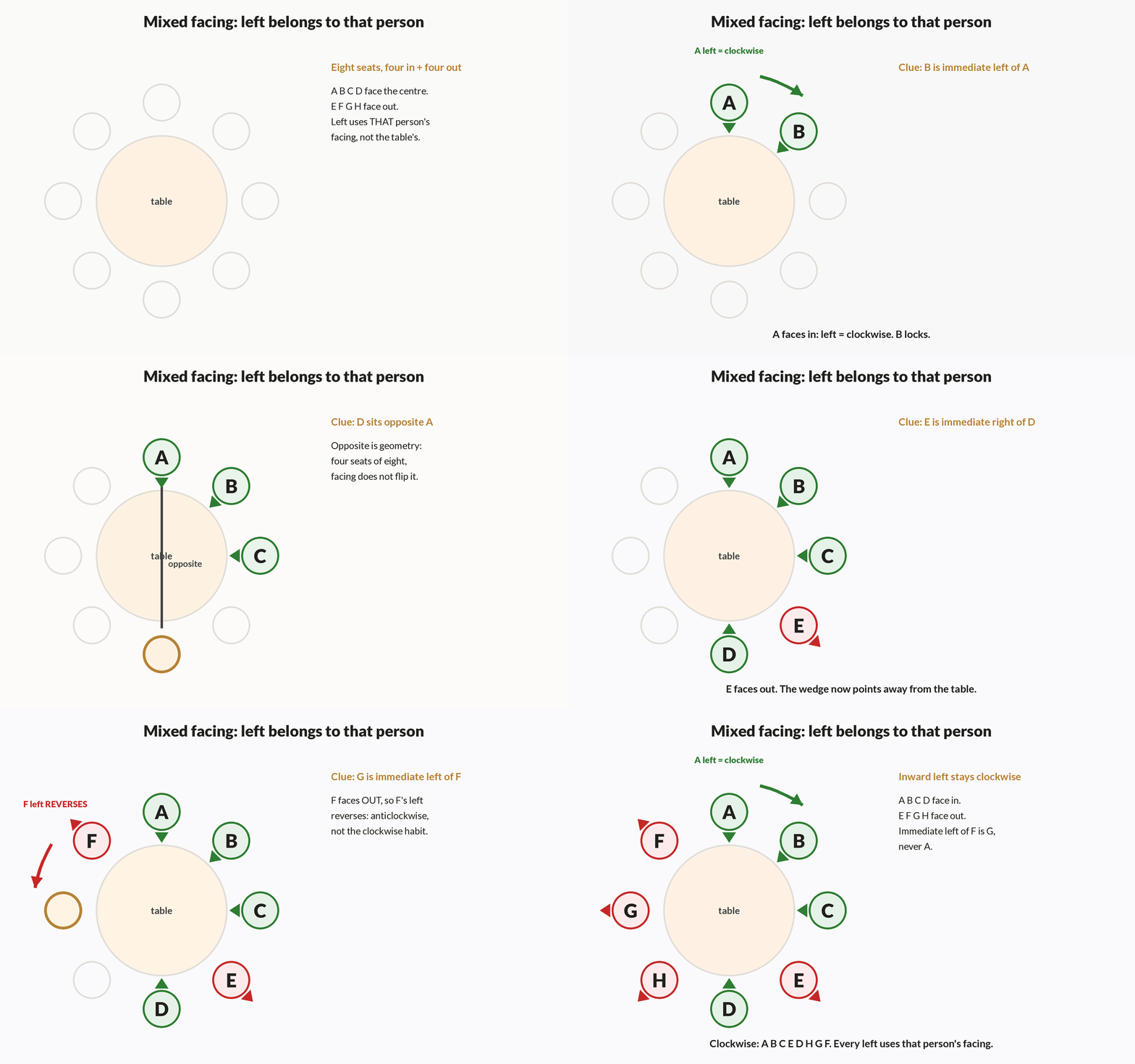
Eight people around a circular table, four facing the centre and four facing out, is the mixed-facing frame banking mains keep writing — SBI PO included. Left and right are not a property of the table. They are a property of the person the clue names. For a centre-facing person, immediate left is the next seat clockwise on the page. For an outward-facing person, immediate left reverses: the next seat anticlockwise. The same English word 'left' walks opposite ways around the ring, and it walks that way only for the person whose facing you just read.
Fix one centre-facing person as a handle — A at the top of the sketch, facing in. 'B is to the immediate left of A' uses A's facing, so B sits clockwise of A. 'C is to the immediate left of B' then uses B's facing, not A's. If B also faces the centre, C continues clockwise; if B faced out, C would sit back on A's other side and the clue set would look contradictory. Opposite is safer: it is a counted diameter (four seats away when eight sit equally) and does not care which way anyone looks. Place every opposite before you spend another left/right.
The trap is copying the centre-facing map onto every clue, including the clues about people who face out. Immediate left of outward-facing F is anticlockwise — G in the worked ring — and the option that sits clockwise of F is A, which is exactly who you would name if you forgot F's facing. Mark in or out beside every name before the first left/right is applied, and re-read each left/right against that person's own mark on the finished ring.
Facing of the named person
- Mark every facingWrite 'in' or 'out' beside each name, or beside each seat as soon as facing is known. Four in and four out is a count you can re-check at the end.
- Translate left on that markCentre-facing left = clockwise on the page. Outward-facing left = anticlockwise. Apply the map of the person the clue names, never a global clockwise habit.
- Place opposites as geometryOpposite is n/2 seats away. It does not flip with facing, so it is the safest second anchor after one named person is fixed.
- Recheck each left on the ringOn the finished seats, take every 'immediate left of X' clue and walk X's own facing. One reversed person kills the board.
| Clue | Facing you read | Left walks |
|---|---|---|
| Immediate left of A (in) | A's, centre | Clockwise to B |
| Immediate left of B (in) | B's, centre | Clockwise to C |
| Immediate left of F (out) | F's, outward | Anticlockwise to G |
Eight seats, four in and four out
A–H sit around a circular table. A, B, C and D face the centre; E, F, G and H face out. A faces the centre. B is to the immediate left of A. C is to the immediate left of B. D sits opposite A. E is to the immediate right of D. F is to the immediate right of A. G is to the immediate left of F. Who sits to the immediate left of F?
- A at seat 0 facing in; left of A (in)clockwise → B at seat 1, B faces in
- Left of B (in)clockwise → C at seat 2, C faces in
- D opposite A (eight seats)D at seat 4, D faces in
- Right of D (in) is anticlockwise; right of A (in) is anticlockwiseE at seat 3 (out); F at seat 7 (out)
- Left of F (out) is anticlockwise; leftover seat 5G at seat 6 (out); H at seat 5 (out)
- Immediate left of FG
Pro tip. Clockwise around the finished ring is A (in), B (in), C (in), E (out), D (in), H (out), G (out), F (out). Treating F as centre-facing would name A as F's left — that is the trap option.
F faces out. Seats clockwise from A are A (in), B (in), C (in), E (out), D (in), H (out), G (out), F (out). Immediate left of F is
- G
- A
- H
Outward facing makes left = anticlockwise, so from F the next person anticlockwise is G. A is clockwise of F, which would be F's left only if F faced the centre. H is two seats anticlockwise, so not immediate.
Notes
- Linear Arrangement - Fix and Branch: Start from the most restrictive clue (a person at an end, or two people with a fixed gap). Draw the row and place definite positions first, leaving flexible clues for later branching.
- Circular Arrangement - Facing Direction: For people facing the centre, left and right are opposite to your page orientation; for people facing outward, they match. Always note facing before applying 'to the left/right of' clues.
- Handling 'Between' and 'Immediate' Clues: 'Exactly two persons between A and B' fixes a gap of 3 seats; 'immediately left/right' fixes adjacency. Convert every clue into a concrete gap or adjacency.
- Double-Row / Facing Rows: Two rows face each other; a person in row 1 facing north aligns with a specific person in row 2 facing south. Map the correspondence carefully to translate cross-row clues.
- Common trap: Left/right reverses for centre-facing circular seating - a clue 'B is to the immediate right of A' places B clockwise or anticlockwise depending on facing; getting this backwards flips the whole arrangement.
Formulas
- Persons strictly between A and B = (gap in seat numbers) - 1.
- Circular seats for n people: positions are 360/n degrees apart; adjacency wraps from last to first.
- Centre-facing circle: clockwise = a person's LEFT; outward-facing: clockwise = a person's RIGHT.
- Linear row of n: exactly n-1 adjacency pairs; ends have only one neighbour.
- Two facing rows of n: person i in row 1 sits opposite a fixed person in row 2 once one alignment is fixed.
Exam traps & shortcuts
- Begin with clues that give absolute positions (ends, fixed seat numbers) before relative 'left/right' clues.
- For circular puzzles, write 'faces centre' or 'faces out' beside each seat and translate left/right accordingly.
- Keep a small list of possibilities when a clue allows two placements, then eliminate using later constraints.
- Re-verify every original clue against your final arrangement; a valid arrangement must satisfy all of them simultaneously.
Reference tables
Short facts that turn wording into numbers. They do not replace facing rules.
| Fact | Use |
|---|---|
| Persons between A and B = (seat-number gap) − 1 | Linear or shorter circular arc |
| Row of n: n − 1 adjacency pairs; ends have one neighbour | End clues and 'not at an end' |
| Centre-facing: clockwise = left | Circular immediate-left clues |
| Outward-facing: clockwise = right | Same clues, reversed map |
| Two facing rows of n: one opposite freezes all columns | Cross-row translations |
Recap
The night-before pass.
- Fix then branch
- Absolute ranks and ends first; adjacency next; negatives and soft relatives last.
- Centre left
- Facing centre: left = clockwise, right = anticlockwise. Outward swaps both.
- Gaps
- Exactly k between means seat-number gap k+1; immediate means gap 1.
- Facing rows
- Align columns; one opposite locks the map; do not slant opposites.
- Forced answers only
- If two completions remain, the asked seat is not unique — do not invent which end is which.
- Recheck
- Every original clue must hold on the final board, including the one you never used while drawing.
Practise Seating Arrangement & Puzzles
Reading is free and needs no account. Practice, mocks and progress live in the app.
- 43 exam-style questions on this topic, with explanations
- A 6-question practice set that ends the chapter
- Timed mocks scored with the real marking scheme
- Readiness tracked per topic, kept on your device