RBI Grade B Officer · General Intelligence & Reasoning
Syllogism
Drawing valid conclusions from given statements using Venn-diagram-based logical deduction.
A syllogism question gives you two or three short sentences about groups — 'All pens are books. All books are red.' — and a list of conclusions. Your job is not to pick the conclusion that sounds likely. It is to decide what those sentences force on every picture of the groups you could still draw. A conclusion 'definitely follows' only when you cannot redraw the groups, keep every sentence true, and break the conclusion. Each concept below names one piece of that test: the four sentence shapes, the every-diagram rule, the conversions that keep truth, and the traps (Some versus All, either-or, starved premises) the options are built from.
- RBI Grade B Officer
- Medium level
- 7 concepts
- 116 practice questions
1The four statement types
Every syllogism premise is one of four shapes, and each shape is a force on the groups, not a hint about wording. 'All A are B' puts every member of A inside B — every pen is a book, in the running chain this topic uses. 'No A is B' keeps the two sets disjoint: they share nothing. 'Some A are B' forces an overlap — at least one shared member — without saying how large, and without saying that anything sits outside. 'Some A are not B' forces at least one member of A to sit outside B — an outsider in A exists.
The exam question is almost never 'which wording is which'. It is 'what does this wording force on every diagram you could still draw'. Learn the four forces first; the Venn sketch is only a reminder of the force. Whatever the wording does not force stays possible: after 'Some teachers are poets' you still do not know whether every teacher is a poet, and after 'All A are B' you still do not know whether anything in B sits outside A.
Name the type by stripping the nouns: All / No / Some / Some-not. Then state the force in one clause (inclusion, disjoint, overlap exists, outsider exists) and leave the rest open — including All under a Some premise, which the later concept treats as a named trap rather than a surprise.
Figure. Four forces as relation edges, not circles: subset, disjoint, some (dashed), and outsider (dashed).
Read the force
- Name the typeStrip the nouns and match the stem to All / No / Some / Some-not. 'Some teachers are poets' is Some; 'All pens are books' is All. The nouns wait; the force comes from the quantifier.
- State the forceAll → inclusion; No → disjoint; Some → overlap exists; Some-not → an outsider in A exists. Say that force in a clause before you draw anything — the drawing is only a reminder.
- Leave the rest openWhatever the wording does not force stays possible — including All under a Some premise. 'Some A are B' does not block 'All A are B'; it also does not prove it.
| Wording | Force on the sets | Still open |
|---|---|---|
| All A are B | A lies inside B | Whether anything in B is outside A |
| No A is B | A and B share nothing | Nothing about other sets |
| Some A are B | At least one member is in both | Whether All A are B also holds |
| Some A are not B | At least one member of A is outside B | Whether the rest of A is inside B |
'Some teachers are poets' forces which of the following to be true of every diagram still consistent with the statement?
- No teacher is a poet
- At least one person is both teacher and poet
- Every teacher is a poet
Some forces an overlap — at least one shared member — and nothing else. 'No teacher is a poet' contradicts that overlap. 'Every teacher is a poet' is still allowed as a possibility, but it is not forced, so it is not true in every consistent diagram.
2Valid means true in every diagram
Hold two sentences for the rest of this concept: All pens are books. All books are red. A conclusion 'definitely follows' only when it survives every diagram still consistent with the statements — not the one convenient sketch you drew first. If you can redraw the sets, keep every premise true, and break the conclusion, the conclusion does not follow.
Chain the inclusions first. All pens are books puts every pen inside books. All books are red puts every book inside red. So every pen sits inside red in every remaining diagram: All pens are red follows, and it does not depend on how much extra red you draw around the books. A looser red — extra red things that are not books — is still allowed, and All pens are red still holds there. A counter-sketch that parks a pen outside red would have to park a book outside red, which the second premise forbids, so that counter-diagram cannot be drawn.
The same nest gives the conversion Some red are pens, once pens are treated as a non-empty exam set: if every pen is red, at least one red thing is a pen. Both conclusions survive every remaining diagram, so both follow. The practical attack is the restrictive end of that test: draw the most constrained reading the premises allow, and reject any conclusion that already fails there. A conclusion that needs a looser redraw to look true was never definite.
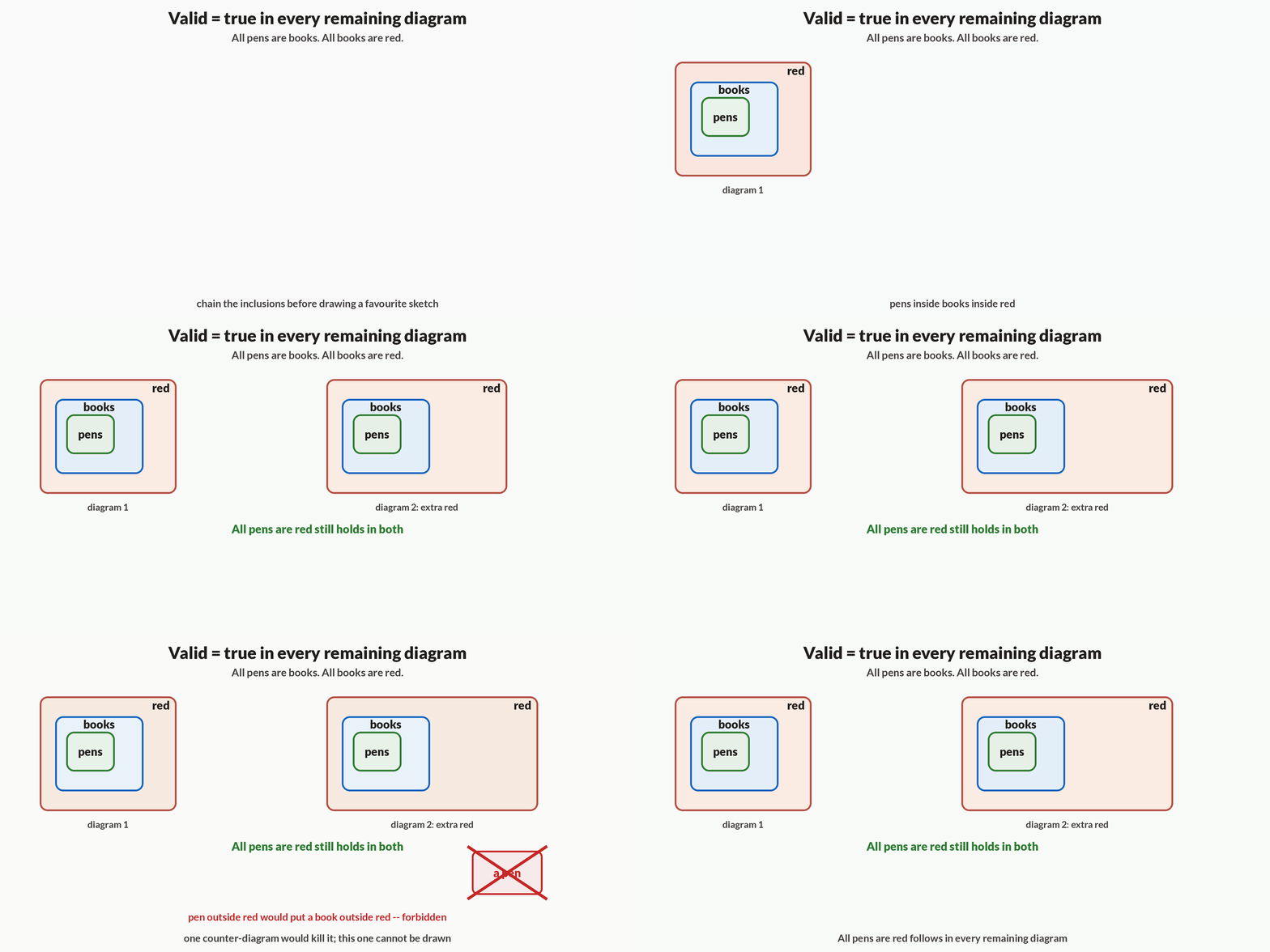
Order of attack
- Lay the inclusionsTranslate each All / No into the forced nesting or split before touching Some. All pens are books; All books are red — two subset edges, no overlap guesswork yet.
- Chain the nestIf A sits inside B and B sits inside C, A sits inside C in every remaining diagram. Pens sit inside books sit inside red, so pens sit inside red whether or not extra red things exist.
- Test the conclusionAsk whether the conclusion can fail while the premises stay true. One counter-diagram kills a 'definitely follows' claim. Parking a pen outside red would break All books are red, so All pens are red cannot be killed.
Basic two-premise chain
Statements: All pens are books. All books are red. Conclusions: (I) All pens are red. (II) Some red are pens.
- All pens are bookspens ⊂ books
- All books are redbooks ⊂ red
- pens ⊂ books ⊂ redAll pens are red — I follows
- All pens are red (conversion of the subset)Some red are pens — II follows
- Both conclusionsboth follow
Pro tip. Chain nested All statements directly: the smallest set is a subset of the largest in every diagram, which is why both conclusions here are definite.
Statements: All pens are books. All books are red. Which reading of the conclusions is correct?
- Only I follows, because II needs a separate Some premise
- Both follow: pens sit inside red, so some red things are pens
- Neither follows, because the diagrams can still be redrawn
pens ⊂ books ⊂ red forces All pens are red in every diagram, and a non-empty subset always converts to Some red are pens. Redrawing cannot break either claim without breaking a premise.
3Conversion that keeps truth
Conversion swaps subject and predicate — it flips the two nouns and asks whether the new sentence is still forced. Some and No convert cleanly: 'Some A are B' is the same claim as 'Some B are A', and 'No A is B' is the same claim as 'No B is A'. All does not convert to All — 'All A are B' never gives 'All B are A' — but it does give the weaker 'Some B are A' whenever A is treated as a non-empty exam set. That is why All pens are red, from the nest above, yields Some red are pens, and never All red are pens.
The invalid twin is the one the options love. From 'All judges are lawyers' the valid conversion is 'Some lawyers are judges'; 'All lawyers are judges' is the converse that syllogism never gives. When a conclusion looks like a restatement with the nouns flipped, test the conversion explicitly before marking it as a fresh claim — match the row (Some stays Some, No stays No, All weakens to Some) and reject All-to-All on sight.
Only conversions that keep truth flip All into Some on the other side, or swap the ends of a Some. No converts to No; Some-not does not flip cleanly.
Flip then check
- Flip the nounsWrite the conclusion with subject and predicate swapped. All judges are lawyers flips to a claim about lawyers and judges; Some A are B flips to Some B are A.
- Match the rowSome and No keep their wording; All weakens to Some on the flipped side. All pens are red converts to Some red are pens, not to All red are pens.
- Reject All-to-AllIf the flipped claim still says All, it is asking for the converse that syllogism never gives. All lawyers are judges does not follow from All judges are lawyers.
| Given | Valid conversion | Invalid twin |
|---|---|---|
| Some A are B | Some B are A | — |
| No A is B | No B is A | — |
| All A are B | Some B are A | All B are A |
From 'All judges are lawyers', which conclusion is the valid conversion?
- All lawyers are judges
- Some lawyers are judges
- No lawyer is a judge
All converts only to the weaker Some on the flipped side. All lawyers are judges is the invalid All-to-All twin; No lawyer is a judge contradicts the subset.
4Definite versus possibility
Exam stems use two wordings that look similar and score differently. A 'definitely follows' / 'conclusions that follow' stem needs a claim true in every diagram still allowed by the premises — the every-diagram test you just used on All pens are red. A 'possibility' / 'which of the following is possible' stem needs only one consistent diagram in which the claim holds. Mixing the two keys is the quiet error: a conclusion that can be drawn is not the same as a conclusion that must be drawn.
Read the stem wording before you build cases. If the statements allow both 'All A are B' and a proper overlap of A with B, then 'All A are B' is possible (one remaining diagram has full inclusion) and is not definite (the overlap diagram is a counter-example). For definite, hunt a counter-diagram; for possibility, hunt a supporting diagram. The forced skeleton of All and No stays in both tests; only the Some regions flex.
Figure. Same premises leave both diagrams standing. Possibility needs only the All nest; definitely-follows dies on the overlap counter-diagram.
Pick the key first
- Read the stem wordingDefinitely / follows → must hold in all diagrams. Possibility / can → holds in at least one. The same conclusion can pass one test and fail the other; the stem chooses which test you run.
- Build the forced skeletonLay every All and No the premises force; leave Some regions flexible. All books are red is a nest; Some A are B is a floor on overlap, not a ceiling.
- Apply the matching testFor definite, hunt a counter-diagram. For possibility, hunt a supporting diagram. If both All A are B and a proper overlap remain, All A are B is possible and not definite.
| Stem wording | Passes when | Fails when |
|---|---|---|
| Definitely follows | True in every diagram consistent with the premises | Any one counter-diagram exists |
| Possibility | True in at least one consistent diagram | Every consistent diagram blocks it |
Statements allow both 'All A are B' and a proper overlap of A with B. The conclusion 'All A are B' is asked under a 'which of the following is possible' stem. The correct ruling is
- It does not follow, because overlap is also allowed
- It is possible, because at least one consistent diagram has All A are B
- It definitely follows, because Some never blocks All
Under a possibility stem, one supporting diagram is enough. The same conclusion would fail a definitely-follows stem, because the overlap diagram is a counter-example — but that is a different key.
5Some does not block All
The everyday reading of 'some' is 'some but not all'. In syllogism that reading is wrong. 'Some A are B' is satisfied by a mere overlap and is also satisfied when every A is B. So a possibility conclusion 'All A are B' can still be live after a Some premise, and a definite conclusion 'Some A are not B' does not follow from Some alone. 'Some actors are singers' leaves both diagrams standing: a proper overlap of actors with singers, and the nest where every actor is a singer.
That is why a possibility stem can still accept All after Some, and why you must not mark Some-not as definite from Some by itself — Some never forced an outsider. The twin habit is forgetting conversion: once Some A are B is given, Some B are A is already in hand. Hear Some as a minimum — at least one shared member, a floor, not a 'not all' ceiling — and leave the All case alive unless a premise forces an outsider.
Figure. Both diagrams satisfy Some A are B. The everyday 'not all' reading is the terracotta trap; full inclusion stays possible.
Keep All open
- Hear Some as minimumSome means at least one shared member — a floor, not a 'not all' ceiling. 'Some actors are singers' is true of a tiny overlap and true of a full nest.
- Leave the All case aliveUnless a premise forces an outsider, All A are B stays a possible diagram. Some alone never proves Some-not, and never kills All.
- Write the converseFrom Some A are B, note Some B are A before hunting new conclusions. That conversion is already in hand; it is not a fresh deduction.
Statements: Some actors are singers. Which possibility still survives?
- No actor is a singer
- All actors are singers
- Some actors are not singers — as a definite conclusion
Some forces an overlap, which already kills 'No actor is a singer'. All actors are singers is a stricter diagram that still contains that overlap, so it remains possible. 'Some actors are not singers' would need an outsider forced by a premise; Some alone does not make it definite.
6Either-or complementary pairs
When two conclusions share the same subject and predicate and are contradictory — typically Some versus No, or All versus Some-not — and neither is individually certain, the answer can be 'either I or II follows'. The pair exhausts the remaining cases: the groups either overlap or they do not; they cannot do both, and they cannot do neither. The gate before that answer is brutal: if either conclusion is already definite on its own, either-or is off the table. First prove uncertainty; only then check complementarity.
Watch the running chain of a different pair: Some cats are dogs. All dogs are pets. Conclusions: (I) Some cats are pets. (II) No cat is a pet. The overlap cats∩dogs is non-empty, and every dog sits inside pets, so every cat in that overlap sits inside pets. I is definite. II is then false, not 'still open'. Either-or does not fire — only I follows. Complementary shape is not enough if one side is already locked.
Figure. Schematic relations only: a dashed 'some' link forces a non-empty overlap of cats with dogs, and the subset edge drops that overlap inside pets — so Some cats are pets is definite.
Gate then pair
- Test each conclusion aloneIf one already holds in every diagram, mark that one and stop — not either-or. Some cats are pets is already forced by Some cats are dogs plus All dogs are pets.
- Confirm both are openEach must fail in some consistent diagram and succeed in another. If I is definite, II is not open, and the either-or gate never opens.
- Check the complementary shapeSame terms, contradictory pair (Some + No, or All + Some-not). Then either-or applies — and only then. Complementary wording with one side already certain is a trap key.
| Pair | Why they exhaust | Before you mark either-or |
|---|---|---|
| Some A are B / No A is B | Overlap versus empty intersection | Neither side may already be definite |
| All A are B / Some A are not B | Full inclusion versus a forced outsider | Neither side may already be definite |
When either-or does not fire
Statements: Some cats are dogs. All dogs are pets. Conclusions: (I) Some cats are pets. (II) No cat is a pet.
- Some cats are dogscats ∩ dogs ≠ ∅
- All dogs are petsdogs ⊂ pets
- cats in the overlap sit inside petsSome cats are pets — I definite
- I definite, so II ('No cat is a pet')false; not either-or
- Answeronly I follows
Pro tip. First test whether one conclusion is definitely true; only if both are uncertain and contradictory do you consider either-or.
Statements: Some cats are dogs. All dogs are pets. Conclusions: (I) Some cats are pets. (II) No cat is a pet. Correct answer?
- Either I or II follows
- Only I follows
- Neither follows
The cats that are dogs are pets, so I is definite. II is then simply false. Either-or needs both sides uncertain; that gate fails here.
7Premises that yield nothing definite
Two universal negatives together give no definite relation between their extremes: from 'No A is B' and 'No B is C' you cannot fix how A meets C. A and C may overlap, sit apart, or nest; every one of those pictures keeps both No's true, so none of them is forced. Two particular premises — Some with Some, or Some with Some-not — likewise refuse a definite conclusion between the extremes. There is no middle term that can chain.
When both premises are of those starved shapes, 'none follows' is often the honest key. Do not invent a nest the premises never forced. A fancy diagram that puts A inside C after two No's is a picture you chose, not a picture the statements chose. Classify each premise (All / No / Some / Some-not), check the starved pairs, and refuse any conclusion that needs an inclusion you were never given.
Figure. Two No premises fix only A–B and B–C. A versus C stays free — overlap, apart, or nest — so none of those conclusions is definite.
Spot the starve
- Classify each premiseMark All / No / Some / Some-not on both lines. No A is B and No B is C is two universal negatives; Some A are B and Some B are C is two particulars.
- Check the starved pairsTwo No's, or any two particulars with no universal affirmative to anchor them, yield no definite link between the extremes. A and C stay free after No A is B and No B is C.
- Refuse the fancy diagramIf a conclusion needs an inclusion you were never given, it does not definitely follow. A nest you can draw is not a nest the premises forced.
Statements: No A is B. No B is C. A definite conclusion about A and C
- Must be 'No A is C'
- Must be 'Some A are C'
- Need not follow at all — the extremes are not fixed
Two universal negatives leave A and C free to be disjoint, overlapping, or nested in ways the premises never constrain. Neither No nor Some about A and C is forced.
Notes
- Syllogism - Venn Method: Represent each statement as overlapping circles. A conclusion is valid only if it holds in EVERY possible diagram consistent with the statements, not just one convenient drawing.
- The Four Statement Types: 'All A are B' (A inside B), 'No A is B' (disjoint), 'Some A are B' (overlap), 'Some A are not B' (part of A outside B). Know their exact Venn representations.
- Definite vs Possible Conclusions: A 'definitely follows' conclusion must be true in all cases; a 'possibility' conclusion is valid if it CAN be drawn in at least one case. Distinguish the two wordings carefully.
- Complementary Pairs (Either-Or): When two conclusions are 'Some A are B' and 'No A is B' about the same terms and neither is individually certain but together they exhaust the cases, the answer is 'either... or...'.
- Common trap: 'Some A are B' also allows 'All A are B' as a possibility, and 'Some A are B' always implies 'Some B are A' (conversion) - test converses explicitly.
Formulas
- 'Some A are B' <-> 'Some B are A' (valid conversion).
- 'No A is B' <-> 'No B is A' (valid conversion).
- 'All A are B' implies 'Some B are A' but NOT 'All B are A'.
- Two universal negatives or two particular premises together yield no definite conclusion.
- Either-Or rule: two conclusions form a complementary pair when they share subject and predicate and are contradictory (Some + No, or All + Some-not).
Exam traps & shortcuts
- Draw the least-overlapping (most restrictive) diagram first; if a conclusion fails there, it does not definitely follow.
- For every 'Some' statement, immediately note its converse - it is often the intended valid conclusion.
- When neither of two conclusions is certain, check if they form an either-or complementary pair before marking 'none follows'.
- Treat 'possibility' conclusions as valid if you can construct even one consistent diagram supporting them.
Reference tables
Forces, conversions and the either-or gate on one page.
| Rule | Keep | Reject |
|---|---|---|
| Definitely follows | True in every consistent diagram | True in only some diagrams |
| Possibility | True in at least one consistent diagram | Blocked in every diagram |
| Conversion | Some↔Some, No↔No, All→Some (flipped) | All→All (flipped) |
| Either-or | Complementary pair, both still uncertain | Either side already definite |
| Starved premises | Two No's or two particulars → none definite | Invented nests between the extremes |
Recap
The night-before pegs.
- Every diagram
- Definitely follows means every consistent diagram, not the sketch you liked first.
- Four forces
- All includes, No splits, Some overlaps, Some-not leaves an outsider — and Some still allows All.
- Conversion
- Flip Some and No freely; weaken All to Some on the flip; never promote All to All.
- Either-or gate
- Both conclusions uncertain and complementary — otherwise not either-or.
- Starved pairs
- Two No's or two particulars fix nothing definite between the extremes.
Practise Syllogism
Reading is free and needs no account. Practice, mocks and progress live in the app.
- 116 exam-style questions on this topic, with explanations
- A 6-question practice set that ends the chapter
- Timed mocks scored with the real marking scheme
- Readiness tracked per topic, kept on your device