RRB JE Junior Engineer · General Intelligence & Reasoning
Blood Relations & Direction Sense
Family relationship puzzles and direction-distance tracking using position and turns.
Two threads run through this topic, and one small cast carries each. For blood relations you will follow a single family — grandfather Mahesh, his only son Ramesh, Ramesh's wife Sunita, and their two children Arjun and Priya — through tree sketching, self-reference traps, coded symbols and generation counting. For direction sense you will follow a single walker, Kavya, through legs, turns and the finishing distance. Draw the tree or the path; do not keep either in your head.
- RRB JE Junior Engineer
- Medium level
- 7 concepts
- 104 practice questions
1Sketch the family tree first
Start by meeting the family that carries every blood-relation idea in this topic. Mahesh is the grandfather. He has exactly one son, Ramesh. Ramesh is married to Sunita, and the couple have two children: a son, Arjun, and a daughter, Priya. Five people, three layers — and every trick this topic teaches can be shown on them. An exam stem never hands you a tidy list like that; it hides the same facts inside one winding sentence, and your first job is always to recover the cast onto paper.
Why not just reason in the sentence's own words? Because kinship words smuggle in two facts at once — a sex and a generation — and prose lets both drift. 'Cousin' does not tell you male or female; after three clauses of 'whose', 'their' and 'his', someone has quietly moved up or down a layer. Never track relations only in words; a sketch removes gender and generation ambiguity before any chain is named. The sketch language is five marks: (+) after a name means male, (−) means female, (=) between two names means they are married, a horizontal link joins siblings, and a vertical link runs from a parent down to a child.
Draw the running family once and the marks explain themselves. Put Mahesh (+) alone at the top. Drop one vertical link down to Ramesh (+): a parent-to-child step always moves one line lower, and one such step is what the word generation means. Put Sunita (−) beside Ramesh with (=) between them — marriage never changes a line, so a husband and wife sit level. From the couple, drop vertical links to Arjun (+) and Priya (−), and join the two children with a horizontal sibling link so they sit level with each other. Three lines on the page, and every question about these five people becomes a matter of reading, not remembering.
Make the sketch the first move on every stem, even one that sounds easy. The concepts that follow — self-reference phrases, coded symbols, generation counting — all end with 'read the answer off the tree', and none of them work if there is no tree to read. Ten seconds of drawing buys back every minute the words would have stolen.

Order of attack
- Place eldersPut the oldest named person at the top of the page — Mahesh, in the running family — and step one line lower for every parent-to-child link. Vertical position is generation; nothing else moves it.
- Mark sex and marriageTag each name (+) male or (−) female the moment the stem reveals it, and join spouses with (=) on one line: Ramesh (+) = Sunita (−). Leave the tag off until the stem forces it — a guessed sex is a planted error.
- Hang the childrenDrop a vertical link from the couple to each child and join the children with one horizontal sibling line, so Arjun and Priya sit level under both parents. The finished tree is what every later concept reads its answer from.
| Mark | Means |
|---|---|
| (+) | Male |
| (−) | Female |
| (=) | Married couple, same generation |
| Horizontal link | Siblings |
| Vertical link | Parent → child (one generation) |
In a family-tree sketch, where do a brother and sister sit relative to their parents?
- On the same generation line under the parents, joined as siblings
- One generation above the parents, because siblings are elders
- On opposite sides of a marriage (=) link between them
Siblings share a generation under the same parents. A marriage (=) link is for spouses, not for a brother–sister pair.
2Resolve self-reference phrases first
Pointing and photograph stems have a favourite hiding place: the speaker tucks themselves inside a descriptive phrase, and the phrase does not sound like 'me'. Take 'the only son of my father' and read it slowly: my father has exactly one son. If the man speaking is himself a son of that father, that one son can only be the speaker. The phrase is a mirror — but a solver in a hurry invents a brother instead, and every relation downstream lands one person off.
These self-reference phrases are the most common exam trap, so give them a fixed drill: before touching anything else in the sentence, rewrite the phrase as a named person. 'Only son of my father', spoken by a male, is the speaker himself. 'Only daughter of my mother', spoken by a female, is the speaker herself. Mind the speaker's sex, though: when Priya — a daughter — says 'the only son of my father', the phrase still forces exactly one person, but that person is her brother Arjun, not Priya herself. The word 'only' is what does the forcing: it forbids a second son, which is why the phrase resolves to one person instead of several.
Now run the classic on our family. Arjun points at a photograph and says, 'She is the daughter of the only son of my grandfather.' Rewrite from the inside out. 'My grandfather' is Mahesh. 'The only son of Mahesh' — Mahesh has exactly one son — is Ramesh, Arjun's own father. The sentence has collapsed to 'she is the daughter of Ramesh', and Ramesh's daughter is Priya. Priya and Arjun share both parents, so the woman in the photograph is Arjun's sister. Notice the order: the phrase resolved first, then one kinship step at a time, and the final label was read off the tree, never guessed from the wording.
The habit generalises to every pointing stem: peel from the innermost phrase outward, replace each phrase with a person the moment it is forced, and refuse to name the final relation until the tree shows both people. If a phrase does not force a single person — the stem says 'a son' rather than 'the only son' — then the puzzle must supply another clue, and the honest move is to hold both candidates until it does.
Figure. The photograph cast for the worked example: grandfather's only son is the speaker's father; the woman and the speaker hang as siblings under that father.
Order of attack
- Rewrite the phraseReplace the self-reference phrase with a named person before anything else: 'only son of my father' is the speaker when the speaker is male, and the speaker's brother when the speaker is female. 'Only' forbids a second candidate — that is what makes the rewrite safe.
- Peel inside outResolve nested phrases from the innermost outward. In 'daughter of the only son of my grandfather', pin the grandfather first, then his only son, then that son's daughter — one person forced at each layer.
- Name the relationPlace the final person on the sketch and read the asked relation off the drawing — Priya lands level with Arjun under the same parents, so: sister. Never name the relation from the original wording; the wording is where the trap lives.
Photo blood relation
Pointing to a photograph, a man says, 'She is the daughter of the only son of my grandfather.' How is the woman related to the man?
- 'My grandfather's only son'the man's father
- Woman = daughter of that only sondaughter of the man's father
- Daughter of one's fatherthe man's sister
Pro tip. Translate 'only son/daughter of…' phrases into a specific person first; the rest of the chain then resolves cleanly.
A man says of a boy, 'He is the only son of my father.' The boy is
- The speaker himself
- The speaker's brother
- The speaker's son
'Only son of my father' names the father's only son — the speaker, when the speaker is that son. Reading it as a separate brother invents a second son the phrase forbids.
3Decode the code, then chain
Some stems compress kinship into algebra: 'A + B means A is the father of B; A − B means A is the sister of B.' Nothing new is being asked — each coded pair is just one edge of a family tree written sideways — but the symbols are defined fresh in every stem and mean nothing outside it. A plus that means 'father of' in this paper can mean 'married to' in the next. So the key is stem-local: copy it down before reading the expression, and decode each symbol into a plain relation first, before any chaining.
Decoding on the running family makes the notation feel ordinary. With the key above, 'Ramesh + Arjun' reads 'Ramesh is the father of Arjun' — a true edge in our tree, drawn as a vertical link. 'Priya − Arjun' reads 'Priya is the sister of Arjun' — also true, drawn as a horizontal sibling link. Each decoded pair is one English sentence and one drawn edge. If a decoded sentence cannot be drawn as a single edge, you have misread the key: go back to the stem's key, not to your memory of some other paper's.
Longer strings chain pairwise, left to right, with the middle person shared. 'Ramesh + Priya − Arjun' unpacks into two sentences: 'Ramesh is the father of Priya' and 'Priya is the sister of Arjun'. Now walk the tree: Ramesh is Priya's father, and Priya and Arjun are siblings — exam siblings share both parents unless the stem says otherwise — so Ramesh is Arjun's father too. The asked relation ('how is Ramesh related to Arjun?') is read off the finished sketch: father. The expression never gets an answer directly; the tree it decodes into does.
The two failure modes are both shortcuts. Guessing from the punctuation — 'minus feels like a sister' — flips a sex the moment a stem defines '−' as brother instead. And chaining before decoding lets a middle person carry the wrong sex or level through the whole expression. Decode, draw, then chain: three small steps that make the longest coded string as safe as the five-person family you have already drawn.
Figure. Copy the stem-local key, decode each pair into English, then read Ramesh as Arjun's father off the finished tree.
Decode then chain
- Write the keyCopy every symbol definition from the stem into a one-line key — '+ = father of, − = sister of' — before reading the expression. Keys are stem-local; last paper's meanings are dead.
- Decode each pairTurn each coded pair into one English sentence and one drawn edge: 'Ramesh + Priya' becomes 'Ramesh is the father of Priya', a vertical link on the tree. A pair that cannot be drawn as one edge means the key was misread.
- Chain to the askWalk the decoded edges left to right — the middle name is shared — until the two asked people are linked on the sketch: 'Ramesh + Priya − Arjun' chains a father edge and a sibling edge into 'Ramesh is Arjun's father'. Name that link and stop.
| Stem fragment | After decode |
|---|---|
| A + B (given: + = father of) | A is father of B |
| A − B (given: − = sister of) | A is sister of B |
| Next symbol in the same expression | New pair; decode again, then join |
A stem defines A + B as 'A is father of B'. Before naming how C relates to A in a longer coded string, the first move is to
- Decode every symbol into a plain kinship word, then chain the people
- Assume + always means uncle in every paper
- Skip the code and draw any three-generation tree
Codes are stem-local. The method is decode each symbol from the given key, then chain — not to reuse a symbol meaning from another paper.
4One vertical link is one generation
A generation is a counting unit, and only one kind of link counts. Number the tree's levels from the top: the oldest named person sits on level 0, and every parent-to-child link adds exactly 1 as you step down. Marriage adds nothing and a sibling link adds nothing — siblings and spouses stay on the same level. On the running family: Mahesh sits on level 0; his son Ramesh sits on level 1, and Sunita, married to Ramesh, sits on level 1 beside him; Arjun and Priya, children of that couple, share level 2. Two vertical steps separate Mahesh from Arjun, so they are two generations apart — age, name order and sex never enter the count.
Once levels are numbered, the family splits into two sides, and English names them. Relatives reached through your father are paternal; relatives reached through your mother are maternal. Mahesh is Arjun's paternal grandfather, because both downward steps from Mahesh to Arjun pass through Arjun's father, Ramesh. Sunita's parents — not drawn in our tree — would be Arjun's maternal grandparents, because the path to them runs through his mother. Exam stems lean on this pair of words to force one specific person: a 'maternal uncle' is the mother's brother, never the father's.
Every everyday label is a read off the level map, not a new counting system. Same level with shared parents: sibling. One level up but beside your parent, rather than your parent: uncle or aunt. That person's child sits back down on your own level: cousin. Two levels up through a parent: grandparent. And '-in-law' labels ride the (=) link sideways — your spouse's relatives keep their own level and attach through the marriage. Draw first, count vertical links, then translate; the label always comes last.
The figure keeps the same shape with an anonymous cast — spouses A and B sharing level 0, their children C and D sharing level 1 — to make the point that levels care only about links. Swap in Ramesh, Sunita, Arjun and Priya and nothing about the counting changes. That indifference to names is exactly what makes level counting reliable under exam pressure.
Figure. Schematic for the quick-check cast: spouses A and B on level 0; children C and D on level 1. Sex does not change the level number.
How it works
- Mark levelsNumber the top generation 0 — Mahesh — and add 1 for every parent-child edge going down: Ramesh and Sunita on level 1, Arjun and Priya on level 2. Only vertical links change the number.
- Keep peers flatSpouses and siblings share a level however the stem scatters them across clauses; marriage and sibling links add zero to the count.
- Read the askTranslate the finished level map: same level with shared parents — sibling; one level up beside your parent — uncle or aunt (paternal through the father, maternal through the mother); two levels up through a parent — grandparent.
A and B are married. C is their daughter. D is C's brother. Which statement about levels is forced?
- A, B share one level; C, D share the level below them
- D sits one level above C because he is male
- A sits two levels above B because he is named first
Spouses share a generation; their children — daughter and brother — share the next generation down. Sex and name order do not move levels.
5Track each leg as a vector
Meet the walker who carries the direction half of this topic. Kavya stands at her gate, about to walk several straight stretches — call each stretch a leg — with a turn between legs. Before she moves, fix the frame: draw a compass with North up the page, East to the right, South down, West to the left. That compass belongs to the page, not to Kavya — it never rotates, however many times she turns. From now on two different things live on your sketch: where Kavya is (her position) and which way her nose points (her facing, which the next concept handles in full).
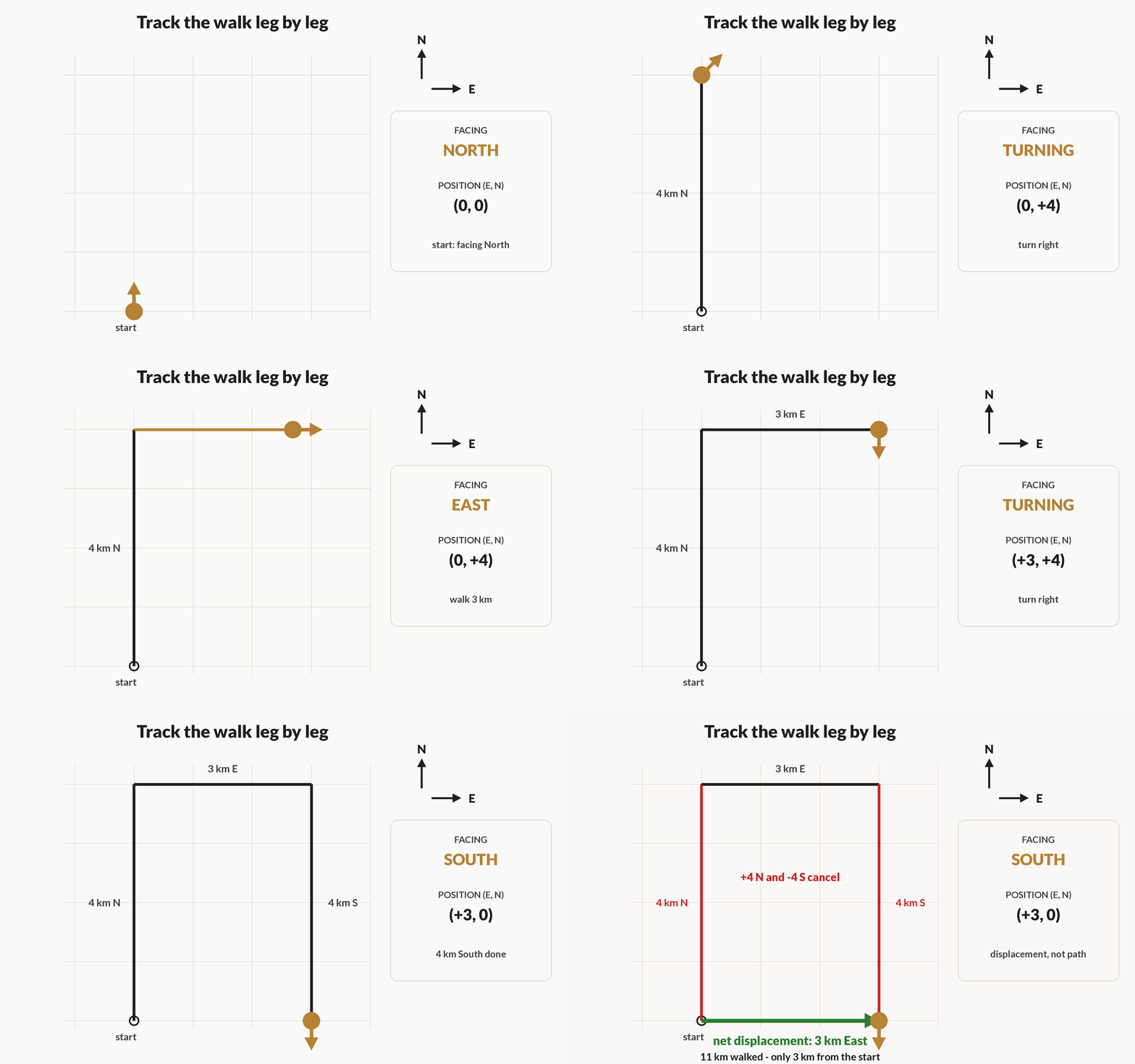
Track her position as a pair of signed numbers: how far East she has ended up, then how far North — East counts positive on the first number, North positive on the second, so West and South are simply negatives. Kavya starts at (0, 0) facing North and walks 4 km: her position becomes (0, +4). She turns right — her facing swings to East — and walks 3 km: eastward kilometres add to the first number, so she stands at (+3, +4). She turns right again — facing South now — and walks 4 km: southward kilometres subtract from the second number, and the +4 collected going North minus the 4 spent going South leaves exactly 0. She finishes at (+3, 0).
Now separate the two numbers an examiner can ask about. Kavya's legs total 4 + 3 + 4 = 11 km of walking — that is path length, what a pedometer counts. But her final position, (+3, 0), says she stands just 3 km due East of her gate — that is displacement, the straight-line offset from start to finish. Net displacement is the sum of signed east–west and north–south components — not the sum of the path lengths. The northward and southward stretches cancelled each other completely; only the eastward stretch survived.
The bookkeeping habit, then: write the running pair after every leg, and only trust the final pair. Answers read off a half-finished path — 'she walked 4 km North first, so she must end North of the start' — are exactly the wrong turns this topic sells. The leg-by-leg animation traces this same 4–3–4 walk so you can watch the second number rise to +4 and fall back to 0 while the first number quietly keeps the +3.
Order of attack
- Fix the compassDraw North up and East right before the first leg, and write Kavya's starting facing beside the start point. The compass belongs to the page and never rotates.
- Walk, then turnFor each leg, add its signed kilometres to the running pair — East positive on the first number, North positive on the second — and only after the leg ends apply the spoken turn to the facing. The 4–3–4 walk runs (0, +4), then (+3, +4), then (+3, 0).
- Read the netCancel opposite components and report what survives: +4 North against 4 South leaves 0, so Kavya's answer is the untouched +3 — 3 km East. Path length (11 km) is a different number; never report it as distance from the start.
Direction and distance
A man walks 4 km North, turns right and walks 3 km, then turns right and walks 4 km. How far and in which direction is he from the start?
- Start facing North; walk 4 km North(0, +4)
- Turn right → East; walk 3 km(+3, +4)
- Turn right → South; walk 4 km(+3, 0)
- Net from start3 km East
Pro tip. Track coordinates leg by leg; vertical moves that cancel leave a clean horizontal (or vertical) answer.
After walking 4 km North and then 4 km South, a walker's north–south component is
- 0 — the two legs cancel
- 8 km North — path length always adds
- 4 km South — the last leg alone remains
Signed components cancel. Path length is 8 km but displacement on that axis is zero.
6Turns follow current facing, not North
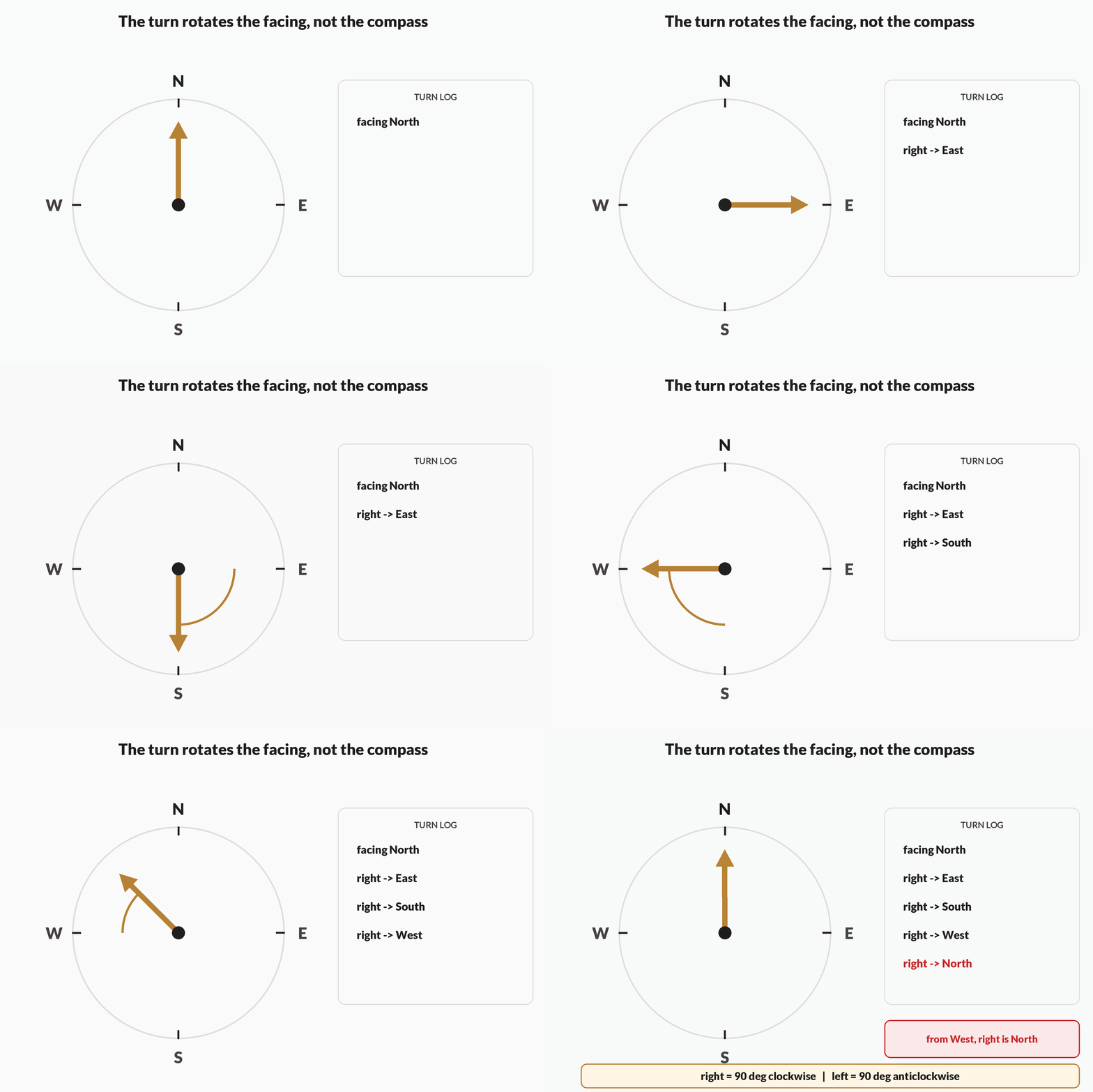
Facing is the direction Kavya's nose points, and it is the one thing on the sketch that rotates. A turn instruction changes her facing and nothing else. 'Turn right' means rotate the facing a quarter circle — 90 degrees — clockwise as the page shows it; 'turn left' means a quarter circle anticlockwise. Unless a stem says otherwise, a turn is 90 degrees. When a stem does say otherwise, the same rotation logic scales: a 45-degree right turn from North lands halfway round, facing North-East, and a 180-degree turn — an about-turn — points her the opposite way from any facing.
Here is the trap the concept exists to kill. A left or right turn is relative to the current facing direction, not to North. 'Right' is not a compass direction and never means East by itself: it means clockwise from wherever the nose points now. Facing North, Kavya's right turn does land on East — which is exactly why the false shortcut survives its first few uses. But run the cycle further: facing West, her right turn lands on North, and her right hand points North too. A solver who translated 'right' as 'East' now has her walking the wrong way.
So the working rule is one cycle, run in either direction. Clockwise reads North, East, South, West and back to North: every right turn advances one step along it, and every left turn walks the same cycle backwards. Update the facing the moment the turn is spoken — before reading the next distance — because the next leg's compass direction is decided entirely by the facing it starts from. The rotating-arrow animation runs the full circle of right turns, North back to North, so you can watch the facing move while the compass frame stays put.
One more facing convention appears in stems about two people. Left and right of a person facing you are mirrored relative to your own: if Kavya walks toward you, the hand on your left side is her right hand. Photograph and 'standing opposite' stems use this constantly — before assigning anyone's left or right, decide whose facing the stem means, and translate into that person's frame, not yours.
How it works
- Name the facingWrite the compass direction Kavya's nose points at the moment the turn is spoken. The turn acts on that — not on North, and not on the previous leg's name.
- Rotate the headingRight = one step clockwise on N–E–S–W (90 degrees unless the stem says 45 or 180); left = one step anticlockwise. From West, a right turn lands on North — 'right means East' is the planted error.
- Walk on the new headingAttach the next distance to the updated facing only. If the stem switches to another person's left or right, mirror it into that person's frame before rotating.
| Facing now | After one right turn |
|---|---|
| North | East |
| East | South |
| South | West |
| West | North |
Right hand when facing West
A person faces West. In which compass direction does that person's right hand point?
- Facing West; right = clockwise on N–E–S–Wnext heading North
- Right-hand directionNorth
Pro tip. Remember a person's right hand points North when they face West — the same clockwise cycle as a right turn (W → N). The false memory 'West → South' is a left turn.
A walker faces South and turns left. The new facing is
- East
- West
- North
Left from South is anticlockwise on the cycle: South → East. West would be a right turn; North would be turning around.
7Shortest distance from net components
When the walk ends, the running pair holds everything: a net east–west remainder x and a net north–south remainder y. The first question is never a formula — it is which remainders survived. If one remainder is already zero — as in a walk that cancels North against South and leaves pure East — the distance is just the surviving component and the square root never opens. Kavya's 4–3–4 walk is exactly that case: she finishes at (+3, 0), so her shortest distance home is 3 km, direction due East, and any square-root work would be wasted motion.
When both remainders survive, the geometry is a right angle, and the shortest way back is the hypotenuse. Freeze Kavya mid-walk, after only her first two legs: she stood at (+3, +4) — 3 km East and 4 km North of the gate. Walking back along her own path would cost 3 + 4 = 7 km, but the straight line home cuts the corner: d = \sqrt{x^2 + y^2} = \sqrt{3^2 + 4^2} = \sqrt{9 + 16} = \sqrt{25} = 5 km. Read the formula as a sentence: square each remainder, add the squares, take one square root of the sum. It is not \sqrt{9} + \sqrt{16} — squaring first is what lets two perpendicular directions combine into one straight line.
Direction is named from the signs of the two remainders. Both positive — East and North surviving — puts the finish in the north-east quadrant, and a direction-sense answer says 'north-east of the start'; strictly, the finish lies exactly on the North-East diagonal only when the two remainders are equal, but quadrant naming is what these answers use. Mixed signs move the quadrant: positive x with negative y is south-east, and so on. Sign errors here are quieter than formula errors, because squaring destroys the sign — so name the quadrant from the signed pair before you square anything.
The full finishing drill: cancel opposites to get the signed pair; if a component is zero, report the other component's size and compass name and stop; otherwise square, add, root once, and name the quadrant from the signs you noted before squaring. Every direction-sense answer in this topic is one of those two endings — and both are read from the same pair of numbers the leg-by-leg tracking already built.
Figure. Schematic — x and y carry no scale claim. After cancelling opposite legs, a net x East and a net y North remain at a right angle; the shortest way back to the start is the straight hypotenuse d = √(x² + y²), not the walked corner. If one component is zero, d is just the surviving leg and the root never opens.
How it works
- Sum componentsFinish the walk with the signed pair: net x (East positive) and net y (North positive). The signs decide the direction words later, so note them before squaring anything.
- Cancel what cancelsIf either remainder is zero, the answer is the other remainder's size and compass name — Kavya's (+3, 0) is simply 3 km East — and you stop; no square root.
- Otherwise take dWith both remainders alive, square each, add, and take one root: at (+3, +4), d = \sqrt{9 + 16} = 5 km, north-east of the start. Root of the sum — never the sum of roots.
After all legs, net displacement is 3 km East and 0 km North–South. The shortest distance from the start is
- 3 km East — the surviving component alone
- \sqrt{3^2 + 3^2} km, because every path needs the square-root formula
- 0 km, because North and South cancelled
With y = 0, d is just |x|. The square-root form is for leftover x and y together; zero path length is wrong because East still remains.
Notes
- Blood Relations - Family Tree: Draw a diagram using symbols (+ for male, - for female, = for married couple, a horizontal line for siblings, a vertical line for parent-child). Never track relations only in words; a sketch removes ambiguity.
- Coded Relations: When relations are given as codes (A+B means A is father of B, A-B means A is sister of B), decode each symbol first, then chain them from left to right to reach the required relation.
- Pointing/Statement Puzzles ('the man in the photo is my father's only son'): resolve phrases like 'only son of my father' = the speaker himself (if male). These self-reference phrases are the most common exam trap.
- Direction Sense - Vector Tracking: Place a compass (N up, E right); mark each move as a vector and track the current facing after left/right turns. Net displacement uses horizontal and vertical components.
- Common trap: A left/right turn is relative to the current facing direction, not to North - always update your heading before applying the next turn.
Formulas
- Shortest distance between start and end: d = \sqrt{x^2 + y^2} where x,y are net east-west and north-south displacements.
- Turn rule: facing North, a right turn -> East, another right -> South, then West, then North (clockwise cycle).
- 'Only son of my father' = the speaker himself; 'only daughter of my mother' = the speaker herself.
- Generation count: each parent-child link is one generation down; siblings/spouses stay on the same level.
- Left/right of a person facing you is mirrored relative to your own left/right.
Exam traps & shortcuts
- Always draw the family tree with standard symbols instead of reasoning in prose - it prevents gender and generation errors.
- For coded relations, decode the rightmost pair first and work leftwards to name the final relationship.
- In direction problems, sketch each leg on graph-style axes and add signed components to get net displacement.
- Remember a person's right hand points South when they face West - useful for shadow/turn questions at sunrise/sunset.
Reference tables
The night-before strip for both halves of the topic.
| Rule | Keep |
|---|---|
| Family marks | (+) male, (−) female, (=) spouses; vertical = parent–child; horizontal = siblings |
| Self-reference | 'Only son of my father' → speaker (if male); rewrite before chaining |
| Coded kinship | Decode every symbol from the stem key, then chain — never reuse another paper's key |
| Turns | Right = clockwise on N→E→S→W; facing West, right hand → North |
| Net distance | d = \sqrt{x^2 + y^2} only when both components remain; else the surviving axis |
Recap
Read only this the night before.
- Sketch
- Tree with (+)/(−)/(=) before any prose chain. Siblings share a level; each vertical link is one generation.
- Self-reference
- Rewrite 'only son of my father' to the speaker first. The photo puzzle's woman is the man's sister.
- Codes
- Stem-local keys only. Decode each symbol to a plain relation, then chain.
- Path
- Components, not path length. 4 N + 3 E + 4 S leaves 3 km East.
- Facing
- Turns follow current facing, not North. Right from West is North.
- Distance
- Open \sqrt{x^2 + y^2} only when both remainders survive.
Practise Blood Relations & Direction Sense
Reading is free and needs no account. Practice, mocks and progress live in the app.
- 104 exam-style questions on this topic, with explanations
- A 6-question practice set that ends the chapter
- Timed mocks scored with the real marking scheme
- Readiness tracked per topic, kept on your device