RRB JE Junior Engineer · General Intelligence & Reasoning
Clocks & Calendars
Angle and time problems on clocks and finding days using odd-days and leap-year concepts.
A clock question asks where two hands sit on a 360-degree circle; a calendar question asks how a weekday shifts after a span of days. One running clock threads the first half: 3:40, the same time the angle example already uses. Watch the minute hand on 8 and the hour hand already 20 degrees past 3 — that drift is the whole first trap. One running calendar threads the second half: 1 January 2024 is a Monday and 2024 is a leap year, so 1 January 2025 is a Wednesday. Odd days (the remainder after dividing by 7) and the leap-year century rule are the only two facts the calendar half needs.
- RRB JE Junior Engineer
- Medium level
- 7 concepts
- 45 practice questions
1How fast each hand moves
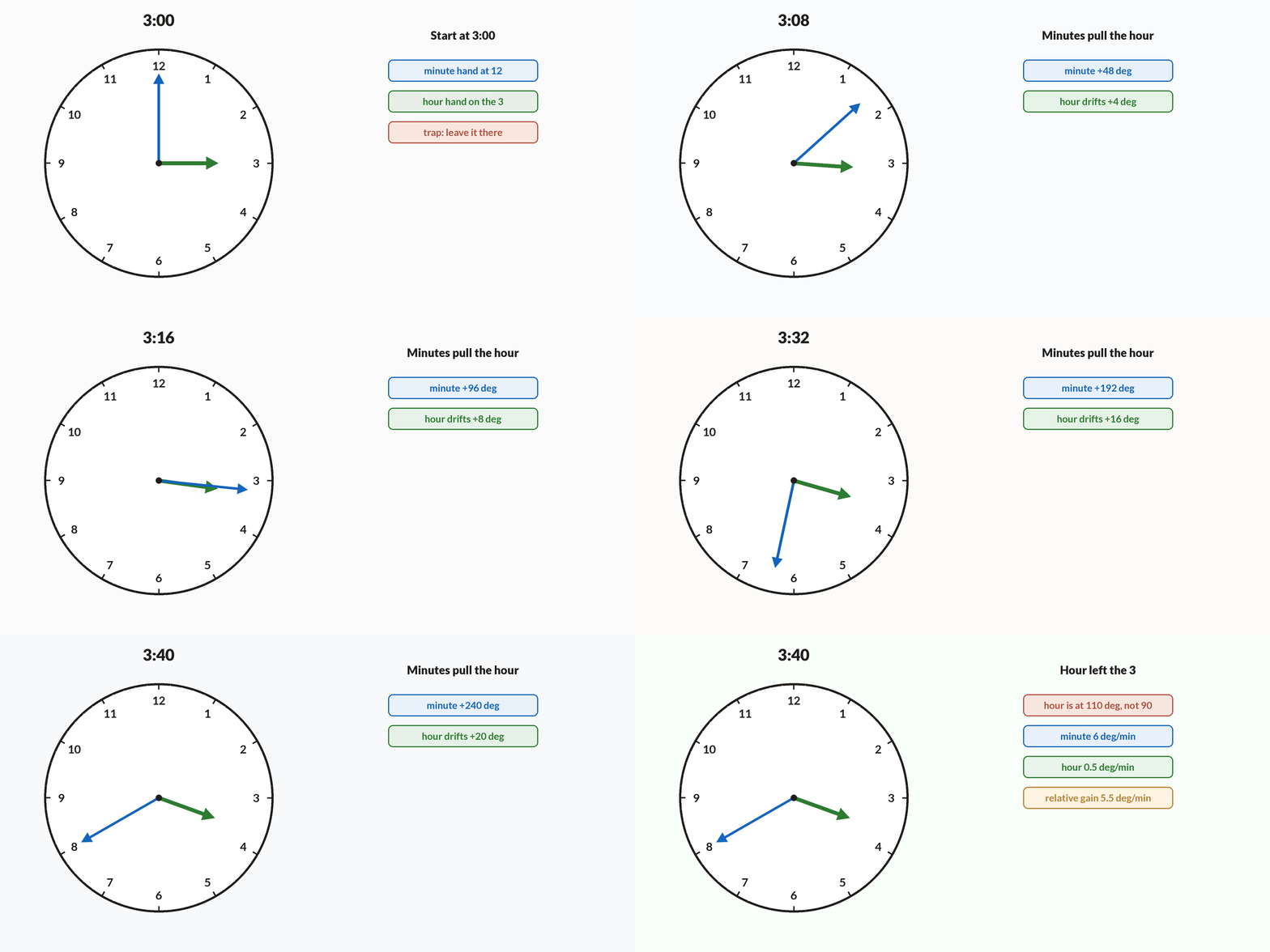
A clock face is a circle of 360 degrees. The minute hand runs all the way around that circle once every 60 minutes, so it moves 6° per minute (360 / 60). The hour hand is slower: it runs all the way around once every 12 hours, which is 720 minutes, so it moves 0.5° per minute — or 30° in a full hour (360 / 12). Those two speeds, 6 and 0.5, are the only rates this topic needs; every later formula is built from them.
The running time is 3:40. At 3:00 exactly the minute hand sits on 12 (0° from the 12-mark) and the hour hand sits on 3 (90° from the 12-mark). Forty minutes later the minute hand has moved 6 \times 40 = 240° and points at 8. The hour hand has not stayed on 3: forty minutes at 0.5° each have dragged it 20° toward 4, so it now sits at 90 + 20 = 110°. The common trap is treating the hour hand as stuck on the hour mark. At 3:40 the hour hand is not at 3.
The relative speed is just the difference: the minute hand gains on the hour hand at 6 - 0.5 = 5.5° per minute. That 5.5 is what spaces coincidences and right angles later in this topic. Until you believe the hour hand moves with the minutes, every angle you compute will be 20° off at 3:40 — and off by 0.5M at any other time. The animation on this card is that drift: the minute hand sweeps toward 8 and the hour hand leaves the 3.
Build the rates
- Minute hand360° / 60 = 6° per minute from the 12 o'clock mark. At 3:40 that is 6 \times 40 = 240°, which is the 8.
- Hour hand360° / 12 = 30° per hour, so 30° / 60 = 0.5° per minute. At 3:40 the hour hand sits at 30 \times 3 + 0.5 \times 40 = 110°, not on the 3.
- Relative gainMinute hand gains on hour hand at 6 - 0.5 = 5.5° per minute — the number behind coincide and right-angle timings.
| Hand | Speed | Position at H:M |
|---|---|---|
| Minute | 6°/min | 6M |
| Hour | 0.5°/min (30°/h) | 30H + 0.5M |
| Relative (min − hour) | 5.5°/min | used for coincide / right-angle times |
At 2:30, where is the hour hand measured from 12?
- Exactly on the 2 mark (60°)
- At 75° — halfway from 2 toward 3
- At 90° — on the 3 mark
Hour position is 30H + 0.5M = 30\times 2 + 0.5\times 30 = 60 + 15 = 75°. Leaving it on the 2 mark forgets the minute-driven drift; putting it on 3 treats half an hour as a full hour.
2Angle between the hands
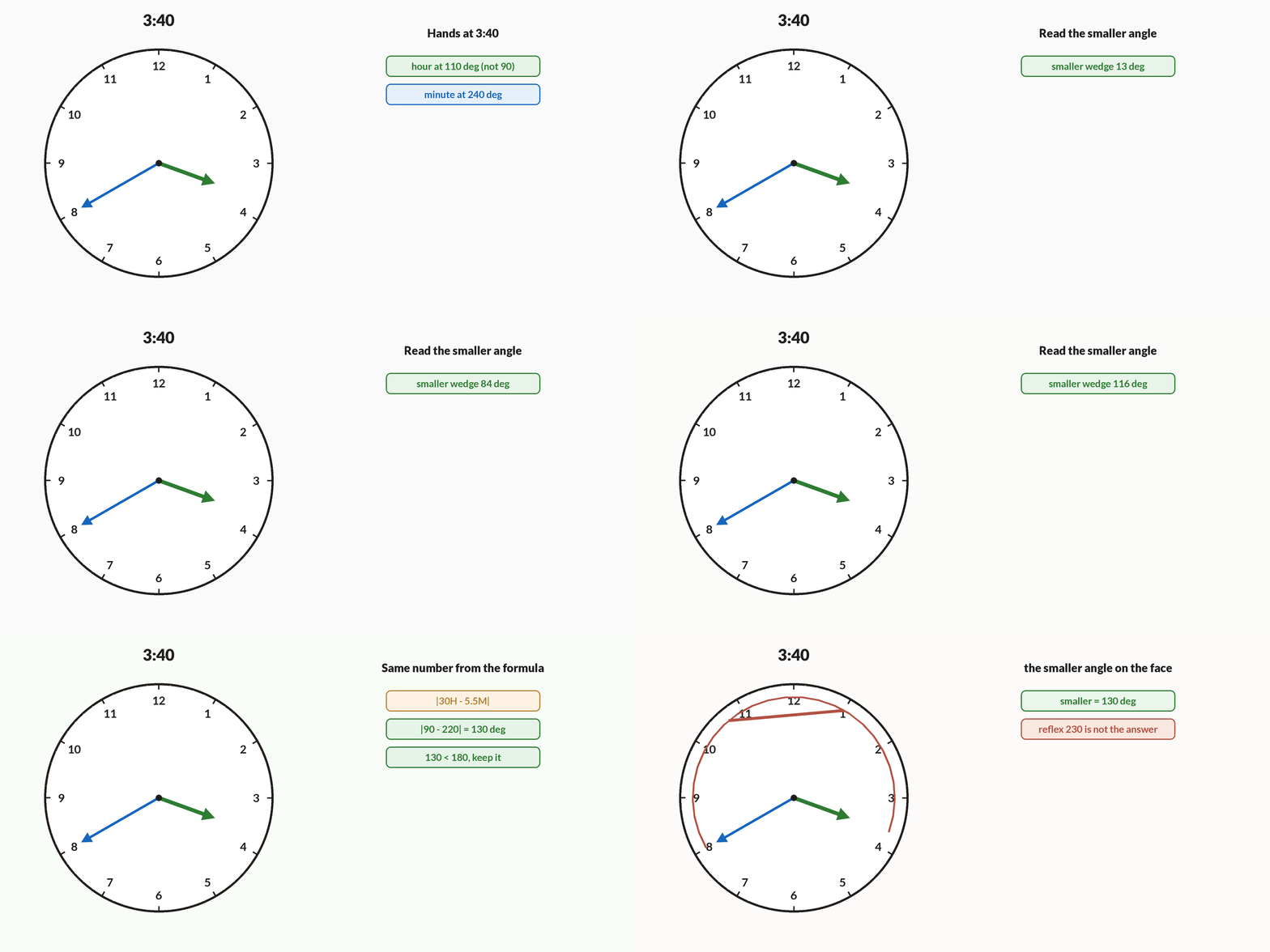
Once both positions are measured from 12, the angle between the hands is the absolute difference of those positions. There is a one-line formula that already includes the hour-hand drift: angle = |30H - 5.5M| degrees. H is the hour as shown (0 through 11); M is minutes past that hour. The 30H term is the hour hand sitting on the hour-mark — at 3:40 that is 30 \times 3 = 90. The 5.5M term packs minute-hand travel minus the hour-hand's extra drift: 6M - 0.5M = 5.5M, so 5.5 \times 40 = 220. Subtract: |90 - 220| = 130.
Two angles sit on every face: 130 and 360 - 130 = 230. Exam answers almost always want the smaller angle on the face, so if the formula returns more than 180° you replace it with 360° minus that value. 130 is already under 180, so 130 stands. Watching the hands at 3:40 makes the same 130 visible as the wedge from the hour hand at 110° to the minute hand at 240° — |110 - 240| is 130, matching the formula. You never need to sketch the face to get the number; plug H and M straight into the absolute-value formula. The hour hand's 0.5M term is already inside the 5.5.
How it works
- Identify H and MH is the hour as shown (0–11); M is minutes past the hour. For the running 3:40, H = 3 and M = 40.
- Compute |30H - 5.5M|One subtraction; keep the absolute value. |30 \times 3 - 5.5 \times 40| = |90 - 220| = 130°.
- Take the smaller angleIf the result is over 180°, replace it with 360° minus that result. 130 is already the smaller angle, so it stands; 230 is the reflex you throw away.
Angle at 3:40
What is the angle between the hour and minute hands at 3:40?
- H = 3, M = 40; compute 30H30 \times 3 = 90
- 5.5M5.5 \times 40 = 220
- Angle = |90 - 220|130°
- 130 < 180, so smaller angle stands130°
Pro tip. Plug straight into |30H - 5.5M|; only if the result exceeds 180 subtract from 360 for the smaller angle.
Using |30H - 5.5M|, the angle at 2:20 is
- 50°
- 60°
- 110°
|30\times 2 - 5.5\times 20| = |60 - 110| = 50°. Taking |30\times 2 - 6\times 20| = 60° drops the hour hand's minute motion; 110° is the raw difference before the absolute value is read as the interior angle choice.
3How often hands coincide or form a right angle
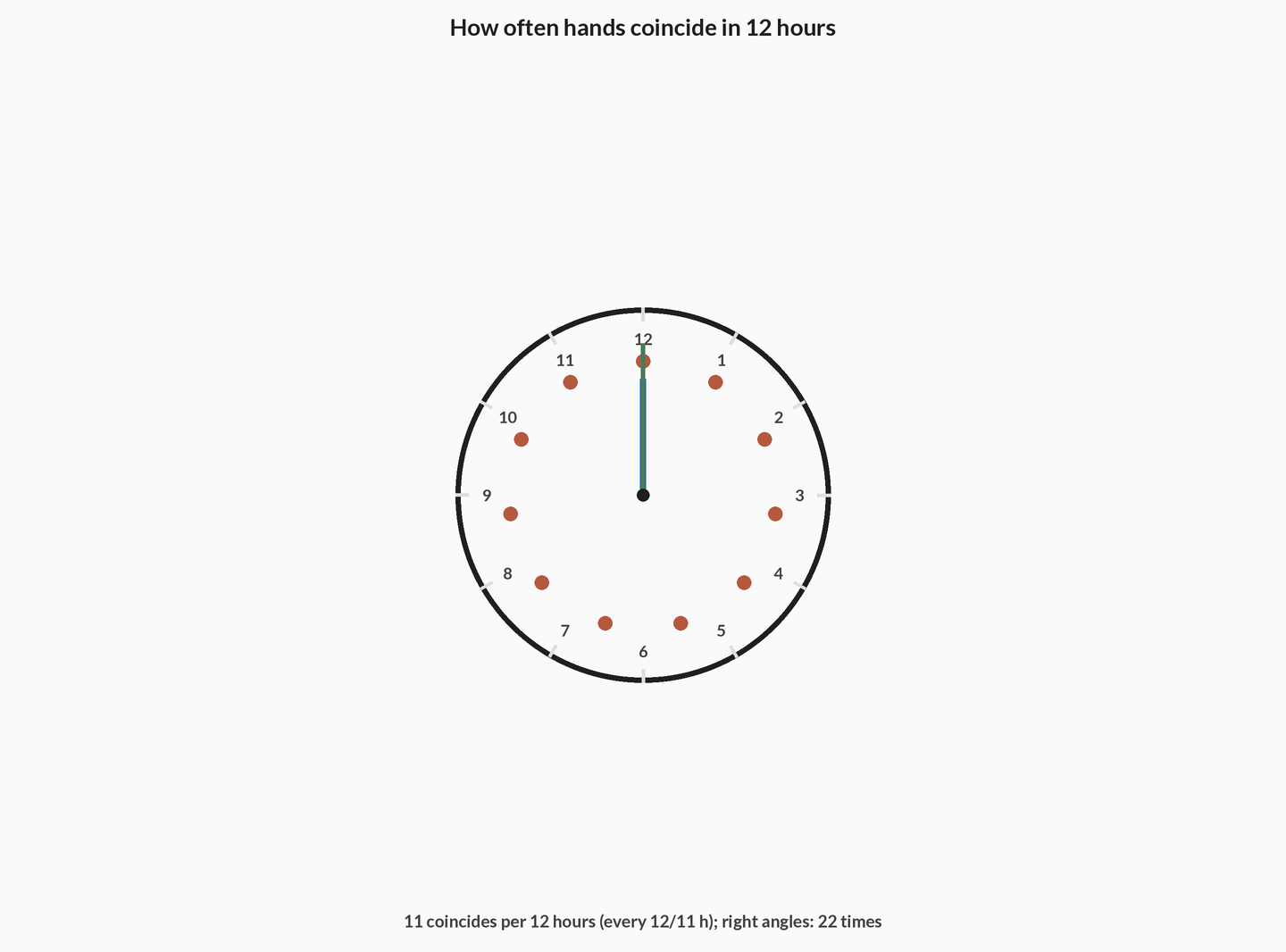
Hands coincide when the angle between them is 0° — they point at the same mark. Start from noon, when they already overlap. The minute hand then has to gain a full 360° on the slower hour hand to overlap again. At the relative speed 5.5° per minute that takes 360 / 5.5 = 720/11 \approx 65\tfrac{5}{11} minutes, a little after 1:05. The next overlap is the same gap later, a little after 2:10, and so on. Count the meetings in twelve hours: noon, then one after 1, 2, …, 10 — that is eleven. They coincide 11 times, not 12, because the meeting that would have been 'around 11' is the same meeting as noon/midnight. The 11-to-1 window merges with that shared endpoint.
Right angles are the same idea at 90°. The minute hand must gain 90° on the hour hand, which at 5.5° per minute takes 90 / 5.5 = 180/11 minutes, and it can do that on either side of the hour hand, so you get two right angles in most hour-ish windows. The same kind of shortfall that killed the twelfth overlap kills two of those windows (near 3 and near 9), leaving 22 right angles in twelve hours, not 24. 'How many times between…' questions are counting these meetings, not recomputing a face angle. The relative speed 5.5°/min is what spaces the meetings; the counts themselves are the facts to keep.
Order of attack
- Name the eventCoincide means angle 0°; right angle means 90° (either side of the hour hand).
- Use the standard count12 hours → 11 coincides, 22 right angles. Do not invent 12 and 24 — those are the naive once-per-hour guesses the options plant.
- Space with relative speedMinutes between consecutive coincides: 360 / 5.5 = 720/11. The same 5.5 from the 3:40 card is doing the spacing.
| Event | Times in 12 hours | Spacing cue |
|---|---|---|
| Coincide (overlap) | 11 | every 720/11 minutes |
| Right angle (90°) | 22 | roughly twice per hour, with gaps near 3 and 9 |
| Straight line (180°) | 11 | same "one short" pattern as coincides |
In 12 hours, how many times do the hour and minute hands coincide?
- 11
- 12
- 24
They meet 11 times in 12 hours — the twelfth meeting would be the same noon/midnight event already counted at the other end. 12 is the naive once-per-hour guess; 24 confuses coincides with right-angle meetings.
4Odd days — the weekday remainder
Weekdays repeat every 7 days. Tuesday plus 7 days is Tuesday again; Tuesday plus 8 days is Wednesday. So only the remainder after dividing a span of days by 7 matters. That remainder is the number of odd days — the leftover 0, 1, 2, …, 6 that actually shift the weekday from a known anchor. A span of 14 days has 0 odd days and does not move the weekday at all; a span of 15 days has 1 odd day and moves it by one.
An ordinary year has 365 days. 365 divided by 7 is 52 weeks with 1 day left over, so 1 odd day. A leap year has 366 days: 52 weeks plus 2 leftover days, so 2 odd days. That is the whole calendar half of this topic in one sentence: convert the span to a leftover, then walk the weekday that many steps. Counting full date arithmetic when only the remainder is needed is wasted work and a common source of off-by-one errors. The running calendar uses this immediately: 2024 is a leap year, so the span from 1 January 2024 to 1 January 2025 carries 2 odd days.
Figure. Weekdays repeat every 7 days, so only the leftover after dividing the span by 7 shifts the weekday. An ordinary year (365) leaves 1; a leap year (366) leaves 2; a week (7) leaves 0.
How it works
- Fix an anchor weekdayYou need one known date → day pair; everything else is a shift from there. Here the anchor is 1 January 2024 = Monday.
- Count odd days in the spanConvert years, months or day counts to a total, then reduce mod 7. A leap year is 366 ≡ 2 (mod 7); an ordinary year is 365 ≡ 1.
- Add mod 7Advance the anchor by that many weekdays (0 stays put, 1 is the next day, …). Monday + 2 = Wednesday.
| Span | Days | Odd days (mod 7) |
|---|---|---|
| Ordinary year | 365 | 1 |
| Leap year | 366 | 2 |
| Week | 7 | 0 |
From one 1 January to the next 1 January in a non-leap year, the weekday
- Stays the same
- Advances by 1 day
- Advances by 2 days
An ordinary year contributes 1 odd day, so the weekday advances by one. Staying the same would mean 0 odd days (a multiple of 7); advancing by 2 is the leap-year shift.
5Which years are leap years
A year is a leap year if it is divisible by 4 — except century years, which must be divisible by 400. So 2000 is a leap year (2000 / 400 = 5) and 1900 is not (1900 / 400 is not a whole number, even though 1900 / 4 is). That single exception changes February's length — 29 days instead of 28 — and therefore the odd-day count for the year: leap years contribute 2 odd days, ordinary years contribute 1. February 29 is the extra leftover day.
The running calendar needs this rule before the weekday can be trusted. 2024 is not a century, and 2024 / 4 = 506 exactly, so 2024 is a leap year and carries 2 odd days. Getting the century rule wrong on a year that does end in 00 flips the odd-day contribution from 2 to 1 (or the reverse) and shifts every later weekday in the problem by one. 1900 and 2100 are the classic traps: both look leap if you only test ÷4, and neither is. A span that starts on 1 March of a leap year has already left February 29 behind, so that remaining year behaves like an ordinary year — a trap the 1 January running example does not hit.
Figure. Leap if divisible by 4, except century years, which must be divisible by 400. 2016 is leap; 2017 is not. 1900 is a century and fails ÷400; 2000 is a century and passes.
Classify the year
- Century?If the year ends in 00, demand divisibility by 400 — not merely by 4. 2000 yes; 1900 no.
- OtherwiseLeap iff divisible by 4. 2024 / 4 = 506, so 2024 is leap; 2023 is not.
- Apply to odd daysLeap → 2 odd days for the year; ordinary → 1. February 29 sits inside that leap count.
| Year | Test | Leap? |
|---|---|---|
| 2016 | ÷4 | yes |
| 2017 | not ÷4 | no |
| 1900 | century, not ÷400 | no |
| 2000 | century and ÷400 | yes |
Which of these is a leap year?
- 1900
- 2000
- 2100
2000 is divisible by 400. 1900 and 2100 are century years not divisible by 400, so they are ordinary — the classic trap if you only check ÷4.
6Day of the week from odd days
Given an anchor date and its weekday, advance by the odd days in the intervening span. For a full year from 1 January to the next 1 January, that span is just the year's own odd-day count: 1 if ordinary, 2 if leap. The running calendar is exactly this shape. 1 January 2024 is a Monday. 2024 is a leap year (divisible by 4, not a century), so it contributes 2 odd days. Monday plus 2 weekdays is Wednesday, and that is 1 January 2025.
Do not reopen the calendar and count every month unless the span is irregular — a date that is not the same calendar day a year later, or a span that starts after 28 February in a leap year (because the extra day then sits inside the span) versus one that finishes before it (the extra day sits outside). Year-length mod 7 is enough when both dates are the same calendar day a year apart. An ordinary year from a Sunday 1 January lands on Monday; answering Tuesday is the leap-year shift applied to a year that did not earn it.
Figure. 1 January 2024 is a Monday. 2024 is a leap year, so the span is 366 days and 366 mod 7 = 2. Monday plus 2 weekdays is Wednesday: 1 January 2025.
How it works
- Confirm leap or ordinaryApply the century rule to the year that contains the span between the two identical calendar dates. 2024 / 4 works and 2024 is not a century, so leap.
- Read odd daysLeap → 2; ordinary → 1. 366 mod 7 = 2 is the same fact as 'leap year → 2 odd days'.
- Shift the weekdayAdd that many days to the anchor weekday, wrapping past Sunday. Monday + 2 = Wednesday, so 1 January 2025 is Wednesday.
1 January 2025 from a leap 2024
If 1 January 2024 is a Monday, what day is 1 January 2025? (2024 is a leap year.)
- 2024 leap? (÷4, not a century)yes → 366 days
- Odd days in 2024366 mod 7 = 2
- Monday + 2 odd daysWednesday
- 1 January 2025Wednesday
Pro tip. Only the odd days (year length mod 7) shift the weekday — leap years shift by 2, ordinary years by 1.
If 1 January 2023 is a Sunday and 2023 is not a leap year, 1 January 2024 is
- Sunday
- Monday
- Tuesday
Ordinary year → 1 odd day → Sunday + 1 = Monday. Tuesday would be the leap-year shift; Sunday forgets the odd day entirely.
7Odd days in 100 and 400 years
Longer calendar spans use packed remainders so you do not list every year. One hundred years with a non-leap century contain 24 leap years and 76 ordinary years: 24 \times 2 + 76 \times 1 = 124 odd days, and 124 \bmod 7 = 5. So 100 years contribute 5 odd days. Four hundred years contain one extra leap century (the one divisible by 400), which is 97 leap years and 303 ordinary years: 97 \times 2 + 303 = 497, and 497 \bmod 7 = 0. So 400 years contribute 0 odd days — a full cycle that lands on the same weekday. Those two facts sit on top of the ordinary/leap year counts and the century leap rule.
When a problem jumps across centuries, reduce with these codes instead of listing every year. Pull out as many 400-year blocks as you can and drop them (each adds 0). Each leftover 100-year block adds 5, then reduce mod 7. Finish with the remaining individual years at 1 or 2 odd days each. A 400-year block can be dropped entirely because it adds 0 odd days. 5 is the 100-year code; do not confuse it with a single ordinary year's 1.
Figure. Packed remainders: an ordinary year adds 1 odd day, a leap year adds 2, 100 years add 5, and 400 years add 0. Pull out 400-year blocks first, then add 5 per leftover century.
Using the codes
- Split the spanPull out as many 400-year blocks as you can — each adds 0, because 497 odd days is a multiple of 7.
- Pack centuriesEach leftover 100-year block adds 5 odd days (then reduce mod 7). 124 mod 7 = 5 is that code, not a guess.
- Finish with yearsAdd 1 or 2 per remaining year by the leap rule, then reduce mod 7 once at the end.
| Span | Odd days | Why it helps |
|---|---|---|
| Ordinary year | 1 | default year shift |
| Leap year | 2 | includes Feb 29 |
| 100 years | 5 | pack a century |
| 400 years | 0 | drop whole 400-year blocks |
A span of exactly 400 years shifts the weekday by how many days?
- 0
- 1
- 5
400 years = 0 odd days, so the weekday is unchanged. 5 is the 100-year code; 1 is a single ordinary year.
Notes
- Clock Angles: The hour hand moves 0.5 degrees per minute and the minute hand 6 degrees per minute. The angle between them at H hours M minutes is found by comparing their absolute positions from 12 o'clock.
- Hand Overlaps and Right Angles: The hands coincide 11 times in 12 hours (every 65 5/11 minutes) and form a right angle 22 times in 12 hours. Use these counts for 'how many times' questions.
- Calendar - Odd Days: The day of the week repeats every 7 days, so only the remainder (odd days) after dividing total days by 7 matters. An ordinary year has 1 odd day, a leap year 2 odd days.
- Leap Year Rule: A year is a leap year if divisible by 4, except centuries which must be divisible by 400 (2000 is leap, 1900 is not). This affects February and the odd-day count.
- Common trap: Forgetting that the hour hand also moves as minutes pass (it is not fixed on the hour) leads to wrong clock angles; always add the hour hand's minute-driven movement.
Formulas
- Angle between hands = |30H - 5.5M| degrees (take 360-value if it exceeds 180).
- Minute hand gains on hour hand at 5.5 degrees per minute.
- Hands coincide every \frac{720}{11} \approx 65\tfrac{5}{11} minutes.
- Odd days: ordinary year = 1, leap year = 2; 100 years = 5, 400 years = 0 odd days.
- Day counting: total odd days mod 7 gives the shift in weekday from a known reference date.
Exam traps & shortcuts
- Use |30H - 5.5M| directly for any clock-angle question instead of drawing the clock.
- For 'day of the week' questions, count only odd days (remainder mod 7), not the full date arithmetic.
- Remember the month odd-day codes or count days from a known anchor like 1 Jan of the year.
- Check century leap rule (÷400) whenever the year is a multiple of 100 to avoid a one-day error.
Reference tables
Formulas and remainders reused across the seven concepts.
| Item | Value | Use |
|---|---|---|
| Angle between hands | |30H - 5.5M| (then min with 360° - that) | any H:M angle |
| Relative speed | 5.5°/min | coincide / right-angle spacing |
| Coincide spacing | 720/11 minutes | time between overlaps |
| Ordinary / leap year | 1 / 2 odd days | weekday year-shift |
| 100 / 400 years | 5 / 0 odd days | long calendar spans |
Recap
Read only this the night before.
- Hour hand moves
- Position is 30H + 0.5M, never frozen on the hour. Forgetting the 0.5M is the whole clock-angle trap.
- Angle
- |30H - 5.5M|; if over 180, take 360 minus that for the smaller angle.
- Meetings
- 11 coincides and 22 right angles in 12 hours; coincides every 720/11 minutes.
- Odd days
- Only days mod 7 shift the weekday. Ordinary year +1, leap year +2.
- Leap centuries
- ÷4, but centuries need ÷400 — 2000 yes, 1900 no.
- Long spans
- 100 years → 5 odd days; 400 years → 0. Drop 400-year blocks first.
Practise Clocks & Calendars
Reading is free and needs no account. Practice, mocks and progress live in the app.
- 45 exam-style questions on this topic, with explanations
- A 6-question practice set that ends the chapter
- Timed mocks scored with the real marking scheme
- Readiness tracked per topic, kept on your device