RRB NTPC (Railways) · General Intelligence & Reasoning
Mirror & Water Images
Identifying the reflection of figures, letters and numbers in mirror and water surfaces.
A mirror image and a water image are reflections across different axes, and mixing those axes is the whole exam. A vertical mirror placed beside a word swaps left and right; a water surface placed below it swaps top and bottom. Hold two running objects through this topic: the word BOOK next to a side mirror, and the number 108 sitting above still water. Every concept below either names which axis you are on, which letters or digits survive that axis unchanged, or how to kill an option that applied the other axis.
- RRB NTPC (Railways)
- Easy level
- 7 concepts
- 45 practice questions
1Mirror image: left–right flip
Start with the object in the world. You are holding a card that says BOOK, and a vertical mirror stands on the right-hand side of the card, like a wardrobe door. Light that left the left end of the word (the B) hits the mirror and appears on the right side of the reflection; light that left the right end (the K) appears on the left. Top and bottom do not swap — the word does not stand on its head. A vertical mirror placed beside a figure swaps left and right while top and bottom stay fixed.
For a word, that means two moves at once: the letter order reverses, and each asymmetric letter is laterally inverted. Laterally inverted means each glyph is flipped as if you turned the paper over left-to-right: a B that used to bulge toward the right now bulges toward the left. The first letter of the original word ends up at the right-hand end of the reflection. BOOK reversed is K-O-O-B, so when you read the mirror image left to right you start at K.
The two O's are a gift. O looks the same after a left–right flip, so those two letters keep their shape and only move with the reversed order. B and K are asymmetric: each must face the opposite way in the reflection. The finished reading is a laterally inverted KOOB — order reversed, B and K flipped, O and O left alone. Skipping the glyph flip and only reversing the string is half the job; skipping the reverse and only flipping B and K in place is the water-image habit applied to a mirror stem.
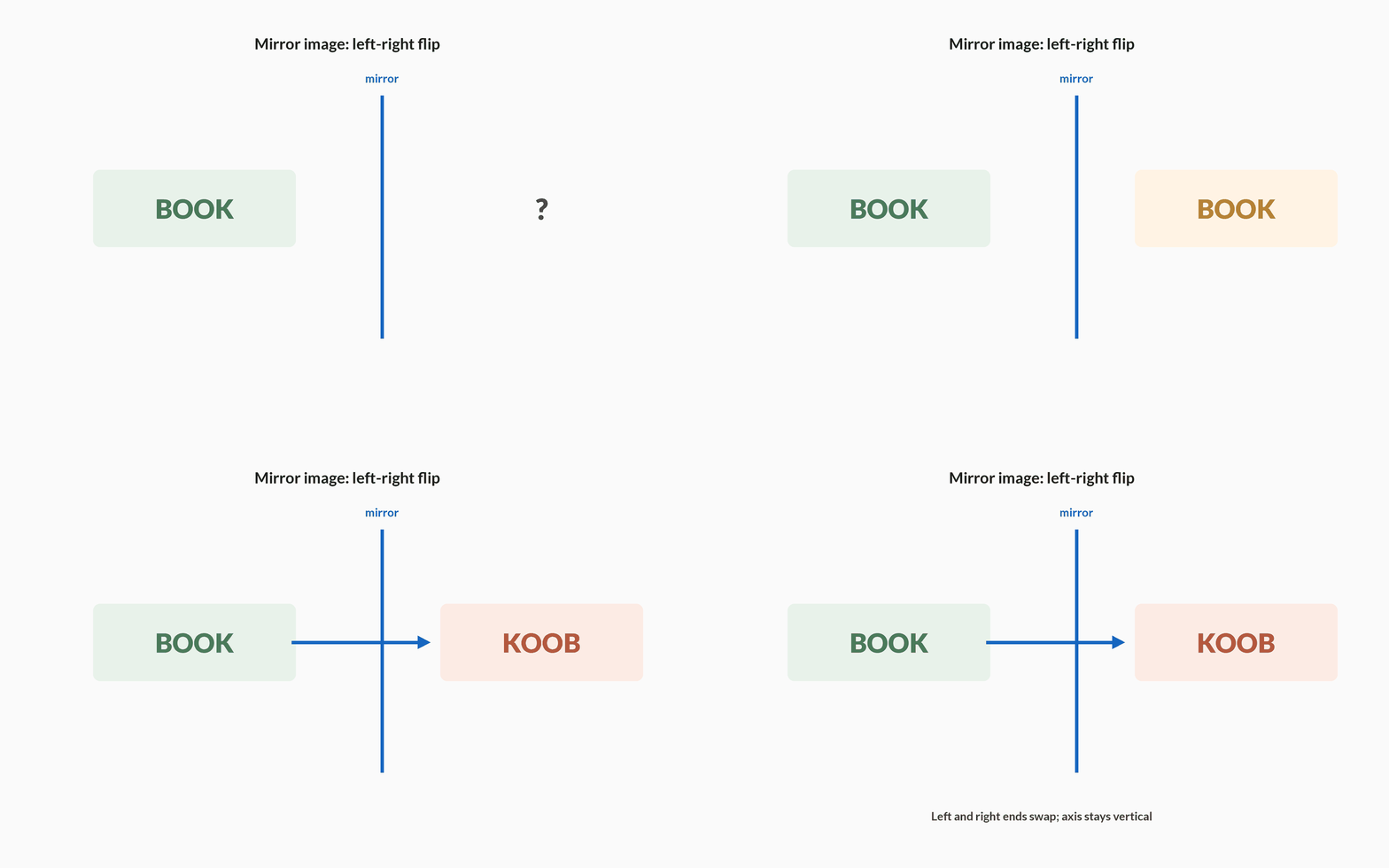
Order of attack
- Name the axisSide mirror = vertical axis, like a wardrobe door standing beside the word. Left and right swap; height is unchanged. Top and bottom do not trade places.
- Reverse the stringWrite the letters right-to-left so the original first letter sits at the far right. BOOK becomes K-O-O-B. This reverse is the order rule; it is not optional even when every letter is symmetric.
- Flip each glyphLaterally invert every letter that is not vertically symmetric; leave the anchors alone. O is unchanged; B and K each face the opposite way. The left-to-right reading of the reflection is laterally inverted KOOB.
Mirror Image of a Word
What is the mirror image of the word 'BOOK' when the mirror is placed on its right side?
- Side mirror reverses letter orderBOOK → K-O-O-B
- O is vertically symmetricO unchanged
- K and B are asymmetriceach faces the opposite way
- Left-to-right reading of the reflectionlaterally inverted KOOB
Pro tip. Reverse the whole word order first, then apply lateral inversion to each individual letter.
A vertical mirror sits on the right of the word LEFT. In the mirror image, where does L appear?
- At the left end, still first
- At the right end, after the order reverses
- Nowhere — L is vertically symmetric and vanishes
A side mirror reverses letter order, so the original first letter moves to the right-hand end. L is not among the vertically symmetric anchors, so it still appears — flipped — rather than vanishing. Keeping L on the left is the water-image habit applied to a mirror stem.
2Vertical symmetry anchors
Some capital letters already look the same in a side mirror, because a vertical line down their middle splits them into matching halves. Those letters are the vertical-symmetry anchors: A, H, I, M, O, T, U, V, W, X, Y. Treat them as anchors. When you scan options, check that those letters still sit where the reversed order demands; if an option moves or warps an anchor, discard it and spend the time on the asymmetric letters that actually change shape.
Take MATH as a worked word, because every letter on it is an anchor. M, A, T and H all sit on the vertical-symmetry list. A side mirror still reverses order — the reverse is about position, not about shape — so MATH becomes H-T-A-M. Each glyph is still the same shape: H is still H, T is still T. An option that draws a warped T, or that keeps M on the left as if order had not reversed, is already dead. You never needed to invent a glyph flip for any of those four letters.
BOOK from the previous concept shows the mixed case. O is an anchor and stays O. B and K are not on the list: they are asymmetric, so they must laterally invert. The Side-mirror letter fate table is the split: vertically symmetric letters keep their shape and only move with word order; asymmetric letters (B C D E F G J K L N P Q R S Z, and any other letter not on the anchor list) must face the other way. Circle the anchors in the stem first, place them after the reverse, and only then compare the letters that actually change.
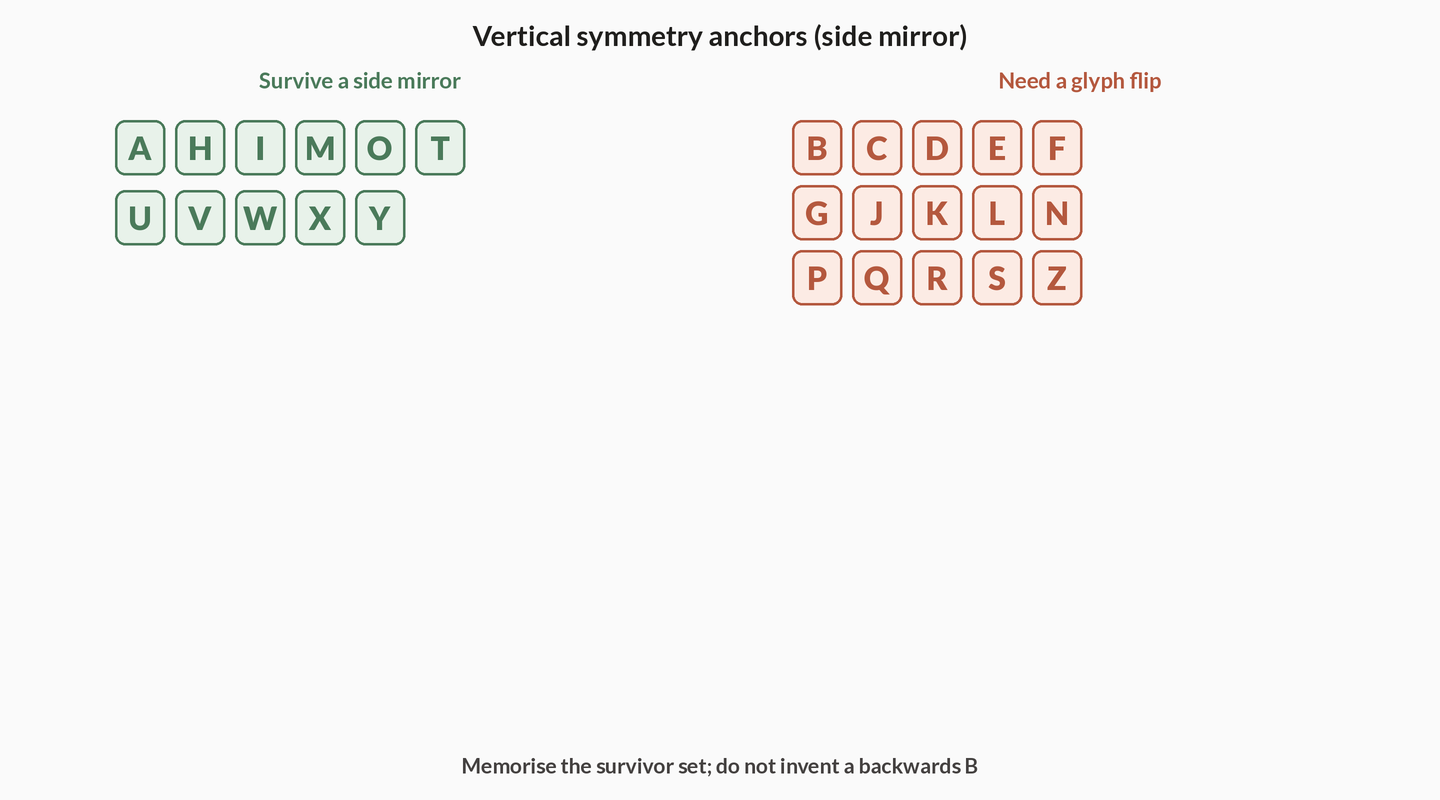
How to use anchors
- Mark the anchorsCircle every A, H, I, M, O, T, U, V, W, X, Y in the stem word. In MATH that is all four letters; in BOOK that is the two O's. These glyphs will not change shape.
- Place them after reverseAfter reversing order, each anchor must occupy its new slot unchanged. MATH becomes H-T-A-M with every glyph still itself. Order still reverses; symmetry does not cancel the reverse.
- Cull optionsDrop any option that alters an anchor's shape or puts it in the wrong slot; only then compare the asymmetric letters. A warped T in H-T-A-M is enough to kill the option without looking at anything else.
| Letter class | Examples | In a side mirror |
|---|---|---|
| Vertically symmetric | A H I M O T U V W X Y | Shape unchanged; only position may move with word order |
| Asymmetric | B C D E F G J K L N P Q R S Z (and others not listed above) | Laterally inverted; must face the other way |
In a side-mirror image of the word MATH, which letter must look identical to the original once order is reversed?
- Only M and A — T and H change shape
- M, A, T and H — all four are vertically symmetric
- Only the vowels; consonants always invert
M, A, T and H are all on the vertical-symmetry list, so after the order becomes H-T-A-M each glyph is still the same shape. The first option wrongly demotes T and H; the third invents a vowel rule the topic never uses.
3Water image: top–bottom flip
Now put the card on a table above still water. The reflection sits below the word, as if you folded the page upward onto the surface. The axis is horizontal — a waterline under the figure — so top and bottom swap and left and right stay put. The left end of the word is still the left end in the water. A water image is the reflection in a horizontal mirror placed below the figure. Top and bottom swap; left and right stay fixed.
For a word or number, letter order is preserved — only each character flips vertically, as if you folded the page upward onto still water. Vertically flipped means each glyph is turned upside-down about that waterline: the top of an 8 becomes the bottom of the 8. Hold 108 as the running number. The digits stay 1, then 0, then 8, left to right. You do not reverse them to 801. Each digit is flipped top-to-bottom. 0, 1 and 8 happen to look similar after that flip, which is why 108 is a favourite stem: the order rule is the whole question, because the glyphs barely change.
Contrast this with BOOK beside the wardrobe. The side mirror reversed BOOK to KOOB. Water would keep BOOK in that order and flip each letter top-to-bottom instead. B and K would still change shape, but they would change by a vertical flip, not a lateral one, and B would still sit on the left. That is the entire difference in one sentence: water keeps sequence and flips height; a side mirror reverses sequence and flips width.
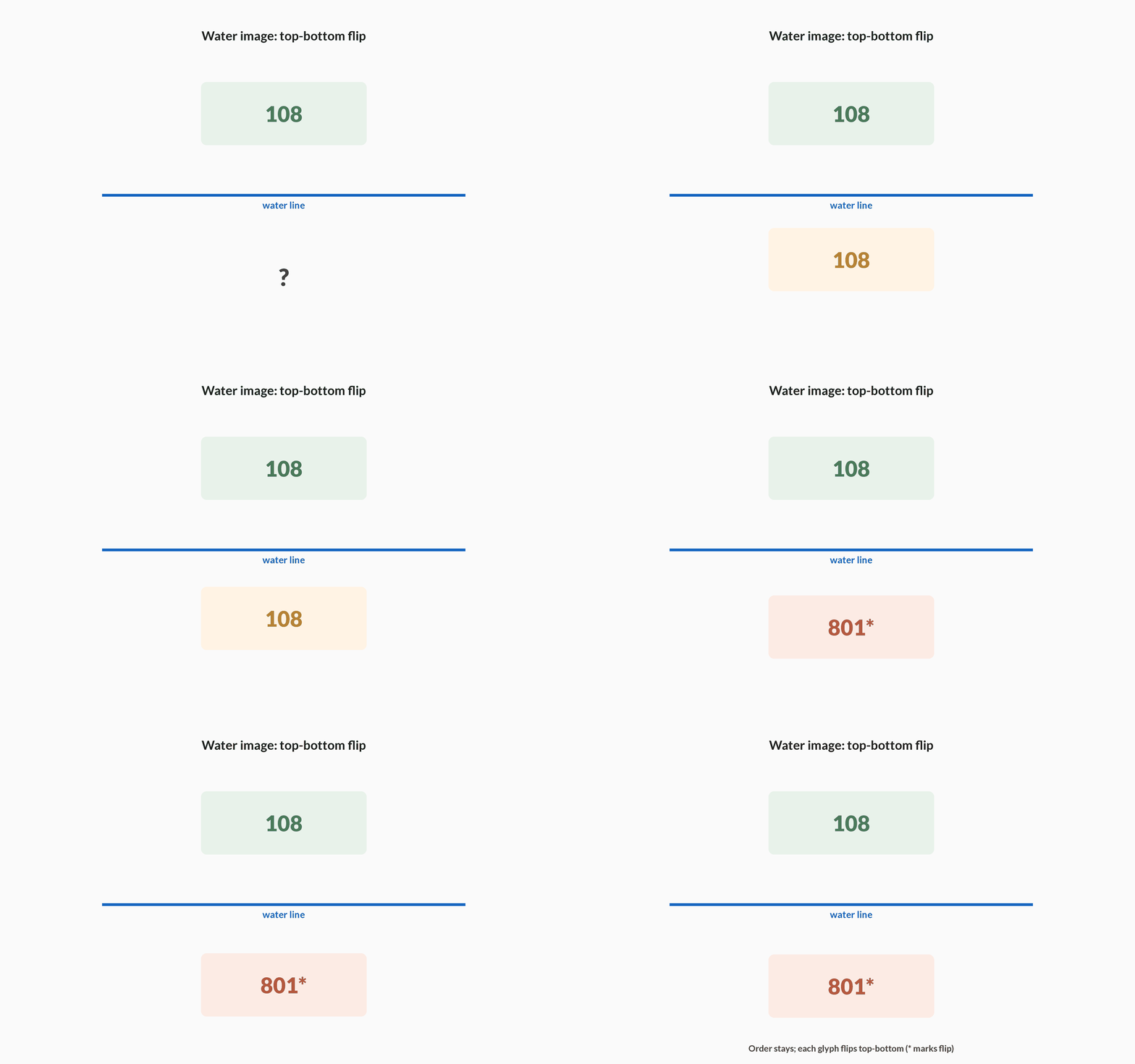
Order of attack
- Name the axisWater = horizontal axis below, like still water under the card. Height swaps; left–right order does not. The left end of 108 stays the left end.
- Keep the sequenceWrite the same left-to-right order; do not reverse the string. 108 stays 1, 0, 8. Reversing to 8-0-1 is the side-mirror order rule applied to the wrong surface.
- Flip each glyph downVertically invert every character that is not horizontally symmetric. 0, 1 and 8 look similar after a top–bottom flip, so the water image of 108 is 108 with each digit flipped down — order untouched.
Water Image of Digits
What is the water image of the number 108?
- Water image keeps left-to-right orderdigits stay 1, 0, 8
- 1, 0 and 8 about a horizontal axiseach looks similar when flipped down
- Contrast with a side mirrormirror would reverse order; water does not
- Water image108 with each digit vertically flipped
Pro tip. For water images, keep the left-right order and only flip each character vertically.
The water image of the word CAB is formed. What happens to letter order?
- It becomes BAC — water reverses like a side mirror
- It stays C-A-B; only each letter flips top-to-bottom
- The middle letter jumps to the end because water rotates 180°
Water keeps left-to-right order and only flips each glyph vertically. Reversing to BAC is the side-mirror move. A 180° rotation is a different transform entirely and is not what a water image does.
4Word order: mirror versus water
The fastest eliminate-and-choose move on this topic is word order, and it does not require drawing a single glyph. In a mirror image the whole word reverses, so the original first letter appears on the right. In a water image the word order stays, so the original first letter stays on the left. Mixing those two rules is the common trap — applying a left–right reverse to a water stem, or keeping order on a mirror stem.
Hold RACE as the running word, because the Mirror versus water on a word table is built on it. Side mirror: reverse the string to E-C-A-R, so E sits at the left end of the option and R sits at the right. Water: keep R-A-C-E, so R stays on the left and each letter flips top-to-bottom. An option that shows E at the left and R at the right cannot be water. An option that shows R still on the left cannot be a side mirror. You can kill three of four options with that one check before any glyph looks 'backwards'.
Read the stem's surface words first. Side, right, vertical, beside → expect order reverse, first letter to the right end. Water, below, horizontal, pond → expect order kept, first letter still on the left. Then find the original first letter in each option and drop mismatches. Glyph flips are a second pass on whatever survives. The BOOK wardrobe and the 108 waterline already taught the two moves; this concept is only the classifier that tells you which move the stem asked for.
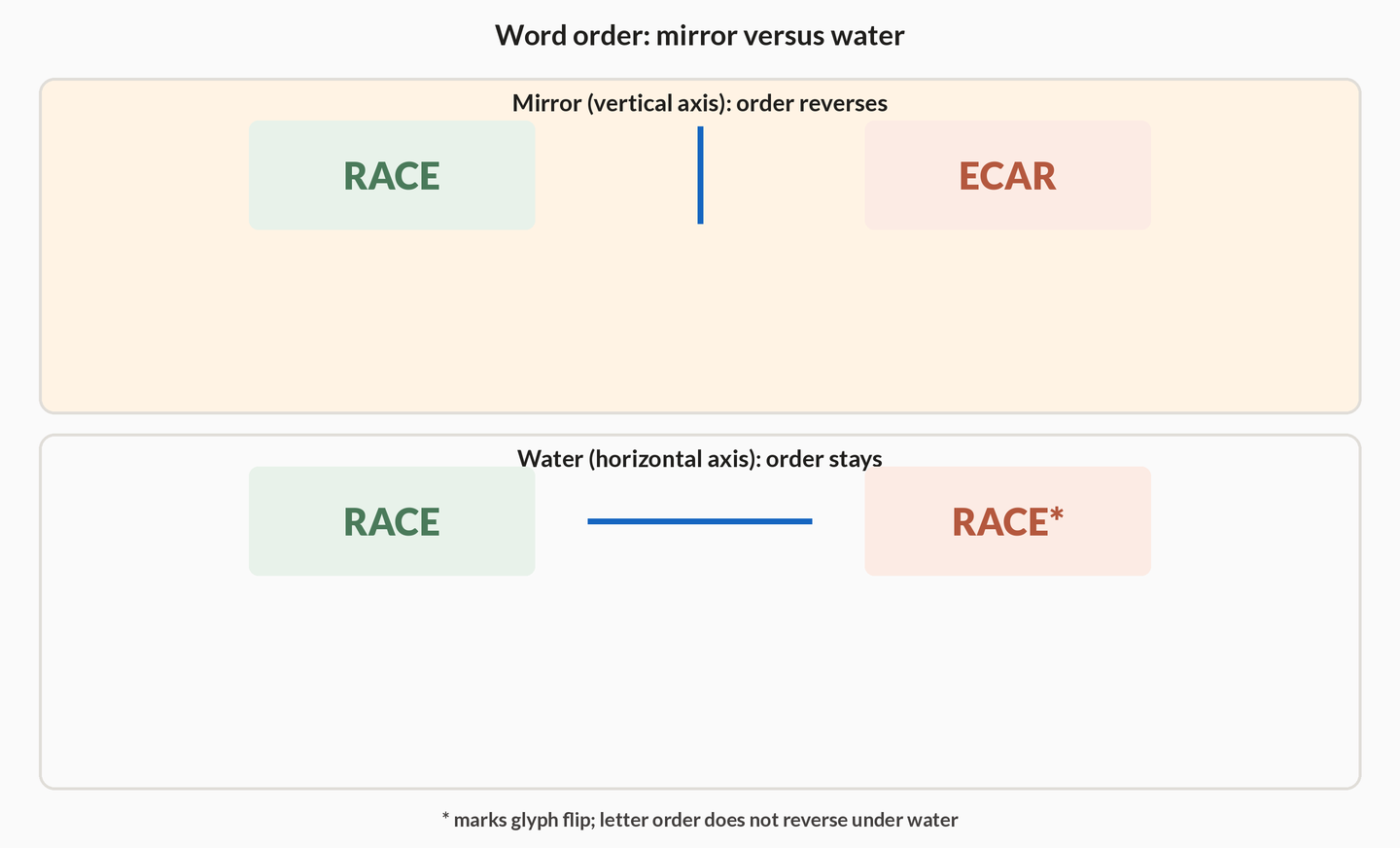
Eliminate by first letter
- Read the stem's surfaceSide / vertical mirror → expect order reverse. Water / below → expect order kept. Underline those words in the stem so the axis is chosen before any option is opened.
- Find the first letterMirror: it must sit at the right end. Water: it must sit at the left end. For RACE, side-mirror options start with E and end with R; water options still start with R.
- Drop mismatchesAny option that puts the first letter in the wrong end is the other transform; discard it before comparing glyph flips. Order is enough to kill the mixed-axis trap.
| Transform | Axis | Letter order | Where the first letter lands |
|---|---|---|---|
| Mirror (side) | Vertical | Reverses | Right end |
| Water (below) | Horizontal | Preserved | Left end |
An option for the word RACE shows E at the left end and R at the right. Which transform could that option be?
- Water image — order always puts E first
- Side-mirror image — order reverse puts original R on the right
- Either, because both transforms reverse vowels only
RACE reversed is E-C-A-R, so E on the left and R on the right is exactly the side-mirror order. Water would keep R on the left. There is no vowel-only reverse rule.
5Horizontal symmetry for water images
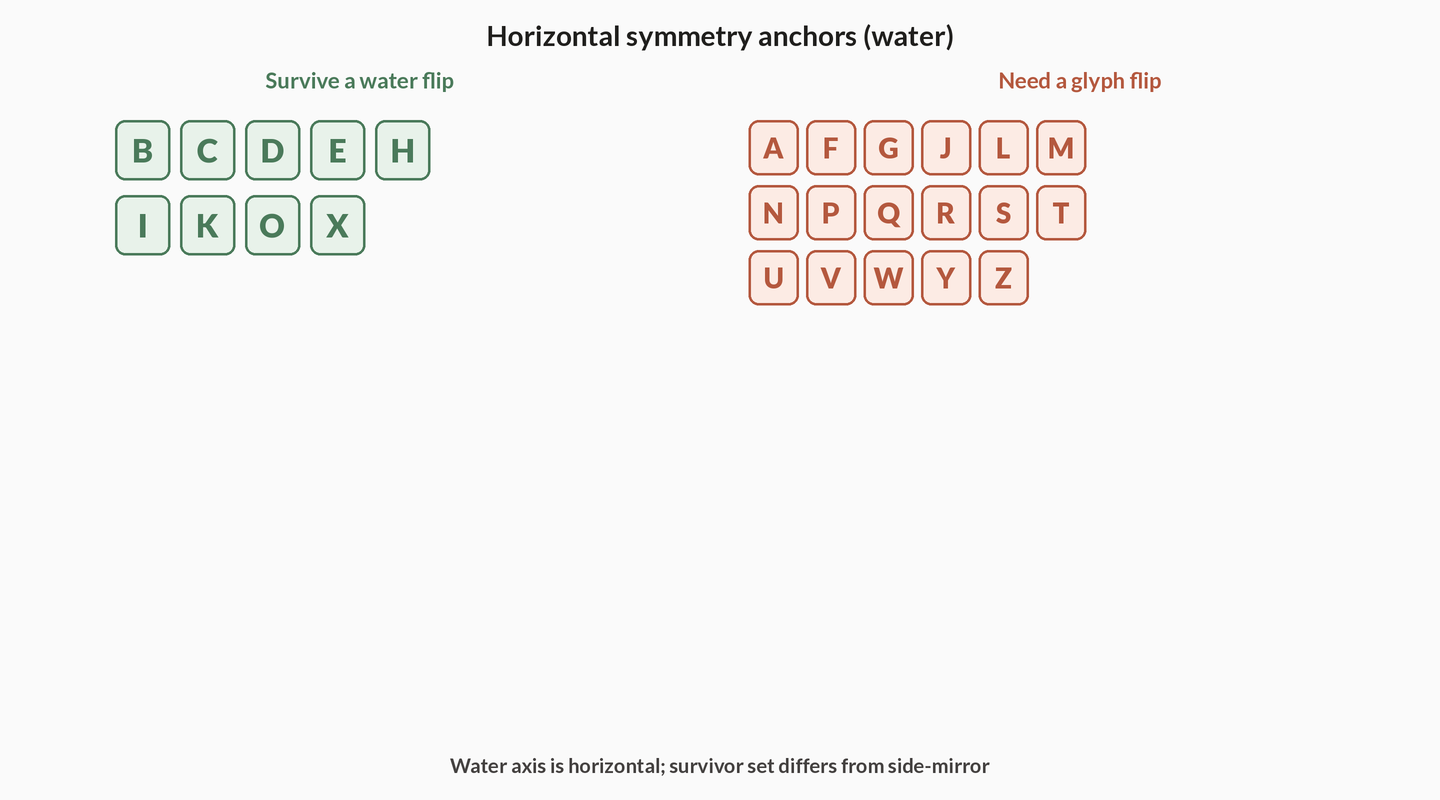
Water has its own anchor list, and it is not the side-mirror list. Letters with horizontal symmetry are unchanged by a water image: B, C, D, E, H, I, K, O, X. A horizontal line through the middle of B splits it into matching halves, so flipping B top-to-bottom leaves a B. They are the water-image anchors, the counterpart of the vertical list used for side mirrors.
A letter can sit on one list and not the other — A survives a side mirror but flips in water; B survives water but laterally inverts in a side mirror — so never reuse the wrong anchor list. That sentence is the concept. A is a tall triangle with a crossbar: a vertical split matches, a horizontal split does not, so A is a side-mirror anchor and a water flip. B is the opposite. O sits on both lists and survives both transforms. If you catch yourself treating A as a water anchor because you memorised it for BOOK's side mirror, stop — that is the wrong list.
On a water stem, mark B C D E H I K O X as survivors and flip everything else top-to-bottom. The Water-image letter fate table is the split: horizontally symmetric letters keep their shape (and order is already preserved, because water never reverses); letters not on that list (A F G J L M N P Q R S T U V W Y Z) invert vertically. Identify the surface first, then pick the matching list. Side mirror → vertical-symmetry list from the previous concept. Water → this horizontal list.
Pick the matching list
- Identify the surfaceSide mirror → vertical-symmetry list (A H I M O T U V W X Y). Water → horizontal-symmetry list (B C D E H I K O X). Pick the list from the stem's axis, never from habit.
- Mark survivorsOn a water stem, B C D E H I K O X keep their shape; everything else flips top-to-bottom. In BOOK under water, B and O survive; K does not.
- Reject cross-list habitsIf you catch yourself treating A as a water anchor because it is a mirror anchor, stop — that is the wrong list. A flips in water; B survives water and still laterally inverts in a side mirror.
| Letter class | Examples | In a water image |
|---|---|---|
| Horizontally symmetric | B C D E H I K O X | Shape unchanged; order already preserved |
| Not horizontally symmetric | A F G J L M N P Q R S T U V W Y Z | Vertically inverted |
Which letter is unchanged in a water image but changes in a side-mirror image?
- A — vertical symmetry saves it in both
- B — horizontal symmetry saves it in water; a side mirror still laterally inverts it
- O — O changes in every reflection
B is on the horizontal list (water) and not on the vertical-only story for asymmetric side-mirror letters — a side mirror laterally inverts B. A is the opposite pattern (vertical anchor, not horizontal). O is on both lists and survives both transforms.
6Digit symmetry in reflections
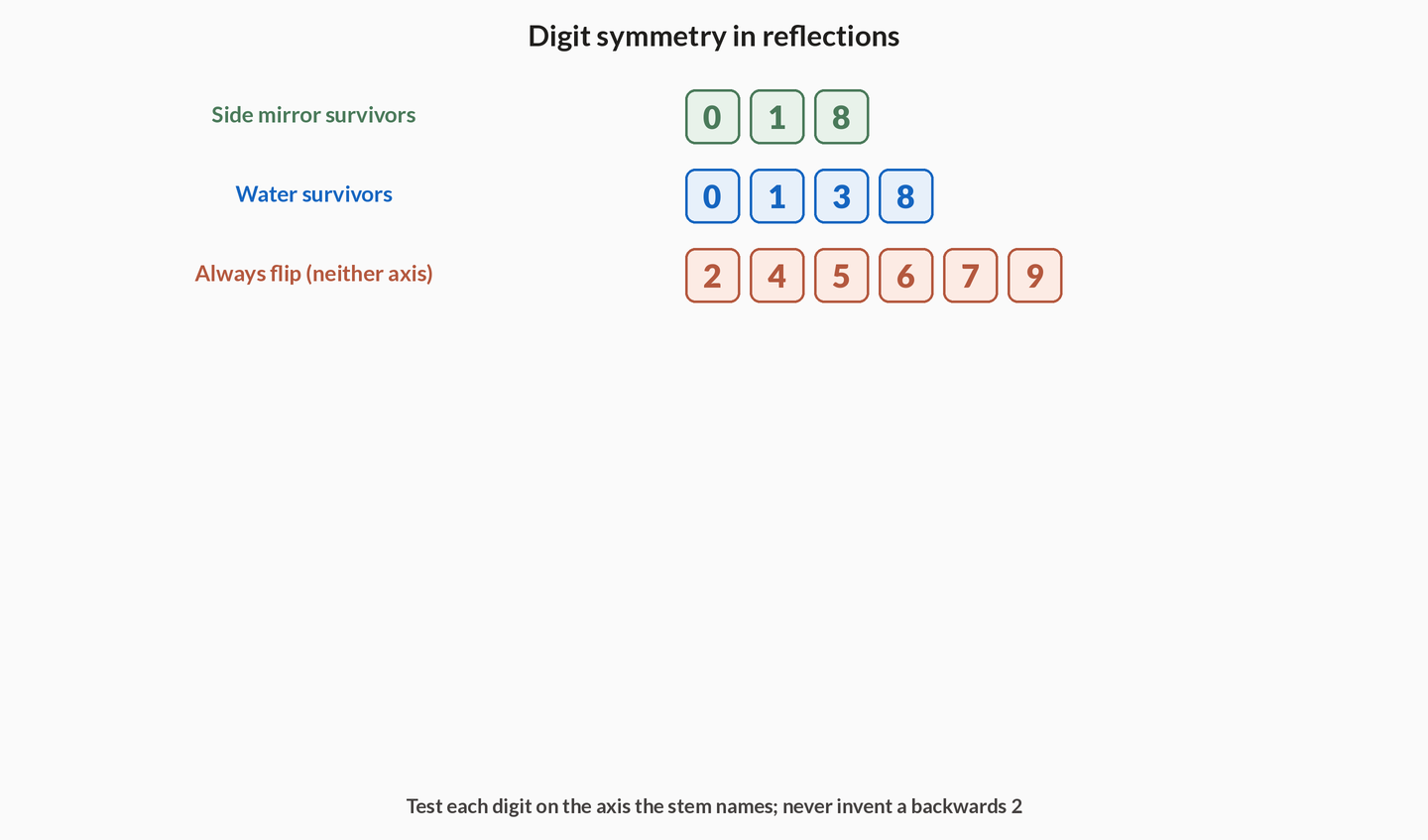
Digits have their own short lists, shorter than the letter lists, and they still obey the same two order rules. For a side mirror, 0, 1 and 8 are the usual unchanged anchors — a vertical split leaves them looking like themselves. For a water image, 0, 1, 3 and 8 are the digits that look similar after a top–bottom flip — treat "similar" carefully on 3, whose water form is easy to confuse with a mirrored 3 in rushed options. Combine these with the order rule: water keeps digit order; a side mirror reverses it.
Return to 108. Water: keep 1-0-8 and flip each digit down. 0, 1 and 8 are on the water look-alike list, so the water image still reads 108. Side mirror to the right of 108: reverse the string first, so order becomes 8-0-1, and each digit is handled laterally. 0, 1 and 8 are also the side-mirror anchors, so the shapes stay, but the reverse still happens. Keeping 1-0-8 on a side-mirror stem is the water rule wearing digit symmetry as an excuse. Symmetric digits keep their shape, not their position in the string.
The Digit anchors by surface table is the whole lookup. Side mirror: 0, 1, 8, and reverse the digit string. Water image: 0, 1, 3, 8 (3 is only similar), and keep the digit string. The remaining digits — 2, 4, 5, 6, 7, 9 — change under either reflection. An option that leaves a 2 unflipped after claiming a transform is wrong, the same way an option that leaves K unflipped in BOOK is wrong.
Digits in two moves
- Fix order from the surfaceMirror → reverse the digit string. Water → keep the string. For 108, water stays 1-0-8; a side mirror becomes 8-0-1. Symmetry never cancels that reverse.
- Apply the digit listSide mirror anchors: 0, 1, 8. Water look-alikes: 0, 1, 3, 8 — and 3 is only similar. Use the list that matches the surface you already named.
- Watch 2, 4, 5, 6, 7, 9These change under reflection; options that leave them unflipped after claiming a transform are wrong. Digits are not deleted, and a leading 1 does not vanish.
| Surface | Digits that look the same (or similar) | Order rule |
|---|---|---|
| Side mirror | 0, 1, 8 | Reverse the digit string |
| Water image | 0, 1, 3, 8 (3 is only similar) | Keep the digit string |
A side mirror sits to the right of the number 108. What happens to digit order?
- Order stays 1-0-8 because 0, 1 and 8 are symmetric
- Order becomes 8-0-1; symmetry does not cancel the reverse
- The 1 disappears because side mirrors drop leading digits
Symmetric digits keep their shape, not their position in the string. A side mirror still reverses order, so 108 becomes 8-0-1 with each digit laterally handled. Keeping 1-0-8 is the water rule. Digits are not deleted.
7Trap: mixing mirror with water
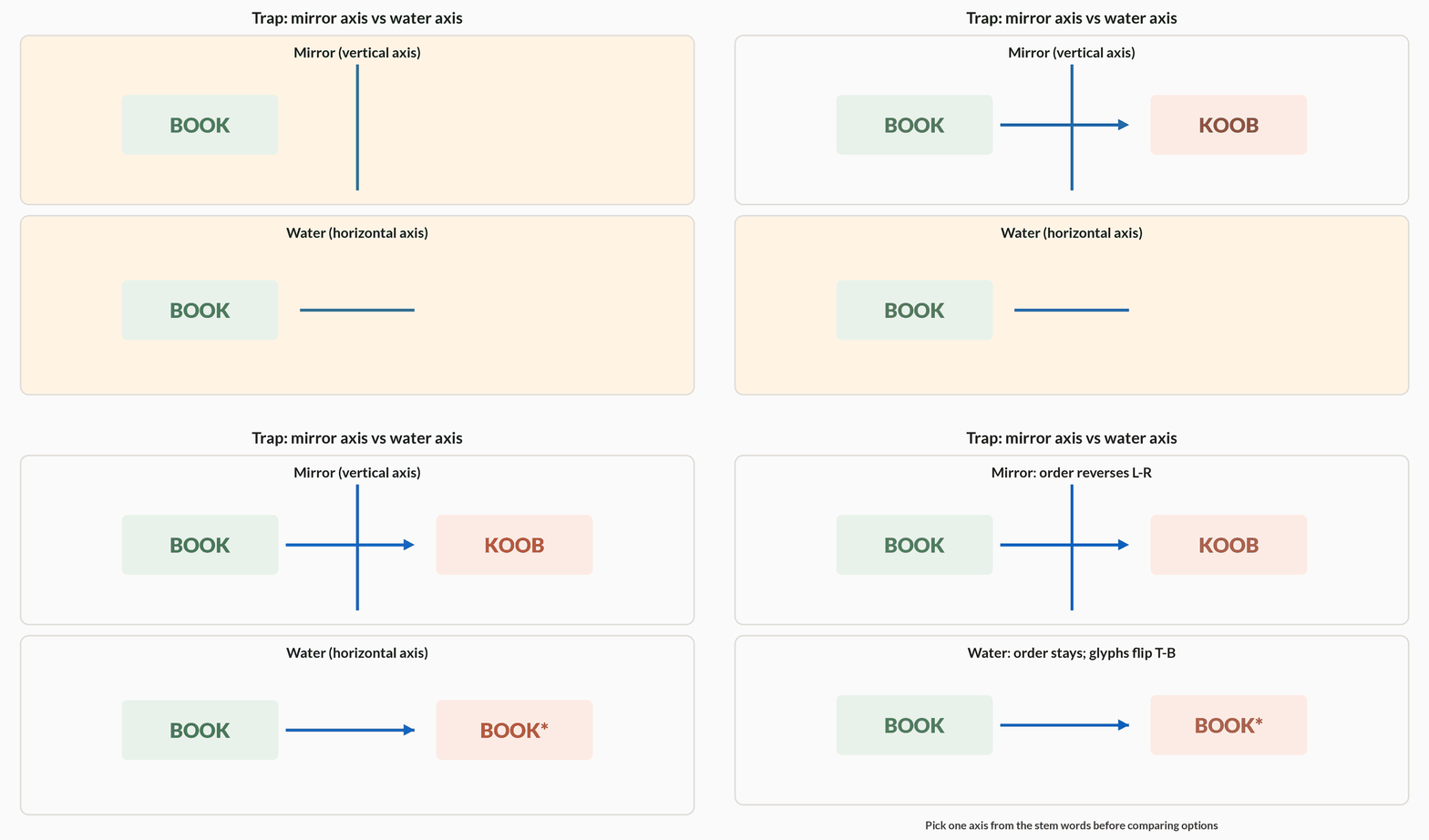
The durable mistake on this topic is swapping the axes: treating a water stem with a left–right reverse, or a mirror stem with a pure top–bottom flip. Mirror changes left/right; water changes up/down. When options look alike, ask which axis the stem named, then check where the first character landed — that single check kills most mixed-axis traps before glyph detail matters.
Work DEAL as the diagnostic. Stem: water image of DEAL. Water keeps order, so D must stay on the left and L on the right, with each letter flipped top-to-bottom. An option that shows L on the left and D on the right, each letter flipped top-to-bottom, used a mirror reverse and then dressed the glyphs in water-style vertical flips. That option is the mixed-axis trap in one picture. L can appear — water does flip letters that lack horizontal symmetry — it simply must not lead the string.
The working habit is three questions in a fixed order. First: underline the surface words. "Mirror / right / side / vertical" versus "water / below / horizontal" — pick one axis and refuse the other. Second: predict the first character's end. Mirror → right end. Water → left end. If the option fails this, stop; do not then argue about whether a B looks right. Third: only then compare flips, using the matching symmetry list for the surviving options — vertical anchors for a side mirror, horizontal anchors for water — and never borrow the other surface's anchors.
Axis check
- Underline the surface words"Mirror / right / side / vertical" versus "water / below / horizontal" — pick one axis and refuse the other. DEAL as a water stem has already chosen horizontal; a reverse of DEAL is then illegal.
- Predict the first character's endMirror → right end. Water → left end. If the option fails this, stop. L leading DEAL is a mirror reverse, even if every letter is flipped top-to-bottom.
- Only then compare flipsUse the matching symmetry list for the surviving options; never borrow the other surface's anchors. Vertical list for a side mirror, horizontal list for water — mixing those lists is the same trap as mixing the axes.
Stem: water image of DEAL. An option shows L on the left and D on the right, each letter flipped top-to-bottom. Why is it wrong?
- Water never flips letters — only mirrors do
- Water keeps order, so D must stay on the left; this option used a mirror reverse
- L cannot appear because L lacks horizontal symmetry
Water preserves left-to-right order, so DEAL must still begin with D on the left. L-…-D is the side-mirror reverse wearing water-style vertical flips — the mixed-axis trap. Water does flip non-horizontal letters, and L can appear (flipped); it simply must not lead the string.
Notes
- Mirror Image - Left-Right Flip: A vertical mirror (placed to the side) swaps left and right while keeping top and bottom fixed. Letters and words reverse their order and each letter is laterally inverted.
- Symmetric Letters: Letters with vertical symmetry (A, H, I, M, O, T, U, V, W, X, Y) look the same in a side mirror; use them as anchors to check an option quickly.
- Water Image - Top-Bottom Flip: A horizontal mirror (placed below) swaps top and bottom while keeping left and right fixed. It is the reflection you would see on still water.
- Word Reflection: In a mirror image the whole word reverses order (LEFT-first letter appears on the RIGHT); in a water image the word order stays but each letter flips vertically.
- Common trap: Confusing mirror (side) with water (below) flips - mirror changes left/right, water changes up/down; mixing them gives the wrong option.
Formulas
- Mirror (vertical axis): left <-> right; top and bottom unchanged; word order reverses.
- Water (horizontal axis): top <-> bottom; left and right unchanged; word order preserved.
- Vertically symmetric letters (A,H,I,M,O,T,U,V,W,X,Y) are unchanged by a side mirror.
- Horizontally symmetric letters (B,C,D,E,H,I,K,O,X) are unchanged by a water image.
- Digits 0, 1, 8 are symmetric to a side mirror; 0, 1, 3, 8 look similar in some water reflections.
Exam traps & shortcuts
- Check the symmetric letters in a word first; if they match, focus on the asymmetric ones to pick the option.
- For a word in a side mirror, read it right-to-left with each letter flipped.
- For water images, keep letter order but flip each letter vertically (imagine folding the page up).
- Use the position of the first letter (right end for mirror, top for water) to eliminate wrong options fast.
Reference tables
One row per surface. Use it to pick the axis before you touch an option.
| Surface | Axis | What swaps | Word / number order | Letter anchors |
|---|---|---|---|---|
| Mirror (side) | Vertical | Left ↔ right | Reverses | A H I M O T U V W X Y |
| Water (below) | Horizontal | Top ↔ bottom | Preserved | B C D E H I K O X |
Shape anchors only — order still follows the surface row in Mirror and water at a glance.
| Surface | Digits that stay (or look similar) | Reminder |
|---|---|---|
| Side mirror | 0, 1, 8 | Still reverse the string |
| Water image | 0, 1, 3, 8 | 3 is similar, not identical in every font; still keep order |
Recap
Read only this the night before.
- Mirror
- Vertical axis: left↔right, word order reverses, first letter ends on the right.
- Water
- Horizontal axis: top↔bottom, word order stays, first letter stays on the left.
- Mirror anchors
- A H I M O T U V W X Y keep shape in a side mirror — use them to cull options.
- Water anchors
- B C D E H I K O X keep shape in water — do not reuse the mirror list.
- Digits
- Side mirror: 0, 1, 8 and reverse order. Water: 0, 1, 3, 8 and keep order.
- Trap
- Mixing axes: a water stem with a reversed string, or a mirror stem with order kept.
- Attack
- Name the surface → place the first character → check anchors → only then compare flipped glyphs.
Practise Mirror & Water Images
Reading is free and needs no account. Practice, mocks and progress live in the app.
- 45 exam-style questions on this topic, with explanations
- A 6-question practice set that ends the chapter
- Timed mocks scored with the real marking scheme
- Readiness tracked per topic, kept on your device