SSC CGL · General Awareness
Current Affairs
National and international events of the last several months including schemes, sports and awards.
Eight concepts on how SSC and banking current-affairs papers actually work: static–current linkage, posts that recur in appointments, summit groupings, scheme notes (ministry + objective), index–agency pairs, civilian award order, mega-event cycles, and the UN P5 with a study-window habit. Prefer evergreen structure over a rotting 'current CJI' name — tables and pegs survive the news cycle.
- SSC CGL
- Medium level
- 8 concepts
- 873 practice questions
1News questions ride a static backbone
Current affairs questions in SSC and banking exams usually connect a recent event to a static fact — pairing a summit with its host country's capital and currency, or a scheme with its ministry. Revising only headlines without the static backbone is why answers feel familiar and still go wrong.
Build a one-line who–what–where–when note for every event. Exams reward the specific pairing (person + post + date), not a vague memory that 'something happened'.
Figure. News stems ride a static backbone — lock the lasting fact before the headline.
| News item type | Static fact to lock beside it |
|---|---|
| Summit / grouping meeting | Host capital, currency, member list |
| Appointment | Constitutional/institutional post and appointing route (as taught elsewhere) |
| Scheme launch or redesign | Nodal ministry and one-line objective |
| Index / report release | Releasing agency and what the index measures |
A paper names a recent G20 leaders' meeting and asks for the host country's capital. What is the durable exam skill this stem is testing?
- Memorising only the meeting's slogan without geography
- Linking the current event to a static fact (host capital) that sits beside the news
- Ignoring the host because G20 has no geography
Summit stems routinely pair the event with capital/currency/members. Slogan-only memory and 'no geography' both drop the static hook the notes describe.
2Posts that recur in appointment news
Appointment questions cluster on a short list of constitutional and institutional posts: the RBI Governor, the Chief Justice of India (CJI), the CAG, the Chief Election Commissioner, and the Chairpersons of SEBI and NITI Aayog.
Lock the post titles and what each institution does. Do not put a named 'current' office-holder in pegs — those names rot between printings. When a paper names a person, your job is still the post and the institution.
Figure. Appointment news recycles the same posts — lock the post, not a rotting incumbent name.
| Post | Institution / cue |
|---|---|
| RBI Governor | Reserve Bank of India — monetary authority |
| CJI | Chief Justice of India — Supreme Court |
| CAG | Comptroller and Auditor General |
| Chief Election Commissioner | Election Commission of India |
| Chairperson, SEBI | Securities market regulator |
| Chairperson, NITI Aayog | Policy think tank (PM is Chair; CEO/Vice Chair often in news) |
Headlines announce a new head of the monetary authority. Which post title matches that institution in the appointment list used here?
- Chief Election Commissioner
- RBI Governor
- CAG
The RBI is the monetary authority; its head in these lists is the RBI Governor. The CEC runs elections; the CAG audits — neighbouring posts, wrong institution.
3G20, BRICS, SCO, ASEAN, QUAD
Recurring summit groupings include G20 (twenty major economies), BRICS (Brazil, Russia, India, China, South Africa and newer members), SCO, ASEAN, and QUAD (India, USA, Japan, Australia).
Exams ask membership and the expansion cue for BRICS more than the communiqué text. Cluster defence exercises and summits by partner or host city when you revise — category beats isolated headlines.
Figure. Summit stems ask membership and host habit, not every communiqué line.
| Grouping | What to lock |
|---|---|
| G20 | Twenty major economies |
| BRICS | Brazil, Russia, India, China, South Africa (+ newer members) |
| SCO | Shanghai Cooperation Organisation (name cue) |
| ASEAN | Southeast Asian grouping (name cue) |
| QUAD | India, USA, Japan, Australia |
Which four countries form the QUAD as locked in these notes?
- India, USA, Japan, Australia
- Brazil, Russia, India, China
- USA, UK, France, Russia
QUAD is India, USA, Japan, Australia. Brazil–Russia–India–China is the BRICS core cue; USA–UK–France–Russia is part of the P5 set, not QUAD.
4Schemes: ministry and objective
Flagship initiatives such as PM Vishwakarma, PM Gati Shakti, Digital India, Make in India and Ayushman Bharat regularly appear. For each scheme, note the launching or nodal ministry and a one-line objective — that pair is what MCQs test when the scheme is 'in the news'.
Do not invent beneficiary counts or budget lines. Those are the stalest cells in current-affairs tables.
Figure. For any scheme in the news: ministry and objective first; year only if the stem asks.
| Scheme (examples in notes) | What to record when it appears |
|---|---|
| PM Vishwakarma | Ministry + one-line objective |
| PM Gati Shakti | Ministry + one-line objective |
| Digital India | Ministry + one-line objective |
| Make in India | Ministry + one-line objective |
| Ayushman Bharat | Ministry + one-line objective |
Ayushman Bharat appears in a 'schemes in the news' block. What two facts should your one-line note prioritise, according to this topic's method?
- Only the logo colour and the launch song
- Nodal / launching ministry and a one-line objective
- Only a guessed beneficiary count for the current year
Ministry plus objective is the durable pair. Logo trivia and unsourced beneficiary counts are exactly what these notes tell you not to invent.
5Reports and indices — agency first
Global indices such as the Human Development Index (UNDP), the Global Hunger Index, the World Happiness Report and Ease of Doing Business are common. Note the releasing agency and what the index claims to measure; India's relative standing is asked when a fresh edition is in the window — but the agency pairing is the evergreen half.
Ease of Doing Business has been reformed or paused in international practice at times; still treat the exam habit as agency + theme unless your static sheet updates. Prefer agency over a memorised rank that will be wrong next year.
Figure. Index stems are agency-first: who publishes, then what it ranks.
| Index / report | Agency or theme cue |
|---|---|
| Human Development Index | UNDP |
| Global Hunger Index | Hunger / undernutrition theme (releasing agency not fixed in this topic — lock it when a fresh edition is in your window, do not invent it here) |
| World Happiness Report | Happiness / well-being ranking theme |
| Ease of Doing Business | Business climate ranking theme (World Bank legacy cue in many keys) |
A stem names the Human Development Index and asks who releases it. The locked agency cue in these notes is
- UNDP
- RBI
- SEBI
HDI is the UNDP pairing. RBI and SEBI are Indian financial regulators, not the HDI publisher.
6Civilian awards in descending order
Civilian honours in descending order are Bharat Ratna, Padma Vibhushan, Padma Bhushan and Padma Shri. Bharat Ratna is the highest civilian award and, in the standard exam note, can be awarded to a maximum of three persons in a year.
Gallantry: the highest peacetime award is the Ashoka Chakra; the highest wartime award is the Param Vir Chakra. Padma rank is Vibhushan > Bhushan > Shri — 'Vibhushan' as the grandest of the three Padmas.
Figure. Same civilian ladder as static GK — news of Padmas still follows this order.
| Award | Place / note |
|---|---|
| Bharat Ratna | Highest civilian; max three in a year (exam note) |
| Padma Vibhushan | Highest of the three Padmas |
| Padma Bhushan | Middle Padma |
| Padma Shri | Fourth in the civilian descending list |
| Ashoka Chakra | Highest peacetime gallantry |
| Param Vir Chakra | Highest wartime gallantry |
Arrange in descending order of precedence: Padma Shri, Bharat Ratna, Padma Bhushan, Padma Vibhushan.
- Padma Shri > Padma Bhushan > Padma Vibhushan > Bharat Ratna
- Bharat Ratna > Padma Vibhushan > Padma Bhushan > Padma Shri
- Bharat Ratna > Padma Shri > Padma Bhushan > Padma Vibhushan
Descending civilian order is Bharat Ratna, then Padma Vibhushan, Padma Bhushan, Padma Shri. The other options invert Padma ranks or put Shri above Vibhushan.
7Four-year mega-event cycles
The Summer Olympics, FIFA World Cup and Cricket World Cup are each held once every four years in the standard exam framing; the Commonwealth Games and Asian Games also follow four-year cycles.
When a tournament is in the news, lock the sport, the host (static capital habit), and the four-year rhythm — not every squad list.
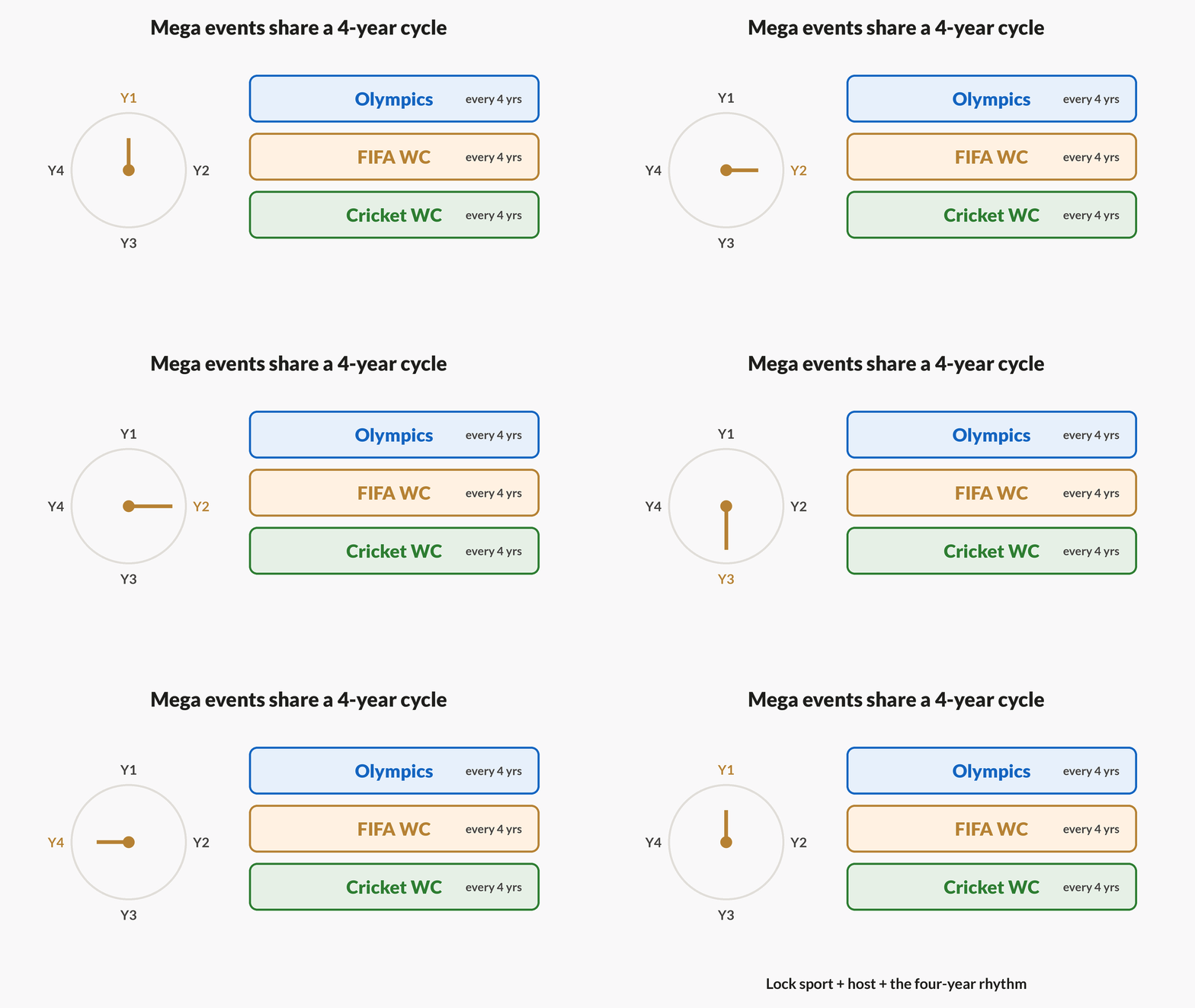
| Event | Cycle (exam framing) |
|---|---|
| Summer Olympics | Every four years |
| FIFA World Cup | Every four years |
| Cricket World Cup | Every four years |
| Commonwealth Games | Four-year cycle |
| Asian Games | Four-year cycle |
In the cycle framing used here, the Summer Olympics, FIFA World Cup and Cricket World Cup are alike in that each is
- Held every year in a fixed city
- Held once every four years
- Organised only by the UN Security Council
These notes lock a four-year rhythm for those three. They are not annual fixed-city events, and the UNSC does not organise them.
8UN P5, six organs, study window
The UN has six principal organs. Its five permanent Security Council members (P5) are the USA, UK, France, Russia and China, each with veto power. The ten non-permanent members are elected for two-year terms and cannot veto.
SSC and banking exams typically test current affairs from roughly the previous 6–8 months before the exam date, with heavier weight on the most recent 3 months. Categories to track: persons in news, places in news, schemes, defence exercises, MoUs, science and space (ISRO), books and authors.
Figure. UN Security Council P5 plus six principal organs; revise a rolling 6–8 month window (heaviest last 3).
| Item | What to lock |
|---|---|
| P5 | USA, UK, France, Russia, China — veto |
| Non-permanent UNSC | Ten members; two-year terms; no veto |
| UN principal organs | Six |
| Study window | About 6–8 months; heaviest last 3 months |
| Buckets | Persons, places, schemes, defence, MoUs, ISRO, books |
Which statement about the UN Security Council matches these notes?
- All fifteen members hold an identical veto
- The P5 — USA, UK, France, Russia, China — hold veto; ten non-permanent members serve two-year terms without veto
- Only India and Brazil hold permanent veto seats
Veto belongs to the P5. Non-permanent members are ten, on two-year terms, without veto. India and Brazil are not P5 in this framing.
Notes
- Static-current linkage: Current affairs questions in SSC/banking exams usually connect a recent event to a static fact, such as pairing a summit with its host country's capital and currency, so revise the static backbone alongside the news.
- National appointments: Frequently tested constitutional and institutional posts include the RBI Governor, the CJI (Chief Justice of India), the CAG, the Chief Election Commissioner and the Chairpersons of SEBI and NITI Aayog.
- Summits and their groupings: Recurring topics include G20 (20 major economies), BRICS (Brazil, Russia, India, China, South Africa and newer members), SCO, ASEAN and QUAD (India, USA, Japan, Australia).
- Government schemes in the news: Flagship initiatives such as PM Vishwakarma, PM Gati Shakti, Digital India, Make in India and Ayushman Bharat regularly appear, so note each scheme's launching ministry and objective.
- Reports and indices: Global indices like the Human Development Index (UNDP), Global Hunger Index, World Happiness Report and Ease of Doing Business are common; note the releasing agency and India's relative standing.
Formulas
- Study window: SSC and banking exams typically test current affairs from roughly the previous 6-8 months before the exam date, with heavier weight on the most recent 3 months.
- Awards backbone: Civilian honours in descending order are Bharat Ratna, Padma Vibhushan, Padma Bhushan and Padma Shri; the highest gallantry award in peacetime is the Ashoka Chakra and in wartime the Param Vir Chakra.
- Sports mega-events cycle: The Summer Olympics, FIFA World Cup and Cricket World Cup are each held once every four years; the Commonwealth Games and Asian Games also follow four-year cycles.
- UN and world bodies: The UN has six principal organs, and its five permanent Security Council members (P5) are the USA, UK, France, Russia and China, each with veto power.
- Categories to track: Persons in news, places in news, schemes, defence exercises, MoUs and agreements, science and space missions (ISRO), and books and authors form the standard current-affairs buckets.
Exam traps & shortcuts
- Build a one-line 'who-what-where-when' note for every event; exams reward the specific pairing (person + post + date) rather than a vague memory.
- Group defence exercises by partner country and summits by host city - clustering by category beats trying to recall isolated headlines.
- For awards, remember Bharat Ratna is the highest civilian award and can be awarded to a maximum of three persons in a year.
- Revise the P5 (veto powers) as 'US-UK-France-Russia-China' - they anchor most UN Security Council questions.
Reference tables
Revision scaffolding that does not depend on this week's headlines.
| Item | Lock |
|---|---|
| Study window | ~6–8 months; focus last ~3 months |
| Buckets | Persons, places, schemes, defence, MoUs, ISRO, books/authors |
| Static hook | Capital/currency; ministry; agency; post title |
| Appointment posts | RBI Governor, CJI, CAG, CEC, SEBI & NITI chairs |
Stable orderings that outlive a news cycle.
| Item | Lock |
|---|---|
| Civilian order | Bharat Ratna > Padma Vibhushan > Padma Bhushan > Padma Shri |
| Gallantry peaks | Ashoka Chakra (peace); Param Vir Chakra (war) |
| P5 | USA, UK, France, Russia, China |
| QUAD | India, USA, Japan, Australia |
Recap
Read only this the night before — structure, not last week's names.
- Method
- Every headline needs a static hook: capital/currency, ministry, agency, or post title.
- Posts
- RBI Governor, CJI, CAG, CEC, SEBI chair, NITI chair — lock posts, not rotting personal names in pegs.
- Groupings
- G20 = 20 economies; BRICS core + newer members; QUAD = India, USA, Japan, Australia.
- Schemes
- For Vishwakarma, Gati Shakti, Digital India, Make in India, Ayushman Bharat: ministry + one-line objective.
- HDI
- Human Development Index — UNDP. Prefer agency over a memorised rank.
- Awards
- Bharat Ratna > Padma Vibhushan > Padma Bhushan > Padma Shri; Ashoka Chakra (peace), PVC (war).
- Cycles
- Olympics, FIFA WC, Cricket WC — four-year framing; CWG and Asian Games too.
- P5 / window
- P5 veto: US-UK-France-Russia-China. Study ~6–8 months; heaviest last ~3.
Practise Current Affairs
Reading is free and needs no account. Practice, mocks and progress live in the app.
- 873 exam-style questions on this topic, with explanations
- A 6-question practice set that ends the chapter
- Timed mocks scored with the real marking scheme
- Readiness tracked per topic, kept on your device