AP Exams (Advanced Placement) · Mathematics (JEE & NDA)
Vector Algebra
Addition of vectors, scalar and vector products, scalar triple product and geometric applications of vectors.
Seven concepts from components through dot and cross products to triple products and section formula — each identity used on a short calculation you can recompute.
- AP Exams (Advanced Placement)
- Medium level
- 7 concepts
- 5 practice questions
1Vectors, addition and components
A vector has magnitude and direction; vectors add by the triangle or parallelogram law. A unit vector is \hat{a}=\dfrac{\vec{a}}{|\vec{a}|}, and any vector in space is \vec{a}=a_x\hat{i}+a_y\hat{j}+a_z\hat{k} with magnitude \sqrt{a_x^2+a_y^2+a_z^2}.
Figure. Parallelogram law in the plane: \vec{a} and \vec{b} from a common origin, diagonal \vec{a}+\vec{b}. Not to scale for any particular magnitude.
Reading a component form
- List the componentsWrite \vec{a}=(a_x,a_y,a_z) along \hat{i},\hat{j},\hat{k}.
- Magnitude|\vec{a}|=\sqrt{a_x^2+a_y^2+a_z^2}.
- Unit vectorDivide by the magnitude: \hat{a}=\vec{a}/|\vec{a}|.
The magnitude of \hat{i}+\hat{j}+\hat{k} is
- 1
- \sqrt{3}
- 3
\sqrt{1+1+1}=\sqrt{3}. Answering 1 confuses the vector with a unit vector; 3 sums components.
2Dot product and angle
The dot product is \vec{a}\cdot\vec{b}=|\vec{a}||\vec{b}|\cos\theta=a_xb_x+a_yb_y+a_zb_z. It is zero for perpendicular vectors. Perpendicularity is instant from a vanishing dot product — pick that test when the question hints at a right angle.
Figure. Dot product pairs magnitude with the cosine of the included angle; it vanishes exactly when the vectors are perpendicular.
Finding the angle
- Dot the componentsSum a_xb_x+a_yb_y+a_zb_z.
- Both magnitudesCompute |\vec{a}| and |\vec{b}|.
- Solve for \theta\cos\theta=(\vec{a}\cdot\vec{b})/(|\vec{a}||\vec{b}|).
Angle between two vectors
Find the angle between \vec{a}=\hat{i}+\hat{j}+\hat{k} and \vec{b}=\hat{i}-\hat{j}+\hat{k}.
- \vec{a}\cdot\vec{b}=1-1+11
- |\vec{a}|=|\vec{b}|=\sqrt{3}both magnitudes
- \cos\theta=\dfrac{1}{3}\theta=\cos^{-1}\tfrac{1}{3}
Pro tip. Compute the dot product and both magnitudes first; the cosine formula then gives the angle in one substitution.
(\hat{i}+\hat{j}+\hat{k})\cdot(\hat{i}-\hat{j}+\hat{k}) equals
- 1
- 0
- 3
1-1+1=1. Zero would mean perpendicular; 3 is |\vec{a}|^2 for the first vector alone.
3Projection of one vector on another
The scalar projection of \vec{a} on \vec{b} is \dfrac{\vec{a}\cdot\vec{b}}{|\vec{b}|}. It is the signed length of the shadow of \vec{a} along the direction of \vec{b} — positive when the angle is acute, negative when obtuse.
Figure. The projection of \vec{a} on \vec{b} is the signed segment along \vec{b} cut by the perpendicular from the tip of \vec{a}.
Projection from the angle example
For \vec{a}=\hat{i}+\hat{j}+\hat{k} and \vec{b}=\hat{i}-\hat{j}+\hat{k}, find the projection of \vec{a} on \vec{b}.
- \vec{a}\cdot\vec{b}1 (from the angle card)
- |\vec{b}|=\sqrt{3}denominator
- Projection =1/\sqrt{3}\dfrac{1}{\sqrt{3}}
Pro tip. Projection reuses the same dot product as the angle formula; only the denominator changes from |\vec{a}||\vec{b}| to |\vec{b}|.
Projection of \vec{a} on \vec{b} is
- \dfrac{\vec{a}\cdot\vec{b}}{|\vec{b}|}
- \dfrac{\vec{a}\cdot\vec{b}}{|\vec{a}|}
- |\vec{a}||\vec{b}|
Divide the dot product by the magnitude of the vector you project onto.
4Cross product and area
The cross product \vec{a}\times\vec{b}=|\vec{a}||\vec{b}|\sin\theta\,\hat{n} is a vector perpendicular to both, with magnitude equal to the area of the parallelogram they span. It is zero for parallel vectors and anti-commutative. Parallelism is instant from a zero cross product.
Figure. Right triangle in the coordinate plane with legs 1 and 2 (to scale along each axis separately). Area \tfrac12\cdot 1\cdot 2=1 matches \tfrac12|\vec{AB}\times\vec{AC}|.
Triangle area from two edges
- Form two edge vectorsFrom a common vertex, \overrightarrow{AB} and \overrightarrow{AC}.
- Cross themCompute \overrightarrow{AB}\times\overrightarrow{AC} (determinant form in components).
- Halve the magnitudeArea =\tfrac12|\overrightarrow{AB}\times\overrightarrow{AC}|.
Area of a triangle from vectors
Find the area of the triangle with vertices A(0,0,0), B(1,0,0), C(0,2,0) using vectors.
- \overrightarrow{AB}=\hat{i}, \overrightarrow{AC}=2\hat{j}edge vectors
- \hat{i}\times 2\hat{j}=2\hat{k}magnitude 2
- Area =\tfrac12\times 21 square unit
Pro tip. Half the magnitude of the cross product of two edge vectors gives the triangle's area directly, in any dimension.
Area of triangle A(0,0,0), B(1,0,0), C(0,2,0) is
- 1
- 2
- 1/2
\tfrac12|\hat{i}\times 2\hat{j}|=\tfrac12\cdot 2=1. Answering 2 forgets the half; 1/2 halves twice.
5Scalar triple product and coplanarity
The scalar triple product [\vec{a}\ \vec{b}\ \vec{c}]=\vec{a}\cdot(\vec{b}\times\vec{c}) equals the volume of the parallelepiped formed by the three vectors. It is zero when the vectors are coplanar — so coplanarity is the vanishing of that triple product.
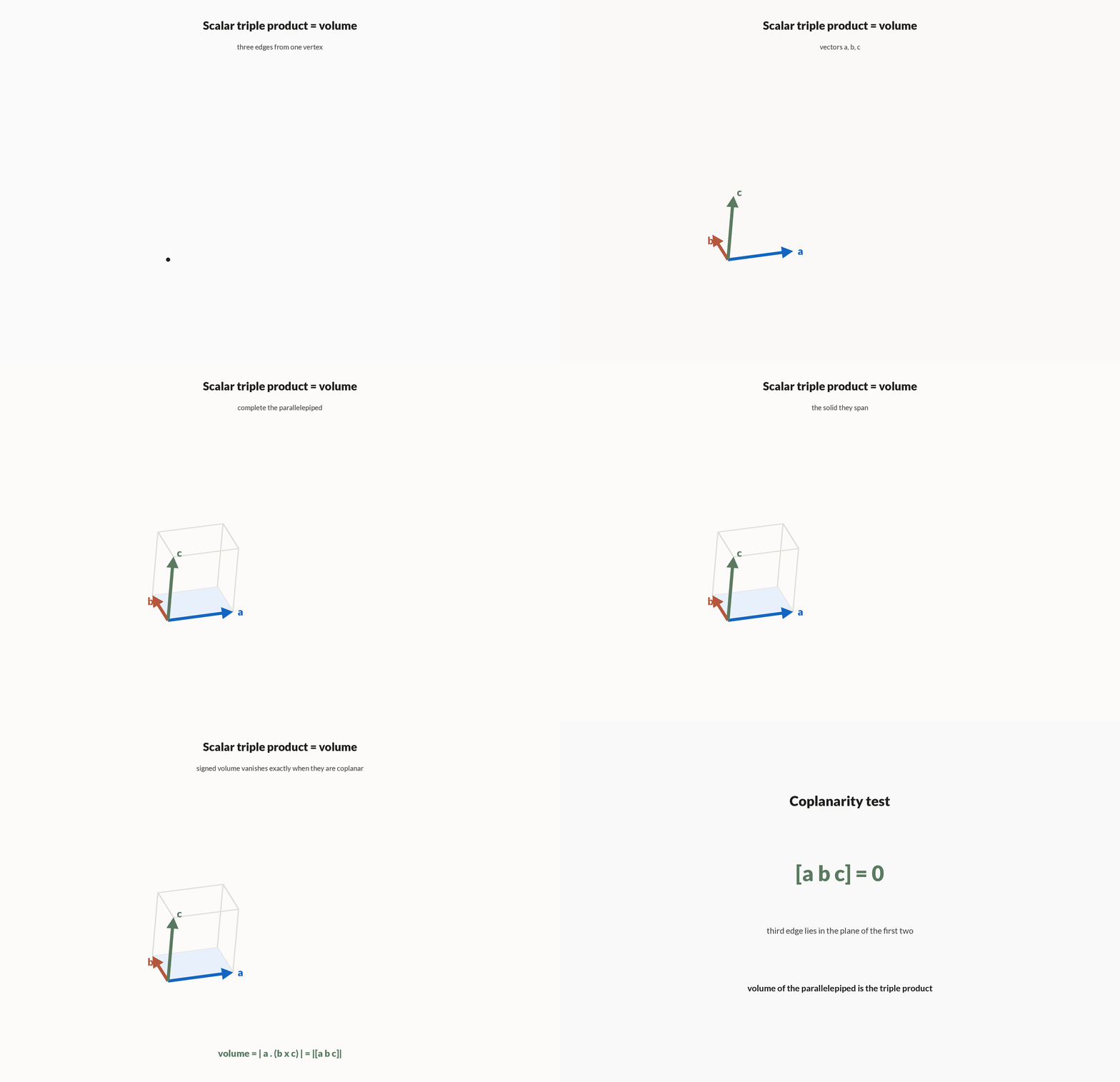
Testing coplanarity
- Form the determinantEvaluate \vec{a}\cdot(\vec{b}\times\vec{c}) as a 3\times 3 determinant of components.
- Read the signZero means coplanar; non-zero means a genuine parallelepiped of that volume.
- Ignore order up to signSwapping two vectors flips the sign but not the coplanarity verdict.
Three vectors are coplanar if and only if
- [\vec{a}\ \vec{b}\ \vec{c}]=0
- \vec{a}\cdot\vec{b}=0
- \vec{a}\times\vec{b}=\vec{0}
Vanishing scalar triple product is the coplanarity criterion. A zero dot or cross product is a two-vector relation, not a three-vector one.
6Vector triple product identity
The vector triple product satisfies \vec{a}\times(\vec{b}\times\vec{c})=(\vec{a}\cdot\vec{c})\vec{b}-(\vec{a}\cdot\vec{b})\vec{c}. The result lies in the plane of the inner two vectors — a useful expansion when a question nests a cross inside a cross.
Figure. The expansion \vec{a}\times(\vec{b}\times\vec{c})=(\vec{a}\cdot\vec{c})\vec{b}-(\vec{a}\cdot\vec{b})\vec{c} is a combination of \vec{b} and \vec{c}, so the result lies in their plane. Arrows are schematic, not a solid in space.
\vec{a}\times(\vec{b}\times\vec{c}) expands to
- (\vec{a}\cdot\vec{c})\vec{b}-(\vec{a}\cdot\vec{b})\vec{c}
- (\vec{a}\cdot\vec{b})\vec{c}-(\vec{a}\cdot\vec{c})\vec{b}
- \vec{a}\cdot(\vec{b}\times\vec{c})
BAC–CAB: (\vec{a}\cdot\vec{c})\vec{b}-(\vec{a}\cdot\vec{b})\vec{c}. The swapped version flips the sign; the scalar triple is a different object.
7Vector line and section formula
The vector equation of a line is \vec{r}=\vec{a}+\lambda\vec{b}. The position vector dividing the segment from \vec{a} to \vec{b} in the ratio m:n is \dfrac{n\vec{a}+m\vec{b}}{m+n} — the same weighted average as in coordinate geometry, written with vectors.
Figure. Segment from A to B with mid-point M (ratio 1:1). Schematic — not the numeric vectors of the ledger drawn to scale.
Section point in vector form
Find the position vector of the point dividing the join of \vec{a}=\hat{i} and \vec{b}=3\hat{i}+2\hat{j} in the ratio 1:1.
- Mid-point: m=n=1\dfrac{\vec{a}+\vec{b}}{2}
- \dfrac{\hat{i}+(3\hat{i}+2\hat{j})}{2}\dfrac{4\hat{i}+2\hat{j}}{2}
- Simplify2\hat{i}+\hat{j}
Pro tip. For 1:1 the section formula collapses to the mid-point; unequal ratios weight the farther endpoint more lightly.
The mid-point of \vec{a} and \vec{b} is
- \dfrac{\vec{a}+\vec{b}}{2}
- \vec{a}-\vec{b}
- m\vec{a}+n\vec{b}
Ratio 1:1 gives (\vec{a}+\vec{b})/2.
Notes
- Vectors and addition: A vector has magnitude and direction; vectors add by the triangle or parallelogram law. A unit vector is \hat{a}=\dfrac{\vec{a}}{|\vec{a}|}, and any vector in space is \vec{a}=a_x\hat{i}+a_y\hat{j}+a_z\hat{k} with magnitude \sqrt{a_x^2+a_y^2+a_z^2}.
- Dot product: \vec{a}\cdot\vec{b}=|\vec{a}||\vec{b}|\cos\theta=a_xb_x+a_yb_y+a_zb_z. It is zero for perpendicular vectors and gives the projection of \vec{a} on \vec{b} as \dfrac{\vec{a}\cdot\vec{b}}{|\vec{b}|}.
- Cross product: \vec{a}\times\vec{b}=|\vec{a}||\vec{b}|\sin\theta\,\hat{n} is a vector perpendicular to both, with magnitude equal to the area of the parallelogram they span. It is zero for parallel vectors and anti-commutative.
- Scalar triple product: [\vec{a}\ \vec{b}\ \vec{c}]=\vec{a}\cdot(\vec{b}\times\vec{c}) equals the volume of the parallelepiped formed by the three vectors; it is zero when the vectors are coplanar.
- Geometric applications: The vector equation of a line is \vec{r}=\vec{a}+\lambda\vec{b}; the position vector dividing \vec{a},\vec{b} in ratio m:n is \dfrac{n\vec{a}+m\vec{b}}{m+n}. The vector triple product satisfies \vec{a}\times(\vec{b}\times\vec{c})=(\vec{a}\cdot\vec{c})\vec{b}-(\vec{a}\cdot\vec{b})\vec{c}.
Formulas
- Dot product: \vec{a}\cdot\vec{b}=|\vec{a}||\vec{b}|\cos\theta
- Cross product: |\vec{a}\times\vec{b}|=|\vec{a}||\vec{b}|\sin\theta
- Projection of \vec{a} on \vec{b}: \dfrac{\vec{a}\cdot\vec{b}}{|\vec{b}|}
- Scalar triple product: [\vec{a}\ \vec{b}\ \vec{c}]=\vec{a}\cdot(\vec{b}\times\vec{c})
- Vector triple product: \vec{a}\times(\vec{b}\times\vec{c})=(\vec{a}\cdot\vec{c})\vec{b}-(\vec{a}\cdot\vec{b})\vec{c}
- Area of triangle: \tfrac12|\vec{a}\times\vec{b}|
Exam traps & shortcuts
- Test coplanarity of three vectors by checking [\vec{a}\ \vec{b}\ \vec{c}]=0; a non-zero scalar triple product means they form a genuine parallelepiped.
- Perpendicularity is instant from the dot product (=0) and parallelism from the cross product (=\vec{0}) - pick whichever the question hints at.
- For the area of a triangle with vertices A,B,C, use \tfrac12|\overrightarrow{AB}\times\overrightarrow{AC}| rather than base-height.
Reference tables
Pick the product the question's geometry names.
| Object | Formula |
|---|---|
| Dot product | \vec{a}\cdot\vec{b}=|\vec{a}||\vec{b}|\cos\theta |
| Projection | (\vec{a}\cdot\vec{b})/|\vec{b}| |
| Cross magnitude | |\vec{a}\times\vec{b}|=|\vec{a}||\vec{b}|\sin\theta |
| Triangle area | \tfrac12|\overrightarrow{AB}\times\overrightarrow{AC}| |
| Scalar triple | [\vec{a}\ \vec{b}\ \vec{c}]=\vec{a}\cdot(\vec{b}\times\vec{c}) |
| Vector triple | \vec{a}\times(\vec{b}\times\vec{c})=(\vec{a}\cdot\vec{c})\vec{b}-(\vec{a}\cdot\vec{b})\vec{c} |
| Section m:n | (n\vec{a}+m\vec{b})/(m+n) |
Recap
Read only this the night before.
- Components
- |\vec{a}|=\sqrt{a_x^2+a_y^2+a_z^2}; unit vector divides by that magnitude.
- Dot
- \cos\theta from normalised dot; perpendicular \Leftrightarrow dot zero.
- Projection
- (\vec{a}\cdot\vec{b})/|\vec{b}|, signed.
- Cross
- Area of parallelogram; triangle takes half. Parallel \Leftrightarrow cross zero.
- Triple
- Scalar triple = volume; zero \Leftrightarrow coplanar. Vector triple = BAC–CAB.
- Section
- (n\vec{a}+m\vec{b})/(m+n) for ratio m:n.
Practise Vector Algebra
Reading is free and needs no account. Practice, mocks and progress live in the app.
- 5 exam-style questions on this topic, with explanations
- A 6-question practice set that ends the chapter
- Timed mocks scored with the real marking scheme
- Readiness tracked per topic, kept on your device