CAT (Common Admission Test) · Data Interpretation & Logical Puzzles
Games, Tournaments and Networks
Scoring tables, round-robin and knockout tournaments and route networks.
Seven concepts. Fix the tournament format before you touch points; fix the graph before you sum a route. Most DILR schedule sets collapse when the match count is wrong.
- CAT (Common Admission Test)
- Hard level
- 7 concepts
- 17 practice questions
1Round-robin match count
In a single round-robin with n teams, every unordered pair meets exactly once, so the number of matches is \dfrac{n(n-1)}{2}. Equivalently, each team plays n-1 opponents and dividing the team–match incidences by 2 removes the double count. Divide by 2 because each pair of teams meets only once, not twice — skipping that half doubles the schedule and breaks every points check that follows.
Imagine n dots with one undirected edge for every pair — that edge set is the match list. The teaching move is to count those edges as n(n-1)/2, not to redraw the clique.
How it works
- Name the pairsA single round-robin is one match per unordered pair of distinct teams.
- Count incidencesEach of the n teams plays n-1 others, giving n(n-1) team–match slots.
- Halve onceEach match fills two slots, so matches = n(n-1)/2.
Round-robin match count
In a football league, 8 teams each play every other team exactly once. How many matches are played in total?
- Teams n8
- n(n-1) = 8 \times 756
- Matches = n(n-1)/228
Pro tip. Divide by 2 in round-robin counting because each pair of teams meets only once, not twice.
Six teams play a single round-robin. Total matches are
- 6
- 15
- 30
6 \times 5 / 2 = 15. Choosing 6 mistakes knockout counting; choosing 30 forgets to divide by 2.
2Knockout needs n-1 matches
A single-elimination tournament with n players needs exactly n-1 matches to produce one champion. Each match eliminates exactly one player, and crowning a winner means eliminating everyone else. In any single-elimination event, matches equal players minus one, regardless of the bracket shape — byes and bye rounds change when matches happen, not how many eliminations are required.
Picture a bracket that funnels n names down to one champion: every match drops one name from the board. Counting those drops gives n-1 matches before any round labels are drawn.
How it works
- Count survivors wantedOne champion must remain; n-1 players must leave.
- One exit per matchEach match removes exactly one player from contention.
- Match totalTherefore matches = n-1, independent of how the bracket is drawn.
Knockout tournament
A single-elimination tennis tournament has 16 players. How many matches are needed to decide the champion?
- Players who must be eliminated16 - 1 = 15
- Eliminations per match1
- Matches required15
Pro tip. In any single-elimination event, matches = players − 1, regardless of the bracket shape.
A knockout with 9 players includes byes so the first round is uneven. Matches to decide a champion:
- 8
- 9
- Depends on how byes are placed
Eight players must be eliminated; each match eliminates one. Byes change the schedule layout, not the elimination count.
3Round-robin is not knockout
The standing trap is to feed a knockout stem the round-robin formula, or the reverse. All-play-all uses \dfrac{n(n-1)}{2}; single elimination uses n-1. Confusing round-robin match count with knockout count breaks the whole schedule — every later points or wins claim is then checked against the wrong total.
No spatial figure: write "every pair meets" or "a loss eliminates" beside the stem, then take the matching row of the Format → match count table.
Order of attack
- Read the formatDoes every pair meet, or does a loss remove a player?
- Pick the identityAll-play-all → n(n-1)/2. Single elimination → n-1.
- Lock totals firstFix match count before assigning points, wins, or remaining fixtures.
| Format | Matches | What each match does |
|---|---|---|
| Single round-robin | n(n-1)/2 | Schedules one meeting of a pair |
| Single elimination | n-1 | Eliminates one player |
| Each team's RR fixtures | n-1 | Opponents one team faces (not the league total) |
"12 teams, each plays every other once" asks for match total. The right first move is
- Compute 12 - 1 = 11
- Compute 12 \times 11 / 2 = 66
- Compute 12 \times 11 = 132 and stop
All-play-all is round-robin: n(n-1)/2. The knockout identity n-1 and the undivided n(n-1) are the two classic wrong totals.
4Total points must match the schedule
Once the match count is fixed, translate the scoring rule into a global check. In a pure win/loss system where every match distributes a fixed number of points p (for example win = 2, loss = 0), total points across the table equal that fixed amount times the number of matches. That identity is a consistency filter: if the standings sum to something else, a result or a fixture count is wrong.
Figure. Four teams, single round-robin: 4×3/2 = 6 matches. Each match puts 2 points into the table, so the required total is 2×6 = 12. Listed points A 6, B 4, C 2, D 0 sum to 12 — consistent with the schedule.
How it works
- Fix matchesFrom the format, compute how many matches the league actually plays.
- Points per matchUnder a fixed win/loss rule, each match puts the same p points into the table.
- Cross-check the sumSum every team's points and compare with p \times matches before solving finer questions.
Points-sum check
Four teams play a single round-robin. Each match gives 2 points to the winner and 0 to the loser (no draws). The points table reads A 6, B 4, C 2, D 0. Is the table consistent with the schedule?
- Round-robin matches for n=44 \times 3 / 2 = 6
- Points distributed per match2
- Required table total 2 \times 612
- Sum of listed points 6+4+2+012 — consistent
Pro tip. Run the total-points check before chasing who beat whom; an inconsistent sum means the fixture count or a cell is already wrong.
Five teams, single round-robin, win = 2 / loss = 0, no draws. A consistent points table must sum to
- 10
- 20
- 40
Matches = 5 \times 4 / 2 = 10; each contributes 2 points, so the table sums to 20.
5Results into standings equations
Assign variables for wins, draws and losses (or for games still to play) and turn each standing line into an equation. With a 3–1–0 rule, a decisive match puts 3 points into the table and a draw puts 2, so the global sum is not a single constant times matches unless you already know how many draws occurred. Convert the points table into equations and use the total-points check for consistency after the draw count is known.
Figure. A beat B, B drew with C, A beat C. Scoring is win = 3, draw = 1, loss = 0. A has two wins (6). B has one loss and one draw (1). C has one draw and one loss (1). Decisive matches put 3+3 into the table and the draw puts 2, total 8, matching 6+1+1.
Order of attack
- Score ruleWrite win / draw / loss points explicitly before inventing symbols.
- One team, one equationFor each team, points = 3W + D (under 3–1–0) with W + D + L = matches played.
- Close the booksSum points and compare with 3 \times (decisive matches) + 2 \times (draws).
Three-team 3–1–0 league
Teams A, B and C each play each other once. Scoring is win = 3, draw = 1, loss = 0. Results: A beat B, B drew with C, A beat C. Find the points of A, B and C, and verify the table total.
- Matches played3 \times 2 / 2 = 3
- A: two wins3+3 = 6 points
- B: one loss, one draw0+1 = 1 point
- C: one draw, one loss1+0 = 1 point
- Table sum vs 3+3+2 from results6+1+1 = 8, matches distribute 8
Pro tip. Under 3–1–0, never multiply a blank "3 per match" by the fixture count until you know there were no draws.
In a 3–1–0 league, two matches are draws and one is decisive. Points distributed in total:
- 7
- 8
- 9
Each draw contributes 2 and the decisive match contributes 3, so 2+2+3 = 7. Blindly using 3 \times 3 = 9 ignores draws.
6Shortest route on a weighted network
Model cities as nodes and routes as edges with travel costs as edge weights. A path's length is the sum of its edge weights; the shortest route between two nodes is the path whose sum is smallest. List candidate paths and sum weights — the smallest total is the shortest route — rather than trusting the path with the fewest hops when weights differ.
Figure. Schematic network for the worked example. Edge labels are costs. The cheapest A→D route is A–C–B–D with total 6, not the two-hop routes that each cost 7.
How it works
- Draw the graphOne node per place; one edge per allowed road with its weight labelled.
- Enumerate simple pathsOn a small DILR network, list the distinct routes from start to end that do not revisit a node.
- Compare sumsAdd weights along each path; the minimum sum is the shortest route.
Four-city shortest route
Roads: A–B costs 4, A–C costs 2, B–C costs 1, B–D costs 3, C–D costs 5. What is the least cost from A to D?
- Path A–B–D4+3 = 7
- Path A–C–D2+5 = 7
- Path A–C–B–D2+1+3 = 6
- Minimum of \{7,7,6\}6 via A–C–B–D
Pro tip. Fewer hops need not win: A–C–B–D uses three edges but undercuts both two-edge routes.
On the same network (A–B 4, A–C 2, B–C 1, B–D 3, C–D 5), the shortest A→D cost is
- 6
- 7
- 5
A–C–B–D sums to 6; both A–B–D and A–C–D sum to 7. There is no edge A–D of cost 5.
7Count paths by systematic branching
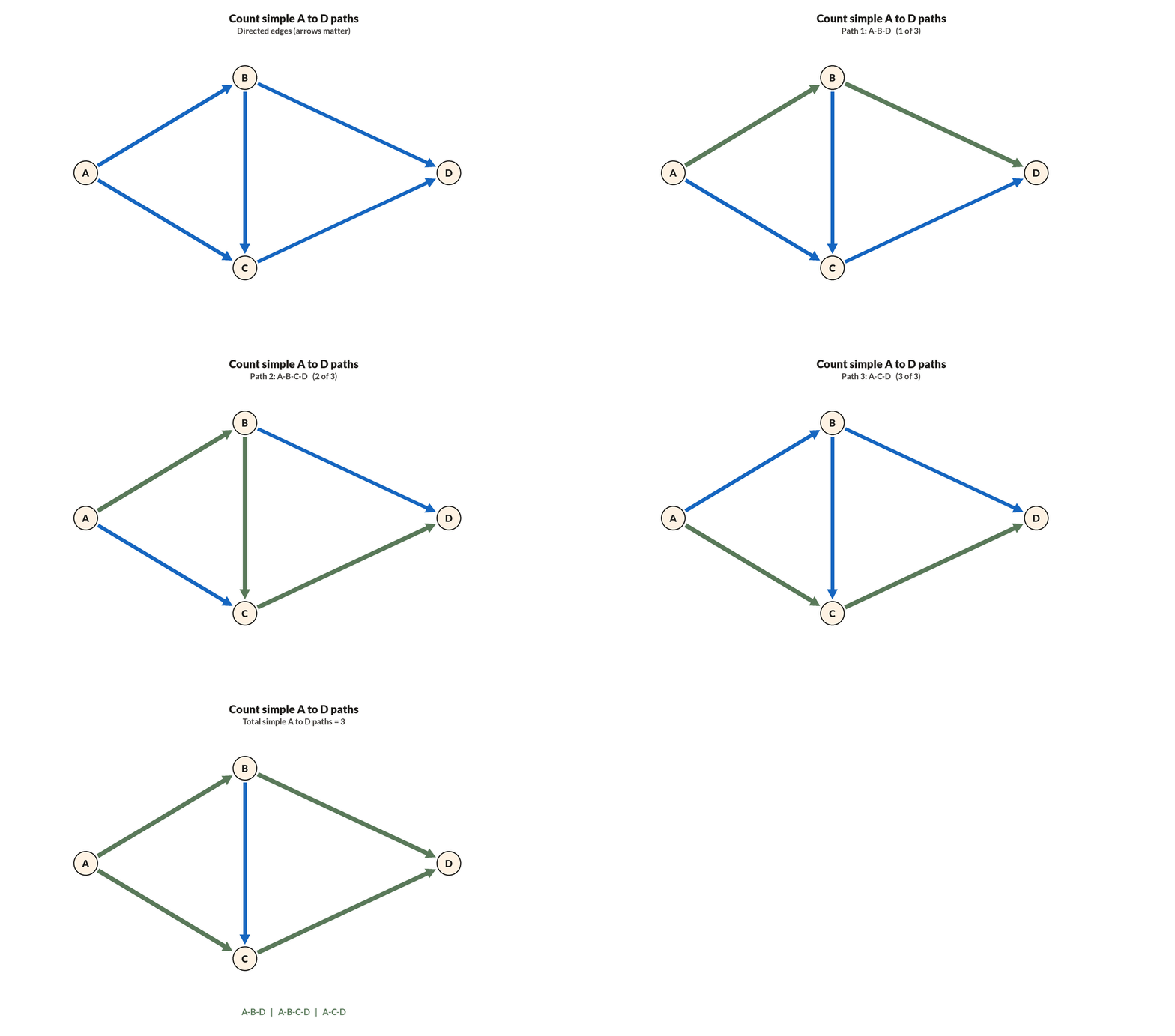
When the question asks how many routes exist rather than which is cheapest, treat the network as a branching tree of choices from the start node. At each node, list the unused legal next edges, and reject a branch that revisits a node if the stem forbids it. Count paths using systematic branching — depth-first or level-by-level — so every simple path is listed once and none are double-counted.
Order of attack
- Fix start and endName the origin and destination; decide whether revisits are allowed (usually not).
- Branch outwardFrom the current node, open one branch per unused outgoing edge.
- Tally completionsA branch that reaches the destination adds one path; a dead end or revisit dies.
Three simple paths
Directed roads: A→B, A→C, B→C, B→D, C→D. How many simple paths run from A to D?
- From A, first hopB or C
- Branch A→B→D1 path
- Branch A→B→C→D1 path
- Branch A→C→D1 path
- Total simple A→D paths3
Pro tip. Write the branches as a tree on scratch paper; the leaf count that ends at D is the answer.
Same digraph (A→B, A→C, B→C, B→D, C→D). Number of simple A→D paths:
- 2
- 3
- 4
The three paths are A–B–D, A–B–C–D and A–C–D. There is no fourth without repeating a node.
Notes
- Round-Robin Counting: In a round-robin with n teams, each plays every other once, giving n(n-1)/2 total matches. Use this to fix total games and total points distributed.
- Knockout Structure: A single-elimination tournament with n players needs n-1 matches to produce one winner, since each match eliminates exactly one player.
- Points Table Logic: Assign points per win/draw/loss and translate standings into equations; total points must equal (points per match) × (number of matches) for consistency.
- Network/Route Problems: Model cities as nodes and routes as edges; find shortest paths by summing edge weights and comparing, or count paths using systematic branching.
- Common trap: Confusing round-robin match count with knockout count - n(n-1)/2 for all-play-all versus n-1 for knockout; using the wrong one breaks the whole schedule.
Formulas
- Round-robin matches = \dfrac{n(n-1)}{2} for n teams.
- Knockout matches to decide a winner = n - 1.
- Total points = (\text{points per match})\times(\text{number of matches}) for win/loss systems.
- Each team in a single round-robin plays n-1 matches.
- Shortest route = minimum sum of edge weights along a path between two nodes.
Exam traps & shortcuts
- Fix the total number of matches first using n(n-1)/2 or n-1 depending on format.
- Convert the points table into equations and use the total-points check for consistency.
- For networks, list candidate paths and sum weights; the smallest total is the shortest route.
- Track eliminations in knockouts - each match removes one player, so counting is direct.
Reference tables
Choose the row from the stem's format before assigning points or remaining games.
| Quantity | Formula | Use when |
|---|---|---|
| Round-robin matches | n(n-1)/2 | Every pair meets once |
| Knockout matches to a champion | n-1 | Single elimination |
| Matches one RR team plays | n-1 | One team's fixture list |
| Fixed-p win/loss table total | p \times (matches) | Every match distributes the same p |
Global checks before local who-beat-whom reconstruction.
| Scoring | Points one match puts in the table | League check |
|---|---|---|
| Win = p, loss = 0, no draws | p | Sum of points = p \times matches |
| Win = 3, draw = 1, loss = 0 | 3 if decisive, 2 if draw | Sum = 3D_{ecisive} + 2D_{raw} |
| Network path cost | Sum of edge weights on the path | Shortest = minimum such sum |
Recap
Night-before pegs for games, tournaments and route networks.
- Format first
- All-play-all → n(n-1)/2. Knockout → n-1. Mixing them falsifies every later check.
- Halve pairs
- Round-robin incidences are n(n-1); matches are half of that because each game has two teams.
- Eliminations
- Knockout matches equal players to remove. Byes rearrange rounds; they do not change n-1.
- Points sum
- Under fixed p per match, table total = p \times matches. Under 3–1–0, count draws before using a flat 3.
- Shortest route
- Sum weights on each simple path; the minimum wins. Fewest hops is not automatically cheapest.
- Path count
- Branch from the start, kill revisits, tally branches that reach the end.
Practise Games, Tournaments and Networks
Reading is free and needs no account. Practice, mocks and progress live in the app.
- 17 exam-style questions on this topic, with explanations
- A 6-question practice set that ends the chapter
- Timed mocks scored with the real marking scheme
- Readiness tracked per topic, kept on your device