CAT (Common Admission Test) · Data Interpretation & Logical Puzzles
Puzzles and Grid-Based Reasoning
Matrix puzzles matching entities across multiple attributes using clues.
Six concepts. Matching puzzles are solved on a tick–cross grid: enter every negative clue as a cross, then let each confirmed tick wipe its row and column until the assignment is forced.
- CAT (Common Admission Test)
- Hard level
- 6 concepts
- 17 practice questions
1Build the matching grid
When each person maps one-to-one onto another attribute (city, colour, fruit), the working surface is a grid with one set of entities on the rows and the other on the columns. Every open cell is still possible; a tick confirms a pair; a cross rules a pair out. For n entities matched one-to-one across an attribute there are exactly n confirmed ticks when the puzzle closes.
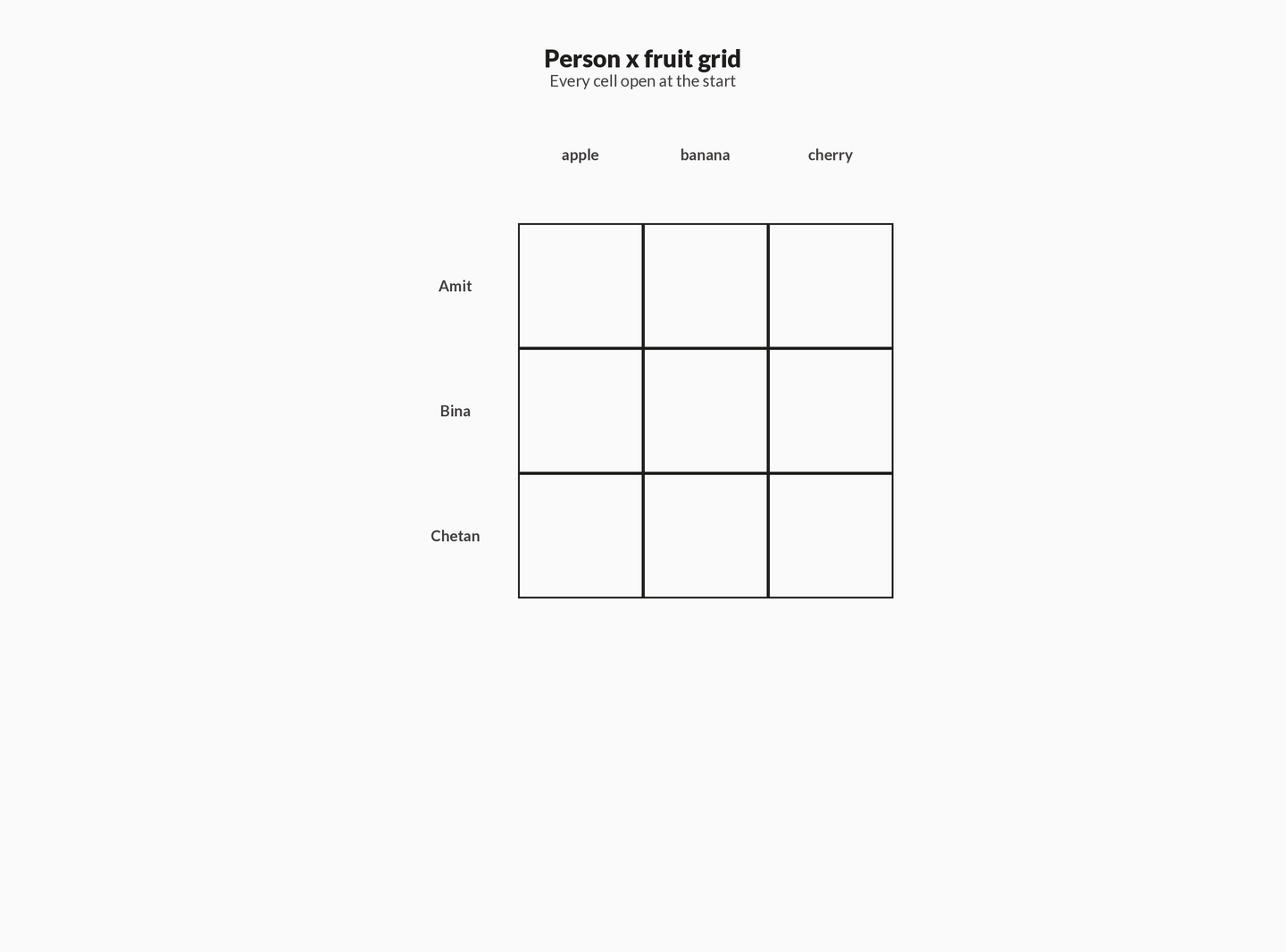
Lay out the surface
- Pick the axesPut the denser clue set on one axis (often people as rows) and the matched attribute as columns.
- Leave cells openDo not invent ticks. An open cell means possible; only a clue or a forced singleton turns it into a tick or a cross.
- Count the ticksWhen the set is one-to-one of size n, the finished grid carries exactly n ticks — one per row and one per column.
| Mark | Means | Immediate effect |
|---|---|---|
| Open | Still possible | Leave it |
| Cross | Ruled out | That pair is dead |
| Tick | Confirmed match | Cross the rest of its row and column |
Four people each own a different pet. In a finished person–pet matching grid, how many ticks must appear?
- Exactly four — one per person and one per pet
- At most four — some rows may stay open
- Sixteen — one tick in every cell of a 4×4 grid
One-to-one of size n forces exactly n ticks. Leaving a row open would leave someone unmatched; filling every cell would assign every person every pet.
2Enter negative clues first
A clue of the form "X is not from City Y" places one cross and nothing else. Those crosses prune the grid before any positive match is written. Entering every negative first is what keeps a later tick from landing in a cell the stem already forbade — and it is usually what opens a singleton row sooner.
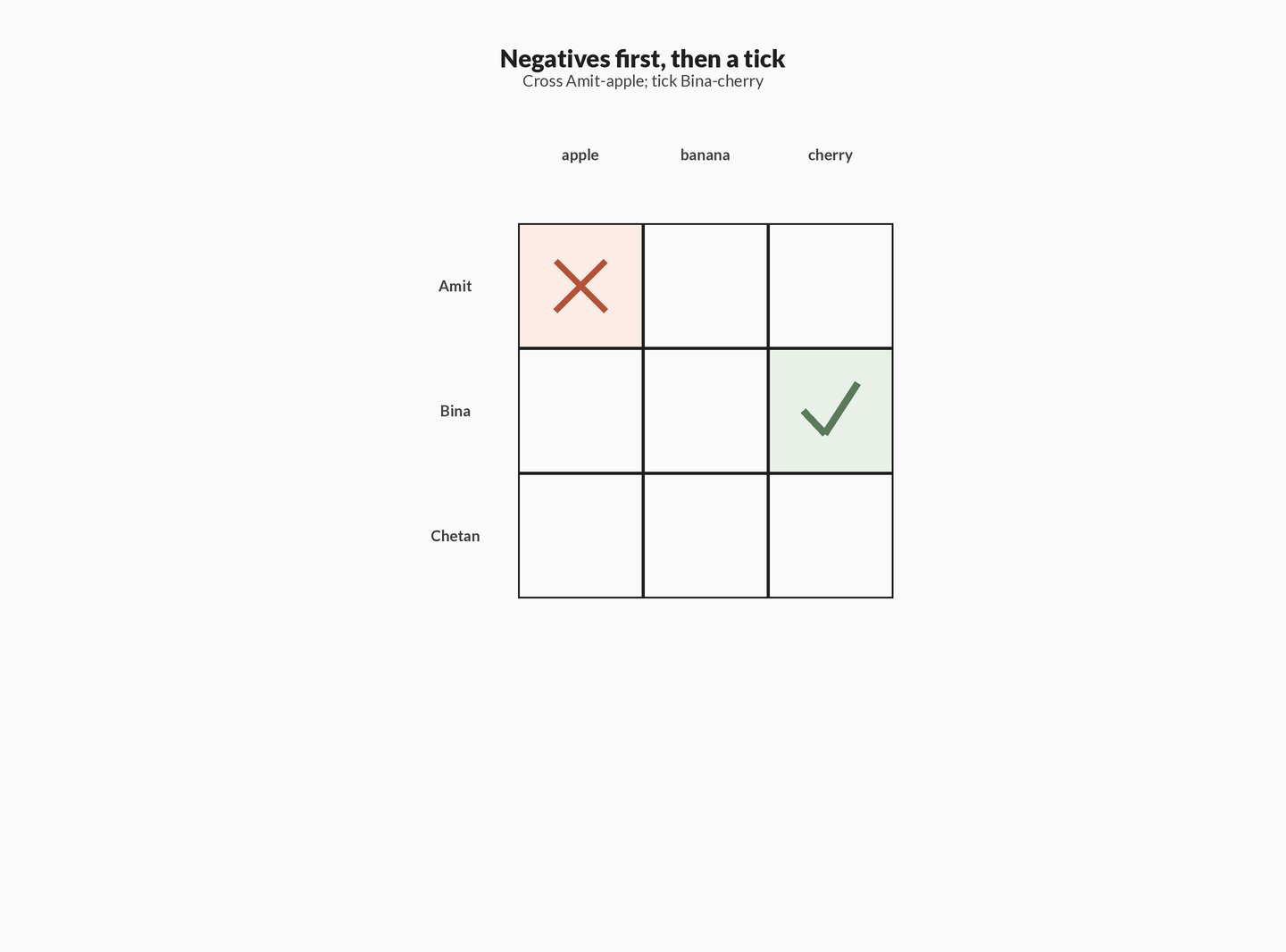
Order of attack
- Harvest the notsScan the stem for every "not", "never", and "neither" and place those crosses before any tick.
- Then take absolutesPositive one-to-one facts ("Bina likes cherry") become ticks after the negative layer is in.
- Watch for singletonsA row that negatives have reduced to one open cell is already a forced tick — no new clue required.
Fruit grid — negatives and first tick
Three friends — Amit, Bina, Chetan — each like a different fruit: apple, banana, cherry. Amit does not like apple. Bina likes cherry. Mark what those two clues force before chasing who likes apple.
- Amit does not like applecross Amit–apple
- Bina likes cherrytick Bina–cherry
- Cherry column after Bina's tickcross Amit–cherry; cross Chetan–cherry
- Amit's open fruits after those marksonly banana left open
Pro tip. Draw the full matrix and enter every negative clue as a cross before positive deductions — the legacy stem's "Amit does not like apple" is useless if you skip straight to Bina's tick and never write the cross.
In a person–city grid, the stem says "Ravi is not from Pune" and later "Meera is from Pune". What should already be on the grid before Meera's tick is written?
- A cross in the Ravi–Pune cell
- A tick in the Ravi–Pune cell
- Nothing — negatives are applied only at the end
"Not from Pune" is a cross on Ravi–Pune. Writing Meera's tick without that cross risks treating Ravi–Pune as still open and inventing a second Pune resident.
3Tick then wipe the row and column
One tick in a row or column forces crosses in every other cell of that row and that column. The common trap is marking only the positive match and ignoring those automatic eliminations — each confirmed match rules out an entire row and column, and that wipe is what forces the next assignment.
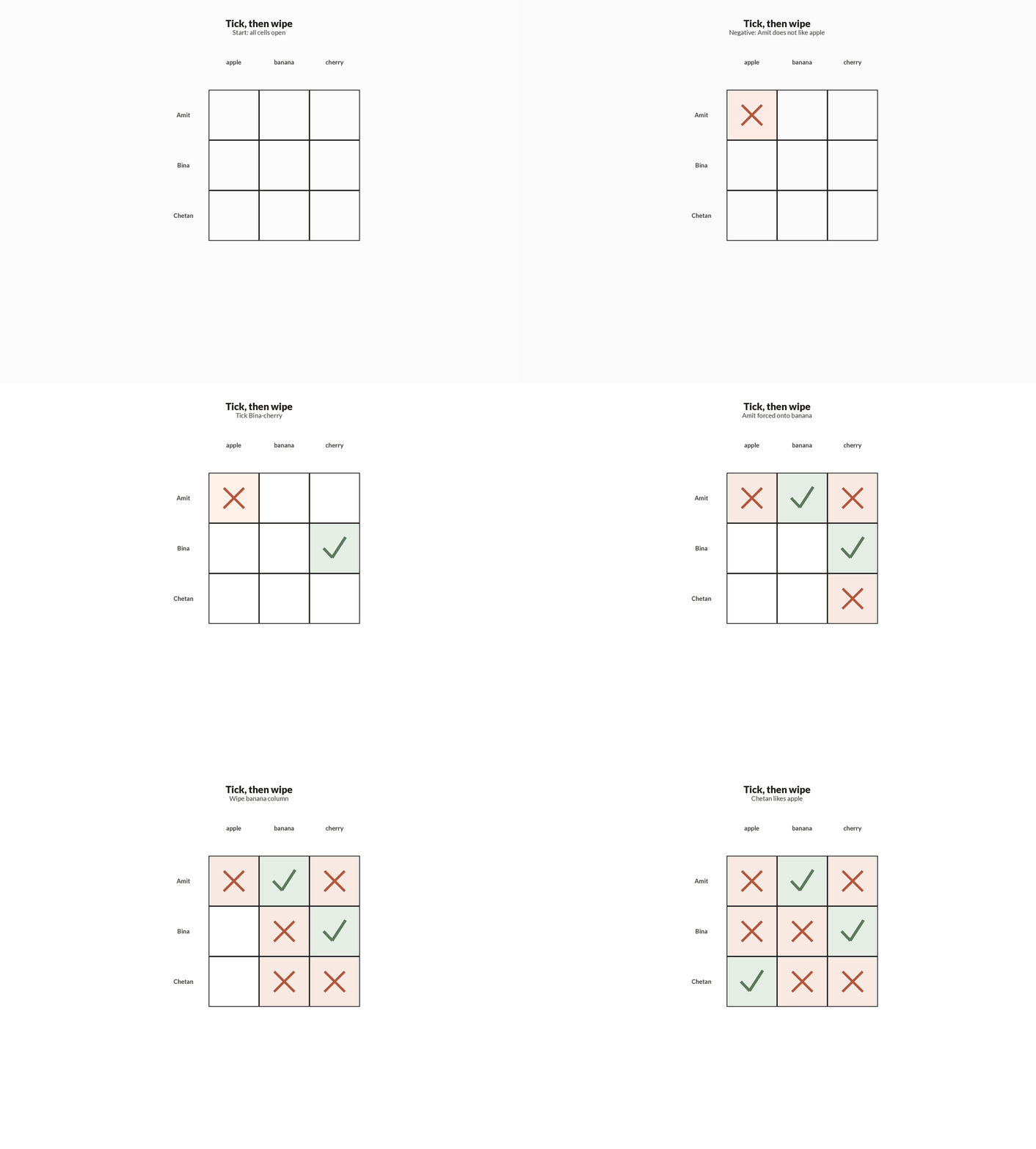
Confirm and propagate
- Write the tickPlace the confirmed person–attribute pair.
- Wipe row and columnImmediately cross every other cell in that person's row and that attribute's column.
- Read the new forcesAny row or column left with a single open cell becomes the next tick — chain without waiting for a fresh clue.
Matching grid puzzle
Three friends — Amit, Bina, Chetan — each like a different fruit: apple, banana, cherry. Amit does not like apple. Bina likes cherry. Who likes apple?
- Bina likes cherry (confirmed)tick Bina–cherry; cross cherry for Amit and Chetan
- Amit does not like apple; cherry already takenAmit → banana (only open fruit left)
- Amit–banana tick wipes banana columncross Bina–banana (already settled); cross Chetan–banana
- Remaining fruit for Chetanapple — Chetan likes apple
Pro tip. Enter each confirmed match, then eliminate its row and column to force the remaining assignments. Stopping after "Bina likes cherry" leaves Chetan's apple invisible.
In a finished step of a 3×3 person–fruit grid, Bina–cherry is ticked. Which cells must already be crosses if the wipe was applied?
- Amit–cherry and Chetan–cherry
- Only Amit–apple
- Every cell in Bina's row including Bina–cherry
A tick wipes the rest of its row and column. The cherry column loses Amit and Chetan; wiping Bina–cherry itself would erase the confirmation.
4Last open cell is a tick
If a row has every cell crossed but one, that last open cell is a confirmed tick — no new stem sentence required. The same rule runs on columns. This is the endgame of every one-to-one grid: negatives and wipes shrink a line until only one possibility remains.
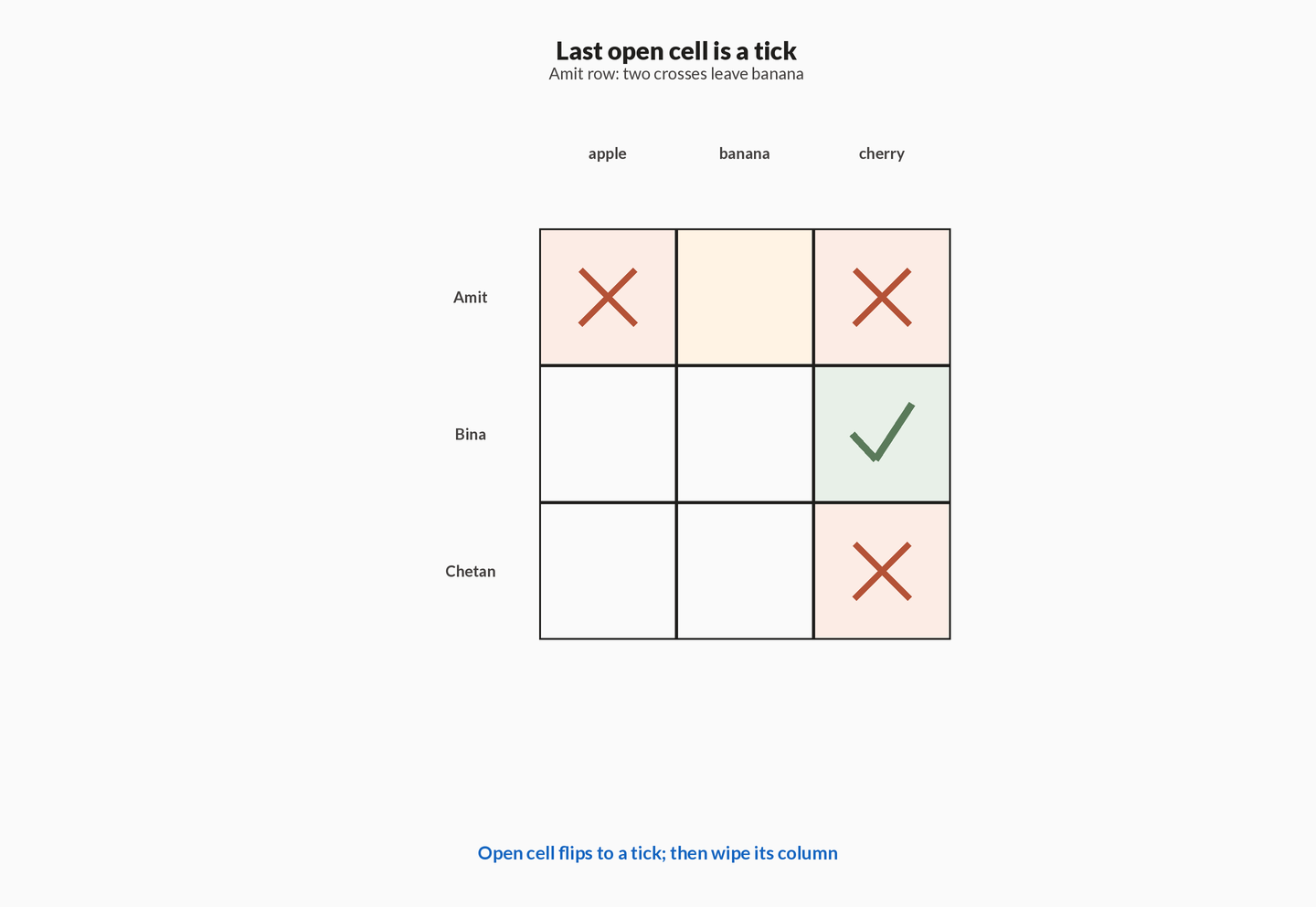
Force the singleton
- Scan rowsAfter each wipe, check every row for a single remaining open cell and tick it.
- Scan columnsDo the same down each column — a lone open cell there is also a tick.
- Wipe againEach new singleton tick re-triggers the row-and-column wipe, which may open the next singleton.
| Grid state | Forced mark | Why |
|---|---|---|
| Row has one open cell | Tick that cell | One-to-one: the person still needs exactly one attribute |
| Column has one open cell | Tick that cell | That attribute still needs exactly one person |
| Tick just placed | Cross rest of row and column | No second person or attribute may share the pair |
In a person–colour grid, Anu's row has red and blue crossed and green still open. No remaining clue mentions Anu. What follows?
- Tick Anu–green — the last open cell in her row is forced
- Leave Anu–green open until a positive clue names green
- Cross Anu–green, because the stem was silent about her
One-to-one forces a tick in the only open cell of a row. Waiting for another clue, or crossing the last cell, would leave Anu unmatched.
5Bridge across attributes
When a puzzle links three attributes (person, city, car), a confirmed A–B link and a confirmed B–C link force the A–C link. Resolve one attribute fully first, then transfer the bridge clue — cross-attribute consistency is what turns two separate two-way facts into a three-way assignment.
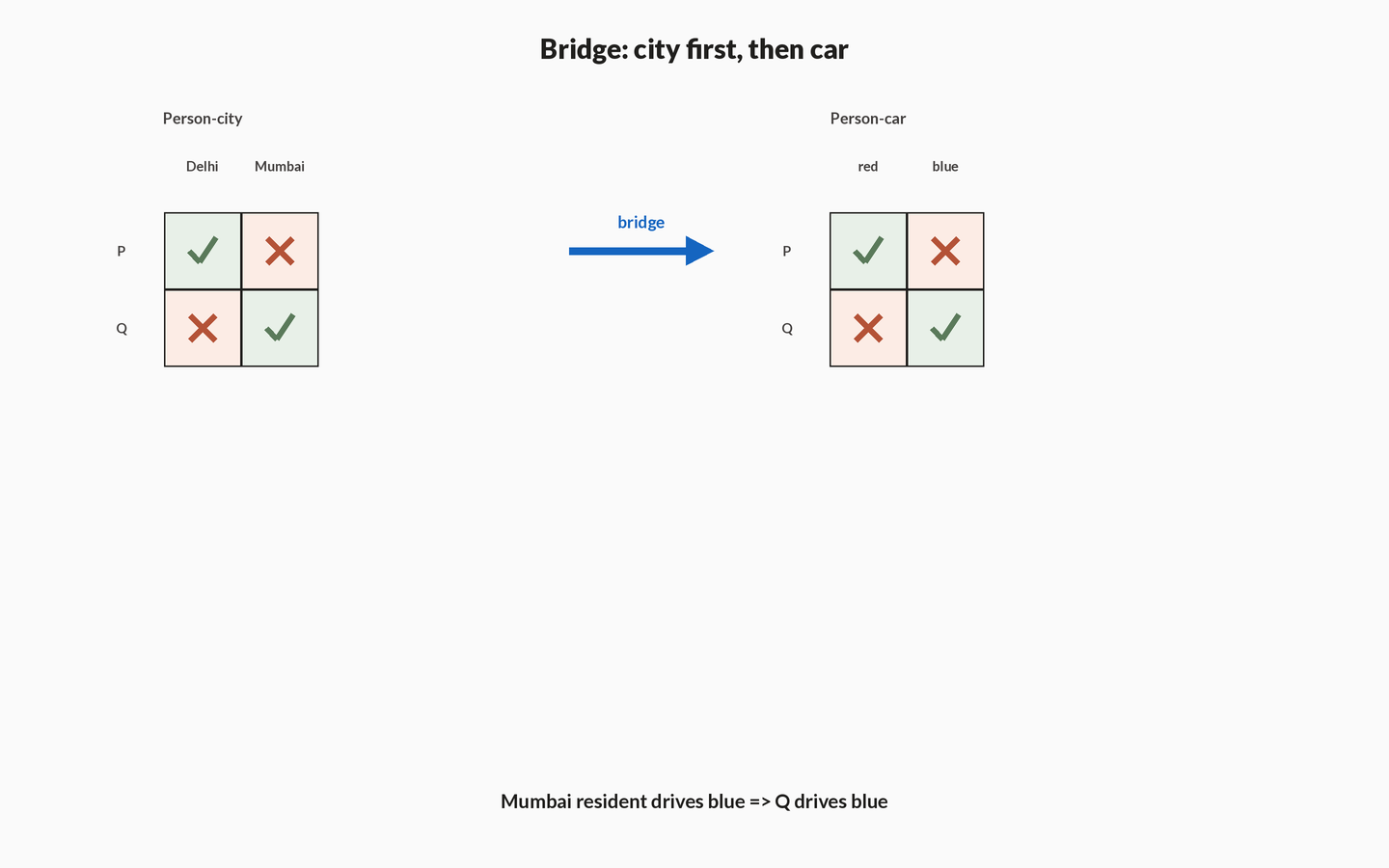
Fix then transfer
- Close one attributeUse the densest one-to-one clues to finish person–city (or whichever pair fills first).
- Read the bridgeA clue that names the second attribute by the first ("the Mumbai resident drives blue") now points at a known person.
- Write the implied pairTransfer the link onto the person–car grid and wipe as usual.
Three-attribute grid
Two people P and Q live in Delhi or Mumbai and drive a red or blue car. P lives in Delhi. The Mumbai resident drives a blue car. What car does Q drive?
- P lives in Delhi; two people, two citiesQ lives in Mumbai
- Mumbai resident drives blue; Q is that residentQ drives blue
- Two cars, one-to-oneP drives red
Pro tip. Resolve one attribute fully (cities), then use the cross-attribute clue to fix the next. Asking "what car does Q drive?" before placing Q in Mumbai leaves the bridge clue with nowhere to land.
P lives in Delhi. The Mumbai resident drives a blue car. Q is the only other person. Which statement is forced?
- Q drives blue
- P drives blue
- Q lives in Delhi
P in Delhi forces Q into Mumbai; the Mumbai–blue clue then attaches to Q. P driving blue would need P in Mumbai; Q in Delhi contradicts the city split.
6Keep linked grids consistent
With three or more attributes, one matrix is not enough — use several linked grids (person–city, person–colour, city–colour) and transfer every confirmed pair across all of them. A tick that exists on one grid but contradicts another is not a solution; the grids are one puzzle, not parallel drafts.
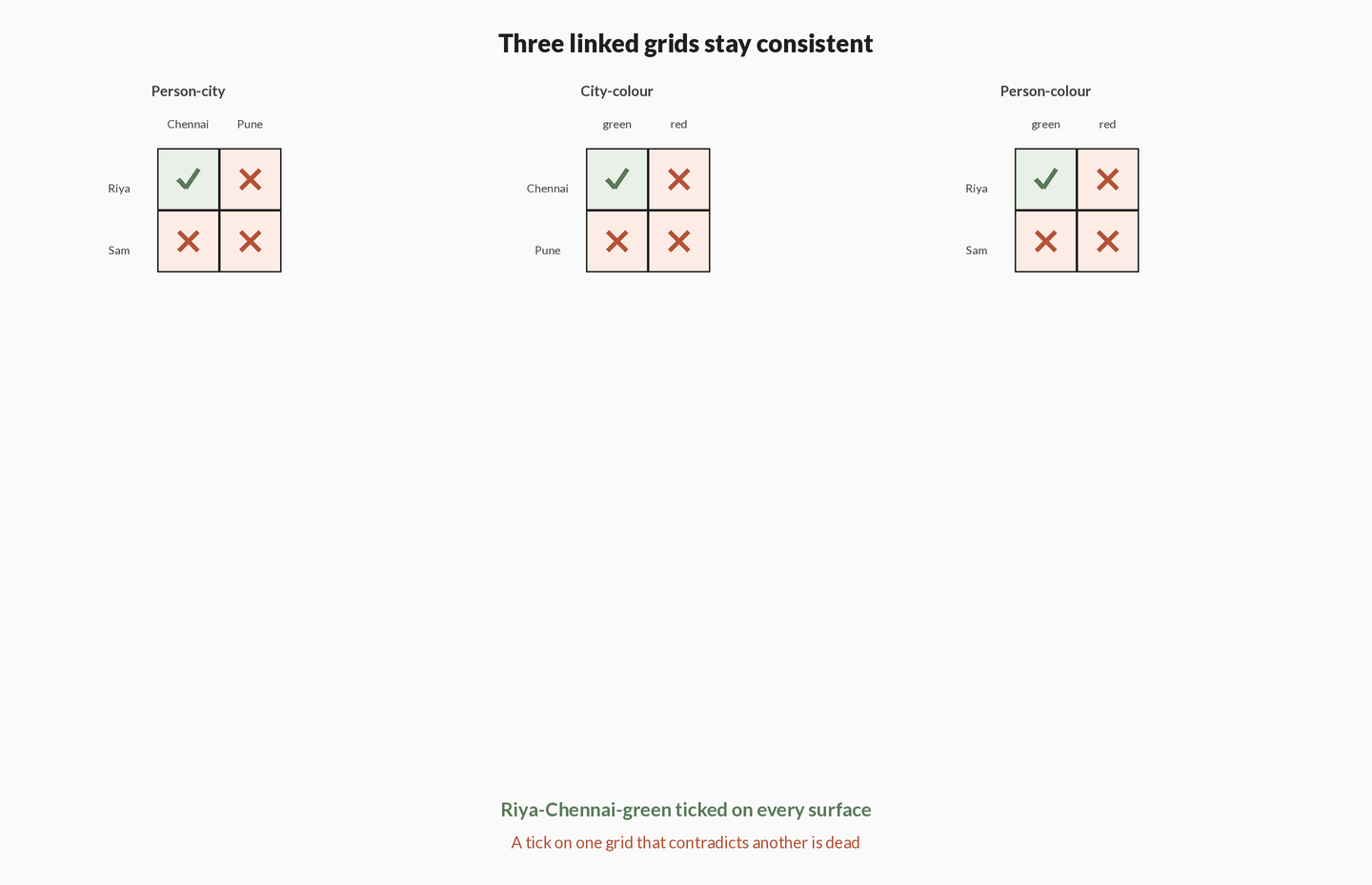
Transfer every link
- Open the pair grids you needFor attributes A, B, C, keep A–B, A–C, and B–C surfaces (or derive the third from the first two).
- Copy each new tickWhen A–B and B–C both tick, write A–C on the third grid before taking the next clue.
- Reject contradictionsIf a transfer would tick a cell already crossed on another grid, the branch is dead — back up.
| Known | Also known | Must write |
|---|---|---|
| A–B tick | B–C tick | A–C tick |
| A–B tick | B–C cross | A–C cross |
| A–B cross | any B–C | no forced A–C tick from that B |
You have ticked Riya–Chennai on the person–city grid and Chennai–green on the city–colour grid. What must appear on the person–colour grid?
- Tick Riya–green
- Cross Riya–green
- Leave Riya–green open until a clue names Riya's colour
A–B and B–C ticks force A–C. Leaving the person–colour cell open treats the grids as separate puzzles and invites a later contradiction.
Notes
- Grid/Matrix Method: For matching puzzles (person-city-colour), build a grid with entities on axes and mark ticks/crosses as clues confirm or rule out combinations. A tick in a row/column crosses out the rest.
- Negative Clues First: 'X is not from City Y' clues place crosses that quickly narrow possibilities; use them to prune before positive deductions.
- Chaining Deductions: When a cell is confirmed, propagate the consequence (its row and column are eliminated for others) immediately to reveal forced placements.
- Multiple Attributes: With three or more attributes, use several linked grids and transfer confirmed links across them consistently.
- Common trap: Marking only positive matches and ignoring the automatic eliminations they cause - each confirmed match rules out an entire row and column.
Formulas
- One tick in a row/column forces crosses in all other cells of that row and column.
- n entities matched one-to-one across an attribute: exactly n confirmed ticks total.
- Negative clue = one cross; positive clue = one tick plus row/column crosses.
- If a row has all cells crossed but one, that last cell is a confirmed tick.
- Cross-attribute consistency: A-B and B-C links imply an A-C link.
Exam traps & shortcuts
- Draw the full matrix and enter every negative clue as a cross before positive deductions.
- After each confirmed tick, immediately cross out its whole row and column.
- When only one cell in a row/column remains open, mark it as confirmed.
- Keep linked grids consistent - transfer any deduced pair across all relevant grids.
Reference tables
Marks and counts that every one-to-one matching puzzle reuses.
| Rule | Consequence |
|---|---|
| One tick in a row or column | Cross every other cell in that row and that column |
| n entities one-to-one on an attribute | Exactly n ticks when the grid is finished |
| Negative clue | One cross — place it before chasing positives |
| Positive clue | One tick, then the row-and-column wipe |
| Row or column with one open cell | That cell is a forced tick |
| A–B tick and B–C tick | A–C tick on the linked grid |
Recap
The night-before pass for grid puzzles.
- Surface
- Rows × columns, open until forced. One-to-one of size n ends with exactly n ticks.
- Negatives
- Write every "not" as a cross before the first tick.
- Wipe
- A tick kills its row and column. Skipping the wipe is the standard trap.
- Singleton
- One open cell left on a line is already a tick.
- Bridge
- Finish one attribute, then transfer A–B and B–C into A–C across linked grids.
Practise Puzzles and Grid-Based Reasoning
Reading is free and needs no account. Practice, mocks and progress live in the app.
- 17 exam-style questions on this topic, with explanations
- A 6-question practice set that ends the chapter
- Timed mocks scored with the real marking scheme
- Readiness tracked per topic, kept on your device