CLAT (Common Law Admission Test) · General Intelligence & Reasoning
Paper Folding & Cutting
Predicting the appearance of paper after folding, punching and unfolding, a spatial reasoning skill.
Every exam item here is a fold sequence, a punch or a cut, then an unfold. You are not being asked to admire the crease pattern. A square sheet is folded into a packet, something is done to the packet — a hole punched through the stacked layers, or a notch cut from a folded edge — and the sheet is opened again. Your job is to say how many marks appear, and where, by counting the layers under the tool and reflecting each mark across the creases in reverse fold order. Hold one concrete sheet through this topic: a square folded in half top-to-bottom, then again left-to-right, then punched once near the centre corner of the packet, clear of both creases. That punch through four layers is the running example every concept below returns to.
- CLAT (Common Law Admission Test)
- Medium level
- 6 concepts
- 44 practice questions
1Each fold doubles the layers
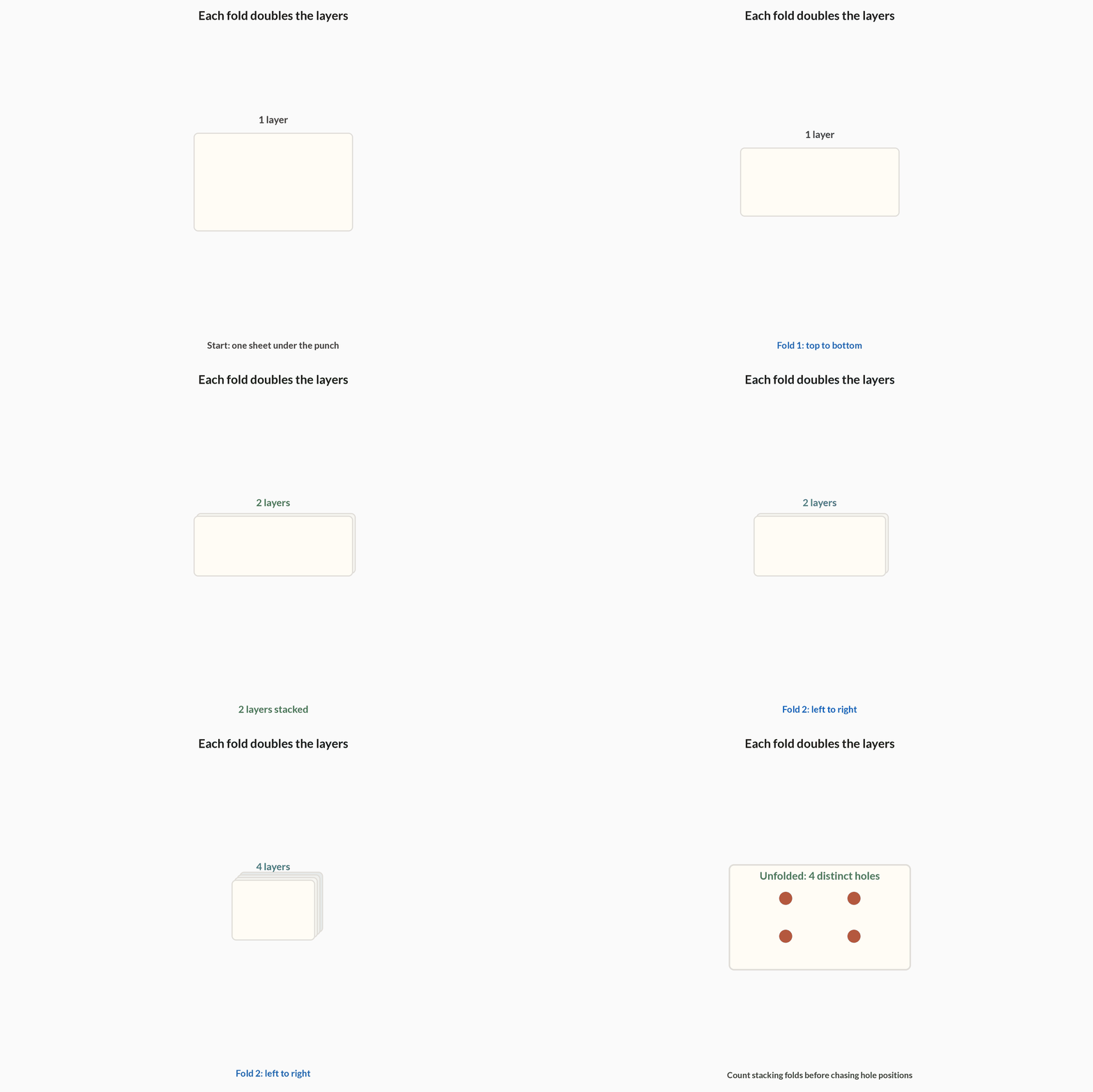
A punch goes through every layer it sits on. That sentence is the whole counting rule. One sheet is one layer. Fold the sheet once so that another thickness of paper covers the punch site, and you now have two layers under the punch; one punch therefore leaves two holes after you open the sheet. Fold twice through the punched region and you have four layers, so one punch leaves four holes. Each stacking fold doubles the layers under the tool. The ceiling is 2^n holes from one punch after n folds — fewer if the punch sits on a fold line and shares a hole between layers.
Run the square. First fold, top-to-bottom: the top half lands on the bottom half, and the punch site now has 2 layers. Second fold, left-to-right: that two-layer packet is folded onto itself, and the punch site now has 4 layers. One punch near the centre corner, clear of both creases, pierces all four layers at four distinct points. Unfold, and those four points separate into four holes — one in each quadrant. The ceiling check is the same number: n = 2 stacking folds, 2^2 = 4.
Before you chase positions, count the folds that actually stack paper under the punch. That count is what kills most wrong options in one look. A decorative crease that never covers the punch does not multiply holes. Three stacking folds with the punch clear of every crease give at most 2^3 = 8 holes, not 3 (that counts folds) and not 6 (that invents a different multiplier).
Count before you place
- Count stacking foldsOnly folds that put another layer under the punch multiply holes. On the running square, top-to-bottom then left-to-right both cover the centre-corner punch, so both count: 1 layer → 2 → 4. A decorative crease that never covers the punch does not.
- Cap at 2^nn stacking folds give at most 2^n holes from one punch when every layer is pierced separately. Two stacking folds cap at 2^2 = 4; three cap at 8. The ceiling is a power of two, never 'number of folds' and never a made-up 6.
- Halve on a creaseIf the punch lands exactly on a fold line, layers share the hole — the count drops below the ceiling. The running punch misses both creases, so the ceiling stands: four holes.
Two folds and one punch
A square is folded in half top-to-bottom, then again left-to-right, and one hole is punched near the centre corner (through every stacked layer). How many holes appear when the sheet is fully unfolded?
- First fold (top-to-bottom) stacks 2 layers2 layers
- Second fold (left-to-right) stacks those again2 × 2 = 4 layers
- One punch through all 4 layers; punch not on a crease4 distinct holes
- Ceiling check: 2^n with n = 22^2 = 4
Pro tip. With two perpendicular folds and a punch clear of both creases, expect four holes — one in each quadrant — before you even look at where they sit.
A sheet is folded three times so that every fold stacks another layer under the punch site, and one hole is punched clear of every crease. The greatest number of holes after unfolding is
- 3
- 6
- 8
Three stacking folds give 2^3 = 8 layers and at most 8 holes. Answering 3 counts folds instead of layers; answering 6 invents a different multiplier. The ceiling is always a power of two when the punch misses every crease.
2A hole mirrors across each crease
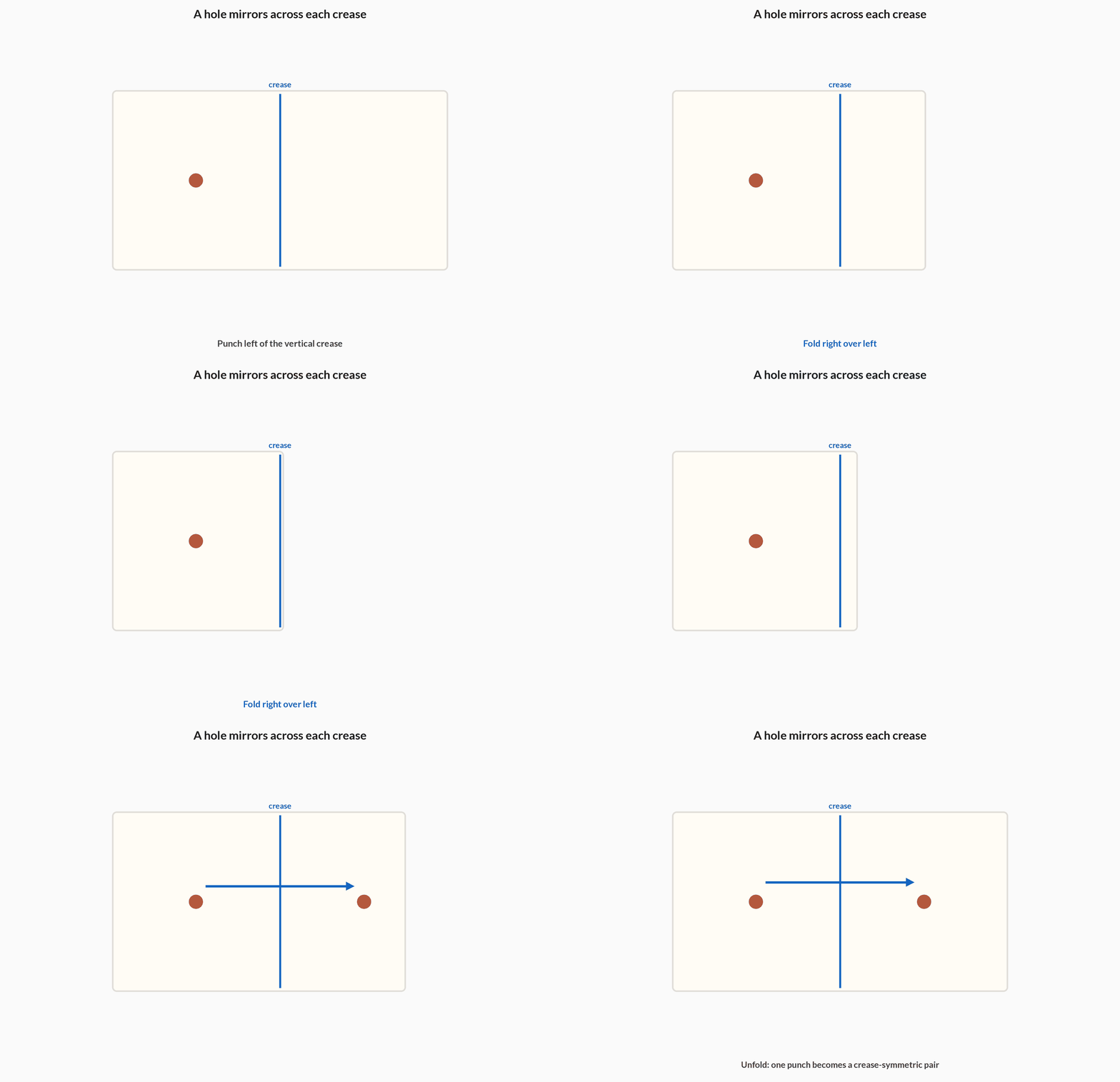
Where the punch sits relative to a fold line is where its twin will sit after you open that fold. The crease is a mirror line: a hole near the crease reflects to the same distance on the other side of that crease. Distance to the crease is preserved; only the side flips. After a left-over-right fold, that near-crease site is the left edge of the packet — not the free edges stacked on the right.
Slow down for the packet, because 'near the crease' and 'near the edge' are opposite places. Fold a square left-over-right along its vertical centre line. The crease is now the left edge of the packet you are holding; the original left and right outer edges are stacked together on the right, as the free edge. A punch near the crease (left edge of that packet) is near the midline of the opened sheet. A punch near the free (right) edge of the packet is near the outer vertical sides of the opened sheet. Those two punch sites produce two very different answers, and the options will offer both.
For one left-over-right vertical centre fold and a punch near the crease (left edge of the packet), both holes end up near the vertical midline of the opened sheet — symmetric about that midline, not out at the free edges. Two layers mean two holes; reflecting a near-crease punch across the midline keeps both copies near the midline. One hole would require the punch to sit on the crease. Outer-edge holes would mean the punch was near the free edge.
Place the twin
- Mark the creaseOn the answer figure, treat each fold line as a mirror you will open. After left-over-right, the vertical centre line is that mirror; after the running two-fold, both the horizontal and the vertical centre lines are.
- Measure to the creaseNote how far the punch sits from the fold, and on which side of the packet. Near the crease (left packet edge after left-over-right) means near the midline when opened; near the free edge means near the outer sides.
- Reflect once per foldOpening that fold copies the hole to the same distance on the other side of the crease. Distance is preserved; only the side flips. Two layers and a near-crease punch give two holes near the midline, not at the outer edges.
Single fold and punch
A square sheet is folded once left-over-right along its vertical centre line, then a single hole is punched near the crease (the left edge of the packet), clear of the crease itself. How many holes appear when unfolded, and where?
- Left-over-right vertical centre foldPacket on the right half; crease = left edge of packet; free edges stacked on the right
- One punch near the crease (left packet edge), clear of the creasepierces both layers near the fold, not at the free edge
- Unfold: reflect across the vertical centre crease2 holes, mirror-symmetric about the midline
- Both copies sit where the near-crease punch wasnear the centre line, not at the outer edges
Pro tip. After left-over-right, the crease is the left edge of the packet and the free edges are on the right. Punch near the crease for holes near the midline; punch near the free edge for holes near the outer sides.
A square is folded once left-over-right on its vertical midline and punched once near the crease (left edge of the packet, not on the crease). After unfolding, the holes are
- One hole only, on the crease
- Two holes near the vertical midline, symmetric about it
- Two holes, one near each outer vertical edge
Two layers mean two holes, and reflecting a near-crease punch across the midline keeps both copies near the midline. One hole would require the punch to sit on the crease. Outer-edge holes would mean the punch was near the free (right) edge of the packet after a left-over-right fold.
3Unfold in reverse fold order
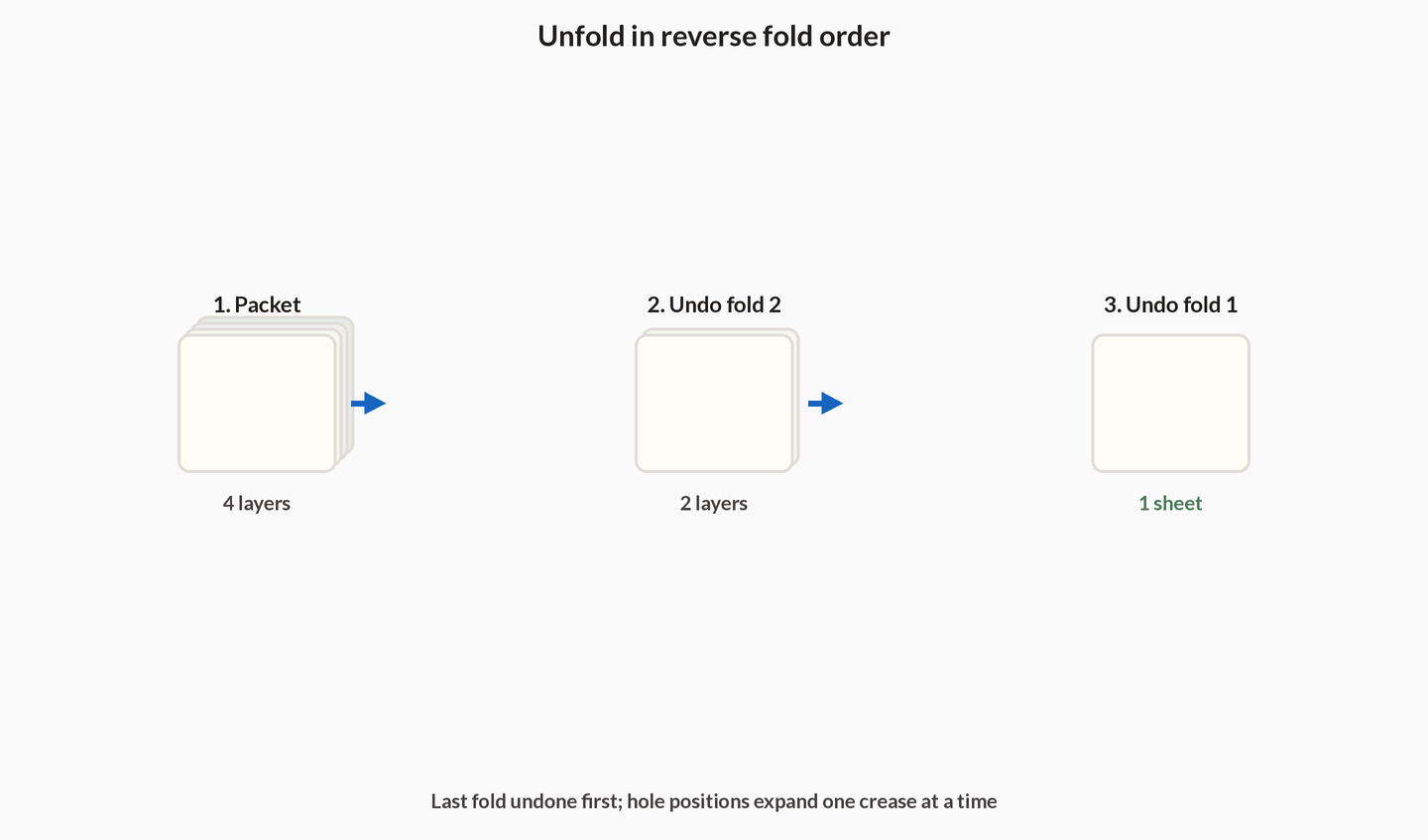
Holes and cuts are mirror-symmetric about each fold line, but the order you open the folds matters. You must unfold in reverse order: reflect the pattern across the most recent crease first, then across the earlier ones. Opening the first fold before the last one puts the copies on the wrong side of the remaining creases. Think of it as undoing a packet you are still holding. The last fold is the one currently closed on top; that is the first hinge you open.
Return to the running square. Fold 1 was top-to-bottom (horizontal crease). Fold 2 was left-to-right (vertical crease). The punch happened after fold 2, through the four-layer packet. The packet you are holding still has fold 2 closed, so the first mirror you open is the vertical crease from fold 2. Reflect the punch across that vertical crease, and the packet thins from four layers to two. Then open fold 1: reflect everything across the horizontal crease, and the sheet is flat. Four holes, one per quadrant, sitting where those two reflections put them.
The common trap is forgetting that reverse order — reflecting across the earliest crease first — and reading an option that looks "mostly symmetric" but is wrong about which fold acted last. Reflecting the punch across the horizontal crease first is the reverse-order trap: it assumes the packet had already opened the later fold, which it had not. Order does matter: each reflection assumes the packet still has the later folds closed.
Open last fold first
- List the folds in timeWrite the sequence as fold 1, fold 2, … as the stem did them. Running square: fold 1 top-to-bottom (horizontal), fold 2 left-to-right (vertical), then punch. The punch happens last, on the fully folded packet.
- Open the last creaseReflect every mark across fold n first — that is the packet you are holding when you punch. Here fold 2 is the vertical crease, so the first mirror is vertical. Four layers become two.
- Work backwardsThen reflect across fold n−1, and so on, until the sheet is flat. After the vertical open, reflect across fold 1's horizontal crease. That is the reverse-order unfold.
- Reject early-first optionsAny answer that matches a first-fold-first reflection is the classic wrong choice. Reflecting across the horizontal crease first is the trap, even when four holes are present.
A sheet is folded top-to-bottom (fold 1), then left-to-right (fold 2), then punched. To place the holes correctly you should first reflect the punch pattern across
- The horizontal crease from fold 1
- The vertical crease from fold 2
- Either crease — order does not matter
Fold 2 is the most recent crease, so it is the first mirror you open. Reflecting across fold 1 first is the reverse-order trap. Order does matter: each reflection assumes the packet still has the later folds closed.
4A cut on a folded edge opens symmetrically
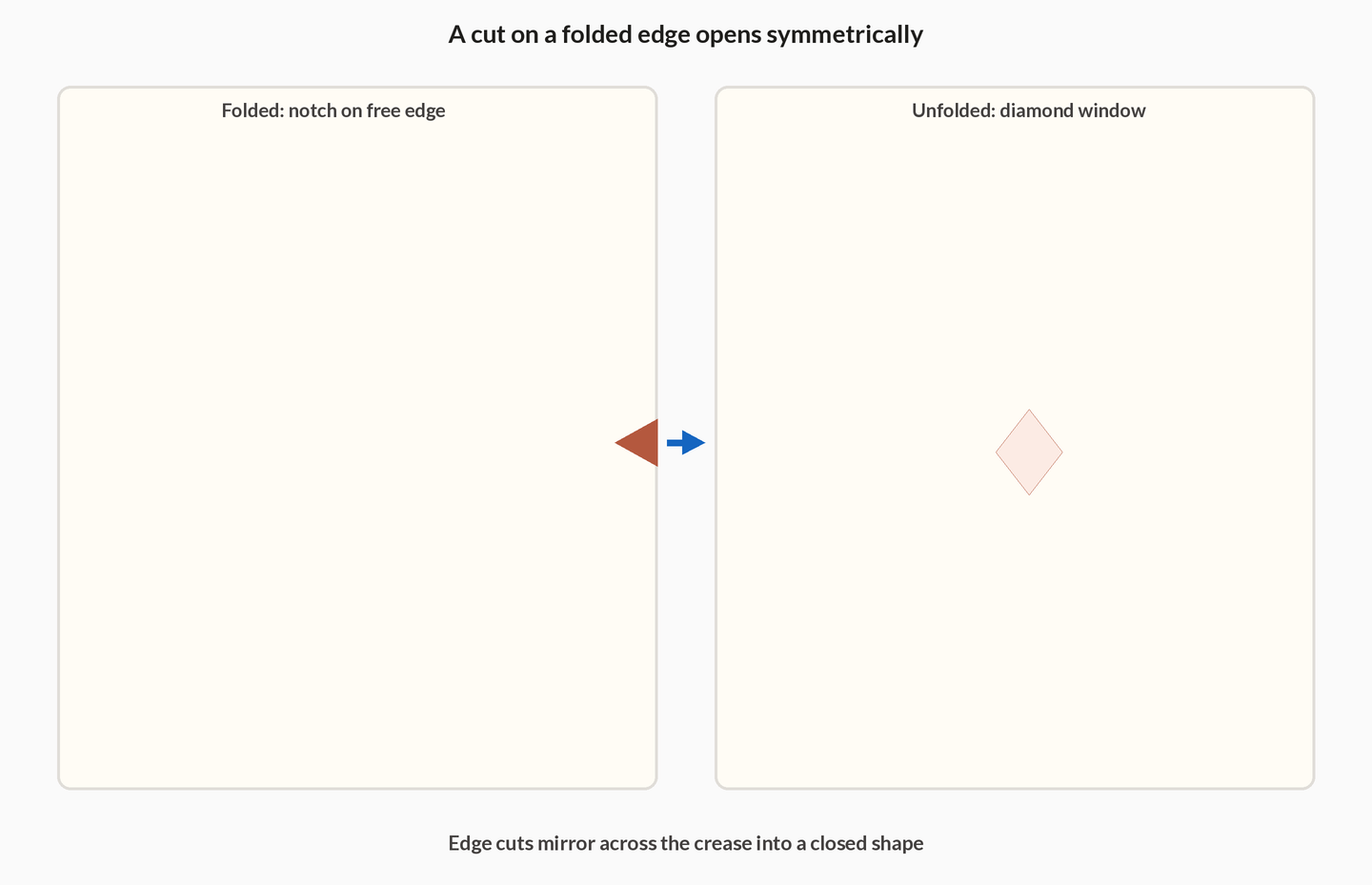
A notch cut into a folded edge is not the shape you will see when the sheet is open. The cut sits on a mirror line, so unfolding opens it into a full figure symmetric about that edge. A triangular notch on a folded edge becomes a diamond (two triangles joined on the crease). A semicircular bite on a fold becomes a full circle. The crease is acting as a hinge: whatever you cut from one side of the hinge is completed by its reflection on the other side when the hinge opens.
The criterion is simple: if the cut touches the fold, treat the crease as a hinge and complete the shape by reflection. If the cut is entirely on one layer away from the fold, it only copies as a separate hole or patch — it does not "open" into a larger single outline. That is the classification this concept exists to make. Touching the fold merges the cut with its twin into one outline. Missing the fold leaves separate copies, the same way a punch clear of the crease leaves separate holes.
The Cut on the fold → shape after unfolding table is the class list. Triangular notch on the folded edge → diamond (two triangles about the crease). Semicircular bite on the folded edge → full circle centred on the crease. Square notch on the folded edge → rectangle straddling the crease. Small hole punch away from every crease → separate copies, no merged outline. On the running square, the tool was a punch near the centre corner, not a notch on an edge, so it stays in the separate-copies class: four holes, not a diamond.
| Cut while folded | Where it sits | After unfolding |
|---|---|---|
| Triangular notch | On the folded edge | Diamond (two triangles about the crease) |
| Semicircular bite | On the folded edge | Full circle centred on the crease |
| Square notch | On the folded edge | Rectangle straddling the crease |
| Small hole punch | Away from every crease | Separate copies — no merged outline |
While a sheet is folded once, a triangular notch is cut from the folded edge. After unfolding, the mark is best described as
- A single triangle on one side of the crease
- A diamond symmetric about the crease
- Two separate triangles with a gap between them
A cut on the folded edge opens about that edge into one outline. Two separate triangles would mean the cut never touched the fold. A single triangle would mean you forgot to reflect across the crease.
5A punch on the crease halves the hole count
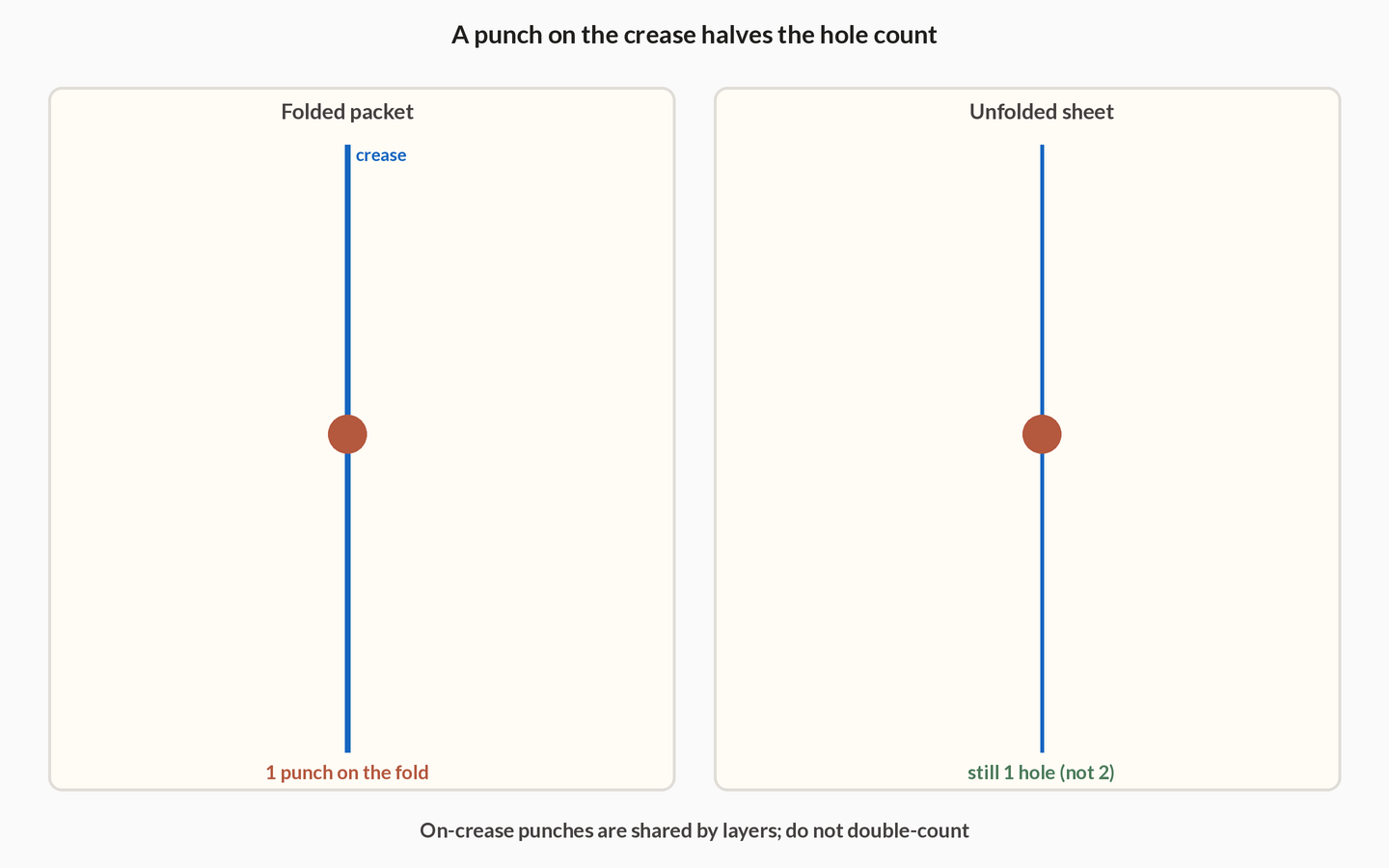
The 2^n ceiling assumes the punch pierces each layer at a distinct point that will separate when the sheet opens. Punch exactly on a fold line and those layers share one hole on the crease — the opened sheet shows half as many holes as the layer count suggested. The layers were stacked on a hinge, and you punched the hinge itself, so opening the hinge does not split that hole into twins. It was already on the mirror line.
One fold normally promises two holes; a punch on that crease yields a single hole lying on the midline. Picture the left-over-right square from the crease-mirror concept, but this time the punch sits exactly on the vertical fold, not near it. Two layers, one shared hole, unfold: still one hole, on the vertical midline. Two stacking folds normally promise four; a punch on one crease (but not both) merges a pair and leaves fewer than four. Always ask whether the stem's punch sits on a crease before locking in 2^n.
The running punch was near the centre corner, clear of both creases, so it does not take this exception: four holes stand. The exception is how the exam undercuts a blind power-of-two. Start from the layer count, then merge copies that land on the same crease point. On a crease means shared hole; clear of every crease means the full 2^n ceiling. The two sites are not interchangeable, and the option that always answers 2 after one fold is the trap of skipping the site check.
Check the punch site
- Find the creasesMark every fold line the stem describes on a mental sketch of the packet. Running square: a horizontal centre crease from fold 1 and a vertical centre crease from fold 2.
- Ask if the punch hits oneOn a crease means shared hole; clear of every crease means the full 2^n ceiling. The running punch misses both, so four holes. A punch exactly on the only crease of a one-fold sheet is one hole on the midline.
- Count after mergingStart from the layer count, then merge copies that land on the same crease point. Do not lock 2^n until the site check is done — on-crease punches are the standard way the exam undercuts a blind power of two.
Punch on the only crease
A square is folded once along its vertical centre line. One hole is punched exactly on the fold line. How many holes appear when the sheet is unfolded?
- One stacking fold, punch would suggest 2^1 if clear of the creaseceiling 2
- Punch sits exactly on the fold lineboth layers share one hole
- Unfold: no separate mirror twin off the crease1 hole, on the vertical midline
Pro tip. On-crease punches are the standard way the exam undercuts a blind 2^n count — check the punch site before you pick the power of two.
A sheet is folded once and punched once. Which punch site gives fewer holes after unfolding?
- A punch clear of the crease, near a free edge of the packet
- A punch exactly on the fold line
- Either site — both give two holes
On the crease, the two layers share one hole, so you get one hole on the midline. Clear of the crease, you get two. The third option is the trap of applying 2^n without checking the punch site.
6Kill options that break crease symmetry
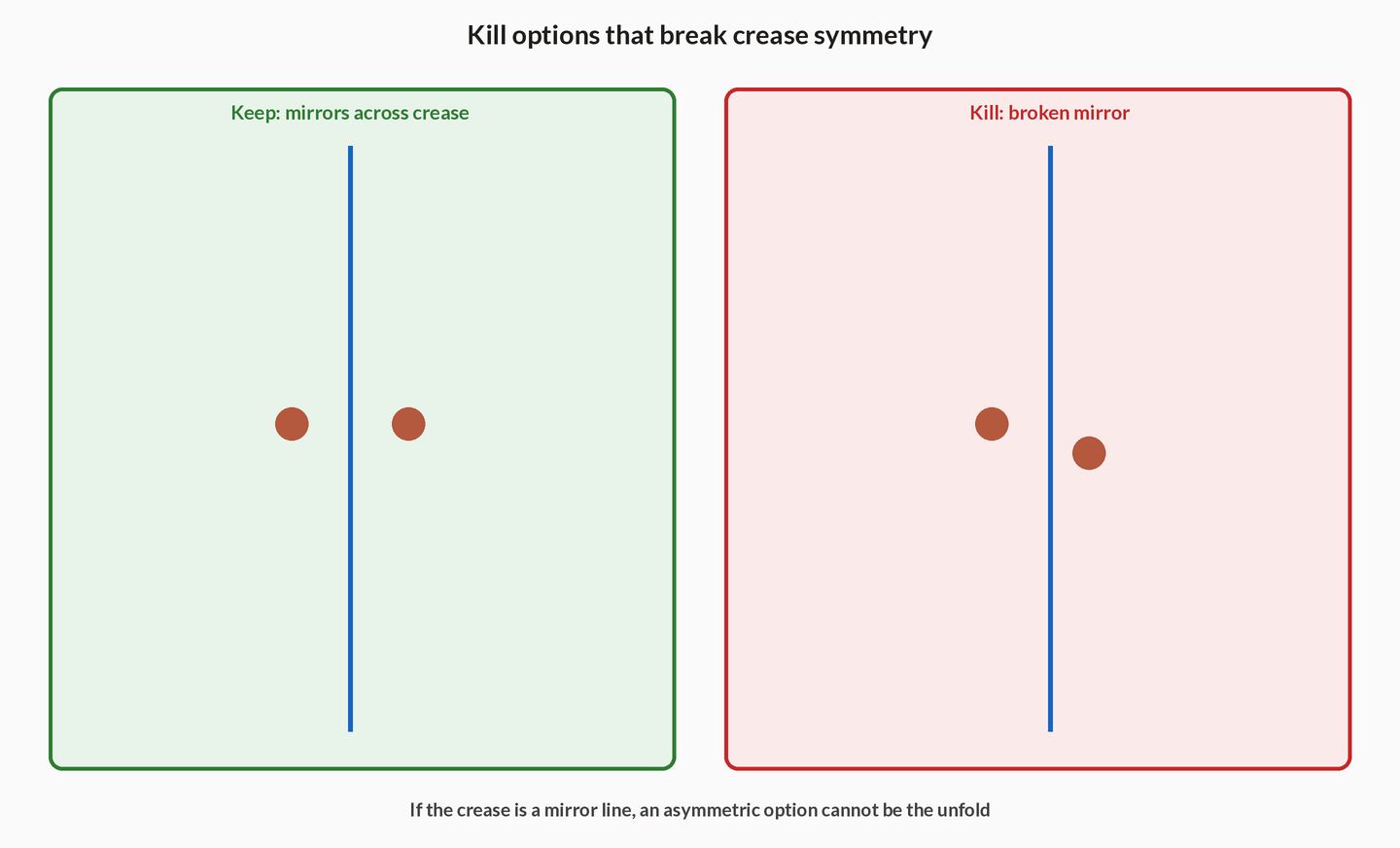
Once you know the fold lines, every legal answer must be mirror-symmetric about each crease that was folded through the punched region. An option whose holes are not mirrors across those creases is wrong, even if the hole count matches 2^n. Count is necessary but not sufficient. Four holes that all sit in the top half of the sheet cannot be the unfold of a packet that was also folded across a horizontal centre line.
In timed papers, mark the fold lines lightly on each option and discard any pattern that fails a crease test before you rebuild the unfold from scratch. Count first, then symmetry — that order is what the hole-count and mirror concepts already taught. On the running square you expect four holes (two stacking folds, punch clear of both creases) and you expect both the vertical and the horizontal centre lines to be mirrors. An option that shows four holes not symmetric about the vertical crease is already dead. You do not then reconstruct it to see 'where the punch might have been'.
Both creases were folded through the punched region, so both are required mirrors. Matching 4 while breaking the vertical mirror is the classic wrong option the symmetry test exists to kill. Matching 4 while breaking the horizontal mirror is the same kill. An option that is symmetric about only one of the two creases is the reverse-order trap wearing a legal count.
Count, then symmetry
- Predict the countUse stacking folds and on-crease punches to know how many holes to expect. Running square: two stacking folds, punch clear of both creases → 4. A different count is already a dead option.
- Draw the creases on optionsEvery fold through the punch region is a required mirror line on the answer figure. Here that is the vertical centre line and the horizontal centre line. Mark both on each option.
- Discard broken mirrorsAny option that fails symmetry about a required crease is out — do not reconstruct it further. Four holes that break the vertical crease are wrong even though 2^2 = 4 matches.
After two perpendicular centre folds and one punch clear of both creases, an option shows four holes but they are not symmetric about the vertical crease. That option is
- Possible, because the hole count 2^2 = 4 already matches
- Impossible — every crease through the punch region must be a mirror line
- Possible if the horizontal crease symmetry still holds
Count is necessary but not sufficient. Both creases were folded through the punched region, so both are required mirrors. Matching 4 while breaking the vertical mirror is the classic wrong option the symmetry test exists to kill.
Notes
- Fold-and-Punch Logic: Each fold doubles the layers, so a single punch appears once per layer when unfolded. Count folds to know how many holes result (n folds through a punched region can give up to 2^n holes).
- Symmetry of Unfolding: Holes/cuts appear mirror-symmetric about each fold line. Unfold in reverse order, reflecting the pattern across the last fold line first.
- Position Tracking: Note where the punch sits relative to the fold line; on unfolding it reflects to the mirror-position on the other side of that line.
- Cut Shapes: A notch cut on a folded edge opens into a full symmetric shape (a triangle cut on a folded edge becomes a diamond) when unfolded.
- Common trap: Forgetting to unfold in reverse order - reflect across the most recent fold first, then the earlier folds, or the hole positions come out wrong.
Formulas
- Maximum holes from one punch after n folds = 2^n (fewer if punch lies on a fold line).
- Each fold line acts as a mirror line for the punched pattern.
- Unfold in reverse fold order, reflecting across the latest crease first.
- A cut on a folded edge opens symmetrically about that edge.
- A punch exactly on a fold line yields half as many holes (shared between layers).
Exam traps & shortcuts
- Count the folds to predict the number of holes before checking options.
- Reverse the folding step by step, mirroring the marks across each crease as you open it.
- Mark the fold lines lightly on the answer figure and check the pattern is symmetric about them.
- Eliminate options whose holes are not mirror-symmetric about the fold creases.
Reference tables
Use this before you chase positions. The ceiling is a power of two; the punch site decides whether you reach it.
| Situation | Holes from one punch |
|---|---|
| n stacking folds, punch clear of every crease | Exactly 2^n |
| n stacking folds, punch on a crease | Fewer than 2^n (layers share the hole) |
| One centre fold, punch near the crease (not the free edge) | 2, symmetric about the midline, near the crease |
| Two perpendicular centre folds, punch near inner corner | 4, one per quadrant, symmetric about both creases |
| Cut (not punch) on a folded edge | Opens into one outline mirrored about that edge |
Recap
Read only this the night before.
- Count
- Stacking folds give at most 2^n holes from one punch. On a crease, the count drops — layers share the hole.
- Mirror
- Each crease is a mirror. Distance to the crease stays; only the side flips. Near-fold punches land near the crease when opened.
- Order
- Unfold in reverse: reflect across the most recent crease first. First-fold-first is the trap.
- Cuts
- A notch on a folded edge opens into a full symmetric shape (triangle → diamond). Off the fold, it only copies.
- Options
- Predict the count, then kill any option that breaks symmetry about a required crease — matching 2^n is not enough.
Practise Paper Folding & Cutting
Reading is free and needs no account. Practice, mocks and progress live in the app.
- 44 exam-style questions on this topic, with explanations
- A 4-question practice set that ends the chapter
- Timed mocks scored with the real marking scheme
- Readiness tracked per topic, kept on your device