Digital SAT Prep · Digital SAT Reading, Writing & Math
Geometry and Trigonometry
Area and volume, lines and angles, right triangles, trigonometry and circles.
Geometry and trigonometry on the Digital SAT — area and volume, lines and angles, right triangles, and circles. Each concept states the rule, shows the figure where one earns its place, and closes with a ledger you can copy on test day.
- Digital SAT Prep
- Medium level
- 7 concepts
- 5 practice questions
1Pythagorean theorem — a missing leg
In any right triangle with legs a and b and hypotenuse c, a^2 + b^2 = c^2. The hypotenuse is always the longest side — opposite the right angle — never one of the legs you are solving for.
Given two sides, isolate the square of the unknown, take the square root, and keep the positive root; lengths on the SAT are positive. Multiples of the 3-4-5 triple (6-8-10, 9-12-15, …) and 5-12-13 appear often enough that spotting them saves the squaring step entirely.
Figure. Legs a and b with hypotenuse c; the missing leg is under the square root after moving a squared.
Finding a leg
- Label the sidesMark the right angle, name the hypotenuse c, and put the given lengths on the two sides you know.
- Substitute into a^2 + b^2 = c^2Plug the known values; leave the missing leg as a symbol or as x^2 on one side of the equation.
- Isolate and rootSubtract the known square, then take the square root. Discard a negative root — a side length cannot be negative.
The other leg
In a right triangle, one leg is 6 and the hypotenuse is 10. Find the other leg.
- a^2 + b^2 = c^2 with a = 6, c = 106^2 + b^2 = 10^2
- 36 + b^2 = 100b^2 = 64
- b = \sqrt{64}b = 8
Pro tip. 6-8-10 is twice 3-4-5 — once you see the scaling, the missing leg is 8 without squaring. If the numbers are not a familiar triple, the algebra still takes three lines.
A right triangle has legs 5 and 12. The hypotenuse is
- 17
- 13
- 7
5^2 + 12^2 = 25 + 144 = 169 = 13^2, so the hypotenuse is 13 — a 5-12-13 triple. Option 17 is 5 + 12, which adds the legs instead of applying the theorem.
2SOH-CAH-TOA — sine from two sides
In a right triangle, label opposite, adjacent, and hypotenuse relative to the angle \theta you care about — not relative to the right angle. Then \sin\theta = \dfrac{\text{opp}}{\text{hyp}}, \cos\theta = \dfrac{\text{adj}}{\text{hyp}}, and \tan\theta = \dfrac{\text{opp}}{\text{adj}} (SOH-CAH-TOA).
The SAT rarely asks you to memorise decimal values; it asks for a ratio in simplest form once the sides are identified. If opposite and hypotenuse are given, sine is one division — no Pythagorean step required.
Figure. Sine is opposite over hypotenuse — read the angle first, then pick the two sides.
Reading sine
- Pick the reference angleMark \theta at a non-right vertex. The side across from \theta is opposite; the side touching \theta (not the hypotenuse) is adjacent.
- Identify hypotenuseThe hypotenuse is the side opposite the right angle — always the longest side.
- Apply SOHSine is opposite over hypotenuse. Reduce the fraction if a common factor appears.
Using sine
In a right triangle, the angle \theta has an opposite side of 5 and a hypotenuse of 13. Find \sin\theta.
- \sin\theta = \dfrac{\text{opposite}}{\text{hypotenuse}}\sin\theta = \dfrac{5}{13}
- No common factor on 5 and 13\sin\theta = \dfrac{5}{13}
Pro tip. Label opposite, adjacent, and hypotenuse relative to the named angle before applying SOH-CAH-TOA — swapping labels is the most common trig trap on the SAT.
In a right triangle, the side opposite \theta is 3 and the hypotenuse is 5. Then \sin\theta equals
- \dfrac{4}{5}
- \dfrac{3}{5}
- \dfrac{3}{4}
SOH gives \sin\theta = 3/5. The value 4/5 is \cos\theta for the 3-4-5 triangle; 3/4 is \tan\theta.
3Special right triangles
Two families appear often enough to memorise. A 45-45-90 triangle has legs in ratio 1:1 and hypotenuse \ell\sqrt{2} when each leg is \ell. A 30-60-90 triangle has sides 1 : \sqrt{3} : 2 — short leg, long leg, hypotenuse — so scaling the short leg by k scales the hypotenuse by 2k and the long leg by k\sqrt{3}.
Multiples of 3-4-5 (6-8-10, 9-12-15, …) and 5-12-13 are Pythagorean triples rather than angle-ratio templates, but spotting them skips squaring on leg problems the same way 30-60-90 skips the algebra when the given side matches a ratio slot.
Figure. 30-60-90 sides stay in ratio 1 : √3 : 2 after any common scale factor.
Using 30-60-90
- Match the given side to a slotDecide whether the known length is the short leg, the long leg, or the hypotenuse in the 1:\sqrt{3}:2 ratio.
- Find the scale factorDivide the given side by its unit-ratio value to get k.
- Scale the unknownMultiply the unknown slot by k (and by \sqrt{3} when the long leg is needed).
Hypotenuse from the short leg
In a 30-60-90 triangle, the side opposite 30^\circ is 5. Find the hypotenuse.
- Short leg : hypotenuse = 1 : 25 : h = 1 : 2
- Scale factor k = 5h = 2k = 10
Pro tip. Memorise 30-60-90 as 1:\sqrt{3}:2 and 45-45-90 as 1:1:\sqrt{2} — spotting them skips the full Pythagorean calculation on half the triangle questions in this domain.
In a 45-45-90 triangle, each leg is 7. The hypotenuse is
- 7\sqrt{2}
- 14
- 7\sqrt{3}
For 45-45-90, hypotenuse = \ell\sqrt{2} = 7\sqrt{2}. The value 7\sqrt{3} belongs to 30-60-90; 14 doubles the leg instead of applying the ratio.
4Cofunction identity
In a right triangle the two acute angles sum to 90^\circ, so each is the complement of the other. That geometry gives \sin\theta = \cos(90^\circ - \theta): the side opposite \theta is adjacent to (90^\circ - \theta), so the two ratios swap numerator and denominator roles against the same hypotenuse.
On the SAT this identity turns a cosine-of-complement question into a sine lookup, and vice versa — useful when only one ratio is given or when the reference angle is stated in the form 90^\circ - \theta.
Figure. In one right triangle the side opposite θ is adjacent to the complement. That single side-label swap is the cofunction identity.
Swapping sine and cosine
- Name the complementIf the angle is \theta, its complement is 90^\circ - \theta — the other acute angle in the triangle.
- Apply the identity\sin\theta = \cos(90^\circ - \theta) and \cos\theta = \sin(90^\circ - \theta).
- Read the given ratioWhen a problem asks for \cos(90^\circ - \theta) and gives \sin\theta, the answer is the same value — no new triangle needed.
Cosine of the complement
In a right triangle, \sin\theta = 0.6. Find \cos(90^\circ - \theta).
- \sin\theta = \cos(90^\circ - \theta)\cos(90^\circ - \theta) = 0.6
Pro tip. \sin 30^\circ = \cos 60^\circ and \sin 45^\circ = \cos 45^\circ are the same identity with numbers plugged in — use it to answer complement questions without redrawing the triangle.
If \sin\theta = \dfrac{3}{5}, then \cos(90^\circ - \theta) equals
- \dfrac{4}{5}
- \dfrac{3}{5}
- \dfrac{5}{3}
By the cofunction identity, \cos(90^\circ - \theta) = \sin\theta = 3/5. The value 4/5 is \cos\theta in the 3-4-5 triangle, not the cosine of the complement.
5Circle area and circumference
For a circle of radius r, circumference C = 2\pi r and area A = \pi r^2. The Digital SAT reference sheet lists both — memorise the relationship, not every decimal approximation.
Circumference is a length (units); area is squared units. A question that gives diameter d wants r = d/2 substituted before either formula — using d directly in \pi r^2 is the common slip.
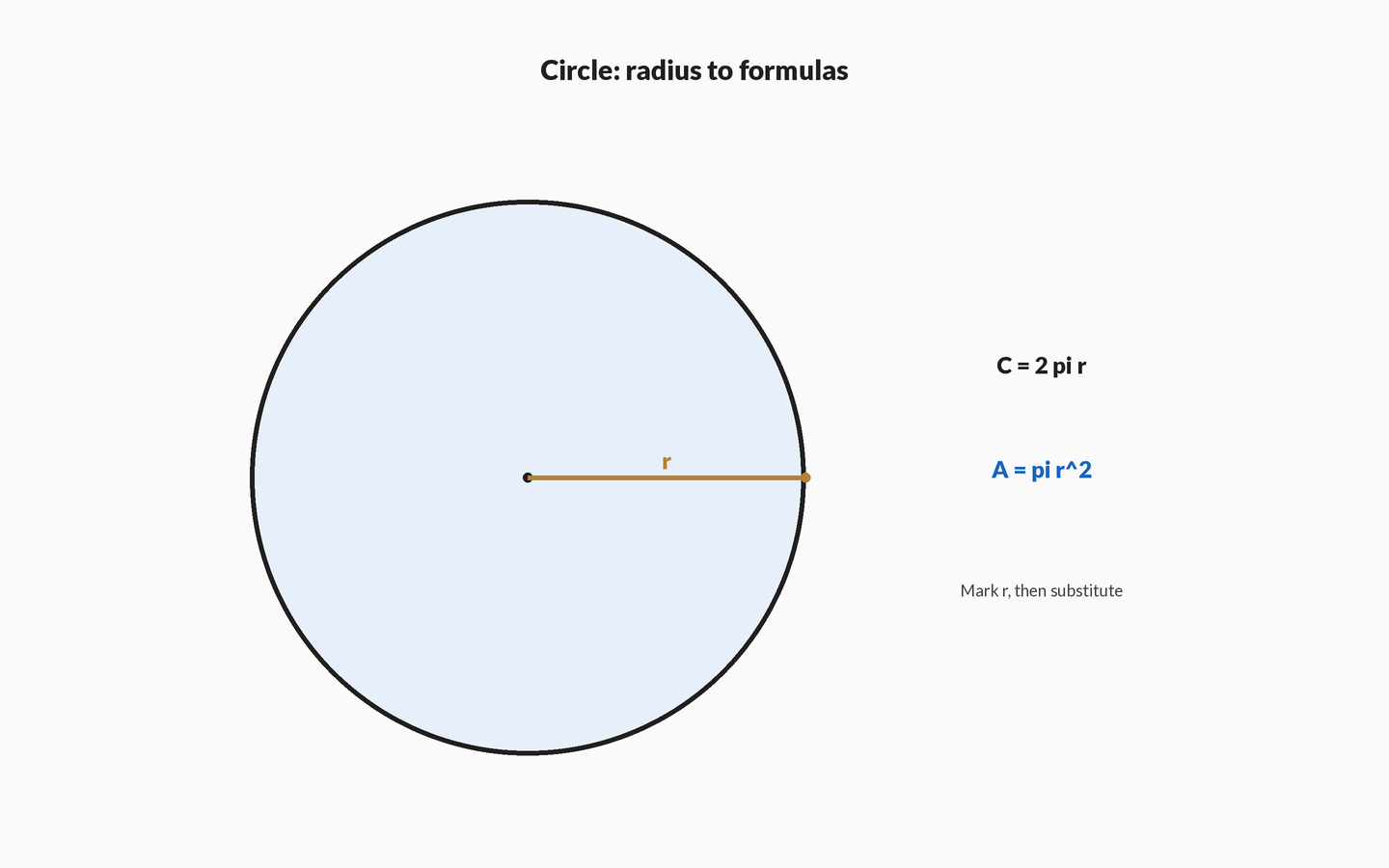
From radius to area
- Read off rIf diameter is given, halve it before substituting.
- Square for areaCompute r^2, then multiply by \pi. Leave answers in terms of \pi unless the choices are decimals.
- Double for circumferenceC = 2\pi r uses r once, not r^2 — area and circumference are different powers of r.
Area at radius 5
A circle has radius 5. Find its area.
- A = \pi r^2 with r = 5A = \pi \cdot 25
- SimplifyA = 25\pi
Pro tip. Lean on the on-screen reference sheet for area and volume formulas on test day — spend memory on triangle ratios and trig relationships instead.
A circle has radius 4. Its circumference is
- 16\pi
- 8\pi
- 4\pi
C = 2\pi r = 2\pi \cdot 4 = 8\pi. The value 16\pi is the area \pi r^2, not the circumference.
6Inscribed angle vs central angle
An inscribed angle has its vertex on the circle; a central angle has its vertex at the centre. Both subtend the same arc, and the inscribed angle is always half the central angle on that arc: \text{inscribed} = \dfrac{1}{2} \times \text{central}.
SAT items often give the central angle and ask for an inscribed angle on the same arc, or give an inscribed angle and ask how many degrees the arc spans — multiply or divide by 2 accordingly, and keep track of which angle sits at the centre versus on the rim.
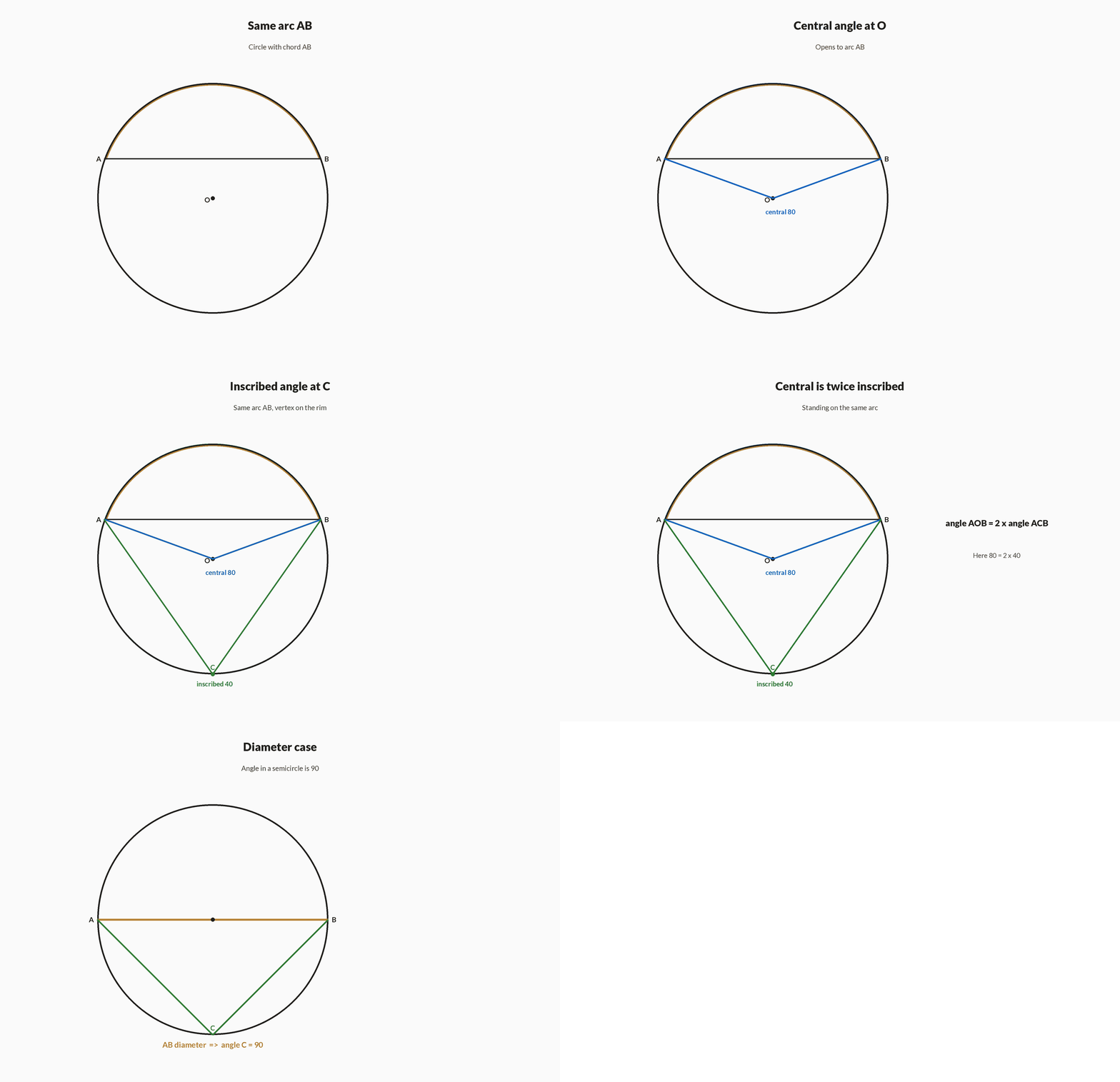
Halving the central angle
- Identify the arcBoth angles must intercept the same arc — the chord endpoints match.
- Locate the verticesCentral angle: vertex at the centre. Inscribed angle: vertex on the circle.
- Apply the half ruleInscribed = \dfrac{1}{2} \times central when the central angle is given.
Inscribed angle from a central angle
A central angle intercepting arc AB measures 80^\circ. Find an inscribed angle on the same arc.
- Inscribed = \dfrac{1}{2} \times central\dfrac{1}{2} \times 80^\circ
- Compute40^\circ
Pro tip. For inscribed-angle problems, remember the central angle is twice any inscribed angle on the same arc — halving is faster than hunting similar triangles around the circle.
An inscribed angle on an arc measures 35^\circ. The central angle on the same arc is
- 17.5^\circ
- 70^\circ
- 35^\circ
Central = 2 \times inscribed = 2 \times 35^\circ = 70^\circ. Halving instead of doubling gives 17.5^\circ, the direction error this rule is meant to catch.
7Similar triangles and area scale
Two triangles are similar when their corresponding angles are equal; then corresponding sides are proportional. If the side-length ratio is k : 1, every linear measure scales by k — but area scales by k^2 because area is two-dimensional.
A SAT question that gives two similar triangles and asks for an area ratio wants the square of the side ratio, not the side ratio itself. Set up \dfrac{A_1}{A_2} = \left(\dfrac{s_1}{s_2}\right)^2 once the matching sides are identified.
Figure. Linear scale k multiplies lengths; area scales as k squared.
Area from side ratio
- Match corresponding sidesPair sides opposite equal angles — never cross-match.
- Form the linear ratioWrite s_1 : s_2 for one pair of corresponding sides.
- Square for areaArea ratio = (s_1/s_2)^2.
Area ratio from sides 3 and 6
Two similar triangles have corresponding sides 3 and 6. Find the ratio of their areas (smaller : larger).
- Linear ratio = 3 : 6 = 1 : 2k = 2
- Area ratio = k^21 : 4
Pro tip. Similar-triangle area questions on the SAT almost always trap the linear ratio — squaring once beats computing both areas with \frac{1}{2}bh.
Similar triangles have corresponding sides in ratio 2:5. The ratio of their areas (smaller : larger) is
- 2:5
- 4:25
- 25:4
Area ratio = (2/5)^2 = 4/25. The value 2:5 is the side ratio; 25:4 inverts both the square and the order.
Notes
- Right Triangle Trigonometry: In a right triangle, \sin\theta = \frac{\text{opp}}{\text{hyp}}, \cos\theta = \frac{\text{adj}}{\text{hyp}}, \tan\theta = \frac{\text{opp}}{\text{adj}} (SOH-CAH-TOA).
- Pythagorean Theorem: For legs a,b and hypotenuse c, a^2+b^2=c^2; common triples include 3-4-5 and 5-12-13.
- Circle Relationships: Circumference =2\pi r, area =\pi r^2; an inscribed angle is half its central angle on the same arc.
- Similar Triangles: Corresponding angles equal and sides proportional; the ratio of areas equals the square of the ratio of side lengths.
Formulas
- Pythagorean theorem: a^2 + b^2 = c^2
- SOH-CAH-TOA: \sin\theta=\frac{opp}{hyp},\ \cos\theta=\frac{adj}{hyp},\ \tan\theta=\frac{opp}{adj}
- Circle: C = 2\pi r, A = \pi r^2
- Cofunction identity: \sin\theta = \cos(90^\circ - \theta)
- Arc length: s = r\theta (with \theta in radians); sector area =\frac{1}{2}r^2\theta
Exam traps & shortcuts
- Recognize special right triangles (30-60-90 with sides 1:\sqrt3:2 and 45-45-90 with 1:1:\sqrt2) to skip the Pythagorean calculation.
- Use \sin\theta = \cos(90^\circ-\theta) to link complementary angles quickly in trig questions.
- For inscribed-angle problems, remember the central angle is twice any inscribed angle on the same arc.
Recap
Night-before pegs for geometry and trigonometry on the Digital SAT.
- Right triangles
- a^2 + b^2 = c^2 on legs and hypotenuse; spot 3-4-5 and 5-12-13 multiples before squaring.
- Trig
- Label opposite, adjacent, and hypotenuse relative to the named angle — then SOH-CAH-TOA. \sin\theta = \cos(90^\circ - \theta) swaps complements.
- Special ratios
- 30-60-90 is 1:\sqrt{3}:2; 45-45-90 is 1:1:\sqrt{2}. Scale all three sides by the same factor.
- Circles
- C = 2\pi r, A = \pi r^2 — halve diameter before substituting. Inscribed angle on an arc is half the central angle on that arc.
- Similarity
- Equal angles imply proportional sides; area ratio is the square of the side ratio.
Practise Geometry and Trigonometry
Reading is free and needs no account. Practice, mocks and progress live in the app.
- 5 exam-style questions on this topic, with explanations
- A 6-question practice set that ends the chapter
- Timed mocks scored with the real marking scheme
- Readiness tracked per topic, kept on your device