CAT (Common Admission Test) · Advanced Quantitative Aptitude
Geometry and Coordinate Geometry
Triangles, circles, polygons, similarity and the coordinate plane.
Seven concepts — because triangle rules, similarity scaling, circle theorems and coordinate tools are four different question types in CAT geometry, and each one has a trap the options lean on.
- CAT (Common Admission Test)
- Hard level
- 7 concepts
- 21 practice questions
1Triangle rules and the inequality
Every triangle's interior angles sum to 180^\circ, and that is the check when an exterior-angle question hands you two remote interior angles. The harder gate is the triangle inequality: each side must be less than the sum and greater than the difference of the other two. A set of three lengths either fails that test outright or forms exactly one triangle — there is no middle ground.
Figure. The three interior angles at the vertices sum to a straight angle around one point — that is the 180^\circ rule in one glance.
How it works
- Angle sumTwo known interior angles leave 180^\circ minus their sum for the third.
- Pick the longest sideCompare it with the sum of the other two — that is the only comparison you need.
- Strict inequalityEquality (a+b=c) gives a degenerate straight line, not a triangle with area.
Do these lengths close?
Can a triangle have sides 3, 4, and 8?
- Sum of the two shorter sides: 3+47
- Compare with the longest side: 7 vs 87 < 8
- Triangle inequalityfails — no triangle
Pro tip. Always test the longest side against the sum of the other two. If that passes, the other two comparisons pass automatically.
Which set of side lengths can form a triangle?
- 5, 12, 18
- 7, 10, 3
- 4, 5, 6
4+5=9>6, 4+6=10>5, and 5+6=11>4 — all three inequalities hold. For 5,12,18 the sum 17 is less than 18. For 7,10,3 we get 7+3=10, which is not strictly greater than 10.
2Similar triangles and area scaling
Triangles with equal corresponding angles have proportional sides: if the side ratio is k, every corresponding length scales by k. Areas scale as k^2, because area is two-dimensional. That square is the whole shortcut — a 2:3 side ratio gives a 4:9 area ratio without touching the heights.
Figure. Corresponding sides are in ratio 3:4, so the areas stand in ratio 9:16 — square the side ratio, do not multiply it by anything else.
How it works
- Match anglesEstablish similarity from equal angles, parallel lines or shared angles.
- Side ratio firstRead or compute the ratio of one pair of corresponding sides.
- Square for areaMultiply the area ratio by itself, or take the square root of an area ratio to recover sides.
From areas to sides
Two similar triangles have areas 45 and 80. Find the ratio of their corresponding sides.
- Area ratio =\dfrac{45}{80}\dfrac{9}{16}
- Side ratio =\sqrt{\text{area ratio}}\dfrac{3}{4}
- Corresponding sides3:4
Pro tip. Take the square root of the area ratio to get the side ratio; never divide the areas directly when the question asks for lengths.
Two similar triangles have corresponding sides in ratio 2:5. The ratio of their areas is
- 2:5
- 4:25
- \sqrt{2}:\sqrt{5}
Area scales as the square of the linear ratio, so (2/5)^2 = 4/25. 2:5 is the side ratio itself, and \sqrt{2}:\sqrt{5} would be the ratio of square roots of sides — not areas.
3Circle angle theorems
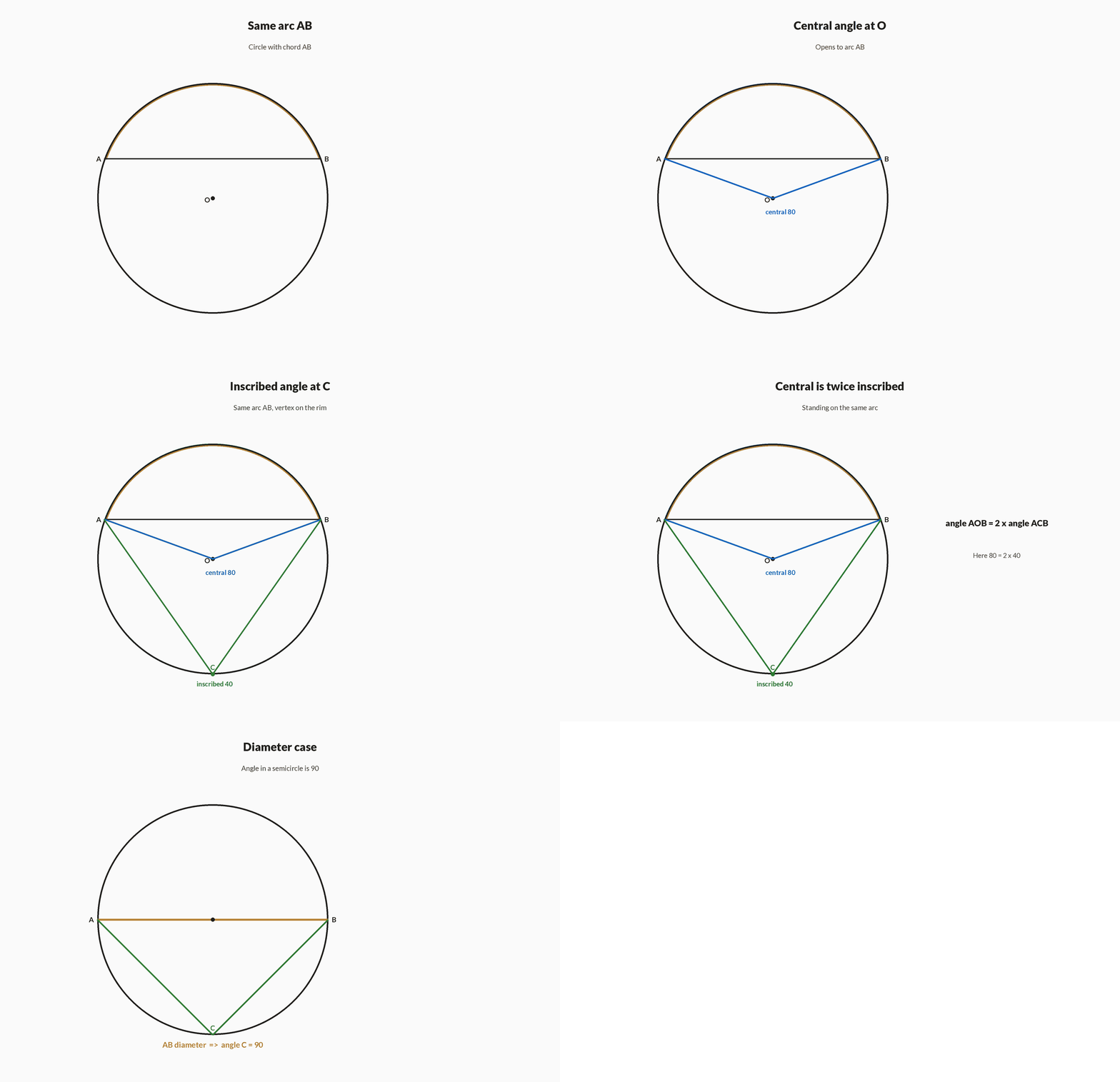
The angle a chord subtends at the centre is twice the angle it subtends at any point on the circumference on the same side of the chord. Angles in the same segment — standing on the same arc — are equal. These two facts convert a circle question into a triangle or similarity chase once you mark the equal angles.
How it works
- Centre vs circumferenceA central angle is double any inscribed angle on the same arc.
- Same segmentTwo inscribed angles on one arc are equal — mark them before you write any ratio.
- Diameter shortcutAn angle in a semicircle is 90^\circ, because the central angle over a diameter is 180^\circ.
In a circle, chord AB subtends 60^\circ at the centre. The inscribed angle ACB on the same side of AB is
- 120^\circ
- 60^\circ
- 30^\circ
An inscribed angle is half the central angle on the same arc, so 60^\circ/2 = 30^\circ. 120^\circ doubles instead of halving, and 60^\circ ignores the centre–circumference distinction.
4Distance and section on the plane
The distance between (x_1,y_1) and (x_2,y_2) is \sqrt{(x_2-x_1)^2+(y_2-y_1)^2} — Pythagoras on the horizontal and vertical legs. A point dividing the segment in ratio m:n is \left(\dfrac{mx_2+nx_1}{m+n},\dfrac{my_2+ny_1}{m+n}\right); the weight on the second endpoint is always the first ratio part m. To test whether a point lies inside a circle centred at (h,k), compare (x-h)^2+(y-k)^2 with r^2 instead of plotting.
Figure. The horizontal leg is 4-1=3, the vertical leg is 6-2=4, and the segment joining the points is the hypotenuse 5 of a 3-4-5 triangle.
How it works
- DistanceSubtract coordinates, square the differences, add, square-root.
- SectionWeight each coordinate by the ratio part on the opposite endpoint: m on (x_2,y_2), n on (x_1,y_1).
- Inside a circleInside when (x-h)^2+(y-k)^2 < r^2; on the circle when equal; outside when greater.
A hidden 3-4-5
Find the distance between (1,2) and (4,6).
- d=\sqrt{(4-1)^2+(6-2)^2}\sqrt{9+16}
- Recognise the triple\sqrt{25}=5
- Distance5
Pro tip. Watch for hidden Pythagorean triples like 3-4-5; the distance then falls out without a calculator.
The point dividing the join of (2,1) and (8,7) in ratio 1:2 (from the first point) is
- (4,3)
- (5,4)
- (6,5)
x=\dfrac{1\cdot8+2\cdot2}{3}=4 and y=\dfrac{1\cdot7+2\cdot1}{3}=3, so (4,3). (5,4) swaps the weights, and (6,5) uses ratio 2:1 from the wrong end.
5Heron's formula
When only the three side lengths are known, Heron's formula gives the area: A=\sqrt{s(s-a)(s-b)(s-c)} with s=\tfrac{a+b+c}{2}. The 13-14-15 triangle with area 84 appears often enough that recognising it saves the entire calculation.
Figure. Only the three side lengths are given — no height — so Heron's formula is the direct route to area 84.
How it works
- Semi-perimeterAdd the three sides and halve to get s.
- The four factorsCompute s, s-a, s-b, s-c before multiplying under the root.
- Square-root lastMultiply the four factors, then take the square root once.
The CAT favourite
Find the area of a triangle with sides 13, 14, and 15.
- s=\dfrac{13+14+15}{2}21
- A=\sqrt{21(21-13)(21-14)(21-15)}\sqrt{21\cdot8\cdot7\cdot6}
- Product inside7056, so A=84
Pro tip. The 13-14-15 triangle with area 84 is a CAT favourite — recognising it saves the whole calculation.
A triangle has sides 5, 12, and 13. Its area is
- 30
- 78
- 65
It is a right triangle (5^2+12^2=13^2), so A=\tfrac12\cdot5\cdot12=30. Heron also gives s=15, A=\sqrt{15\cdot10\cdot3\cdot2}=30. 78 is the perimeter and 65 is a side length.
6Pythagorean triples and right-triangle shortcuts
Memorising 3-4-5, 5-12-13, 8-15-17, and 7-24-25 collapses many distance and right-triangle questions. In any right triangle, the median to the hypotenuse equals half the hypotenuse — a length fact that bypasses coordinate work when the right angle is marked.
Figure. A 3-4-5 right triangle drawn to scale (legs in screen ratio 4:3). Multiples 6-8-10, 9-12-15 are the same shape; median to the hypotenuse is still half of 5.
How it works
- Spot the tripleIf two legs match a memorised pair, the hypotenuse follows without squaring.
- ScaleMultiplying a triple by k gives another triple — (6,8,10) from (3,4,5).
- Median to hypotenuseThe median from the right angle to the hypotenuse has length half the hypotenuse.
| Triple | Triple | Triple |
|---|---|---|
| 3-4-5 | 5-12-13 | 8-15-17 |
| 7-24-25 | 9-12-15 | 12-16-20 |
In a right triangle, the hypotenuse is 10. The median from the right angle to the hypotenuse has length
- 5
- 10
- 2\sqrt{5}
The median to the hypotenuse in a right triangle is exactly half the hypotenuse, so 10/2=5. 10 is the full hypotenuse, and 2\sqrt{5} would be a leg in a 6-8-10 triangle.
7Slopes and perpendicular lines
The slope through (x_1,y_1) and (x_2,y_2) is m=\dfrac{y_2-y_1}{x_2-x_1}. Two non-vertical lines are perpendicular when m_1m_2=-1 — flip the slope and change the sign. A horizontal line has slope 0; a vertical line has undefined slope, and no finite slope satisfies m\cdot(undefined)=-1.
Figure. The two lines cross at right angles because their slopes are negative reciprocals — multiply them and you get -1.
How it works
- Rise over runSubtract coordinates in the same order top and bottom.
- Negative reciprocalA slope of 4/3 pairs with -3/4 for a perpendicular.
- Product testMultiply the two slopes — perpendicular lines give -1.
Perpendicular slope
Find the slope of the line through (1,2) and (4,6), and the slope of any line perpendicular to it.
- m=\dfrac{6-2}{4-1}\dfrac{4}{3}
- Perpendicular slope =-\dfrac{1}{m}-\dfrac{3}{4}
- Check: \dfrac{4}{3}\cdot\left(-\dfrac{3}{4}\right)-1
Pro tip. Before writing the equation of a perpendicular, compute the slope of the given line once and stop — the perpendicular slope is the negative reciprocal.
A line has slope -\tfrac{2}{5}. A perpendicular line has slope
- \tfrac{5}{2}
- \tfrac{2}{5}
- -\tfrac{5}{2}
Perpendicular slopes multiply to -1, so the partner of -2/5 is 5/2. \tfrac{2}{5} forgets the sign flip, and -\tfrac{5}{2} flips the sign twice.
Notes
- Triangle basics: the interior angles sum to 180^\circ, and by the triangle inequality any side is less than the sum and greater than the difference of the other two.
- Similarity: triangles with equal corresponding angles have proportional sides, so the ratio of their areas equals the square of the ratio of corresponding sides.
- Circle theorems: the angle a chord subtends at the centre is twice the angle it subtends at the circumference, and angles in the same segment are equal.
- Coordinate tools: the distance between two points is \sqrt{(x_2-x_1)^2+(y_2-y_1)^2}, and a point dividing a segment in ratio m:n is found by the section formula.
- Pythagorean triples: memorizing 3\text{-}4\text{-}5, 5\text{-}12\text{-}13, 8\text{-}15\text{-}17, and 7\text{-}24\text{-}25 shortcuts many right-triangle problems.
Formulas
- Distance: d=\sqrt{(x_2-x_1)^2+(y_2-y_1)^2}
- Section formula: \left(\frac{mx_2+nx_1}{m+n},\frac{my_2+ny_1}{m+n}\right)
- Heron's area: A=\sqrt{s(s-a)(s-b)(s-c)},\ s=\frac{a+b+c}{2}
- Area from coordinates: A=\frac12|x_1(y_2-y_3)+x_2(y_3-y_1)+x_3(y_1-y_2)|
- Slopes: m=\frac{y_2-y_1}{x_2-x_1}, and perpendicular lines satisfy m_1m_2=-1
- Radii: inradius r=\frac{A}{s}, circumradius R=\frac{abc}{4A}
Exam traps & shortcuts
- Similar-triangle areas scale as the square of the side ratio, so a 2:3 side ratio gives a 4:9 area ratio at once.
- To place a point relative to a circle, compare (x-h)^2+(y-k)^2 with r^2 instead of plotting.
- In a right triangle, the median to the hypotenuse is exactly half the hypotenuse — an instant length shortcut.
- An equilateral triangle of side a has area \frac{\sqrt3}{4}a^2 and height \frac{\sqrt3}{2}a; keep both memorized.
Reference tables
The formulas and triples that recur once coordinates, similarity or radii enter the question.
| Topic | Formula |
|---|---|
| Distance | d=\sqrt{(x_2-x_1)^2+(y_2-y_1)^2} |
| Section (m:n) | \left(\dfrac{mx_2+nx_1}{m+n},\dfrac{my_2+ny_1}{m+n}\right) |
| Heron | A=\sqrt{s(s-a)(s-b)(s-c)}, s=\tfrac{a+b+c}{2} |
| Coordinate area | A=\tfrac12|x_1(y_2-y_3)+x_2(y_3-y_1)+x_3(y_1-y_2)| |
| Inradius | r=\dfrac{A}{s} |
| Circumradius | R=\dfrac{abc}{4A} |
| Equilateral side a | Area \tfrac{\sqrt3}{4}a^2, height \tfrac{\sqrt3}{2}a |
| Pythagorean triples | 3-4-5, 5-12-13, 8-15-17, 7-24-25; median to hypotenuse =c/2 |
Recap
Read only this the night before.
- Inequality
- Test the longest side against the sum of the other two — strict inequality, not equality.
- Similarity
- Side ratio k gives area ratio k^2. Square-root an area ratio to recover sides.
- Circles
- Central angle is double the inscribed angle on the same arc; same-segment angles match.
- Coordinates
- Distance is Pythagoras on \Delta x and \Delta y. Section weights m on the second point.
- Heron
- 13-14-15 has area 84. Compute s first, then the four factors under the root.
- Triples
- 3-4-5 and its multiples hide inside distance questions. Median to hypotenuse is half the hypotenuse.
- Slopes
- Perpendicular slopes multiply to -1. Flip and negate.
Practise Geometry and Coordinate Geometry
Reading is free and needs no account. Practice, mocks and progress live in the app.
- 21 exam-style questions on this topic, with explanations
- A 9-question practice set that ends the chapter
- Timed mocks scored with the real marking scheme
- Readiness tracked per topic, kept on your device