CAT (Common Admission Test) · Advanced Quantitative Aptitude
Time, Speed and Distance
Relative speed, trains, boats and streams, races and circular motion.
Eight ideas under one relation: distance is speed times time. Everything else in the chapter — units, averages, relative motion, trains, boats, circular tracks and the late/early trick — is that identity with one quantity held fixed and another read off.
- CAT (Common Admission Test)
- Medium level
- 8 concepts
- 21 practice questions
1Distance is speed times time
The whole chapter is one identity: \text{Distance}=\text{Speed}\times\text{Time}. Rearrange it for whichever quantity is asked, and keep every quantity in one unit system before you multiply.
When the distance is fixed, speed and time are inversely proportional. If speed becomes \frac{3}{4} of usual, time becomes \frac{4}{3} of usual — the product is the same journey, so the factors must multiply to 1.
Figure. Length is speed and thickness is time, so each rectangle's area is the same 120 km journey. Shorten the speed bar to three-quarters and the time thickness must grow to four-thirds or the area — the distance — would change.
How it works
- Name what is fixedA named route, a scheduled arrival, a race distance — that is the quantity that does not change when the speed does.
- Write D = S × T onceFill the two knowns and solve for the third. Do not average speeds unless the next concept says you may.
- Scale by the inverse factorIf speed is multiplied by k, time is multiplied by 1/k. Checking that the product of the two factors is 1 catches most slips.
Speed falls to three-quarters
A journey of 120 km is usually done at 60 km/h. If the speed falls to \frac{3}{4} of usual, how long does the journey take?
- Usual time = 120/602 h
- New speed = (3/4) × 6045 km/h
- New time = 120/458/3 h
- Inverse check: (3/4) × (4/3) of 2 h8/3 h
Pro tip. The inverse check is faster than re-dividing whenever the speed change is given as a fraction of usual. Write the reciprocal factor first; if the two factors do not multiply to 1 you have already misread the question.
A fixed route takes 3 hours at the usual speed. If the speed is raised to 6/5 of usual, the time taken is
- 2.5 hours
- 3.6 hours
- 2 hours
Distance fixed, so time scales by the reciprocal 5/6: (5/6) × 3 = 2.5 hours. 3.6 multiplies by 6/5 instead of dividing, and 2 would need the speed to rise by 50%, not 20%.
2Convert before you divide
Train lengths arrive in metres and speeds in km/h. Dividing one by the other without converting produces a number with no meaning. Convert first: multiply km/h by \frac{5}{18} to get m/s, or multiply m/s by \frac{18}{5} to get km/h.
The direction of the conversion is a size check. A speed in m/s must be smaller than the same speed in km/h; if the number grew, the fraction was applied backwards.
Figure. Convert before you divide: km/h → m/s multiplies by 5/18, so the number must shrink (90 → 25). The reverse factor 18/5 grows the number — if your m/s reading came out larger than the km/h figure, the fraction ran backwards (the 324 trap on 90 km/h).
How it works
- Pick the unit the lengths useMetres with metres. If the answer is wanted in km/h, convert back only at the end.
- Multiply by 5/18 or 18/5km/h → m/s is × 5/18. The other way is × 18/5. The number must shrink going to m/s.
- Then divideDistance over speed, now in matching units, is the time.
Metres and seconds to km/h
A vehicle covers 540 m in 27 seconds. Find its speed in m/s and in km/h.
- 540 ÷ 2720 m/s
- 20 × 18/572 km/h
- Check: 72 × 5/1820 m/s
- Reference pair20 m/s ↔ 72 km/h
Pro tip. Carry the pairs 5↔18, 10↔36, 15↔54, 20↔72 and 25↔90. An examiner who wants a whole-number answer almost always picks from that list, so recognising 20 m/s as 72 km/h skips the fraction entirely.
A train travels at 90 km/h. Its speed in metres per second is
- 25
- 324
- 18
90 × 5/18 = 25 m/s. 324 is 90 × 18/5 — the conversion run backwards — and no train covers 324 metres in a second. 18 drops the 5 from the fraction.
3Average speed is not an average of speeds
Average speed is total distance over total time, always. Over two equal distances at x and y that is the harmonic mean \frac{2xy}{x+y} — never \frac{x+y}{2}, because more time is spent on the slower leg.
The arithmetic mean is right when the times are equal instead. So the question is which quantity the problem holds equal — the distances or the durations — not which formula to memorise.
Figure. The outward leg is the shallower segment (50 km/h for three hours) and the return the steeper one (75 km/h for two). The dashed line is a car driven at a constant 60 km/h between the same endpoints — the definition of the average. More of the five hours sits under the shallow slope, which is why 60 lies below the midpoint of 50 and 75.
How it works
- Read what is equal"There and back" or "each half of the journey" means equal distances. "For two hours, then for three" means times.
- Total distance and total time separatelyAssume a convenient distance if none is given — the average does not depend on it.
- Divide once, at the endTotal distance ÷ total time. Never average the two speeds and hope.
There at 50, back at 75
A car goes from P to Q at 50 km/h and returns at 75 km/h. Find its average speed for the whole journey.
- Take one-way distance 150 km; out: 150/503 h
- Back: 150/752 h
- 300 km in 5 h60 km/h
- Formula: 2 × 50 × 75 / 12560 km/h
Pro tip. 150 was chosen because it divides by both speeds. Any distance gives the same 60, so pick the LCM of the two speeds and skip the fractions. The answer sits below the midpoint 62.5 and closer to the slower speed — true of every harmonic mean, and enough to kill the arithmetic-mean trap before you compute.
A car covers the first half of a journey at 40 km/h and the second half at 60 km/h. Its average speed is
- 48 km/h
- 50 km/h
- 52 km/h
Equal distances, so the harmonic mean: 2 × 40 × 60/100 = 48 km/h. 50 is the arithmetic mean, right only for equal times. The answer must sit below 50 because more of the journey's time is spent at 40.
4Relative speed
Sit on one of the two moving objects and ask how fast the other seems to approach. Moving towards each other, the speeds add; moving the same way, they subtract. Every overtaking, meeting and crossing problem is that sentence plus a distance.
The two cases differ by a large factor. Two bodies at 60 and 40 km/h close at 100 km/h head-on and at only 20 km/h in the same direction — five times slower, so five times longer to pass, for the same pair.
Figure. Both bars are the relative speed of the same 60 km/h and 40 km/h pair. Opposite directions stack the speeds into 100; the same direction leaves only the 20 km/h difference — one-fifth as long, which is why an overtaking pass takes five times as long as a head-on one.
How it works
- Add or subtract the speedsTowards each other: u + v. Same direction: |u − v|, faster minus slower.
- Name the distance to closeFor objects with length, the sum of the lengths; for points, the gap between them.
- Divide in matching unitsConvert the relative speed to m/s if the lengths are in metres, then divide.
Two trains, both ways
Trains of length 100 m and 150 m travel at 60 km/h and 40 km/h. How long does each take to pass the other, running in opposite directions and then in the same direction?
- Opposite: 60 + 40 = 100 km/h = 100 × 5/18250/9 m/s
- Distance to clear = 100 + 150250 m
- 250 ÷ (250/9)9 s
- Same direction: 20 km/h = 50/9 m/s, so 250 ÷ (50/9)45 s
Pro tip. The ratio of the two answers is exactly 5 — and so is 100 : 20. The distance never changed, so the times are in the inverse ratio of the relative speeds. Once you have one answer the other is a single multiplication.
A train 150 m long overtakes a man walking at 6 km/h in the same direction, taking 15 seconds to pass him. The train's speed is
- 42 km/h
- 36 km/h
- 30 km/h
Relative speed = 150/15 = 10 m/s = 36 km/h. That is the difference of the speeds, so the train does 36 + 6 = 42 km/h. Stopping at 36 answers the relative speed rather than the train's; subtracting instead of adding gives 30.
5What distance does a train actually cover?
A train passing a pole covers its own length, because the pole has none. A train crossing a platform covers its own length plus the platform's, because the rear must clear the far end before the crossing is complete.
Give the pole time and the platform time and the difference between them is the platform's length divided by the speed — two facts, two unknowns, and almost no algebra.
Figure. The same train is drawn twice — at the start of the crossing and at the end. Between those positions it has moved its own 200 m plus the platform's 300 m, which is the long bracket. Shrink the platform to a point and only the train's length remains: the pole case.
How it works
- Decide what has lengthA pole, a man, a signal: no length. A platform, a bridge, a tunnel, another train: length counts.
- Add the lengths that countDistance = train + object. For a pole that is just the train.
- Divide by the speed in m/sConvert first. A km/h figure divided into metres is meaningless.
Train crossing a platform
A train 200 m long crosses a 300 m platform in 25 seconds. Find its speed in km/h.
- Total distance = 200 + 300500 m
- Speed = 500/2520 m/s
- 20 × 18/572 km/h
- Check: 72 × 5/1820 m/s
Pro tip. When a train passes a platform, always add both lengths; forgetting the train's own length is the classic slip. The same addition applies to a bridge, a tunnel, or another train.
A train crosses a pole in 12 seconds and a 180 m platform in 24 seconds. Its length is
- 180 m
- 240 m
- 120 m
The extra 12 seconds buy exactly the platform's 180 m, so the speed is 15 m/s; in the 12 seconds against the pole the train covers its own length, 12 × 15 = 180 m. The train happens to match the platform, which is what makes the other options look plausible.
6Boats and streams
Downstream the current adds to the boat; upstream it subtracts. If b is the boat's speed in still water and s the stream's, downstream is b+s and upstream is b-s. Solving the other way: b=\frac{\text{down}+\text{up}}{2} and s=\frac{\text{down}-\text{up}}{2}.
A round trip on a stream is an equal-distance average-speed problem in disguise. The harmonic mean of the downstream and upstream speeds is the average for the out-and-back, and it is always less than b.
Figure. Downstream and upstream sit equally far above and below the boat's still-water speed — 2.5 km/h either side of 12.5 — which is why averaging them recovers b and halving their gap recovers s. The stream bar is the common offset.
How it works
- Read the two speeds off the timesDownstream speed = distance / downstream time; upstream likewise.
- Average for the boat, halve the gap for the streamb = (down + up)/2 and s = (down − up)/2. Both come out in the same unit as the two speeds.
- Refuse a negative streamIf upstream came out faster than downstream, the legs were swapped — fix the labels before trusting either number.
Boat speed and stream speed
A boat covers 30 km downstream in 2 hours and returns upstream in 3 hours. Find the speed of the boat in still water and of the stream.
- Downstream = 30/215 km/h
- Upstream = 30/310 km/h
- Boat b = (15 + 10)/212.5 km/h
- Stream s = (15 − 10)/22.5 km/h
Pro tip. Boat speed is the average of downstream and upstream; stream speed is half their difference. Checking b > s > 0 (and down = b + s, up = b − s) catches a swapped pair in one line.
Downstream speed is 18 km/h and upstream is 12 km/h. The speed of the stream is
- 3 km/h
- 6 km/h
- 15 km/h
s = (18 − 12)/2 = 3 km/h. 6 is the full difference without halving; 15 is the boat speed (18 + 12)/2, which the question did not ask for.
7Meeting on a circular track
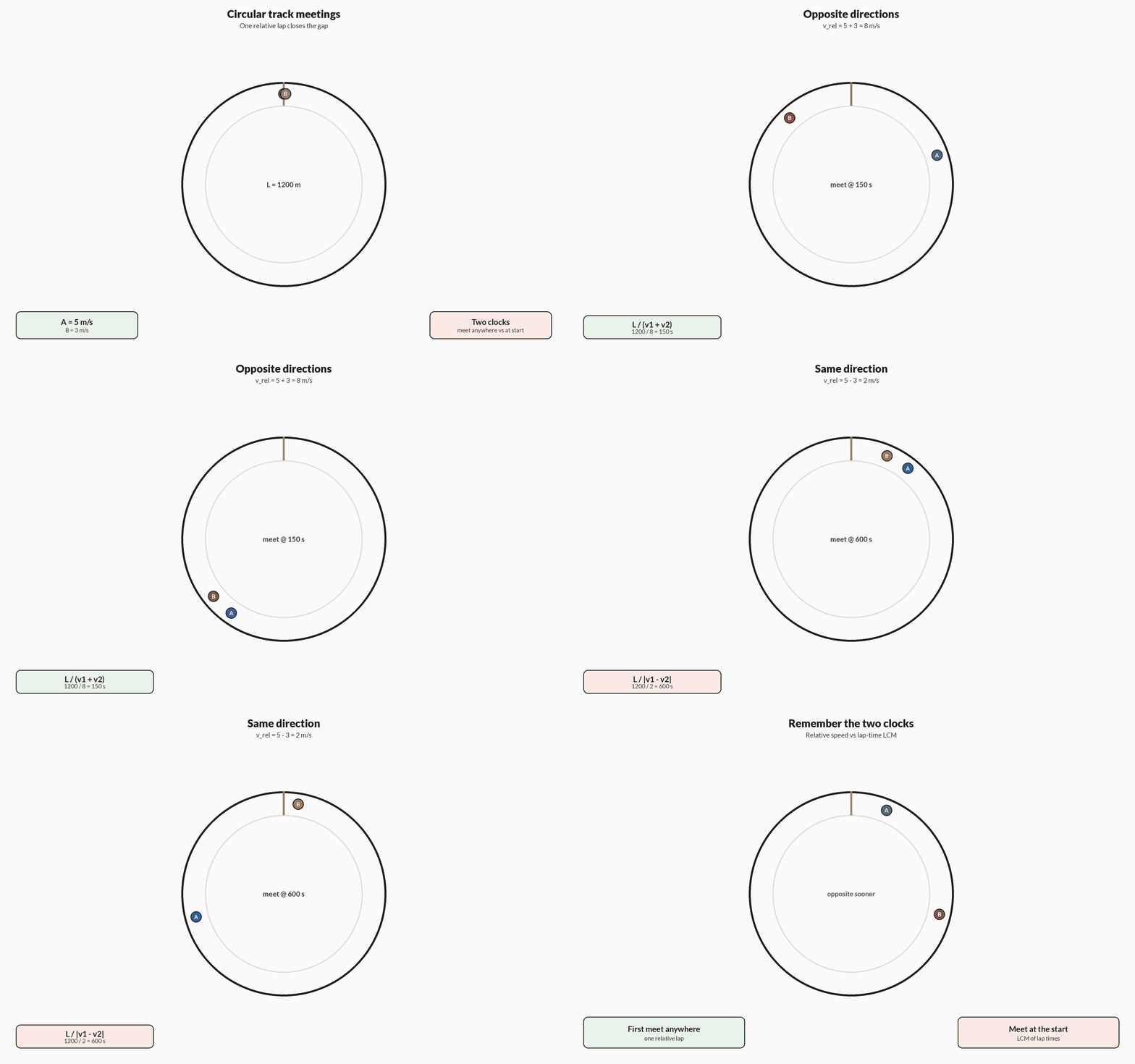
On a circular track of length L, two runners first meet when together they have covered one full lap relative to each other. Opposite directions: meeting time =\frac{L}{v_1+v_2}. Same direction: meeting time =\frac{L}{|v_1-v_2|}.
They next meet at the starting point after the LCM of their individual lap times. First meeting anywhere and next meeting at the start are different clocks — the first uses relative speed, the second uses each runner's own lap.
How it works
- Choose add or subtractOpposite directions add the speeds; the same direction subtracts them. That is the relative speed around the track.
- Divide the lap length by itFirst meeting time = L / v_rel. Keep L and the speeds in matching units.
- For a start-line reunion, take lap-time LCMEach runner's lap time is L/v. They are both at the start together at every common multiple of those times.
First meeting, both ways
Two runners on a 1200 m circular track run at 5 m/s and 3 m/s. When do they first meet, running in opposite directions and then in the same direction?
- Opposite: v_rel = 5 + 38 m/s
- First meet = 1200/8150 s
- Same direction: v_rel = 5 − 32 m/s
- First meet = 1200/2600 s
Pro tip. Their lap times are 240 s and 400 s, so they next coincide at the start after LCM(240, 400) = 1200 s — whether they run the same way or opposite. That 1200 s is not the first meeting; first meeting is the relative-speed calculation above.
On an 800 m circular track, A and B run at 4 m/s and 6 m/s in opposite directions. They first meet after
- 80 s
- 200 s
- 133.3 s
Relative speed 10 m/s, so 800/10 = 80 s. 200 s is the same-direction meeting (800/2); 133.3 s is one runner's lap time and answers the wrong question.
8Late or early at two speeds
When a journey at speed v_1 finishes late by t_1 and the same journey at v_2 finishes early by t_2, the two distance expressions share the scheduled time. Equating them solves for the distance in one step: \frac{D}{v_1}-\frac{D}{v_2}=t_1+t_2 when v_2>v_1.
The scheduled duration itself drops out. You never need to know what time the traveller was supposed to arrive — only how late and how early the two trials were.
Figure. Times in tenths of an hour for the 80 km worked example: 2.0 h is 12 min late, 1.6 h is 12 min early. Both offsets are measured from the schedule rule, so they add: 0.2+0.2=0.4 h is the gap that unlocks D. Bars are to a common time scale.
How it works
- Write both trial timesD/v₁ is late by t₁; D/v₂ is early by t₂. Their difference is t₁ + t₂.
- Factor D outD(1/v₁ − 1/v₂) = t₁ + t₂, with times converted to hours if the speeds are in km/h.
- Solve for DOne multiplication. Check by recovering the scheduled time from either trial.
Twelve minutes either side
A man covers a distance at 40 km/h and is 12 minutes late. At 50 km/h over the same distance he is 12 minutes early. Find the distance.
- Time gap = 12 + 12 = 24 min0.4 h
- D(1/40 − 1/50) = 0.4D/200 = 0.4
- D = 0.4 × 20080 km
- Check: 80/40 = 2 h (12 min late ⇒ schedule 1 h 48 min); 80/50 = 1.6 h12 min early
Pro tip. The two offsets add even when one is late and one is early — both measure distance from the same schedule. Treating them as a difference of 0 minutes is the usual misread when the offsets look equal.
At 30 km/h a journey is 10 minutes late; at 40 km/h it is 10 minutes early. The distance is
- 40 km
- 35 km
- 20 km
D(1/30 − 1/40) = 20/60 = 1/3, so D/120 = 1/3 and D = 40 km. 20 km would fit a 10-minute total gap instead of 20; 35 is an arithmetic split of the two speeds and ignores the times.
Notes
- Core relation: \text{Distance}=\text{Speed}\times\text{Time}; for a fixed distance, speed and time are inversely proportional.
- Relative speed: Two bodies moving toward each other close the gap at the sum of their speeds; moving in the same direction, one overtakes the other at the difference.
- Trains: A train passing a pole covers just its own length; passing a platform or another train covers the sum of the two relevant lengths.
- Boats and streams: Downstream speed is b+s and upstream is b-s, so b=\frac{\text{down}+\text{up}}{2} and s=\frac{\text{down}-\text{up}}{2}.
- Average speed: Over equal distances, average speed is the harmonic mean \frac{2v_1v_2}{v_1+v_2}, never the arithmetic mean of the two speeds.
Formulas
- Basic relation: D=S\times T
- Average speed (equal distances): \bar{S}=\frac{2v_1v_2}{v_1+v_2}
- Relative speed (opposite): v_{\text{rel}}=v_1+v_2
- Stream speeds: b=\frac{d+u}{2},\ s=\frac{d-u}{2}
- Circular track, opposite directions: meeting time =\frac{L}{v_1+v_2}
- Unit conversion: 1\ \text{km/h}=\frac{5}{18}\ \text{m/s}
Exam traps & shortcuts
- Convert km/h to m/s by multiplying by \frac{5}{18} before any train or crossing problem to keep units consistent.
- Since route distance is fixed, use inverse proportion directly: if speed becomes \frac34 of usual, time becomes \frac43.
- On a circular track, two runners first meet after \frac{L}{|v_1\pm v_2|} and next meet at the start after the LCM of their individual lap times.
- For 'reaches late/early at different speeds' problems, equate the two distance expressions to solve for the distance in one step.
Reference tables
Multiply km/h by 5/18 for m/s and m/s by 18/5 for km/h. These five pairs cover most of what an examiner will choose, because they make the answer come out whole.
| km/h | m/s | Covers 1 km in |
|---|---|---|
| 18 | 5 | 3 min 20 s |
| 36 | 10 | 1 min 40 s |
| 54 | 15 | 1 min 6.7 s |
| 72 | 20 | 50 s |
| 90 | 25 | 40 s |
Every line here should be reconstructible from the concept above it, not merely recalled.
| Quantity | Relation | Watch for |
|---|---|---|
| Basic | D = S × T | One unit system throughout |
| Fixed distance | S ∝ 1/T | Factors multiply to 1 |
| km/h to m/s | × 5/18 | The number must get smaller |
| Average speed, equal distances | 2xy/(x + y) | Below the arithmetic mean, always |
| Average speed, equal times | (x + y)/2 | This is the case where averaging is right |
| Relative speed | u + v opposite, |u − v| same way | Same direction is far slower than it looks |
| Crossing a pole | own length ÷ speed | A pole, a man and a signal have no length |
| Crossing a platform | (train + platform) ÷ speed | Forgetting the train's length is the classic slip |
| Boat / stream | b = (d+u)/2, s = (d−u)/2 | Downstream must exceed upstream |
| Circular, opposite | L/(v₁ + v₂) | First meeting anywhere on the track |
| Circular, same way | L/|v₁ − v₂| | Start-line reunion is the LCM of lap times |
| Late / early | D(1/v₁ − 1/v₂) = t₁ + t₂ | The two offsets add; the schedule cancels |
Recap
Read only this the night before.
- Identity
- D = S × T. Fixed distance means speed and time are inverse — multiply one by k and the other by 1/k.
- Units
- km/h → m/s is × 5/18. Convert before dividing metres by a speed.
- Average
- Total distance over total time. Equal distances give 2xy/(x + y), below the mean and nearer the slower speed.
- Relative
- Add speeds head-on, subtract them going the same way. Times scale by the inverse of that ratio.
- Trains
- A pole costs the train's own length; a platform costs both lengths.
- Boats
- b is the average of down and up; s is half their difference.
- Circular
- First meet at L/v_rel. Next meet at the start at the LCM of the lap times.
- Late/early
- D(1/v₁ − 1/v₂) = t_late + t_early. The schedule cancels; the two offsets add.
Practise Time, Speed and Distance
Reading is free and needs no account. Practice, mocks and progress live in the app.
- 21 exam-style questions on this topic, with explanations
- A 9-question practice set that ends the chapter
- Timed mocks scored with the real marking scheme
- Readiness tracked per topic, kept on your device