CAT (Common Admission Test) · Advanced Quantitative Aptitude
Mensuration (2D and 3D)
Areas, perimeters, surface areas and volumes of plane and solid figures.
Eight concepts, because mensuration in CAT is not one formula sheet — it is plane areas you decompose, solids whose volume follows from a base and a height, the one-third rule for cones, spheres whose curved and flat parts are billed separately, melt-and-recast problems where \pi cancels, and the scaling law that turns a doubled radius into an eightfold volume. Every question is one of these ideas with the units moved somewhere you did not look.
- CAT (Common Admission Test)
- Medium level
- 8 concepts
- 21 practice questions
1The scaling law for lengths, areas and volumes
When every linear dimension of a solid is multiplied by k, lengths scale by k, areas by k^2, and volumes by k^3. The exam trap is treating volume like length: doubling the radius of a sphere multiplies its volume by eight, not two, because volume picks up three factors of k while radius carries only one.
The same rule governs every solid in the syllabus — cube, cylinder, cone, sphere — because each volume formula is a product of three linear measures. Halving every edge of a cube cuts its volume by 2^3 = 8, not by half.
Figure. Two cubes drawn to the same scale: the larger face is exactly twice as wide and twice as tall as the smaller one, so its volume is 2 \times 2 \times 2 = 8 times as much — not twice.
How it works
- Count the dimensionsA length uses one copy of k, an area two, a volume three — perimeter scales like length, surface area like area.
- Raise k to that powerTripling every edge multiplies volume by 3^3 = 27 and surface area by 3^2 = 9.
- Apply to the given changeIf only the radius doubles, read k = 2 and write the volume factor as 2^3 = 8 before touching a formula.
| k | Length × | Area × | Volume × |
|---|---|---|---|
| 2 | 2 | 4 | 8 |
| 3 | 3 | 9 | 27 |
| 1/2 | 1/2 | 1/4 | 1/8 |
Doubling a sphere's radius
A solid sphere of radius r is uniformly expanded so every linear dimension doubles. By what factor does its volume increase?
- Original volume V = \frac{4}{3}\pi r^3V
- New radius 2r, so V' = \frac{4}{3}\pi(2r)^3 = \frac{4}{3}\pi \cdot 8r^38V
- Volume factor V'/V8
Pro tip. You do not need \pi or r at all once you see k = 2: the answer is 2^3 = 8. That is why the legacy melt-and-recast examples cancel \pi — the scaling law already told you how many times larger the new solid is.
A cube's edge length is increased from 5 cm to 15 cm. The new volume is how many times the original?
- 3
- 9
- 27
The linear scale factor is 15/5 = 3, so volume scales by 3^3 = 27. The answer 3 treats volume like length; 9 is the area factor 3^2, which would govern a painted surface, not the bulk.
2Plane areas — rectangle, triangle, circle and sector
Every composite 2D figure in CAT decomposes into a handful of plane formulas: rectangle lb, triangle \frac12 bh, circle \pi r^2, equilateral triangle \frac{\sqrt3}{4}a^2, and sector area \frac{\theta}{360^\circ}\pi r^2 with arc length \frac{\theta}{360^\circ}\cdot 2\pi r. The skill is spotting which piece you have, not memorising a longer list.
Sectors appear whenever a wire is bent into an arc or a slice is cut from a circular disc. Read \theta in degrees unless the question states radians, and remember that arc length is a one-dimensional measure while sector area is two-dimensional — mixing them up is the commonest 2D trap after using diameter where radius belongs.
Figure. A rectangle and a triangle side by side: the rectangle's area is length times breadth; the triangle's is half base times height. Circles and sectors have no honest primitive here — their formulas sit in the table.
How it works
- Decompose the figureSplit a composite shape into rectangles, triangles, semicircles or sectors whose formulas you already know.
- Match the formulaA triangle wants base and height perpendicular; an equilateral triangle wants side a only; a sector wants central angle \theta and radius r.
- Add or subtract piecesShaded region = big area minus small area, or sum of non-overlapping parts — never double-count an overlap.
| Figure | Area | Also needs |
|---|---|---|
| Rectangle | lb | length and breadth |
| Triangle | \frac12 bh | base and height ⊥ |
| Circle | \pi r^2 | radius, not diameter |
| Equilateral △ | \frac{\sqrt3}{4}a^2 | side a alone |
| Sector | \frac{\theta}{360^\circ}\pi r^2 | arc = \frac{\theta}{360^\circ}\cdot 2\pi r |
Area of a sector
Find the area of a sector of radius 6 cm and central angle 120^\circ.
- Sector area = \frac{\theta}{360^\circ}\pi r^2 = \frac{120}{360}\pi(6)^2\frac13 \cdot 36\pi
- Simplify \frac{36\pi}{3}12\pi cm^2
- Arc length check: \frac{120}{360}\cdot 2\pi(6)4\pi cm
Pro tip. 120^\circ is one-third of a full turn, so the sector area is one-third of the whole disc: \frac13 \pi r^2. Spotting the fraction of 360^\circ before squaring saves arithmetic on every sector question.
An equilateral triangle has side 4 cm. Its area is
- 4\sqrt3 cm^2
- 8 cm^2
- 16 cm^2
A = \frac{\sqrt3}{4}(4)^2 = 4\sqrt3. The answer 8 comes from \frac12 \times 4 \times 4 and treats it like a right triangle; 16 is the square of the side with no \sqrt3 factor.
3Prisms and cylinders — volume and lateral surface
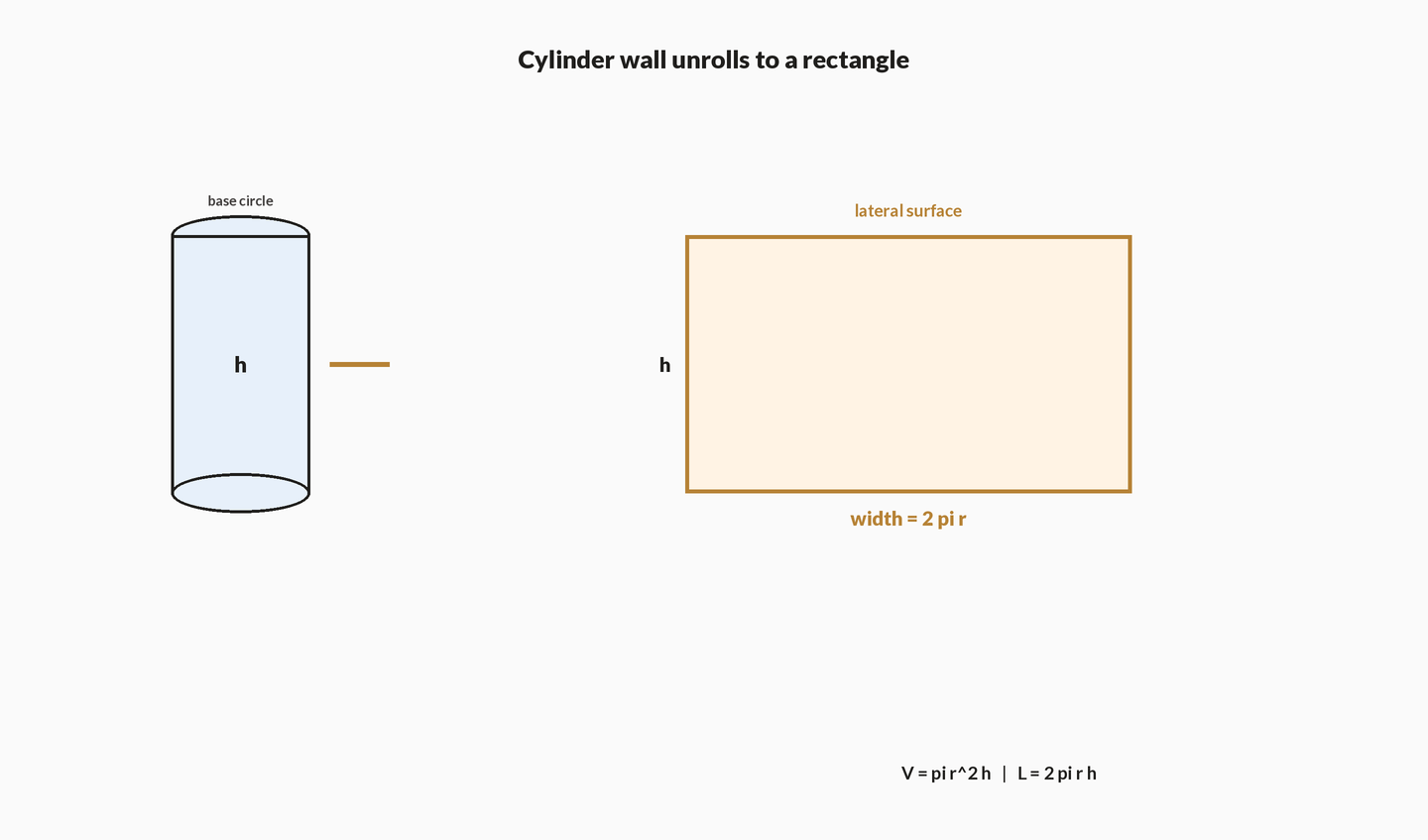
A prism and a cylinder share one idea: volume equals base area times height, V = A_{\text{base}} \times h. The lateral (curved) surface of a cylinder unwraps to a rectangle whose width is the base circumference 2\pi r and whose height is h, so lateral surface area is 2\pi r h.
Total surface area of a closed cylinder adds the two circular bases: TSA = 2\pi r h + 2\pi r^2 = 2\pi r(r + h). When a question asks only for the material on the curved wall — a label on a can, paint on the side of a pillar — it wants lateral surface, not TSA.
How it works
- Find the base areaFor a cylinder, A_{\text{base}} = \pi r^2; for a prism, use the cross-section formula.
- Multiply by heightV = A_{\text{base}} \times h — the height must be perpendicular to the base.
- Surface: lateral vs totalLateral = 2\pi r h for a cylinder; add 2\pi r^2 for both bases when the solid is closed.
| Quantity | Formula |
|---|---|
| Volume | V = \pi r^2 h |
| Lateral surface | 2\pi r h |
| Total surface | 2\pi r(r + h) |
Volume of a cylinder
A cylinder has radius 7 cm and height 10 cm. Find its volume.
- Base area = \pi r^2 = \pi(7)^249\pi
- Volume = 49\pi \times 10490\pi cm^3
- Lateral surface = 2\pi(7)(10)140\pi cm^2
Pro tip. Once you know r and h, write V = \pi r^2 h and LSA = 2\pi r h in one pass — many CAT questions give one and ask for the other with the same numbers.
A closed cylinder has radius 3 and height 5. Its total surface area is
- 30\pi
- 48\pi
- 24\pi
TSA = 2\pi r(r+h) = 2\pi(3)(8) = 48\pi. The answer 30\pi is lateral only (2\pi \cdot 3 \cdot 5); 24\pi forgets one base.
4Cones and pyramids — the one-third volume rule
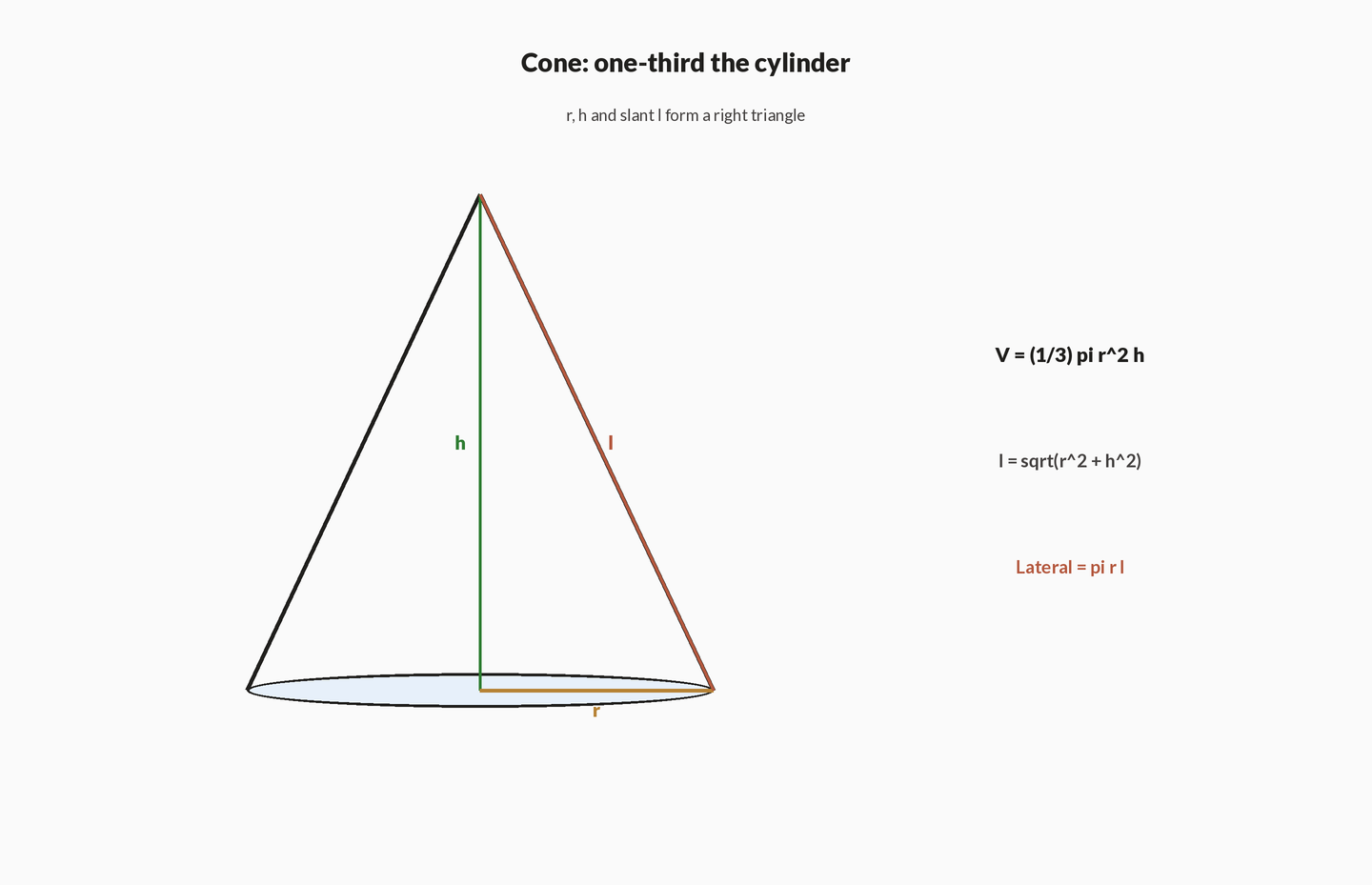
A cone or pyramid has volume one-third of the matching cylinder or prism with the same base and height: V = \frac13 \pi r^2 h for a cone. The factor \frac13 is not a separate memorisation — it is the same relationship that makes a cone exactly one-third of the cylinder it sits inside.
Surface area of a cone needs the slant height l = \sqrt{r^2 + h^2}, not the vertical height h. Curved surface is \pi r l; add the circular base \pi r^2 for total surface area. The 3\text{-}4\text{-}5 family appears constantly because l is a right triangle on the axial section.
How it works
- Compute slant height firstl = \sqrt{r^2 + h^2} from the right triangle with legs r and h.
- Volume with vertical heightV = \frac13 \pi r^2 h — here h is the perpendicular height, not l.
- Surface with slant heightCSA = \pi r l; TSA = \pi r l + \pi r^2.
| Quantity | Formula |
|---|---|
| Volume | V = \frac13 \pi r^2 h |
| Slant height | l = \sqrt{r^2 + h^2} |
| Curved surface | \pi r l |
| Total surface | \pi r l + \pi r^2 |
Total surface area of a cone
Find the total surface area of a cone with base radius 3 and vertical height 4.
- Slant height l = \sqrt{r^2 + h^2} = \sqrt{9 + 16}5
- Curved surface = \pi r l = \pi \cdot 3 \cdot 515\pi
- TSA = 15\pi + \pi r^2 = 15\pi + 9\pi24\pi
Pro tip. Compute the slant height first; the 3\text{-}4\text{-}5 triple makes l = 5 obvious and TSA follows immediately.
A cone has radius 6 and vertical height 8. Its slant height is
- 10
- 14
- \sqrt{28}
l = \sqrt{6^2 + 8^2} = \sqrt{100} = 10 — a 6\text{-}8\text{-}10 triangle. Adding 6 + 8 = 14 treats slant height like a path along the ground and base; \sqrt{28} comes from halving the legs.
5Spheres and hemispheres — volume and surface parts
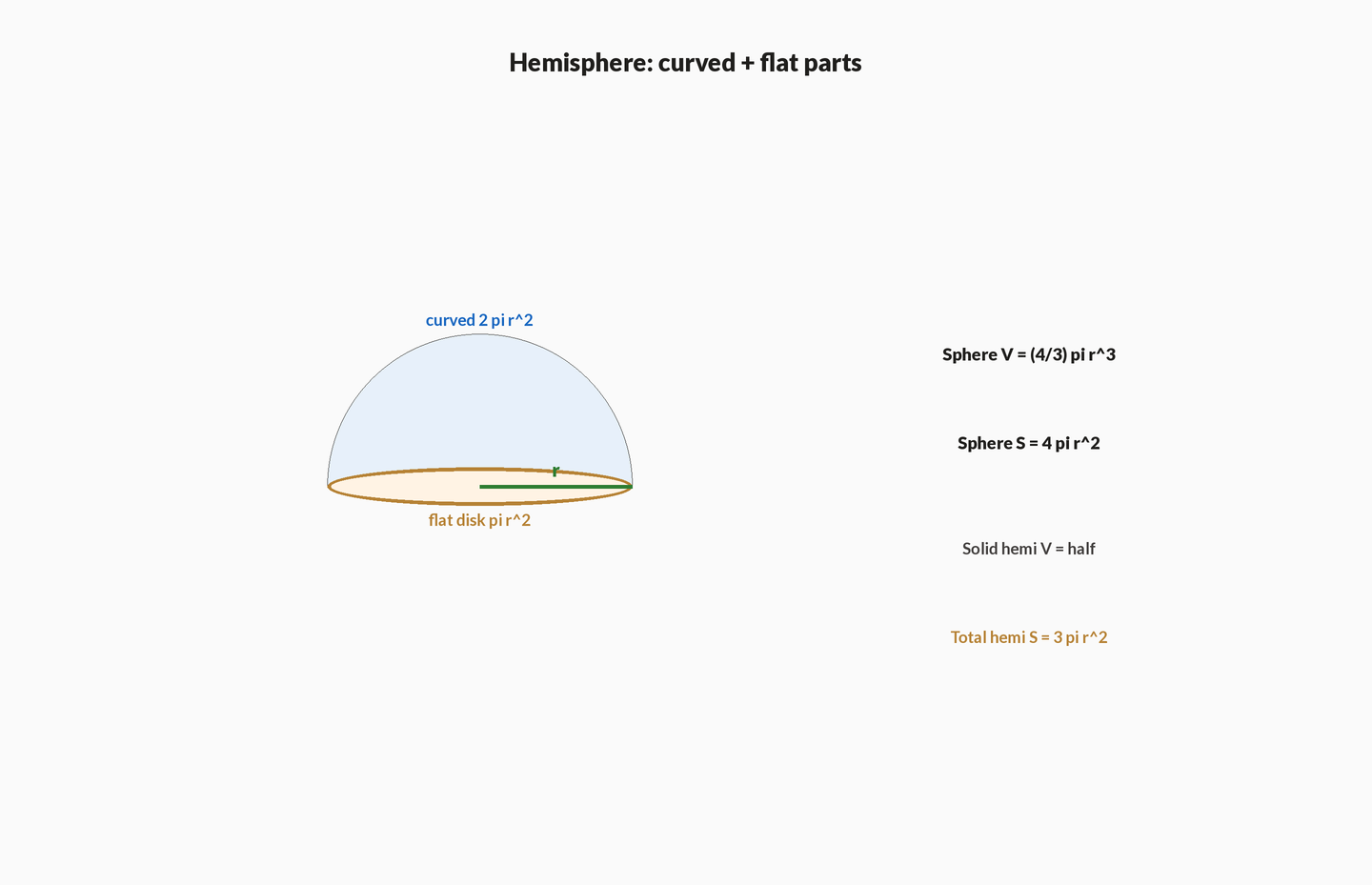
A sphere has volume \frac43\pi r^3 and surface area 4\pi r^2. A hemisphere is half the sphere in volume — \frac23\pi r^3 — but its surface is not half of 4\pi r^2: the curved part is 2\pi r^2 and the flat circular base adds \pi r^2, giving total surface 3\pi r^2.
Questions that say "surface area of a hemisphere" without the word "curved" usually mean the total including the flat base. When only the dome is painted or polished, they want curved surface alone — not the flat base as well.
How it works
- Sphere volume and surfaceV = \frac43\pi r^3, SA = 4\pi r^2.
- Hemisphere volumeHalf the sphere: V = \frac23\pi r^3.
- Hemisphere surface — read the wordingCurved = 2\pi r^2; flat base = \pi r^2; total = 3\pi r^2.
| Solid | Volume | Surface area |
|---|---|---|
| Sphere | \frac43\pi r^3 | 4\pi r^2 |
| Hemisphere (curved only) | \frac23\pi r^3 | 2\pi r^2 |
| Hemisphere (total) | \frac23\pi r^3 | 3\pi r^2 |
Total surface of a solid hemisphere
Find the total surface area of a solid hemisphere of radius 3 cm.
- Curved surface = 2\pi r^2 = 2\pi(3)^218\pi cm^2
- Flat base = \pi r^2 = 9\pi9\pi cm^2
- Total surface = 18\pi + 9\pi27\pi cm^2
Pro tip. Curved hemisphere surface is exactly half the sphere's 4\pi r^2; the flat base is a full circle \pi r^2. Add them only when the solid sits on a flat face.
A sphere of radius 3 is melted into a cone of the same radius. The cone's height is
- 4
- 12
- 36
Equate volumes: \frac43\pi(3)^3 = \frac13\pi(3)^2 h gives 36\pi = 3\pi h, so h = 12. The answer 4 is the height when a sphere of radius 3 is recast into a cylinder of radius 3; 36 forgets the \frac13 on the cone.
6Melt and recast — equate volumes
When a solid is melted and recast into another shape, total volume is conserved — no material is added or lost. Set the two volume formulas equal and solve for the single unknown dimension; every common factor cancels before you touch arithmetic.
The same principle covers wire bent into a circle, a sphere hammered into a cylinder, or metal from one mould poured into another. Identify which dimension is free, write both volumes, equate, and cancel shared terms first — that is faster than substituting numbers into both formulas separately.
Figure. Melting destroys shape but keeps metal volume. Equate old volume to new volume, then solve for the unknown dimension — surface areas are not conserved.
How it works
- Write both volumesUse the correct formula for each shape — sphere, cylinder, cone, cuboid.
- Equate and cancelV_1 = V_2; strike \pi and any shared powers of the radius before solving.
- Solve for the unknownOne linear dimension (height, side, radius) is usually the only unknown left.
Recasting a sphere into a cylinder
A solid sphere of radius 3 is melted and recast into a cylinder of radius 3. Find the height of the cylinder.
- Volume of sphere = \frac43\pi(3)^336\pi
- Set equal to cylinder: 36\pi = \pi(3)^2 h = 9\pi h9\pi h = 36\pi
- Solve for hh = 4
Pro tip. In melt-and-recast problems, \pi cancels on both sides — equate volumes and solve for the unknown dimension.
A metallic sphere of radius 6 cm is melted into a cone of base radius 6 cm. The height of the cone is
- 8 cm
- 24 cm
- 72 cm
\frac43\pi(6)^3 = \frac13\pi(6)^2 h gives 288\pi = 12\pi h, so h = 24. The answer 8 is the cylinder height for the same sphere; 72 treats cone volume like cylinder volume.
7Standard volume ratios — cone, cylinder and hemisphere
When a cone, a cylinder and a hemisphere share the same radius r and the cone's vertical height equals r while the cylinder's height also equals r, their volumes are in the ratio 1 : 3 : 2. The cone contributes \frac13\pi r^3, the cylinder \pi r^3, and the hemisphere \frac23\pi r^3.
Memorising the ratio 1:3:2 is faster than recomputing three volumes on every question, but you should be able to rebuild it from the formulas when the height is not r or the radius differs between solids.
Figure. With the same radius and height equal to that radius, volumes sit in the ratio cone : hemisphere : cylinder =1:2:3. The stacked heights show that ratio only — not a 3D drawing of the solids.
How it works
- Fix the common radiusWrite each volume with the same r before comparing.
- Set heights as givenFor the standard ratio, cone height = r and cylinder height = r.
- Divide by the smallestCone volume \frac13\pi r^3 is the unit; cylinder is 3 times that; hemisphere is 2 times.
| Solid | Volume | Share |
|---|---|---|
| Cone | \frac13\pi r^3 | 1 |
| Cylinder | \pi r^3 | 3 |
| Hemisphere | \frac23\pi r^3 | 2 |
How many cones from one cylinder
A right cylinder of radius r and height r is full of water. How many empty cones of the same radius and height r can it completely fill?
- Cylinder volume = \pi r^2 \cdot r\pi r^3
- One cone volume = \frac13 \pi r^2 \cdot r\frac13 \pi r^3
- Number of cones = \frac{\pi r^3}{\frac13 \pi r^3}3
Pro tip. A cone, cylinder, and hemisphere with equal radius and height r have volumes in the ratio 1:3:2. One full cylinder equals three such cones.
A cone, a cylinder and a hemisphere all have radius r and the cone and cylinder each have height r. Their volumes are in the ratio
- 1:2:3
- 1:3:2
- 2:3:1
Volumes are \frac13\pi r^3, \pi r^3 and \frac23\pi r^3, which simplify to 1:3:2. The answer 1:2:3 swaps hemisphere and cylinder; 2:3:1 starts from the hemisphere.
8Cuboids, cubes and the largest inscribed sphere
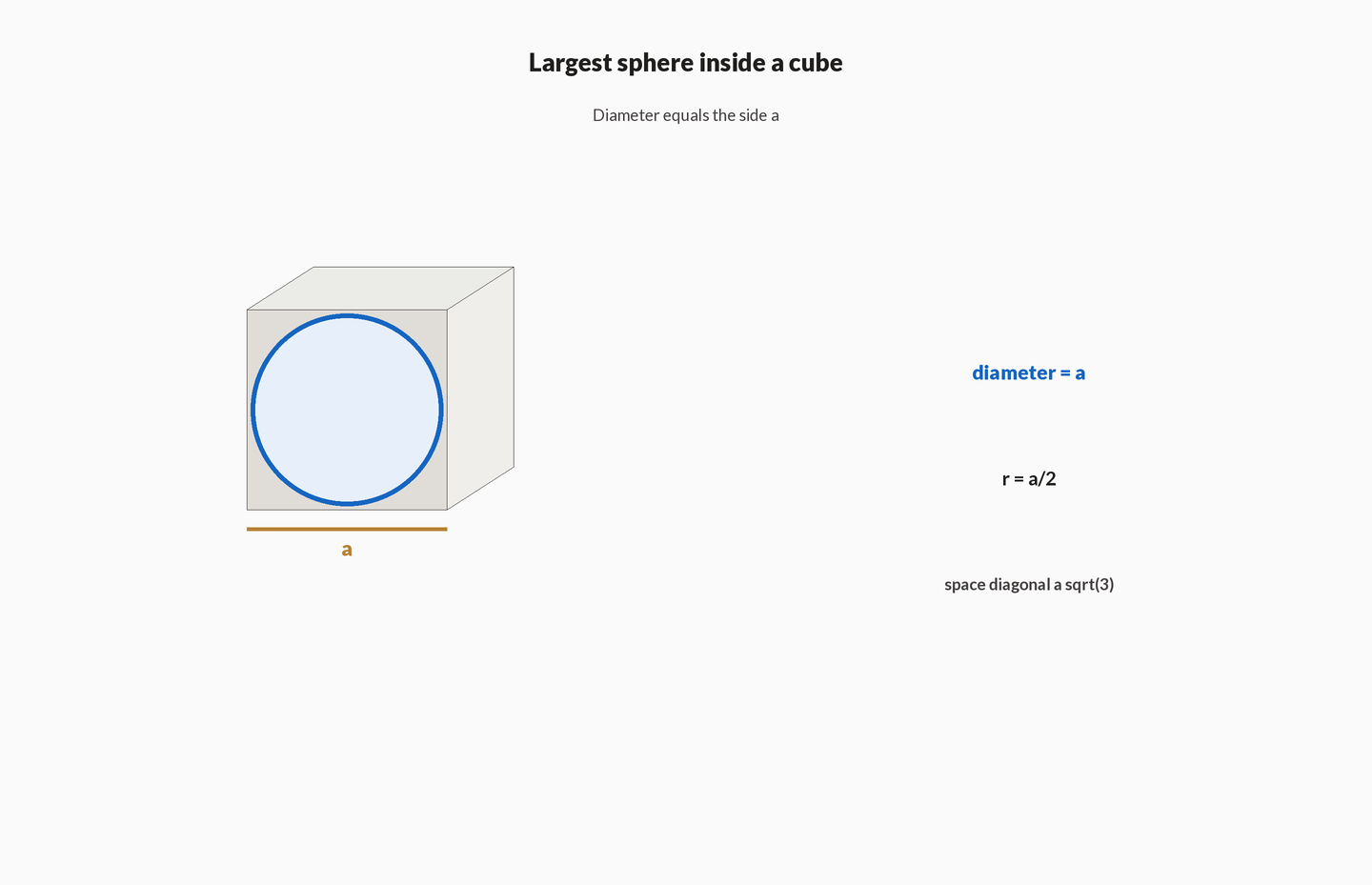
A cuboid has volume V = lbh and space diagonal \sqrt{l^2 + b^2 + h^2}. For a cube of side a, the diagonal is a\sqrt3 and the largest sphere that fits inside has diameter a — the sphere touches the centre of each face, so its radius is \frac{a}{2}.
Inscribed-sphere questions often pair with melt-and-recast or scaling: the sphere's diameter equals the shortest edge of the box it sits in. For a cube, all three edges match, so diameter = side.
How it works
- Cuboid volume and diagonalV = lbh; diagonal = \sqrt{l^2 + b^2 + h^2}.
- Cube special caseSet l = b = h = a: volume = a^3, diagonal = a\sqrt3.
- Largest inscribed sphere in a cubeDiameter = a, radius = \frac{a}{2}, volume = \frac43\pi\left(\frac{a}{2}\right)^3 = \frac{\pi a^3}{6}.
| Quantity | Cuboid | Cube (side a) |
|---|---|---|
| Volume | lbh | a^3 |
| Space diagonal | \sqrt{l^2+b^2+h^2} | a\sqrt3 |
| Inscribed sphere diameter | shortest edge | a |
Space diagonal of a cube
Find the space diagonal of a cube of side 6 cm.
- Diagonal = a\sqrt3 with a = 66\sqrt3 cm
- Largest inscribed sphere: diameter = 6, radius = 3r = 3 cm
- Sphere volume = \frac43\pi(3)^336\pi cm^3
Pro tip. The space diagonal of a cube of side a is a\sqrt3, and the largest sphere that fits inside has diameter a.
The largest sphere that can be placed inside a cube of side 10 cm has radius
- 5 cm
- 10 cm
- 5\sqrt3 cm
The sphere touches the centre of each face, so its diameter equals the side: radius = 5 cm. 10 cm is the diameter, not the radius; 5\sqrt3 confuses the sphere radius with half the space diagonal.
Notes
- Plane areas: rectangle lb, triangle \frac12 bh, and circle \pi r^2 are the building blocks for decomposing composite figures.
- Prisms and cylinders: volume equals base area times height, and lateral surface equals base perimeter times height.
- Cones and pyramids: their volume is one-third of the matching prism or cylinder, so a cone is \frac13\pi r^2 h.
- Spheres: a sphere has volume \frac43\pi r^3 and surface area 4\pi r^2, while a hemisphere has curved area 2\pi r^2 plus a flat base \pi r^2.
- Scaling law: if every linear dimension is multiplied by k, areas scale by k^2 and volumes by k^3.
Formulas
- Cylinder: V=\pi r^2 h,\ \text{TSA}=2\pi r(r+h)
- Cone: V=\frac13\pi r^2 h,\ \text{CSA}=\pi r l,\ l=\sqrt{r^2+h^2}
- Sphere: V=\frac43\pi r^3,\ \text{SA}=4\pi r^2
- Cuboid: V=lbh,\ \text{diagonal}=\sqrt{l^2+b^2+h^2}
- Equilateral triangle: A=\frac{\sqrt3}{4}a^2
- Sector: area =\frac{\theta}{360^\circ}\pi r^2, arc =\frac{\theta}{360^\circ}\cdot2\pi r
Exam traps & shortcuts
- When a solid is melted and recast into another shape, equate the two volumes — total volume is conserved.
- Use the scaling law: doubling a sphere's radius multiplies its volume by 8, not 2.
- A cone, cylinder, and hemisphere with equal radius and height r have volumes in the ratio 1:3:2.
- The space diagonal of a cube of side a is a\sqrt3, and the largest sphere that fits inside has diameter a.
Reference tables
Every line here should be reconstructible from a concept above, not merely recalled.
| Figure | Volume / area | Surface |
|---|---|---|
| Rectangle | Area lb | — |
| Triangle | Area \frac12 bh | — |
| Circle | Area \pi r^2 | — |
| Sector | Area \frac{\theta}{360^\circ}\pi r^2 | Arc \frac{\theta}{360^\circ}\cdot 2\pi r |
| Cylinder | V = \pi r^2 h | TSA = 2\pi r(r+h) |
| Cone | V = \frac13 \pi r^2 h | TSA = \pi r(l+r) |
| Sphere | V = \frac43\pi r^3 | SA = 4\pi r^2 |
| Cuboid | V = lbh | Diagonal \sqrt{l^2+b^2+h^2} |
Recap
Read only this the night before.
- Scaling
- Linear × k, area × k^2, volume × k^3. Doubling radius → volume × 8, not × 2.
- Cone volume
- One-third of the matching cylinder. Slant height l = \sqrt{r^2+h^2} for surface, not for volume.
- Hemisphere surface
- Curved 2\pi r^2; add flat base \pi r^2 for total 3\pi r^2.
- Melt and recast
- Equate volumes; cancel \pi and shared factors before arithmetic.
- Standard ratio
- Cone : cylinder : hemisphere = 1:3:2 when radius and height all equal r.
- Cube
- Diagonal a\sqrt3; largest inscribed sphere has diameter a.
Practise Mensuration (2D and 3D)
Reading is free and needs no account. Practice, mocks and progress live in the app.
- 21 exam-style questions on this topic, with explanations
- A 9-question practice set that ends the chapter
- Timed mocks scored with the real marking scheme
- Readiness tracked per topic, kept on your device